
You notice it when the light hits the painting from the side. The canvas looks slightly loose, one corner sits higher than the others, or the frame rocks against the wall instead of resting squarely. It's tempting to press the frame flat, tighten every key, or reach for a spray bottle, but a canvas can look structurally warped when the problem is tension or indoor climate.
The safest answer to how to fix a warped canvas frame starts with restraint. Identify whether the canvas has slackened, the wooden stretcher bars have bowed, or a corner joint has failed. Then stabilize the environment before making a gradual correction. That approach protects the paint layer, canvas fibers, and the value of the artwork.
Why Your Canvas Frame Warped in the First Place
A warped stretcher usually has a cause. Wood absorbs and releases moisture, so uneven changes can make its bars expand or contract at different rates. After storage in a damp room, transport through changing conditions, or display near a heat source, the frame may twist, bow, or pull the canvas unevenly.
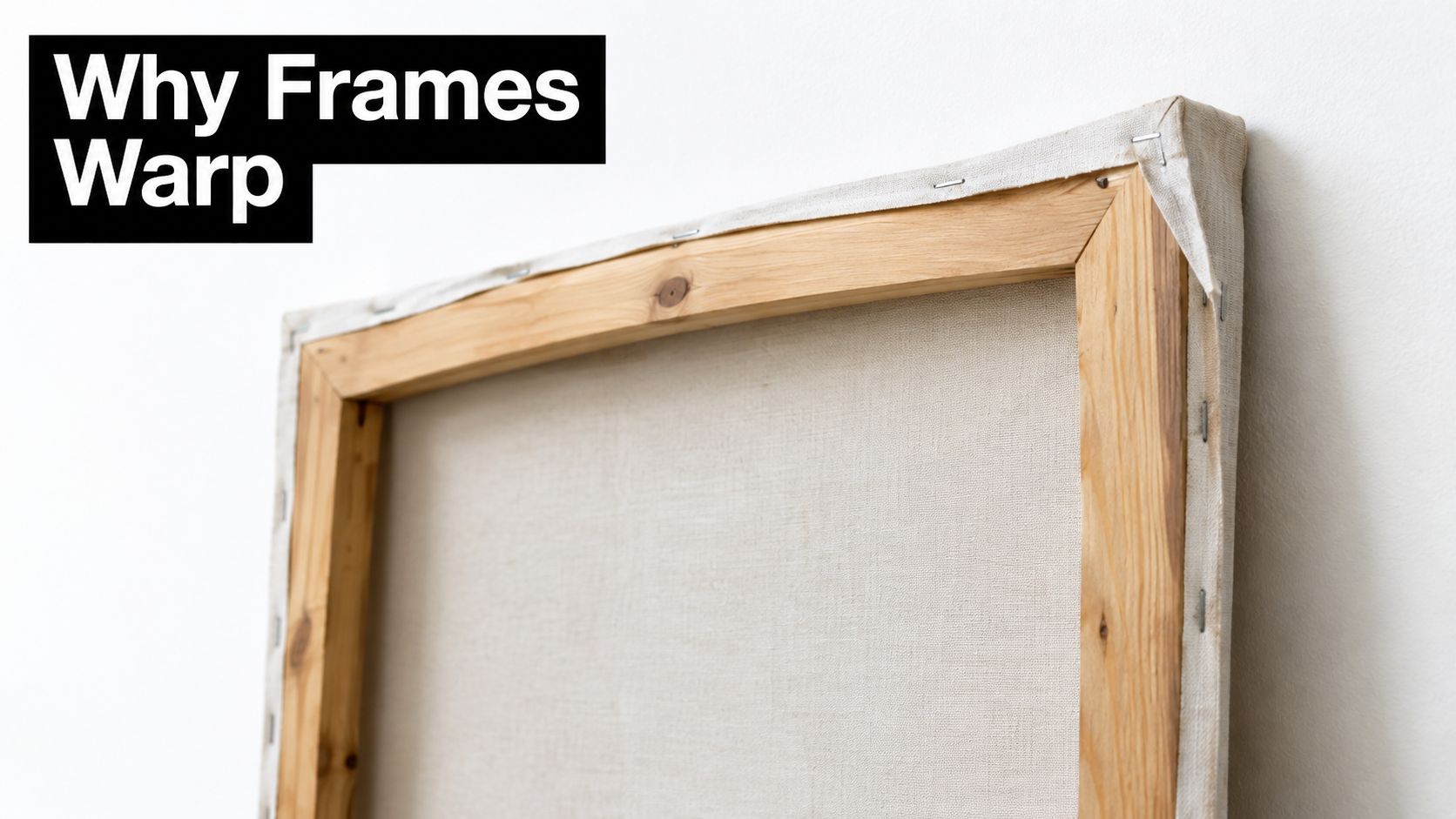
One lifted corner does not automatically mean poor timber. The wood may have reacted to sharp moisture changes, while the canvas lost its previous balance with the stretcher. The Canadian Conservation Institute's guidance on caring for stretched paintings recommends keeping temperature and relative humidity moderate and stable. Sudden humidity swings can deform stretchers and pull the canvas out of plane.
Practical rule: Treat the room before you treat the frame.
Move the artwork away from radiators, fireplaces, air-conditioning outlets, damp basements, and direct heat. Give the wood and fabric time to settle in a stable room before deciding that mechanical correction or carpentry is needed. This pause may resolve a tension problem and avoids forcing a frame while it is still responding to moisture.
Acrylic and mixed-media paintings also need careful environmental handling. Use the broader care guidance in this guide to preserving acrylic paintings before attempting a repair.
If the painting was recently shipped or moved, inspect its packaging and handling history. The guide to moving framed art can help prevent fresh distortion during the next move.
The decision is straightforward: stabilize first, straighten second. Pressing a damp or stressed frame flat can crack the paint layer, tear canvas fibers, or leave the wood in a worse shape.
How to Diagnose the Type of Warp You Have
Start with the painting upright in good, indirect light. Look at the image surface without pressing it. A sagging canvas often shows shallow ripples or a soft-looking field between the stretcher bars, while the frame itself may still appear square. Tap the center of the canvas lightly with one clean fingertip. It should feel resilient, not drum-tight and not loose enough to move visibly.
Next, examine the back. Check whether the staples remain secure, whether the fabric has pulled away from a bar, and whether the corners still meet cleanly. A loose canvas can sometimes be corrected by adjusting tension. It shouldn't be treated like a twisted wooden frame.
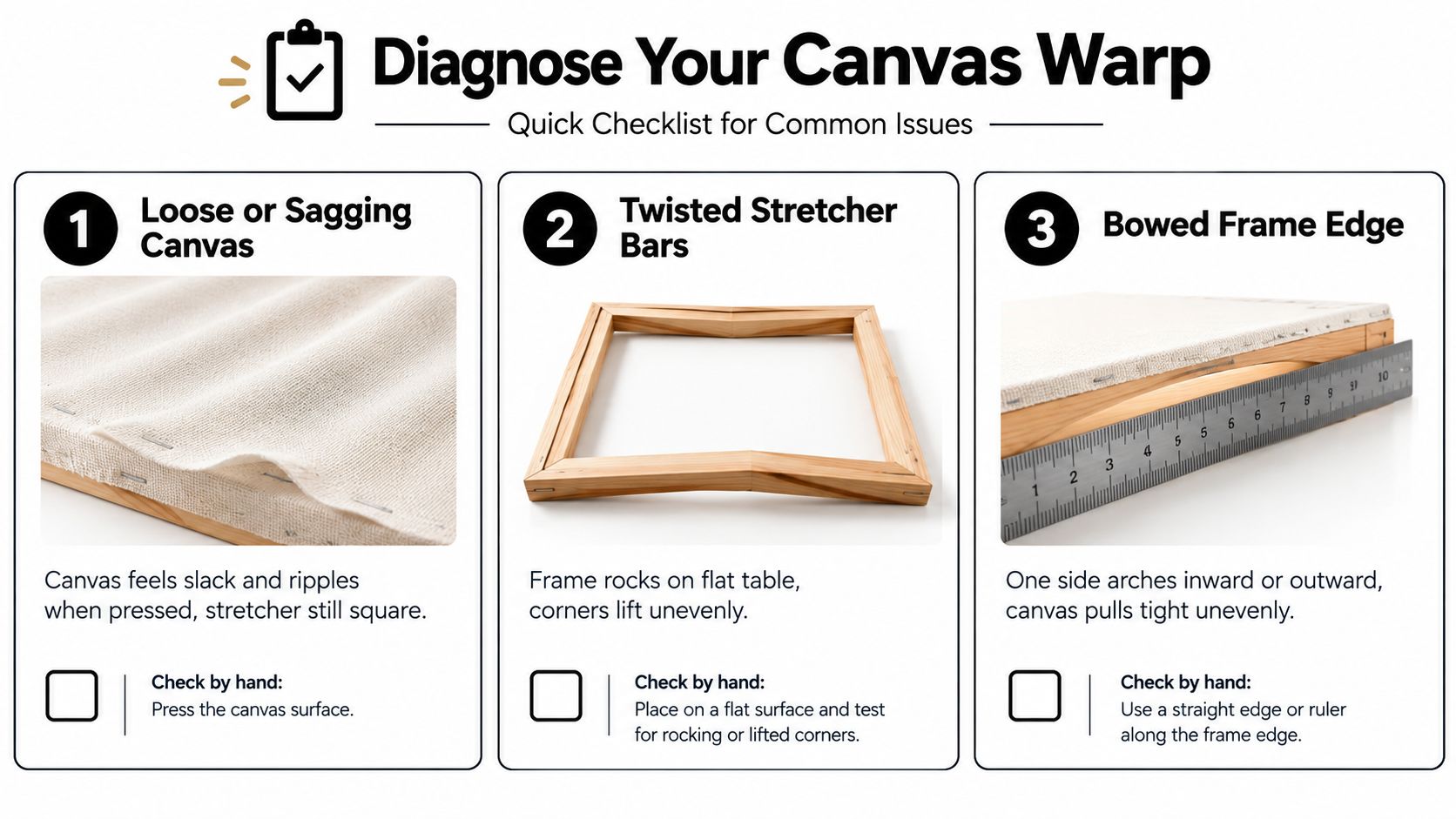
Three signs that separate tension from structure
- Loose or sagging canvas: The fabric ripples or feels slack, but the stretcher remains square and stable on a flat surface.
- Twisted stretcher bars: The frame rocks when placed carefully on a clean, flat table, with opposite corners lifting unevenly.
- Bowed frame edge: One bar arches inward or outward, so the canvas pulls tighter along one edge than another.
Place the painting face-up on a padded, clean surface only if the paint is sound and the surface is protected. A flat table can reveal twist, but never force a painted surface against an unyielding edge. Look along each bar like a framer sighting down a length of timber. A straightedge held beside the outside edge can help show a bow without touching the paint.
Corner failure has its own symptoms. You may see an open joint, a key that has fallen out, a split bar, or a corner that shifts when handled. If the joint moves independently of the canvas, tension adjustment alone won't solve it.
A climate-themed mixed-media work such as William Tucker Climate Change Art Painting Abstract Collection, Cyclones illustrates why diagnosis matters. Acrylic, oil, and mixed media on canvas can combine different surface textures, so a structural correction must account for the artwork rather than treating every canvas as a blank fabric.
Tools and Safety Checks Before You Start
Prepare the workspace before you loosen a staple or touch a wedge. You'll need a clean, flat, padded surface, a small rubber or wooden mallet, stretcher keys if the frame uses them, a staple lifter, small L-brackets for approved structural reinforcement, soft weights, and clean cotton gloves. Keep a ruler or straightedge nearby for checking the bars, and use a hygrometer to monitor the room rather than guessing at its conditions.
A small toolkit is enough for inspection and modest tension work, but the tool itself doesn't make an aggressive repair safe. If you're filling out a general repair kit, this resource on how to build your home toolkit with confidence is useful for choosing basic hand tools without turning a painting repair into a construction project.
Set up a safe work area
Cover the table with clean, smooth padding that won't catch staples or texture. Keep the painting away from food, dust, pets, and open windows. Work with the image surface facing upward unless a specific, controlled step requires otherwise, and never drag the canvas across the table.
Before starting, check these conditions:
- Paint surface: Stop if you see flaking, lifting, cracking, or fragile raised texture.
- Canvas fibers: Stop if the fabric is torn, brittle, punctured, or separating from the bars.
- Frame wood: Stop if a bar is split, sharply bowed, or visibly twisted at a joint.
- Climate: Don't begin in a room with rapidly changing humidity or direct heat.
- Pressure: Use light, distributed support. Avoid clamps, boards, or weights that concentrate force on one point.
Skip heat guns, hair dryers, soaking, and improvised steam. Heat can soften or stress materials unevenly, while excess moisture can affect both the fabric and paint layer. Heavy clamping can flatten one area while driving tension into another.
Take clear photographs of the front, back, corners, and key positions before making changes. That record gives you a reference if you need to reverse a step or speak with a conservator.
Gentle Ways to Straighten a Warped Canvas Frame at Home
Start with the least invasive correction. A canvas that looks warped may be reacting to unstable conditions rather than suffering permanent structural failure. Move it to a clean room with steady conditions, away from heaters, direct sun, and air blowing across one side. Maintain the stable humidity range noted earlier, then allow the wood and canvas to settle before judging the shape again. A mild distortion may reduce without mechanical pressure.
Stabilize the frame before correcting it
If the frame is twisting, place it on a clean, level surface with the painted side protected. Support the stretcher corners, or place modest weights on the stretcher itself, and raise the corners 10–15 cm, or 4–6 inches, above the surface so air can circulate below. The Canadian Conservation Institute's emergency treatment guidance describes this supported corner position for water-damaged paintings.
Keep every support in contact with the wooden stretcher, never the painted canvas. Use even, light pressure and inspect the artwork regularly. Stop if the paint cracks, the canvas develops sharper ripples, or the frame moves abruptly.
A square frame with loose canvas is a tension problem. Use the existing stretcher keys, tapping each one gently and evenly. Work around the frame in small increments, checking the image side after each pass. The aim is to expand the stretcher joints slightly and recover an even surface, not to pull the fabric drum-tight.
Correct a minor twist gradually
A slight twist may respond to opposite-corner pressure only when the joints are sound and the bars are not split. Place the frame on a protected flat surface, support the low corner with a thin, stable pad, and apply controlled pressure to the opposite corner. Release the pressure before inspecting the result. Never force the frame flat in one movement.
If one bar is permanently bowed, wedges will not straighten the timber. An L-bracket can reinforce a sound joint, but a visibly distorted bar usually calls for replacement or professional re-stretching. The guidance on stretching a canvas painting explains general stretcher construction, though a painted artwork requires slower adjustments and lower risk.
Moisture correction should be the last home option. Do not mist the image side. If a conservator has ruled out paint sensitivity and the canvas is strong, controlled local humidification on the back may be considered, followed by flat, supported drying. It should never substitute for climate stabilization.
A video can make stretcher-key movement and corner support easier to understand than still photographs. Review the technique before handling the painting, and keep paper-framing advice separate, including guidance on how to protect posters when framing.
When to Stop and Call a Professional Restorer
Home correction is reasonable only when the problem is minor, the paint layer is stable, and the wooden structure still holds together. A valuable, historic, or sentimental painting deserves a lower-risk decision even if the visible warp looks small. The cost of a mistake is not only cosmetic. A bad adjustment can create cracking, flaking, torn fibers, or a permanently distorted support.
Stop immediately if the paint is lifting, the canvas is torn, the bars are split, or a joint opens when you handle the frame. Don't clamp a severely bowed stretcher or force failed corners to meet. If keys won't hold, the timber has twisted substantially, or the image layer already shows stress, hand the work to a qualified paintings conservator or experienced art restorer.
| Situation | Best Approach | Why |
|---|---|---|
| Canvas is slightly slack and the frame remains square | Careful key adjustment after climate stabilization | The issue may be tension rather than structural failure |
| Frame rocks slightly but joints and paint are sound | Gentle supported correction and close inspection | Small movement may respond without aggressive force |
| One stretcher bar is bowed or split | Professional assessment and likely bar replacement | Reinforcing the wrong area can transfer stress to the canvas |
| Corner joint has failed or keys won't hold | Professional structural repair and re-stretching | The support can't maintain even tension on its own |
| Paint is cracked, flaking, or lifting | No DIY correction | Movement may detach vulnerable paint |
| Artwork has high monetary or sentimental value | Conservator consultation before intervention | Reversibility and documentation matter more than speed |
A conservator may use controlled humidification, gradual tension adjustment, re-stretching, and structural support suited to the specific materials. That's different from pressing the frame flat. The National Park Service warning on warped stretchers explains why a damaged stretcher can also damage the canvas and image layer.
Choose someone who works with paintings rather than only general furniture or picture frames. Ask what they'll inspect, whether they'll document the condition, and how they'll protect the painted surface during structural work. A careful restorer should be willing to tell you when a repair is unsafe.
Keeping Your Canvas Flat for Good
A straight frame can warp again if the painting returns to an unstable room. Keep display and storage areas within 40% to 60% RH, as recommended for stretched paintings by the Canadian Conservation Institute, and avoid sharp swings instead of chasing one perfect reading.
Keep canvases away from direct heat, fireplaces, damp basements, and strong sunlight. For vulnerable or larger works, an airtight backing board or microclimate frame can reduce daily humidity changes. A solid backing also limits dust and accidental contact from behind. The Western Australian Museum conservation guidance notes that very low humidity and fluctuating conditions can contribute to slackness, distortion, cracking, and warping in wooden elements.
Use a simple inspection routine
- Check the corners: Look for opening joints, missing keys, or movement.
- Read the canvas tension: Watch for new ripples, slackness, or uneven pull.
- Inspect the display: Confirm that heat, sunlight, and damp air are not affecting one side.
- Review transport: Support the frame during moves and keep pressure off the painted face.
- Act early: A small tension adjustment is safer than waiting for structural failure.
Store canvas in a dry, climate-controlled area, with the painted face protected from contact with other objects. Hang substantial works with hardware that distributes the load evenly. Large or heavy frames need more than one stable support point.
For guidance on support, hardware, and presentation, see this guide to how to frame canvas paintings. Prevention cannot remove every risk, but it reduces the conditions that bring distortion back.
William Tucker Art offers original and print artwork across wildlife, pet portrait, coastal, and environmental collections, including mixed-media work on canvas. Visit William Tucker Art to explore pieces that can be displayed with careful climate and framing practices.