
A bare wall above the sofa, a tape measure in one hand, and a search bar returning the same handful of heron prints. That's where many people start. The great blue heron is a patient, theatrical bird, and the painters who catch it share a few habits: one clear focal subject, a background with real movement in it, and a painted surface you can see texture on from across the room.
This guide compares six great blue heron paintings you can buy right now, from a $200 giclée to a framed $8,000 mixed-media piece, on medium, scale, price and where the money goes. Each entry also pulls out the technique behind the picture, so collectors can judge what they're paying for and painters can borrow the move.
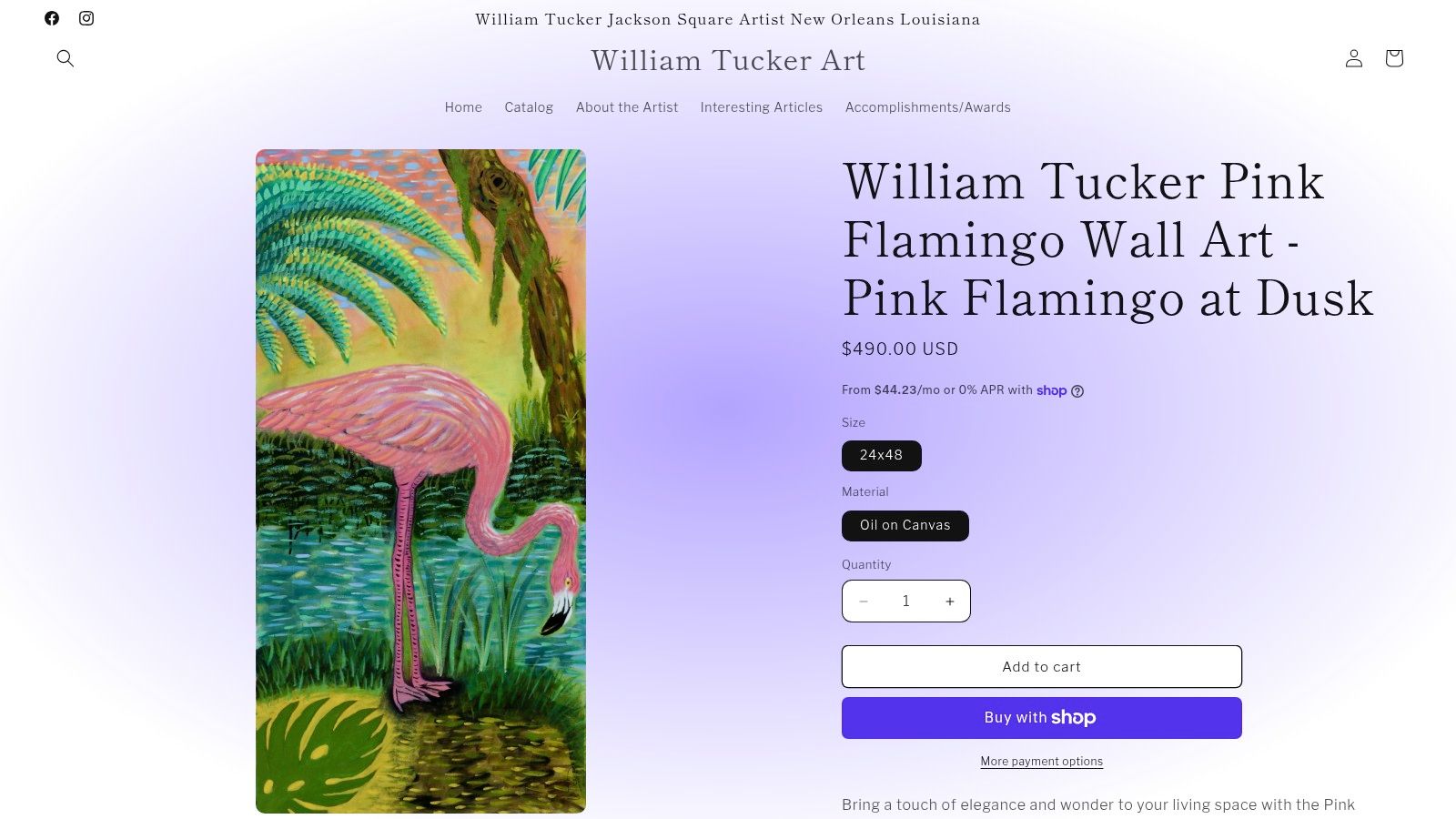
William Tucker, whose work centers on endangered animals, builds his wildlife paintings the same way: a detailed subject held against an abstract field, inviting viewers to reflect on nature instead of admiring it. Hold that structure in mind. You'll see it in every good piece below, and you'll want to style artwork above your sofa before you commit to a size.
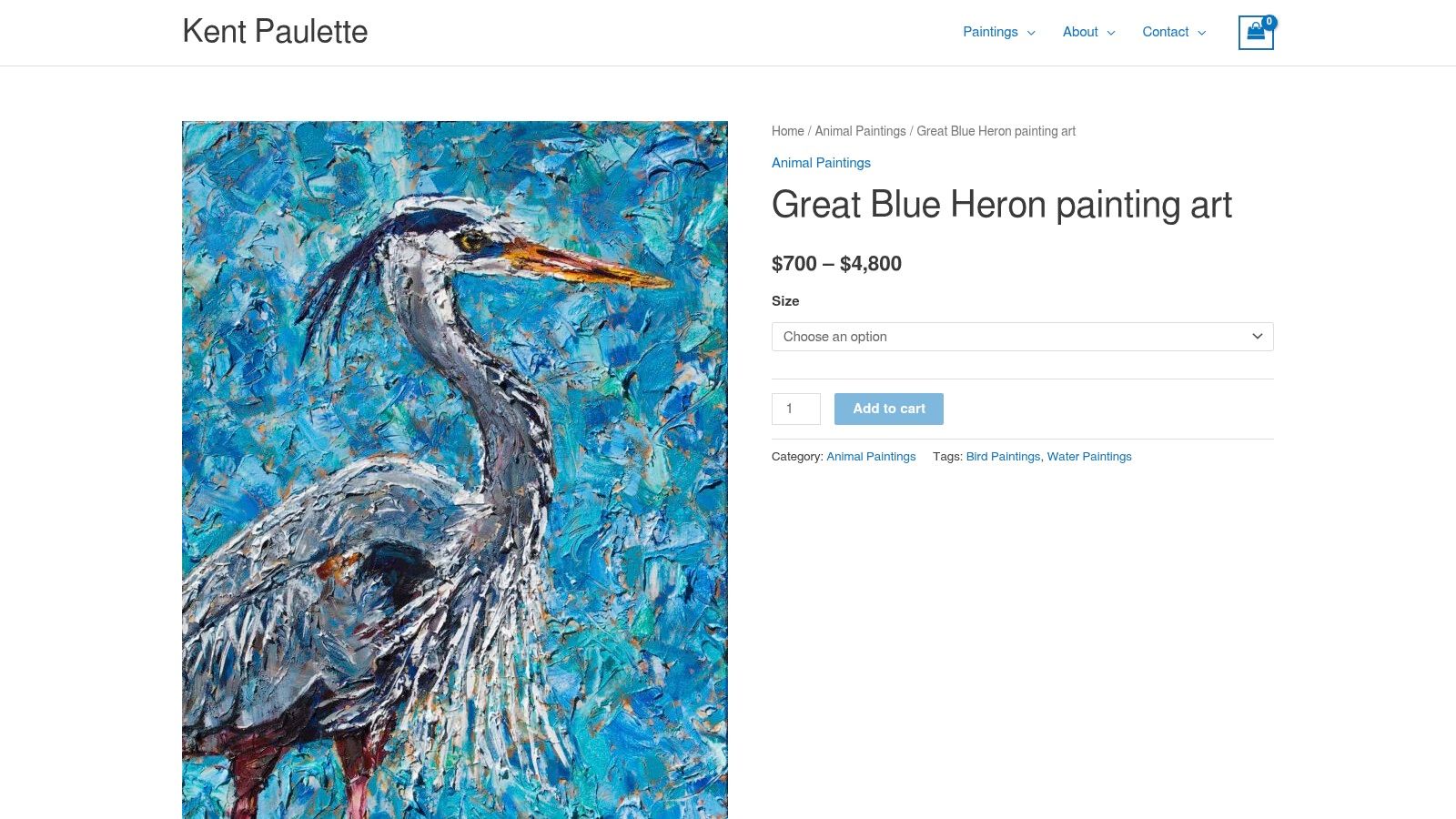
1. Kent Paulette, Great Blue Heron Painting Art
A Coastal Original Sold From the Artist's Own Site
Kent Paulette paints the heron wading and fishing in thick, bright color, a surface that reads as an object rather than an image. The work is listed on Paulette's own product page, so no gallery commission sits between you and the easel, and the listed sizes run from $700 to $4,800.
The page carries a short video of the painting. Watch it before you buy, because loaded paint only shows its real surface when the light moves.
Thick paint does two things a flat print can't. It catches raking light from a window and shifts through the day, and it lets the painter build feathers by carving them out of the stroke instead of drawing them on. The stroke order matters: dark base first, mid-tone body next, white highlights last. The feather-by-feather painting breakdown on William Tucker Art runs that same sequence and is worth borrowing for your own bird studies.
On the price spread: the step from the smallest canvas to the largest buys wall presence, not extra detail. Buy the size your wall needs rather than the size that sounds impressive in a cart.
Resale prices put this range in sensible company. In 2024, 1stDibs listed great blue heron artworks in its inventory from $187 to $14,000, with an average price of up to $1,700.
- Buying direct keeps the conversation open: ask about dimensions, framing and a shipping quote before you pay, and the person answering is the one who made the painting.
- The comments are warm, the page is thin on reviews: published customer remarks praise the colors and the geometric style, while the product page itself shows no reviews, so treat the video as your closest look.
- Confirm the variables: selected size, framing and shipping terms all change the final number.
Measure your wall width first, then pick the size that leaves a hand's width of quiet wall on each side. A colorful heron needs air around it.
2. David Bowker, Great Blue Heron in Flight
Why the Flight Pose Is Hard to Fake
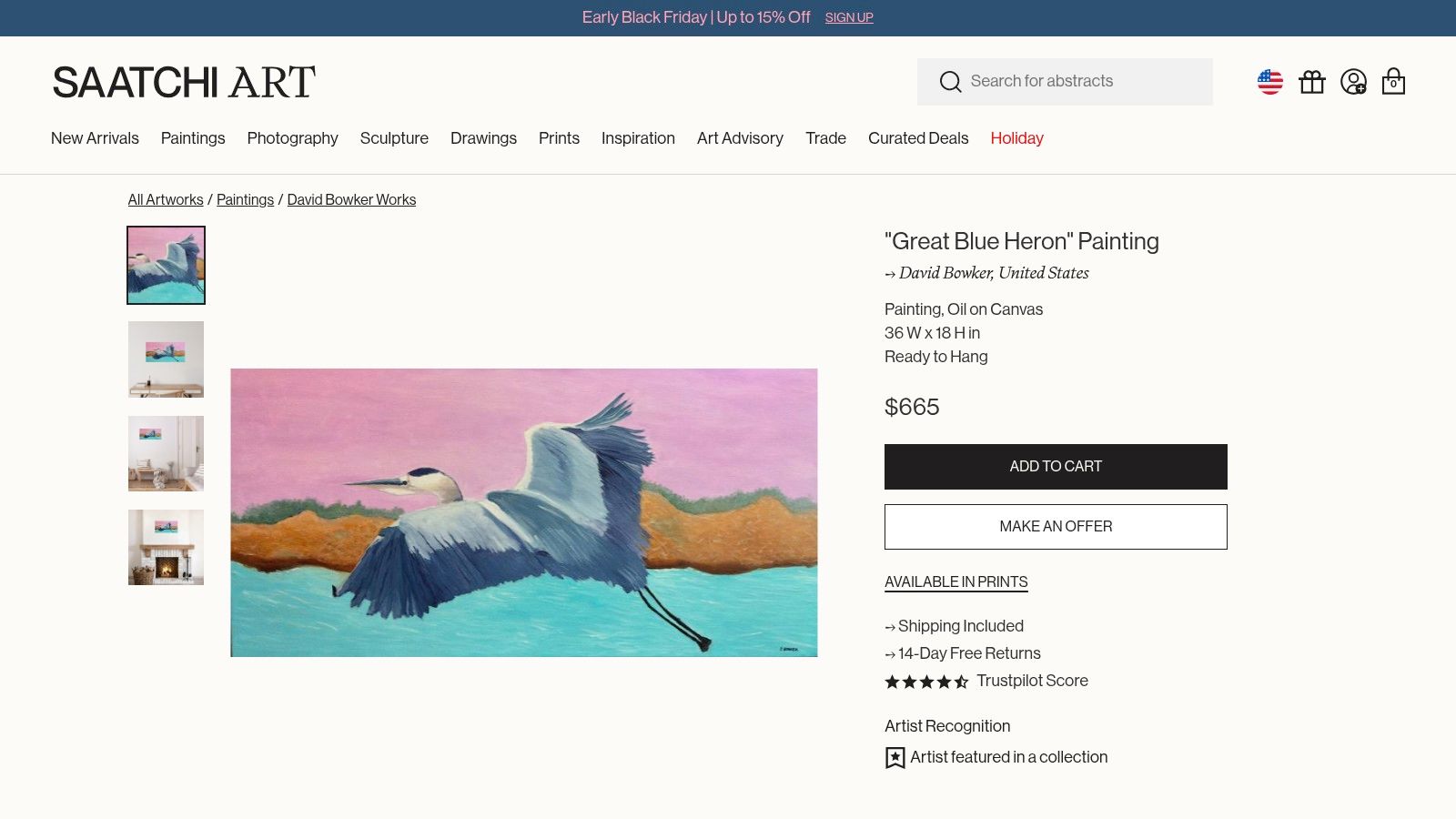
A flying heron exposes weak drawing faster than a standing one. Bowker's Saatchi Art listing for David Bowker's heron prices a 36 by 18 inch impressionistic original oil at $665, one of a kind, certificate of authenticity included, unframed, with U.S. shipping folded into the price.
The anatomy is the test. Adults run about 97 to 137 cm in length, 167 to 201 cm in wingspan and roughly 2.1 to 2.5 kg in mass, according to the All About Birds species profile. Put that much wing over a narrow body and a two-to-one horizontal canvas stops feeling decorative and starts feeling necessary.
Bowker uses the wide field well: wings stretched, body level, no perched posture to hide behind. The value case is simple. At this size and price you are paying for scale and a harder pose; the listing says little about Bowker's broader wildlife practice, so name recognition is doing less work here.
A standing heron reads vertical. A flying heron reads horizontal. Match canvas to pose and the painting looks right before you inspect a feather.
- Budget past the sticker: the canvas is unframed, so a 36 by 18 frame belongs in the total cost.
- Check terms on the live listing: review the current returns and delivery wording on Saatchi Art before you buy, since posted terms can change.
- Judge lift by the underside: pale underwing coverts against darker flight feathers sell the height; if the underside is as heavy as the back, the bird looks pinned.
For painters, copy the sequence rather than the silhouette: lay the darker flight feathers first, keep the underwing lighter, then set the body so the wing carries the eye across the canvas.
Get a framing quote before checkout. If the total still works, this is the value buy among the six: big, original, and harder to fake than another standing portrait.
3. Alan Metzger, Great Blue Heron
The Impressionist Bet
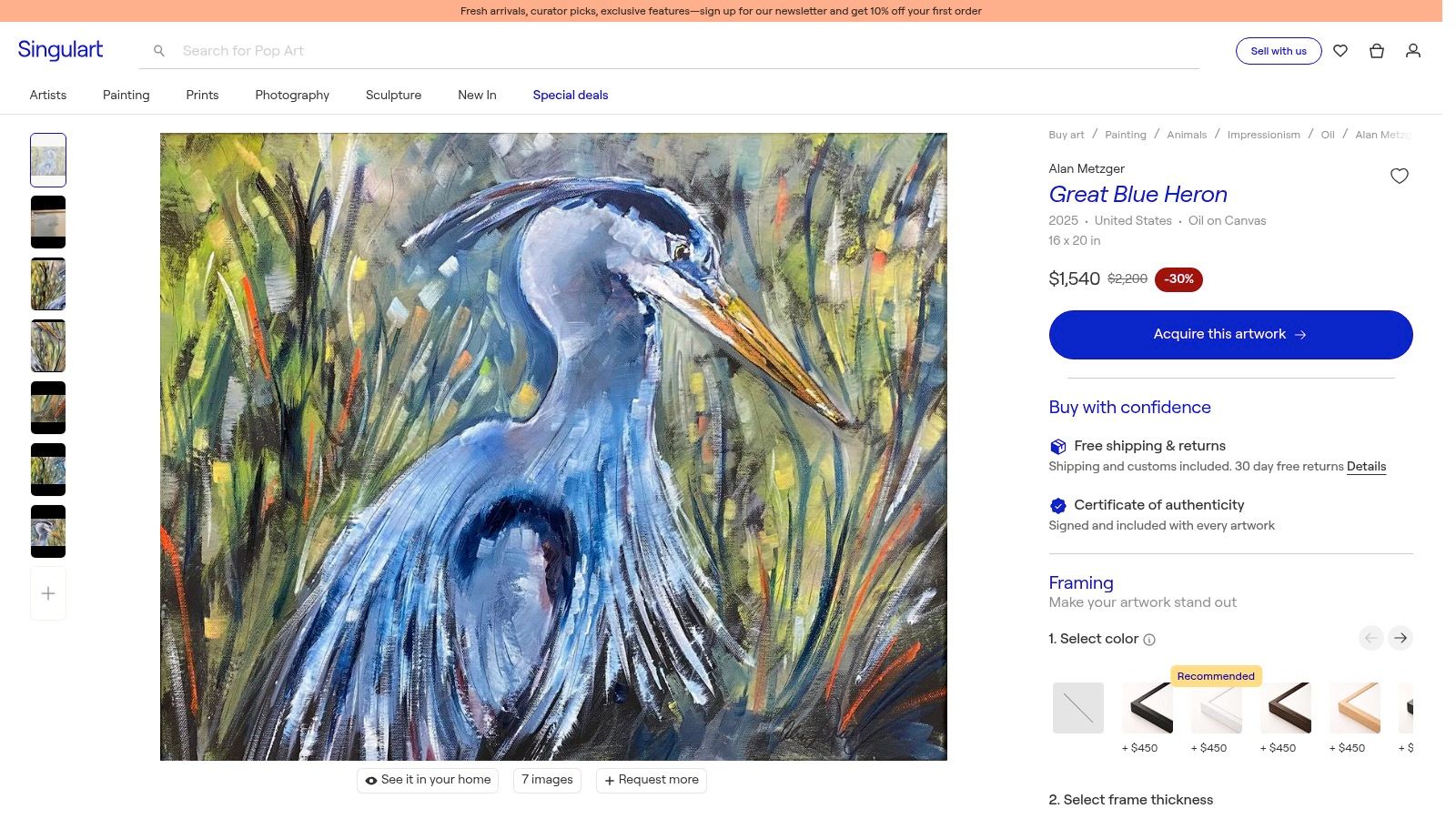
Small originals are where the market tells the truth. Alan Metzger's 16 by 20 inch oil is listed at $2,200 on Singulart, which is serious money for a canvas that fits over a desk, and the listing answers the question a buyer should ask at that price: what protections come with it.
There's a secondary market for heron oils, and that helps. A great blue heron oil by Jon Thompson measuring 29.85 × 55.25 cm sold at auction on July 11, 2024, according to the MutualArt listing. Oils by named makers do trade, and that's part of what you're buying at this level.
Metzger works impressionistically, which means the heron is built from color temperature rather than outline. Blues and greys carry the shadow side, warm ochres carry the light, and your eye fills in the rest from three feet back.
Buy the offer button, not the sticker. A make-an-offer listing on a $2,200 canvas usually has room in it, and the worst outcome is a polite counter.
- Protections are spelled out: shipping and customs are included and the listing states 30-day free returns.
- Ready to hang, still unframed: the painting is mounted on a supported wooden frame, and an optional frame costs extra.
- Commissions are possible: the artist's profile notes commission work, which matters if you want a pair flanking a doorway.
Ask for a straight-on photograph of the canvas edges and the back before you accept delivery. Loose impressionist surfaces are wonderful to live with and hard to judge from a thumbnail.
4. Mike Glier, Great Blue Heron Hunting
Why Cut Paper Changes the Conversation
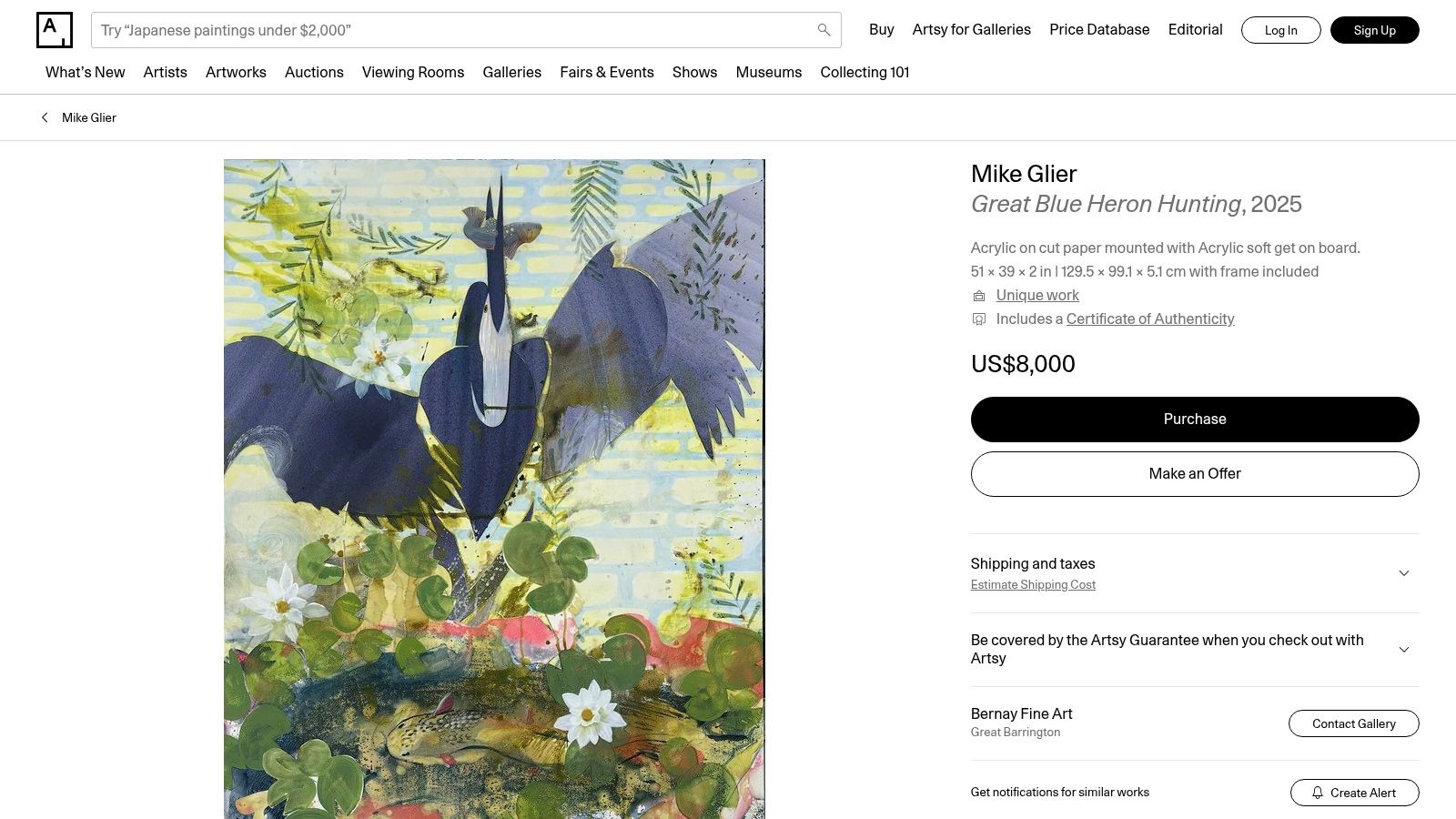
Most bird paintings show a bird existing. This one shows a bird working. Mike Glier's 48 by 36 inch piece, listed at $8,000 through Bernay Fine Art on Artsy, is acrylic paint married to cut paper, with the heron hunting a local brook trout.
The ecology is where the value sits. The International Association of Heron Conservationists estimates the overall great blue heron population at approximately 100,000 to 250,000 birds and notes that Louisiana alone now supports more than 10,000 nesting birds. A heron with a trout in its bill carries that whole food web into your room.
Mixed media at this scale behaves differently on a wall. Cut paper edges throw tiny shadows, so the surface changes as you walk past it, and a framed 48 by 36 inch work becomes architecture rather than decoration.
A heron that's hunting has a job. Predation scenes hold up over years better than portraits, because there's a story already in motion inside the frame.
- Budget the freight: shipping is calculated at checkout and a large framed work changes the delivery math fast.
- Gallery mediation is the point: the purchase runs through Bernay Fine Art in Great Barrington, Massachusetts, with authenticity documentation listed.
- Offers are on the table: the listing accepts a straight purchase or a make-an-offer approach.
Measure the wall and the stairwell. A 48 inch frame that won't clear your landing is an expensive lesson, so confirm crate dimensions with the gallery before you commit.
5. Kim Chase, What the Light Remembered
Light on Water Is the Whole Painting
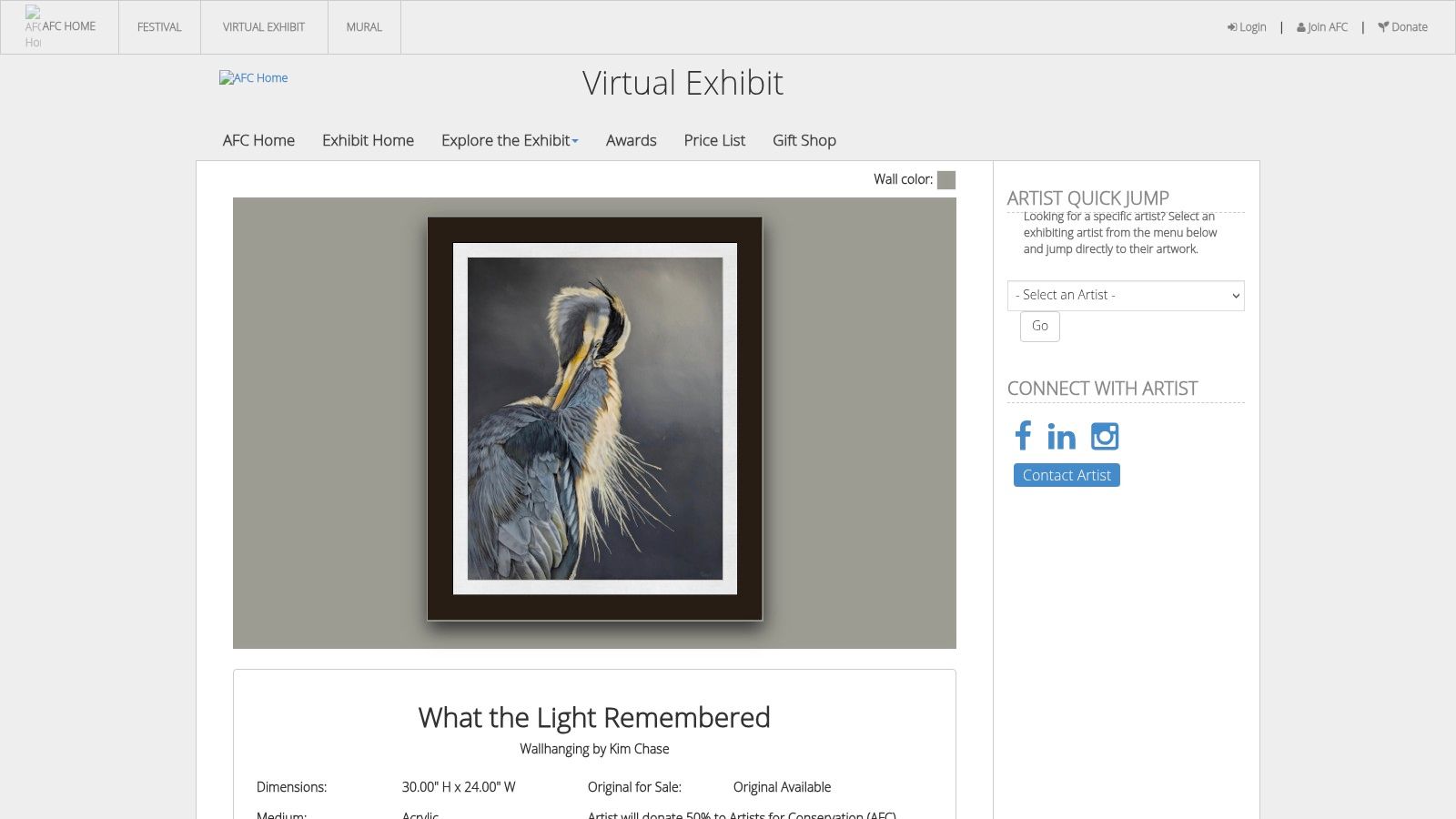
Kim Chase built this 30 by 24 inch acrylic around warm, reflective light, which is the hardest thing in heron painting and the reason so many wetland scenes look flat. Reflections aren't decoration. They set the hour of the day. The guide to painting water reflections on William Tucker Art covers the sequence that works: blocked-in dark shapes first, then the broken verticals, then the few sharp highlights that make water read as wet.
The painting is listed at $2,500 through Artists for Conservation's virtual exhibit, and the artist states that 50% of the sale goes to Artists for Conservation.
That conservation clause lines up with how heron habitat behaves. Breeding colonies are vulnerable to human disturbance, and guidance in the Virginia Bird Atlas species account recommends buffer zones around nesting sites and avoiding disturbance from February through July. A painting that funds habitat protection backs the exact bird it depicts, which gives this piece a story most studio work can't match.
The conservation clause is worth paper: 50% of the sale is a stated contribution. Ask for it on the invoice, not just in the listing copy, so the number survives the transaction.
- Confirm the total: shipping and taxes may be additional, and payment is arranged directly with the artist rather than through a gallery checkout.
- Ask for surface detail: acrylic at 30 by 24 inches shows brushwork, so request a close-up of the water before you commit.
- Sale status is stated: the listing shows whether the piece is still available.
If you're buying partly for the conservation angle, ask which program the money supports and when the transfer happens. A good artist will answer that in one email.
6. Ikki Matsumoto, Great Blue Heron Giclée
What a Stamp Signature Means
This is the entry point, and there's no shame in it. Ikki Matsumoto's great blue heron is offered as a giclée reproduction at $200 with free domestic shipping and a listed size of about 11 by 14 inches through the Matsumoto studio shop, with a choice of rag watercolor paper or poly/cotton artist canvas.
Heron prints have a longer pedigree than most buyers realize. John James Audubon produced a study of the species for his bird series, and Robert Havell Jr. published a finished great blue heron image in 1834 as a hand-colored engraving and aquatint on Whatman wove paper, presented at life size, according to the New York Historical Society print collection. Buying a reproduction puts you in that lineage, not outside it.
Editions are where prints get serious. A 2024 Art Lamay lithograph titled Blue Heron Splendor was listed in an edition of 3,500, with the featured print numbered 463/3500, per the MutualArt listing. Ask where your print sits in its run.
On the signature: posthumous Matsumoto prints carry an estate signature stamp rather than a new hand signature. That's normal for an artist's estate, and it belongs in the description rather than buried in fine print.
- It's a reproduction, plainly: this is a print, not an original, and it should be priced and framed as one.
- Material changes the look: canvas softens the image, rag paper keeps the edges crisp.
- Small originals exist at this price: a watercolor, gouache and pencil piece titled Great Blue Heron in Green Woods was listed at $125 in 2026 at 8.5 × 5.5 inches, per Art in Bloom Gallery, so compare before assuming a print is the only affordable route.
The trade-offs between paper and paint are set out in this comparison of art prints vs originals, and five minutes there will save you a wrong purchase. Ask the studio to confirm paper choice, edition numbering and whether the stamp sits on the front or the verso before you order.
How the six great blue heron paintings compare on medium, size, and listed price
| Item | Medium | Listed Size | Listed Price |
|---|---|---|---|
| Kent Paulette, Great Blue Heron painting art | Original painting; medium unspecified | Multiple size options | $700–$4,800 |
| David Bowker, Great Blue Heron | Oil on canvas | 36 × 18 in. | $665 |
| Alan Metzger, Great Blue Heron | Oil on canvas | 16 × 20 in. | $2,200 |
| Mike Glier, Great Blue Heron Hunting | Acrylic and cut paper | 48 × 36 in. | $8,000 |
| Kim Chase, What the Light Remembered | Acrylic | 30 × 24 in. | $2,500 |
| Ikki Matsumoto, Great Blue Heron giclée | Giclée reproduction | Approximately 11 × 14 in.; other options available | $200 |
Choose the Heron That Fits Your Wall and Your Budget
Three questions settle most of this. How much wall do you have, what can you spend once framing and shipping are counted, and do you want an original or a reproduction. Answer them in that order and the list above collapses to two or three candidates.
Wall size alone narrows the field fast. Glier's 48 × 36 inch heron needs a room that can hold it, while Matsumoto's roughly 11 × 14 giclée fits a hallway or reading corner. Between those extremes, Bowker's wide 36 × 18 canvas suits the space above a sofa, and Chase's 30 × 24 hangs well where a squarer format works better.
Originals reward close looking. The thick paint on a Paulette canvas and the cut paper on Glier's heron both change as you move around the room, and a print can't do that at any price. A giclée is a sensible first heron when the wall is small and the budget is tight, and Matsumoto's paper-or-canvas choice makes it easy to match a frame you already own. At $200, it also leaves room in the budget for custom framing.
Before money changes hands, do three things: confirm the delivered total, ask for authenticity documentation, and read the return window. Certificates of authenticity are listed for the Bowker and Glier herons, so ask each seller for documentation before you pay. A stated return period, like the shipping and return protections on the Metzger listing, tells you how confident the seller is in the piece.
For painters, the lesson across all six is in the layering. Build the depth in stages, let transparent glazes soften the background until it sits back, and keep the bird sharp against it. That's the same structure William Tucker uses to hold a detailed subject against an abstract field, and it's what makes a heron read as alive rather than illustrated.
Then there's the wall itself. Hang the piece so the bird's eye sits near your own standing eye level, leave quiet space on both sides of the frame, and don't crowd it with shelves. If you want to see how a framed heron behaves in a real room before you buy, browse framed heron wall art and study the proportions.
Pick the heron that makes you pause on the way to the kitchen. That's the one you'll still be looking at in five years.
William Tucker paints Louisiana wildlife with that same structure, a detailed subject held against an abstract field, built in layers of acrylic and transparent glazes. Pieces like the Purple Gator original at $85 and the 12x36 Jelly Fish Swimming, finished with collage and oyster shells from the French Quarter, show how far that approach stretches. The studio's wildlife and coastal collections include gator and other Louisiana wildlife pieces that suit a wall like yours, and custom pet portraits open with a $50 non-refundable deposit. Visit William Tucker Art to see what's on the easel now.