
You're standing in a furniture showroom, pointing at a blank wall and comparing a framed print with a stretched canvas. The choice looks like taste, but it's really a decision about what you need the artwork to do. Do you want to fill a room, mark an important moment, or own something with lasting collectible weight?
That's the useful way to approach art prints vs originals. A print isn't a failed original, and an original isn't merely an overpriced print. Each solves a different problem, carries different risks, and creates a different relationship between buyer and artist.
| Decision point | Limited-edition print | Original painting |
|---|---|---|
| Primary strength | Access and display flexibility | Scarcity and physical presence |
| How it's made | Authorized edition from a recorded image or matrix | One-of-one work made directly by the artist |
| Price behavior | Generally easier to evaluate and resell | More variable, with a higher potential ceiling |
| Best fit | Decorating, gifting, first collecting steps | Milestones, patronage, and deep personal attachment |
| Main caution | Quality and edition documentation vary | Total ownership costs can rise well beyond the purchase price |
William Tucker Art offers a useful example of the distinction. Tucker's signed limited editions allow buyers to collect imagery from a working studio painter without paying the price of a one-of-one oil, while his originals suit buyers who specifically want the physical gesture, surface, and singular object. If you want more context on the factors that shape a purchase, this guide to what makes art valuable is a sensible place to start.
The Real Question Behind Art Prints vs Originals
The wrong question is, “Which is better?” The right question is, “What job should this artwork perform over the next decade?”
Most buyers are choosing among three jobs:
Filling space with intention
A blank wall doesn't need an investment asset. It needs scale, color, and a subject you'll still enjoy seeing after the novelty wears off. A carefully printed image can handle that job exceptionally well, especially when you're building a gallery wall, furnishing a first home, or coordinating several rooms.
The print wins here because it gives you control. You can choose a size, frame, and placement without turning one purchase into a major financial commitment. You can also buy related images, which creates visual continuity that a collection of unrelated originals may not provide.
Marking a milestone
A wedding, a new home, a beloved animal, or a meaningful place can justify paying for the object itself. In these cases, an original often carries emotional weight that a print can't fully replace. The visible brushwork, uneven surface, and evidence of the artist's hand become part of the memory.
That doesn't mean a print makes a poor gift. It means you should match the format to the story. Give a print when the image matters most. Choose an original when the singular physical object is part of what you're giving.
Building long-term value
Collectors who care about scarcity, provenance, and the possibility of appreciation usually look first at originals. A one-of-one painting has a supply structure that an edition doesn't share, and that difference affects how serious buyers assess it.
Prints still have a legitimate collectible role. Their value depends on the artist, process, edition terms, condition, documentation, and demand for the image. The market's treatment of prints as original creations in their own right, rather than mere copies, supports that distinction. The practical conclusion is simple: buy the original for singularity, and buy the print for access, enjoyment, and disciplined collecting.
Don't let status language make the decision for you. A print that fits your budget, wall, and purpose is a smarter purchase than an original that strains your finances or sits unseen in storage.
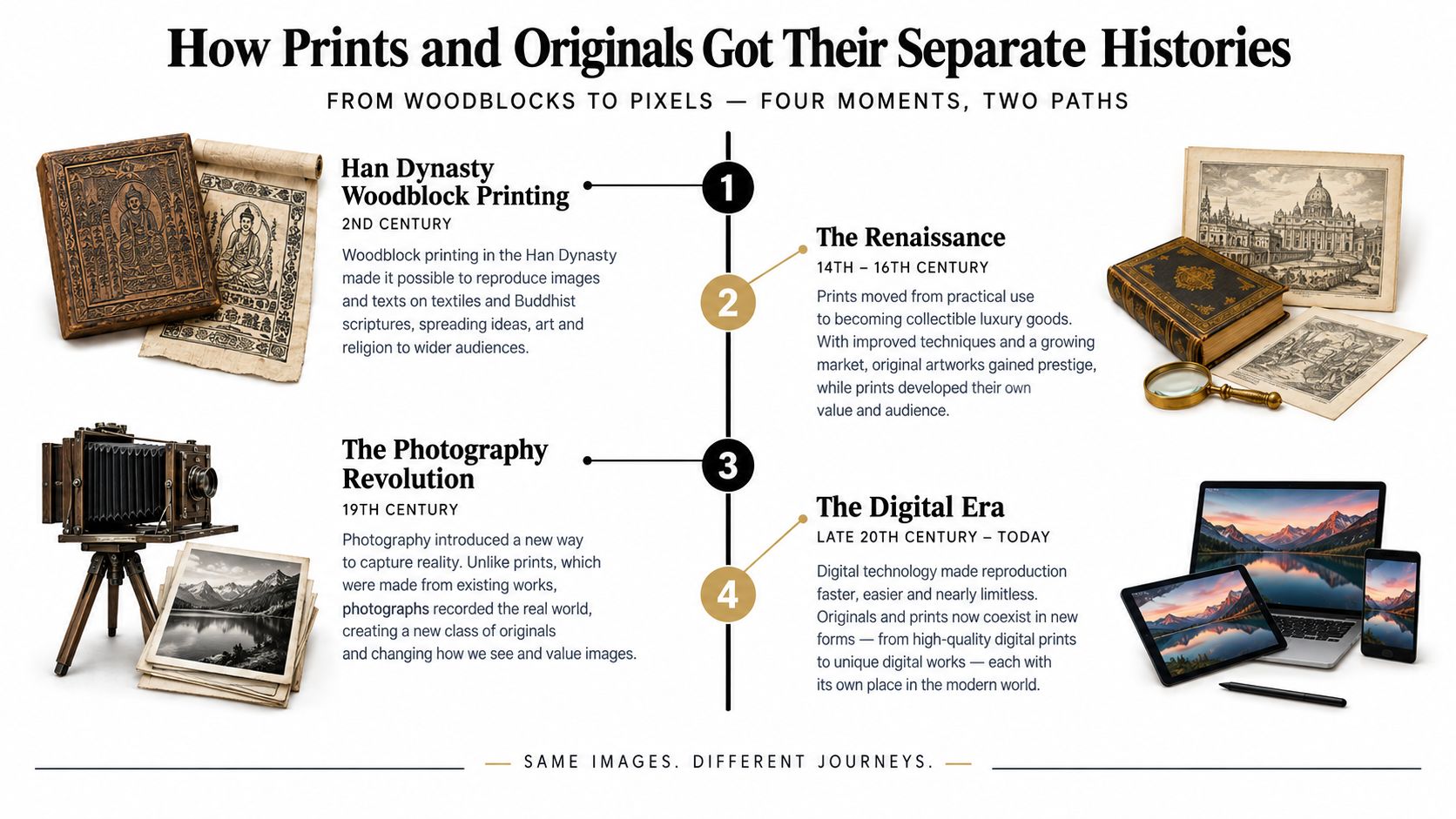
How Prints and Originals Got Their Separate Histories
Prints have never been merely decorative substitutes. Printed artwork dates back to China in the second century AD and Japan in the seventh century AD, while Western printmaking emerged around the 14th century. The European printing press appeared in 1450, accelerating the circulation of images and establishing technical foundations that still influence editioned art today. These milestones are documented in this history of prints and the art market.
A medium with its own tradition
Early woodblock printing served practical and religious purposes before artists and collectors treated prints as independent cultural objects. Japanese printmakers later demonstrated how serial images could carry refined composition, color, storytelling, and social commentary. In the West, printmaking developed through techniques such as engraving, etching, lithography, and screen printing.
That history matters because an authorized print can originate through an artist's controlled process. The Smithsonian distinguishes original prints, created from a matrix such as a plate, stone, block, or screen under the artist's supervision, from photomechanical reproductions that imitate an existing image. Original prints can show plate marks, raised ink, blindstamps, and other evidence of the matrix, while ordinary reproductions are usually flat and machine-produced. See the Smithsonian's explanation of prints and posters for the technical distinction.
Paintings followed a different path. The Renaissance strengthened the cultural position of the artist as an individual creator, and patrons increasingly valued the singular object associated with a named hand. Over centuries, that framework made the one-of-one painting the default symbol of scarcity and prestige.
Why both formats carry status
Prints inherited prestige from a long history of collectibility. Originals inherited prestige from controlled scarcity and physical uniqueness. Neither reputation is artificial, but they answer different desires.
By the early 21st century, prints had become a meaningful auction category. The three leading international auction houses recorded combined global print sales of about USD 170 million in 2023, with Christie's representing just over 45%, or about USD 80 million, according to the Société Générale analysis linked above. That commercial activity doesn't make every print valuable. It does show why dismissing all prints as cheap copies is historically and commercially wrong.
Materials, Value, and Collectibility Side by Side
The label “print” tells you almost nothing by itself. A signed, numbered edition produced on archival paper is a different object from a poster sold without process information. Likewise, “original” describes singularity, not automatic quality. You still need to inspect the materials, condition, provenance, and artist's record.
| Criterion | Prints | Originals |
|---|---|---|
| Substrate | Paper, cotton rag, coated art paper, or occasionally canvas. Premium examples often use heavyweight archival stock. | Canvas, panel, paper, or another surface chosen for the medium and intended effect. |
| Ink or pigment | Giclée processes commonly use pigment-based inks on archival or museum-grade papers. | Oil, acrylic, watercolor, mixed media, or other materials applied directly by the artist. |
| Edition size | Signed and numbered editions create defined scarcity, but the edition terms must be documented. | One-of-one by nature, unless the work is part of a series with related variations. |
| Value trajectory | Easier to price against comparable editions, with a more accessible resale pool. Appreciation remains artist- and market-dependent. | Wider outcomes, with stronger scarcity and a higher possible ceiling, but also more uncertainty. |
| Collectibility | Established auction category with dedicated buyers, publishers, and specialists. | Traditional center of the market, especially for important works with strong provenance. |
Materials decide what you're actually buying
A high-end print can have excellent color fidelity and a long service life when the printer uses appropriate pigment inks and conservation-grade paper. Industry and gallery descriptions commonly associate premium combinations with 100+ years of lightfastness claims under proper conditions, but the buyer should treat those claims as specifications to verify, not magic guarantees. The substrate also matters. Fine-art papers described as 300 to 350 gsm are stiffer and more durable than ordinary poster stock, according to the technical comparison of originals and fine-art prints.
An original gives you something a print can't reproduce materially: actual paint texture, impasto, embedded surface irregularities, and the physical record of decisions made by hand. A print can represent that texture visually, but it won't reproduce the raised paint itself.
The practical verdict
Prints win on accessibility, price predictability, and transaction flexibility. Buyers can compare editions, sizes, signatures, and condition without trying to assign a value to every brushstroke.
Originals win on scarcity and emotional weight. If you care about owning the exact surface the artist made, no print can close that gap.
For shoppers looking for a cohesive room rather than a single centerpiece, resources such as rustic framed wall prints can help clarify how frame style and presentation affect the overall result. The frame is part of the purchase decision, not an afterthought.
What Each Option Actually Costs You Over Time
The sticker price is only the beginning. A print may need archival framing, suitable glazing, and careful shipping. An original may require heavier packaging, specialist transport, insurance adjustments, conservation advice, and more cautious resale handling.
I'm deliberately not assigning invented totals to those categories. Costs vary by size, location, frame choice, medium, and seller. The useful comparison is the direction of the expense.
| Cost category | Limited-edition print | Original painting |
|---|---|---|
| Acquisition | Usually the more accessible entry point, especially for a documented edition. | Higher upfront commitment, with price shaped by the artist, scale, medium, and provenance. |
| Framing | Archival matting and UV-filter glazing protect the paper and can remain relatively predictable. | Custom framing may need deeper space, stronger support, and glazing suited to the medium. |
| Shipping | Often ships flat or rolled in a protective tube, depending on size and paper. | Requires more substantial packing and may need specialist handling. |
| Insurance | Often covered under household contents insurance, subject to policy terms. | May justify a scheduled item or separate rider, with documentation and valuation. |
| Storage | Flat, dry, acid-free storage is straightforward when the work isn't displayed. | Storage needs more room and stable conditions, especially for stretched canvas or fragile surfaces. |
| Resale | Broader buyer pool and simpler online presentation when edition records are clear. | Gallery commissions, appraisal questions, shipping risk, and buyer hesitation can slow the sale. |
Predictability beats false precision
A modest print can become expensive if you choose elaborate framing, but the cost is usually visible before purchase. An original can create expenses that appear later, particularly when the work needs conservation framing or a buyer expects professional delivery.
That's why I advise buyers to ask for a complete ownership estimate before committing. Include the frame, glazing, delivery, installation, insurance treatment, and likely resale route. If you can't explain those items, you're not comparing two artworks. You're comparing one known price with one incomplete budget.
Budget rule: Keep enough room for proper framing and care. An affordable artwork displayed badly is not a bargain.
Resale also deserves honest attention. A limited edition can be listed through an online secondary market, though demand still depends on the artist and edition. An original may command more, but the seller often has to provide stronger documentation and accept more friction. Guidance such as OCAD advice on selling artwork online is useful for understanding presentation, descriptions, photography, and buyer communication.
Before buying an edition, read whether limited-edition prints increase in value with a clear head. Appreciation is possible, not promised. The strongest purchase remains one you're happy to own if resale never becomes relevant.
Which One Fits Your Situation Best
The buyer profiles below come from a pattern I've seen repeatedly in gallery conversations. People rarely regret choosing the format that matched their purpose. They regret buying for status, stretching the budget, or assuming a resale market would solve an emotional purchase.
The first-time collector
Start with a print if you're still learning what you respond to. A signed edition teaches you to assess paper, process, condition, framing, and documentation without forcing you to make a large commitment.
Choose an original instead when you already know the artist's work and keep returning to the same painting. Repeated attention is a better buying signal than the idea that originals are automatically more serious.
The gift buyer
Choose a print when the recipient's taste, wall space, or delivery deadline is uncertain. It's easier to frame, transport, and replace if the recipient later changes rooms.
Choose an original for a milestone that deserves a singular object. A commissioned portrait or a painting tied to a shared place can make the physical uniqueness part of the gift.
The gallery-wall builder
Prints are the clear recommendation. They let you coordinate scale, palette, and subject across several works without turning a decorating project into a series of major acquisitions. Editioned art also makes seasonal rotation practical.
An original can anchor the arrangement, but don't buy several originals just to fill a wall. One strong painting is better than a crowded display of works you chose under pressure.
The investor
Be careful. Neither format should be bought on the assumption that price will rise. Prints offer a wider entry point and potentially easier resale, while originals offer stronger scarcity and a higher upside in the right artist's market.
If liquidity matters, favor documented editions by artists with an active audience. If you have patience, storage, and genuine conviction, investigate originals with clear provenance and a meaningful place in the artist's practice.
The patron of a working artist
Buy the original if your priority is direct support and ownership of the artist's physical labor. Buy the edition if you want to support the practice while making the work accessible to more rooms, families, or collectors.
Tucker's editions make sense for buyers who want the image and an accessible collecting route. Tucker's originals make sense when the actual painted surface is the reason you're buying. That is the cleanest distinction.
Display and Care That Protect Your Investment
Poor display decisions can damage both a print and an original long before the owner notices. Light, humidity, acidic materials, weak hanging hardware, and careless handling are ordinary household risks, not rare conservation problems.
Protect works on paper first
Keep prints away from direct sunlight. The brief specifies that prints hung in direct sun can fade within two years, so don't place valuable paper works beside an unfiltered window and hope the frame will solve everything.
Use acid-free mats, backing boards, and sleeves. Avoid ordinary tape touching the artwork. Store an unframed print flat in a clean, dry environment, preferably in an acid-free sleeve with support that prevents bending. William Tucker Art prints should receive that same basic treatment, particularly when they're waiting to be framed.
Premium papers and pigment inks help, but they don't make a print invulnerable. Ask the framer about UV-filter glazing and leave enough space between the artwork and the glazing so the surface isn't pressed against the glass.
Treat originals as physical objects
Original paintings need support appropriate to their weight and construction. Don't lean a canvas against an exterior wall, where temperature shifts and humidity can affect the support. Keep paintings away from kitchens, bathrooms, radiators, and vents.
For lighting, choose LED sources around 2700 to 3000K and keep works on paper near 30 to 50 lux, following the conservation guidance specified for this article. In bright rooms, UV-filter glazing is particularly useful for originals on paper and works whose surfaces need additional protection.
Before drilling, measure the hanging points, check the wall structure, and use hardware rated for the artwork's weight. This practical guide to perfect picture hanging covers alignment and secure installation without treating the frame as an afterthought.
Collectors with more work than wall space should rotate displays rather than leave everything exposed. Keep a simple record of purchase details, edition information, photographs, and condition. For painted surfaces, consult how to preserve acrylic paintings before attempting cleaning or restoration.
Where Smart Collectors Are Putting Their Money Now
The contrarian answer is that smart buying isn't always about chasing unique originals. Prints and multiples have become a substantial market segment, and recent reporting shows buyers increasingly use them to access artists whose originals sit beyond their budgets.
A market analysis reported that prints and multiples generated about USD 526 million from 198,100 lots sold globally in 2025, representing 23% of fine-art auction transactions worldwide. Another report placed annual print-market turnover at approximately USD 473 million in 2024, with 193,000 prints traded and 54,602 print lots sold at auction, the highest volume in a decade. Those figures come from the 2026 analysis of blue-chip prints and the middle market.
| Metric | Limited-edition prints | Original paintings |
|---|---|---|
| Buyer pool | Broad, because the entry point is more accessible. | Narrower when price, scale, and shipping become significant. |
| Liquidity | Often easier to list and explain when edition details are complete. | Can require more documentation, specialist buyers, and patience. |
| Authentication burden | Process, signature, numbering, publisher, and condition still matter. | Provenance, condition, medium, and attribution require close scrutiny. |
| Capital pressure | Lets collectors spread purchases across artists or themes. | Concentrates more capital in fewer objects. |
| Emotional payoff | Strong image ownership and participation in an artist's market. | Direct ownership of the artist's singular physical gesture. |
The market data supports a practical conclusion, not a guaranteed investment thesis. A print may be easier to sell because more buyers can afford it, but that doesn't mean every edition appreciates. An original may offer greater scarcity, but scarcity without demand is just an expensive storage problem.
Recent coverage also reported that the category's auction share grew by 52% between 2015 and 2025, while prints and multiples rose about 4% in value from 2023 to 2025 even as broader art trade declined nearly 9%, according to the Observer's analysis of prints, multiples, and editions. Treat those comparisons as market context, not a promise attached to any particular artist.
The logic breaks for masterpiece originals, blue-chip estates, and important primary-market debuts. Those works command premiums because buyers are paying for rarity, history, and cultural position that no edition can duplicate.
For anyone building a home, the smarter balance is mixed. Use prints to create a coherent room and originals to mark the works you can't stop thinking about.
William Tucker Art offers both signed limited editions and original paintings, giving you a practical way to choose between accessible display and one-of-one ownership. Visit William Tucker Art to compare the available works and select the format that fits your budget, purpose, and relationship with the artist.