
You've found an elephant print that would look right above the sofa. The size feels right, the colors work with the room, and then the format menu stops you: canvas, framed paper, metal, or acrylic? The photograph on the screen won't tell you which surface will suit that wall, or which version will still look good after years of daylight and seasonal changes.
Animal prints on canvas work best when the image, materials, and room suit each other. Start with the wall's light and humidity, then consider the detail you want to see. A convincing animal portrait needs more than an appealing subject and a promise of archival quality.
Canvas Versus Other Formats at a Glance
Choose canvas for painterly animals, large portraits, and walls where glass would create distracting reflections. Choose framed paper for delicate feather and whisker detail, or consider metal and acrylic for a crisp, contemporary presentation where the manufacturer confirms suitability for the room's moisture levels.
For that elephant above the sofa, canvas is a sensible starting point. Broad shapes and expressive color usually matter more from a seated viewing distance than microscopic detail. A close-up bird study beside a desk asks for a different decision because you'll examine it at arm's length.
Animal print formats compared
| Format | Best for | Detail and texture | Durability and care | Cost tier |
|---|---|---|---|---|
| Gallery-wrap canvas | Painterly animals, large portraits, rooms without glass | Soft woven texture; fine edges can soften | Good with pigment inks and compatible UV-protective varnish; sensitive to humidity swings | Low to mid |
| Floater-framed canvas | Living rooms and studio walls wanting a framed look | Same canvas texture, with a shadow gap | Same care as gallery wrap; frame helps protect edges | Mid |
| Framed fine art paper under glass | Detailed wildlife, feather and whisker studies | Strong micro-detail; glass can reflect light | Glazing blocks dust and handling; specify UV-filtering glazing for prolonged display | Mid to high |
| Unmounted poster paper | Temporary decor, rentals, quick gifts | Good detail; permanence requires disclosed materials | Vulnerable to fading, creasing, and handling without protection | Low |
| Aluminum metal print | Modern offices, bright colors, entryways | Vivid color; fine detail; glossy or matte options | Moisture-resistant construction available; glossy surfaces reflect light | Mid to high |
| Face-mounted acrylic | Bold graphic animals, lobbies, retail | High gloss and apparent color depth | Surface can scratch and show fingerprints; verify edge and mounting suitability | High |
These are relative shopping tiers, not price quotations or quality grades. A higher tier often reflects glazing, mounting, framing, and labor rather than a better image. A carefully produced canvas can be a more appropriate purchase than an expensive acrylic presentation.
Compare finished objects
Ask whether the quoted format arrives ready to hang. An unmounted paper print still needs protection and hardware, while a framed print may already include those costs. Also compare the outside dimensions, since a frame can change how the piece fits above furniture.
Don't treat moisture resistance as permission to hang any metal or acrylic product anywhere. The image layer, backing, exposed edges, and mounting system all need to suit the location. Find the row that matches your wall first, then evaluate the seller's construction details.
What Goes Into a Canvas Print
A canvas print is a complete material system: fabric, preparation, image layer, finish, and wooden support all affect the result. If a seller describes only the artwork and shipping size, you're missing useful buying information.
Start with the canvas weave. Cotton, poly-cotton, and polyester each give the image a different surface, yet fiber content alone won't establish print quality. Ask for the actual canvas specification and, when texture matters, a sample rather than judging from a screen.
From fabric to finished print
The preparation layer seals and conditions the fabric so the ink prints evenly. Sellers may describe it as sizing, primer, or an ink-receptive coating. Ask what they mean, since those terms don't always describe the same product.
The diagram maps the production components. Stretcher bars form the wooden support behind the printed fabric; they hold the canvas under tension beneath the image layer.
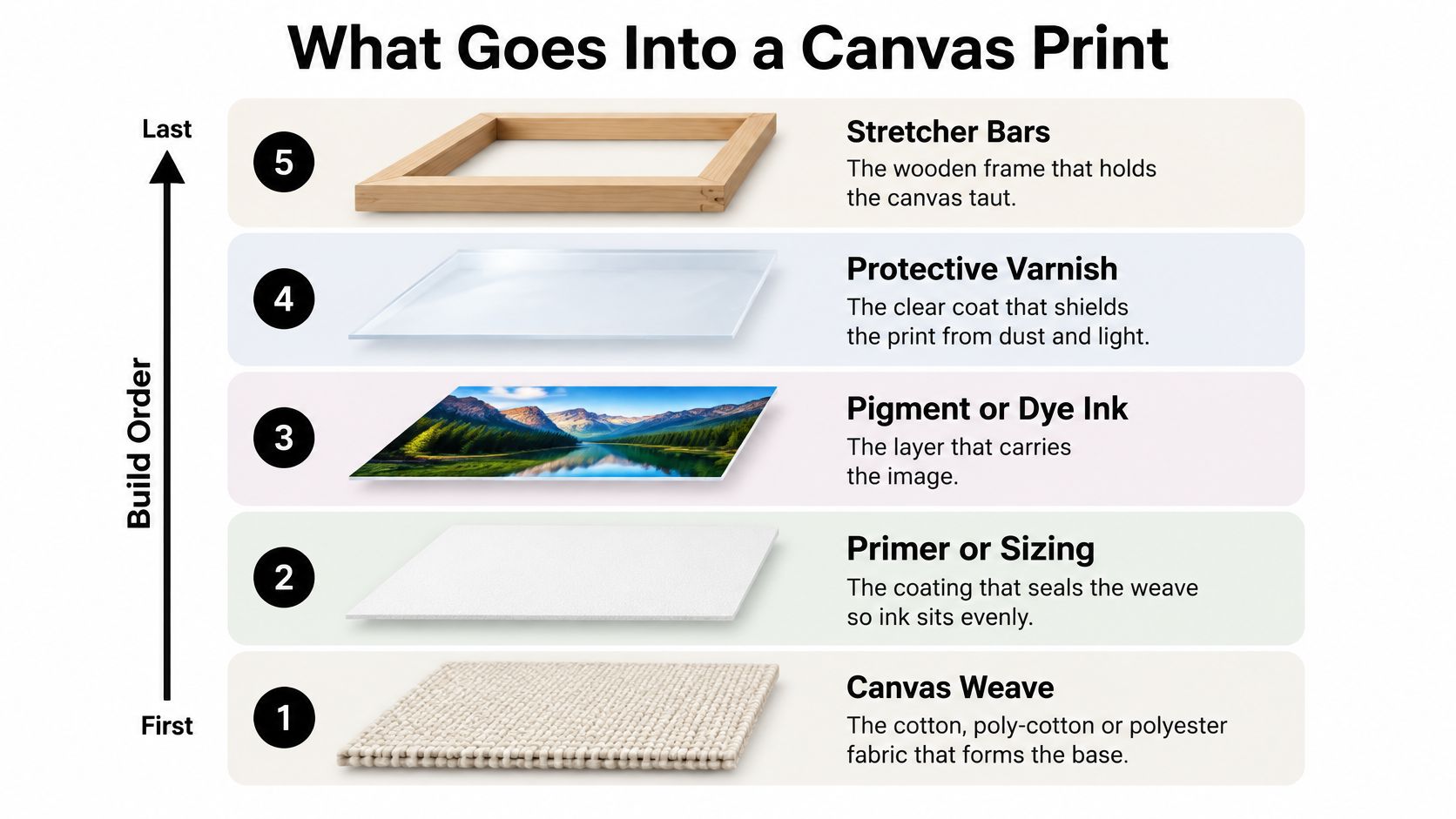
The ink layer carries the animal's expression and color. A compatible protective varnish guards the surface, and straight, sturdy bars keep the weave taut. If you're weighing a rolled print against a finished wall piece, the explanation of what a stretched canvas is clarifies the difference.
Ink systems and expected indoor lifespan
The ranges below come from the MOMAA canvas print quality guide, which reports approximately 75 to 200 years of lightfastness for pigment systems under controlled indoor conditions, compared with roughly 5 to 20 years for dye-based alternatives.
| Ink and substrate | Reported lightfastness (indoor) | Best suited to |
|---|---|---|
| Pigment ink on archival-primed canvas | Roughly 75 to 200 years under controlled conditions | Heirloom wildlife pieces and pet portraits |
| Dye-based ink on canvas or paper | Roughly 5 to 20 years under controlled conditions | Short-term decor, promotional and seasonal use |
| Giclée label without disclosed ink or test data | Not established by the label | Ask for ink type and an independent lightfastness test before buying |
Giclée names an inkjet process. It certifies nothing about permanence. For a keepsake portrait, ask for the ink manufacturer and system, the canvas product, the protective finish, and any independent lightfastness testing covering that combination.
I'd read these figures as a ceiling for careful display. Light and humidity decide how much of the tested lifespan a print delivers, so the same piece can thrive in a shaded living room and struggle in a steamy bathroom. Subtle shifts in fur shading or eye color also make fading obvious in a familiar pet's face long before the whole image looks washed out. And if animal-free materials matter to you, preparation products and varnishes need their own scrutiny, so ask what the sizing and coating contain.
How Canvas Handles Fur, Feathers and Fine Detail
A painterly elephant with broad brushwork is a natural candidate for canvas. A close-up of a snow leopard's eye, with individual whiskers against dark fur, deserves a closer comparison with smooth fine art paper or a suitable metal print. The question is which details must remain distinct, not which format sounds more luxurious.
The Noirci comparison of canvas and paper prints describes the central trade-off: canvas's woven, low-glare surface diffuses reflected light and can support an unglazed presentation, but its texture can soften fine edges and micro-contrast. That's an advantage for expressive brushwork and a potential compromise for tiny feather markings.
Match the surface to the subject
William Tucker Wild Things Endangered Animal Wall Art - New Dawn offers a useful example of a canvas-oriented image: an elephant portrait set against vivid reds, deep purples, and silhouettes beneath a painted sunrise. Its combination of a recognizable animal and textured, expressive surroundings gives the viewer more to read than fine outlines alone.
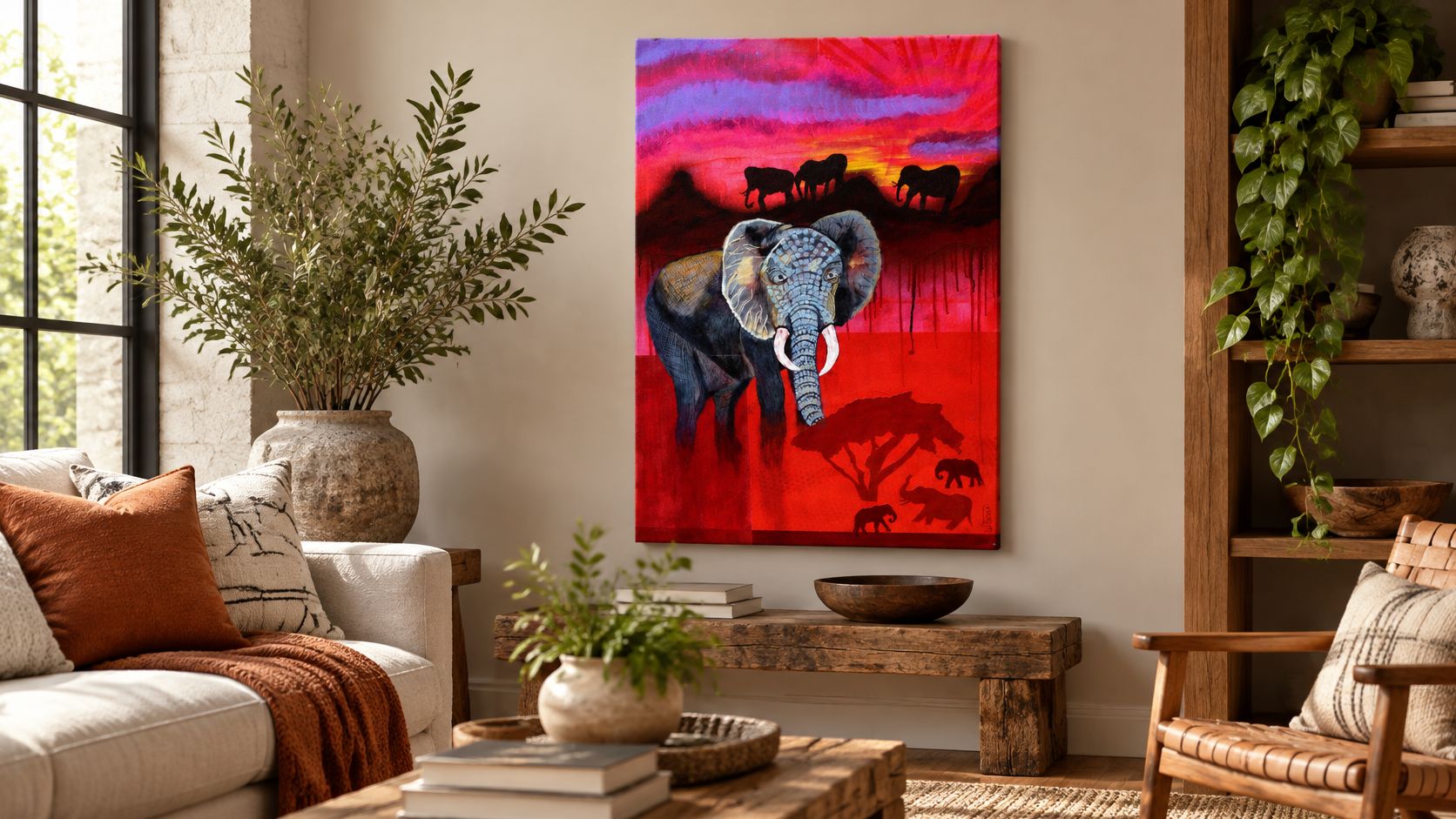
For a photographic portrait, inspect the eyes and the boundary between fur and background. If those areas already look smeared in the source image, canvas won't restore them. Nor will a glossy surface rescue a missed focus point.
Check the file before enlarging
As a hypothetical file-sizing exercise, suppose your printer requests 150 pixels per inch for a 24-by-36-inch print. Multiplying each dimension by that chosen resolution gives a source requirement of 3,600 by 5,400 pixels; that's arithmetic for the example, not a universal quality threshold.
Use your image editor's pixel dimensions, not the file's size in megabytes. Cropping removes usable pixels, and increasing the dimensions through interpolation doesn't recover original whisker or feather detail.
- Sharpen for the output: Ask the printer to apply controlled output sharpening after sizing, without creating bright halos around fur.
- Proof the critical area: Request an actual-size crop containing an eye, whiskers, and a dark-to-light transition.
- Judge at the intended distance: Examine the proof where you'll normally stand or sit, not only with your nose against it.
Measure your own file against the printer's requirements before ordering. If it falls short, reduce the print size, choose a more interpretive treatment, or select a stronger source photograph.
Durability and Display Conditions That Decide Lifespan
You're choosing between a bright south-facing hallway and a bathroom that steams up after showers. The hallway raises a light-exposure problem; the bathroom adds repeated moisture changes and possible condensation. The wall can undo an otherwise careful purchase. Canvas cloth, ink, ground, coatings, and wooden supports respond to environmental changes at different rates, and repeated expansion and contraction can stress the layers, with cracking, separation, or flaking among the possible consequences. Neither room is an automatic home for a keepsake canvas, even if the print carries premium ink.
Stable household conditions matter more than a museum-grade room. Avoid abrupt changes, concentrated heat, damp walls, and direct sun. A UV-protective finish is useful, but it doesn't make a canvas indifferent to its surroundings.
Read the wall before hanging
Watch where sunlight lands throughout the day. A wall that looks shaded while you're shopping at night may receive a strong afternoon beam. Moving the picture to an adjacent interior wall is often a better solution than relying on a coating to compensate for direct exposure.
Practical rule: Choose the safest wall you already have before paying for extra protection against an unsuitable one.
Keep canvas away from fireplaces, radiators, cooking steam, and frequently opened windows. Don't hang it where an exterior wall feels damp or where a vent blows directly across the surface. Glass doesn't solve an unstable room, and glazing a canvas needs appropriate spacing and framing advice.
Run a simple wall test
Use a basic digital hygrometer with a temperature display to compare the proposed position with a sheltered interior wall. As a practical trial, monitor it over a stretch that includes showers, cooking, heating cycles, and changes in weather. Look for a repeated pattern of abrupt changes across the week.
- Log normal activity: Note whether the room was being heated, ventilated, or filled with steam.
- Check for condensation: Inspect nearby windows and the wall surface alongside the meter.
- Move before damage appears: If the spot repeatedly becomes damp or experiences pronounced swings, choose another wall.
If the wall test keeps failing and framed paper suits the room better, Famous Movie Posters' guide to how to frame vintage movie posters covers the related protection questions for paper-based artwork. For canvas, ask the printer about safe dusting and maintenance, and skip household cleaners or extra varnish until you have that guidance.
Framing, Hanging and Lighting a Canvas Print
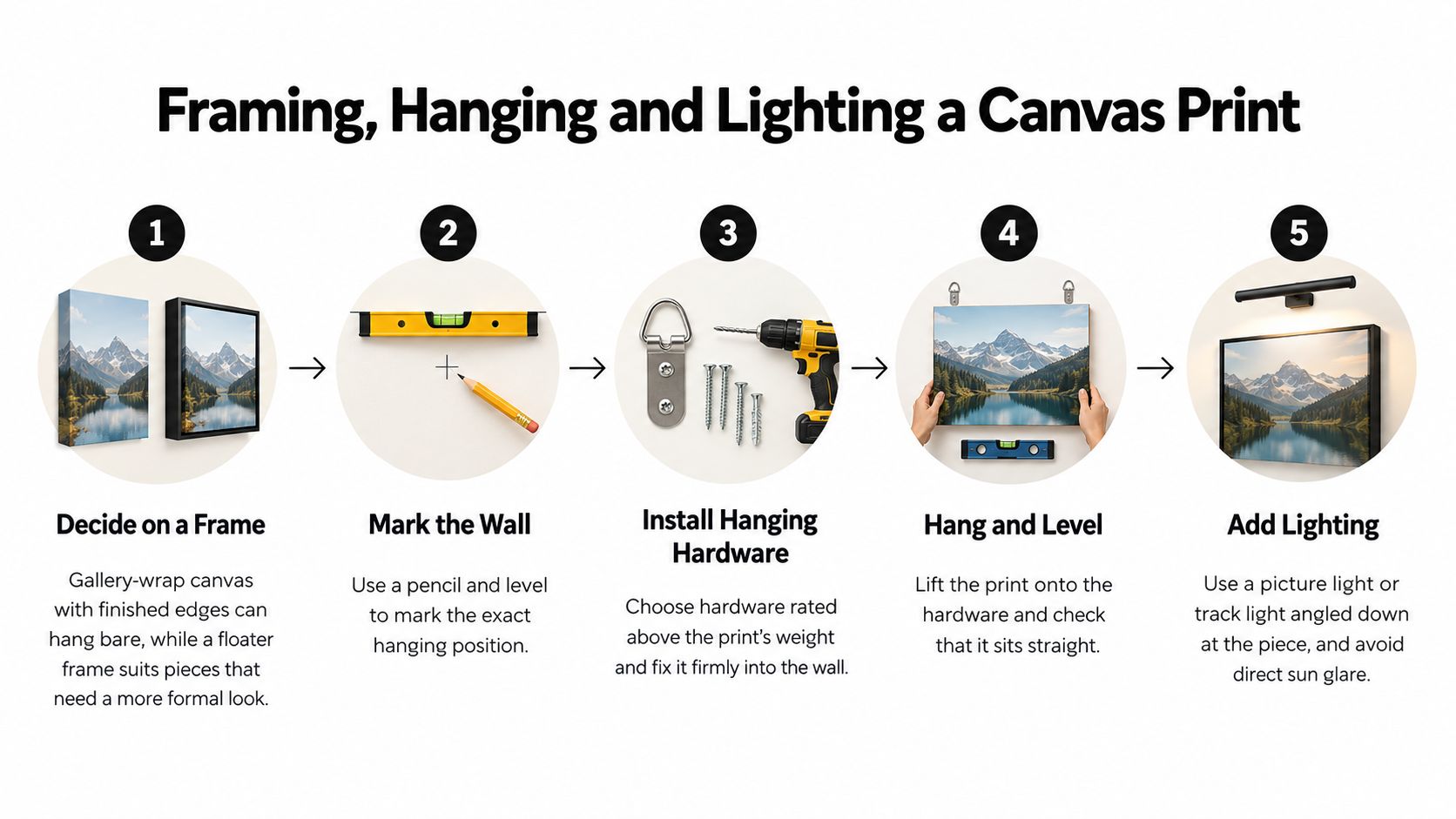
A gallery-wrap canvas with neatly finished edges can hang without an outer frame. A floater frame adds a visible gap around the canvas and suits a more formal presentation. Check the side treatment before buying: a wrapped image can move part of an animal's ear, tail, or background around the edge.
A frame should fit the stretcher depth without pressing against the printed face. The guide to how to frame canvas paintings helps clarify the framing choices before you order components.
Install for the actual wall
- Weigh the finished piece. Include the floater frame when selecting hardware, and choose fixings with a rated capacity comfortably above the complete load. Match the fixing to timber, masonry, or plasterboard rather than trusting a picture hook because it looks substantial.
- Mark the position with a paper template. Center the arrangement over the furniture it belongs to, then check the animal's face from normal seating height. Don't force a generic gallery height onto a room where a sofa, desk, or low ceiling changes the view.
- Use compatible hanging hardware. A paired D-ring arrangement or a properly installed wire system can work, provided the stretcher and hardware suit each other. Attach hardware to the wooden support, never through the printed face.
- Level and check engagement. Confirm that every hook or bracket is fully seated before letting go. Add suitable rear bumpers if needed to protect the wall and discourage rocking.
Light the image, not the varnish
- Position an adjustable LED picture light or track light. Aim from above or the side, then adjust while standing at the normal viewing position. Choose a color appearance that keeps white fur, neutral backgrounds, and warm coats believable rather than noticeably yellow or blue.
- Control daylight separately. Use blinds, curtains, or a different wall when sunlight reaches the picture. If you're considering UV-filtering measures, remember that they don't eliminate visible-light exposure or heat.
Keep floor lamps far enough away that they don't warm the canvas locally. A light that looks attractive from across the room may still produce a distracting sheen across an animal's eyes.
Step back to the position where you'll actually enjoy the print. Confirm that the expression reads clearly, the frame doesn't crowd the subject, and you're seeing the artwork rather than a reflection of the room.
Checking Whether an Animal Print Is Animal-Free
The subject on the canvas says nothing about what went into making it. A wildlife portrait can express concern for animals while containing animal-derived preparation products, coatings, binders, or adhesives. Cotton fabric alone doesn't settle the question, and neither does an artist's stated love of the species depicted.
The Vegesent discussion of vegan artworks identifies materials such as rabbit-skin glue, gelatin-based coatings, and animal-derived binders as reasons to examine the production process. A credible answer needs to cover the finished print and frame, from the sizing that stiffens the fabric to the glue that holds the moulding together.
Animal-derived components to ask about
| Component | Common materials | Question to ask |
|---|---|---|
| Canvas sizing and primer | Rabbit-skin glue or synthetic size | Is the sizing animal-free, and can you name it? |
| Protective coating or varnish | Gelatin-based coatings or synthetic finishes | Is the protective finish free of animal-derived ingredients? |
| Inks and binders | Pigment inks with different binder systems | What is the binder, and is it animal-free? |
| Mounting adhesives | Animal glue or synthetic adhesive, where adhesive mounting is used | Is any mounting adhesive used, and what is it? |
| Framing joinery | Hide glue or synthetic glue | Is the frame assembled with animal glue? |
A conventional stretched canvas is usually secured mechanically to its stretcher, so don't assume adhesive is present. Ask separately about any backing, lining, mounting board, or frame assembly. That gives the seller a specific question to investigate rather than a broad ethical label to interpret.
Ask for traceable answers
Natural and vegan are different claims. Traditional animal glue may be bio-based and still fail an animal-free requirement, while a synthetic preparation may satisfy it. Neither description, by itself, proves that the complete product has a lower environmental impact.
Request a written materials list with product names wherever possible. If the seller relies on a supplier's declaration, ask whether it covers the exact ink, coating, and substrate used for your order.
- Separate the claims: Animal-free, recycled, organic, and environmentally preferable describe different things.
- Include the frame: A verified print can still arrive in a frame assembled with an unverified adhesive.
- Allow an honest unknown: Missing documentation leaves the claim unverified.
A conservation message is a statement about the image. An animal-free claim needs evidence about the object.
If the seller can't identify the sizing, varnish, and any adhesive used, treat the animal-free claim as unverified. When you're buying for a vegan recipient or reselling the work, communicate that uncertainty plainly.
Choosing the Right Canvas Animal Print for Your Space
Match the format to light and humidity first, viewing distance second, and budget third. That order prevents a common mistake: buying a large canvas because it looks economical, then discovering the only available wall is beside a shower or directly opposite an unshaded window.
Use the situations below as purchasing filters. Each recommendation assumes you'll obtain the relevant specifications in writing, rather than interpreting a styled room photograph as proof of suitability.
Recommended format by situation
| Situation | Recommended format | Specs to insist on |
|---|---|---|
| Living room statement wall | Gallery-wrap canvas | Pigment inks, archival canvas, compatible protective finish, sturdy stretcher bars |
| Home office | Matte canvas or framed paper under UV glass | Matte finish to limit screen glare; appropriate UV-filtering glazing for paper |
| Entryway or lobby | Aluminum or face-mounted acrylic | Disclosed scratch and moisture resistance; secure mounting system |
| Pet portrait for a family room | Large canvas | Source-file review, actual-size detail proof, pigment inks, approved crop |
| Exhibit or zoo education panel | Canvas or metal | Documented lightfastness and handling notes |
| Bathroom or kitchen | Metal or face-mounted acrylic | Verified moisture suitability for the complete product; avoid unprotected canvas |
A bathroom or kitchen deserves a stricter decision than a sheltered family room. Don't put unprotected canvas where it will receive steam, splashes, or cooking residue. Even with metal or acrylic, confirm that the backing, edge construction, and hardware are appropriate for the proposed location.
A pet portrait presents a different risk: the emotional value may exceed the usable detail in the photograph. Send the original camera file, not a social-media download or screenshot. Ask the printer to flag softness before production, and approve the crop so a favorite expression doesn't disappear around the stretcher.

Make the room decision tangible
Tape a paper outline of the proposed finished dimensions to the wall. Include the frame's outside dimensions, then sit down, walk through the doorway, and check whether the image will compete with shelving or lamps. The guide to how to choose wall art provides additional help with proportion and placement.
Keep adjacent animal patterns intentional. A detailed wildlife portrait beside several competing prints can become difficult to read, while a restrained cushion or throw can connect the palette without copying the subject. For a separate look at patterned accessories, Pandemonium Millinery's guide to faux fur styling with Pandemonium Millinery offers styling context, not verification of an artwork's materials.
Buy against a short checklist
Before paying, save the product description and confirm the finish, stretcher depth, hanging hardware, and care instructions. For a custom image, obtain file approval and an explanation of what the proof represents. For a keepsake or institutional purchase, ask how the seller supports permanence and material claims.
Pick the situation row before choosing the upgrade. Then request only the specifications that matter for that wall and image, rather than paying for a premium label that doesn't answer your practical questions.
William Tucker Art offers wildlife artwork and pet portraits that combine detailed animal subjects with expressive backgrounds. Visit William Tucker Art to explore the collections, then ask about the materials, finish, and format of the piece you're considering so it suits both your animal and your wall.