
You open a new canvas expecting a simple white rectangle. Instead, you find a carefully built painting surface: fabric pulled over wood, fixed in place, and prepared to receive paint. It may look quiet and uncomplicated, but the way that fabric is woven, primed, and tensioned affects how your brush moves today and how the finished artwork behaves over time.
Understanding the Artistic Foundation
A stretched canvas is fabric pulled tightly over a rigid wooden stretcher frame and secured around its edges. The frame gives the support its shape, while the fabric provides the surface on which you paint. Unlike a loose sheet of cloth, it's designed to remain evenly taut so paint layers have a stable foundation.
That distinction matters when you're standing in an art shop comparing a ready-made canvas with a roll of unmounted fabric. A rolled canvas is a flexible material that still needs a frame or panel. A stretched canvas has already combined the fabric and support into one usable object, so you can place it on an easel and begin working.
Practical rule: A canvas should feel firm and even, not loose like fabric in a bag and not pulled so aggressively that the frame seems strained.
The white surface you see is usually more than raw cloth. A manufacturer may apply sizing and primer to reduce absorbency, protect the fibers, and create a consistent ground for paint. That preparation changes the way a brush glides, how much paint the surface accepts, and how clearly the weave remains visible.
The frame also needs to distribute tension properly. Conservation guidance explains that uneven or insufficient tacking points can lead to slackness, rippling, or corner draws. Natural-fiber supports respond to their surroundings, so stable display conditions are generally 40% to 60% relative humidity and 18°C to 24°C, as described in this conservation guidance for canvas paintings.
Think of the canvas as a small structural system rather than a blank sheet. The fabric, wooden frame, fasteners, and primer work together. If one part is poorly made, you may notice the result as a soft corner, a visible ripple, or a surface that changes under shifting studio conditions.
The Three Essential Components
Look at the back of a stretched canvas and its anatomy becomes much easier to understand. The fabric is the visible skin, but the stretcher bars create the skeleton, and the corner keys provide a limited way to adjust the fit.
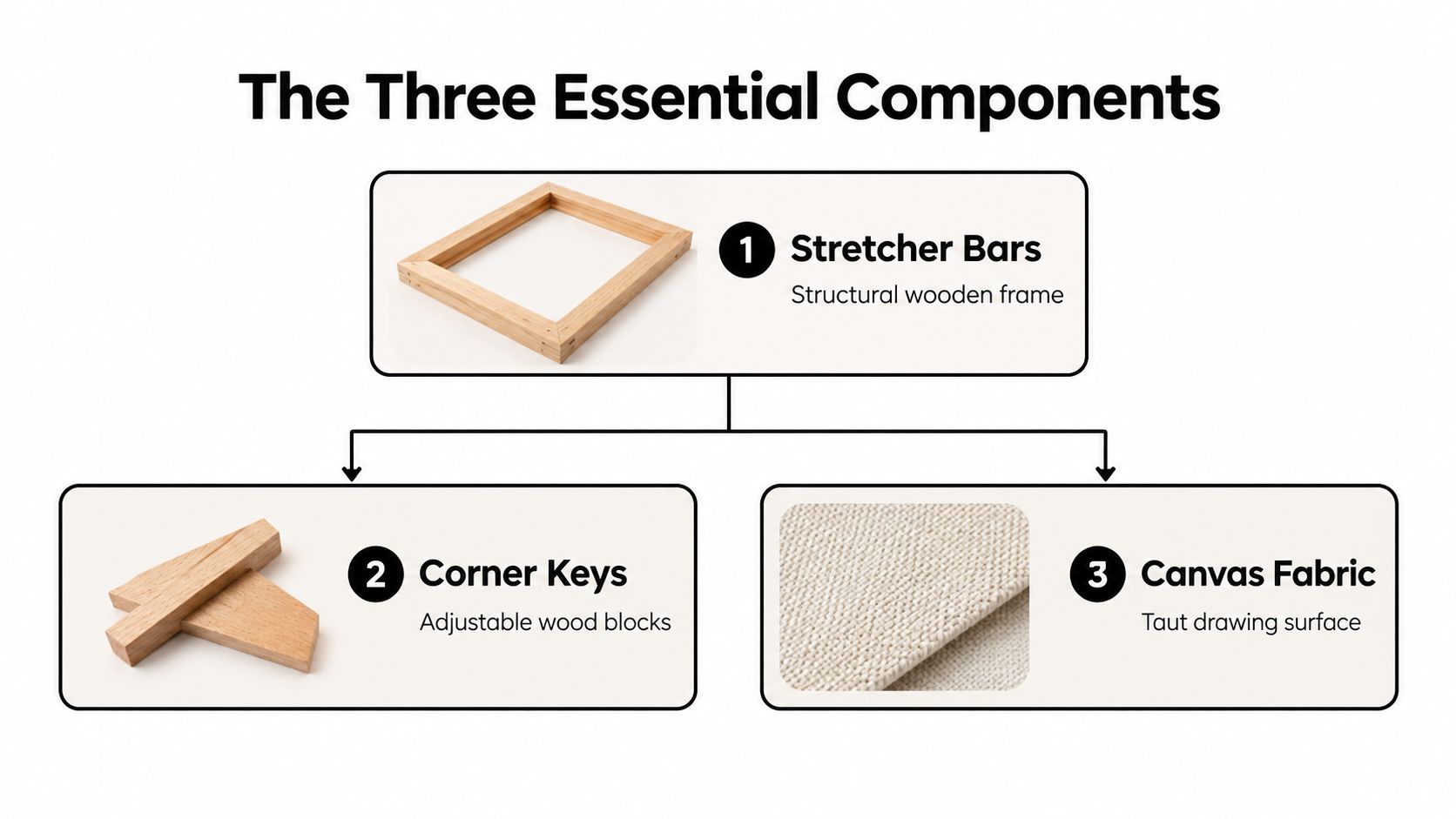
Stretcher bars form the support
The wooden bars join to create the rectangular frame. They need enough rigidity to hold the fabric without twisting, but their construction also needs to accommodate the size and weight of the finished painting. Small canvases may use a straightforward frame, while larger works often need additional structural support to reduce flexing.
The fabric is wrapped around the outer edges and attached from the back or sides. Many secure attachment points help distribute the pull instead of concentrating it in a few places. If the fastening pattern is uneven, the cloth can pull diagonally, producing the corner distortions conservation professionals call corner draws.
Corner keys fine-tune the fit
Small wooden wedges, often called corner keys, fit into slots near the frame's corners. Tapping them gently can expand the frame slightly and restore firmness if the fabric relaxes. They aren't a substitute for careful initial stretching, and forcing them can place too much pressure on the fabric or frame.
Treat keys as maintenance tools, not tension levers. A slight adjustment may help a canvas that has softened, but a badly skewed or damaged support needs more thoughtful repair.
The weave carries the paint
Canvas fabric consists of interlaced threads. Linen, cotton duck, and hessian each have different textures and responses to moisture and tension. The weave affects how much tooth the surface offers, how the paint catches, and how visible the fabric remains beneath thin passages.
Tension needs balance. Conservation research measured a practical target for an average unlined canvas painting at about 1 to 2 N/cm, using spring-based stretcher systems to relate force to elongation. The research on canvas tension and deformation explains why too much tension can deform paint and ground layers, while too little can allow sagging and structural instability.
For a visual demonstration of the frame and fabric working together, this stretched canvas construction video offers a useful companion to the diagram above.
From Panels to Fabric
Canvas became important because artists needed a support that could handle ambitious paintings without carrying all the weaknesses of a rigid wooden panel. Wood offers a firm surface, but it can respond to moisture by moving, warping, or cracking. Fabric mounted over a frame offers a different balance, with lower weight and greater flexibility.
The earliest surviving canvases date from the late 14th century, while canvas use became more widespread from the 16th century, according to the National Gallery's canvas glossary. Fabric supports had existed earlier, but the move toward canvas as a major fine-art surface accelerated in Venice before spreading across Europe.
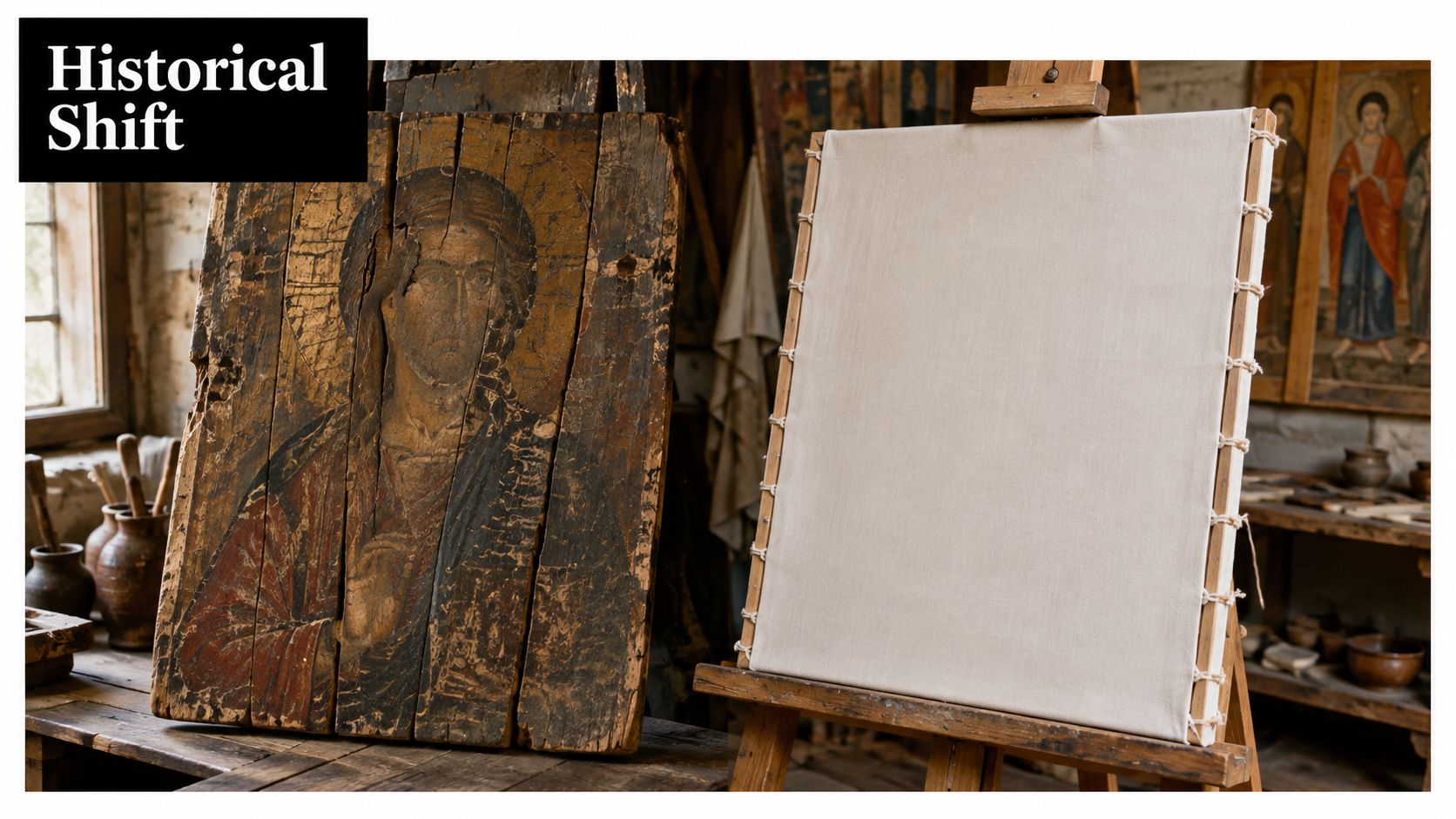
Why Venice favored canvas
Venice's humid environment made wooden panels more vulnerable to warping and cracking. By the 17th century, stretched canvas had become especially common there. The material didn't eliminate environmental movement, but its lighter and more flexible structure gave artists a practical alternative to a large rigid panel.
That flexibility also helped painters work at a larger scale. A substantial canvas could be transported more easily than an equivalent wooden support, particularly before it was mounted. Once stretched, it still offered a defined surface for detailed work, broad brushwork, and layered paint.
The shift became industrial
For centuries, artists and workshops prepared supports by hand. The 19th century brought more commercially available stretchers, strainers, and pre-primed canvases, changing the relationship between artists and materials. Instead of building every support from raw components, painters could purchase a prepared foundation and devote more studio time to the image itself.
The historical lesson is practical. Artists didn't choose canvas only because it looked traditional. They chose it because the format solved problems involving weight, scale, transport, and environmental movement. Those same advantages continue to shape the way artists select supports today.
Fabric Choice and Surface Tension
Two canvases can share the same dimensions and still behave differently under a brush. The fabric's fiber, weave, weight, and preparation all contribute to the surface you feel while painting. A coarse fabric can add visible texture, while a finer weave gives detailed marks a smoother path.
Cotton duck is common in studio painting because it offers a familiar, versatile surface. Linen has a different character and is often selected when the artist wants a distinct weave and a support suited to more conservation-conscious practice. Hessian is coarser and more visibly textured, which can become part of the artwork's visual language.
Primer changes the equation again. Sizing and priming can increase tension and create a surface with a drum-like feel. That doesn't mean the canvas should be dangerously tight. It means the fabric has a consistent resistance beneath the brush, without soft areas that dip when you apply pressure.
Moisture keeps the material moving
Natural fibers respond to changes in humidity. They can absorb and release moisture, which affects their dimensions and the tension across the frame. A canvas that feels perfect in a dry studio may respond differently in a damp room, near a radiator, or on a wall exposed to changing outdoor conditions.
That's why even tension matters more than maximum tension. A strong, consistent construction reduces unwanted movement, but excessive pull can transfer stress into the ground and paint layers. The most useful purchasing question isn't, “How tight is it?” Ask whether the support is evenly tensioned, square, securely fastened, and appropriate for the painting method.
For artists preparing their own supports, this guide to stretching a canvas painting can help clarify the relationship between fabric, frame, and fastening. The aim isn't to create the tightest possible surface. It's to create a stable one that won't develop obvious slackness or distortion during normal use.
Match the surface to the mark
A detailed pet portrait may benefit from a relatively controlled weave, especially around eyes, whiskers, and fine fur. A wide scenic scene or expressive abstract painting may welcome more texture, because the fabric tooth can break up a smooth passage and add physical variation.
Before buying, press lightly at the center and inspect the corners. The surface should respond with consistent firmness. Look across the face at an angle for ripples, skewed threads, or areas that sit lower than the rest. These simple observations tell you more than the word “premium” on a package.
Gallery Ready Advantages
A stretched canvas changes the final presentation as much as it changes the painting process. A rolled canvas is easier to store and transport before framing, but it needs a suitable support later. A stretched canvas arrives as a structured object, which makes it easier to place on a wall, evaluate at full scale, and present without an elaborate frame.
Gallery wrapping offers a particularly clean solution. The fabric folds around the sides of the stretcher bars, and the artist may continue the image around the edges or paint them as part of the composition. This can remove the need for an additional outer frame, although framing remains a personal and curatorial choice.
Comparing common formats
| Format | Main advantage | Practical consideration |
|---|---|---|
| Stretched canvas | Ready-to-hang structure and a direct painted surface | Takes more space during storage and shipping |
| Rolled canvas | Compact transport and flexible storage | Needs stretching and often further preparation |
| Reproducible imagery and varied presentation options | The surface and depth differ from an original painting | |
| Framed panel | Rigid support with a defined frame | Usually weighs more and has a different visual profile |
Framing guidance describes stretched canvas as common in galleries and home décor, often ready to hang, with gallery-wrapped edges that can avoid an additional frame. The same comparison of rolled and stretched canvas gives useful context for deciding whether convenience, compact shipping, or immediate display matters most.
A collector also needs to think beyond the object itself. A stretched work has a presence that a loose roll doesn't have, while a print may offer a different entry point for someone who wants an image without acquiring an original. Galleries can also extend the viewing experience through digital presentation, and resources on how to monetize your art with virtual tours can help artists consider online access alongside physical display.
The broader market remains steady rather than explosive. One 2026 projection estimates the stretched canvas market at about USD 0.54 billion in 2026 and USD 0.64 billion by 2032, as reported in the cited framing comparison. That projection suggests continued interest in the format, but your own decision should still begin with the artwork, support quality, storage conditions, and intended display.
Making Your Selection
When you examine a stretched canvas in person, start with the basics. Set it on a flat surface and look at the front for ripples, dents, or visibly uneven priming. Turn it over to inspect the frame, attachment points, corner joints, and any signs that the wood has twisted.
A useful checklist is short:
- Surface: Check that the weave and primer look consistent across the face.
- Tension: Press lightly in several areas and compare the response.
- Frame: Look for straight bars, secure joints, and a square overall shape.
- Corners: Make sure the fabric isn't bunching or pulling sharply.
- Purpose: Choose a smoother or more textured surface according to your technique.
Pre-stretched canvas can be a sensible choice when you want to begin painting without constructing the support yourself. This overview of pre-stretched canvas is also helpful for beginners comparing ready-made options with a custom-built support.
For a wildlife or pet portrait, the canvas needs to support both close observation and a confident final presentation. Fine details may call for a controlled surface, while a more expressive background can benefit from visible tooth. An artist working in New Orleans, where climate and humidity deserve attention during storage and display, should also think about placement, airflow, and stable indoor conditions.
That same care applies to collectors. Ask what fabric and primer were used, whether the work is already stretched, and how it should be stored or displayed. A well-made support doesn't compete with the painting. It keeps the image stable, visible, and ready to live in your space.
If you're choosing a painted work or commissioning a portrait, visit William Tucker Art to explore wildlife, pet portrait, coastal, and climate-focused artwork made on canvas. Use the support details, surface character, and intended display setting to select a piece that fits both your room and the way you want to experience the art.