
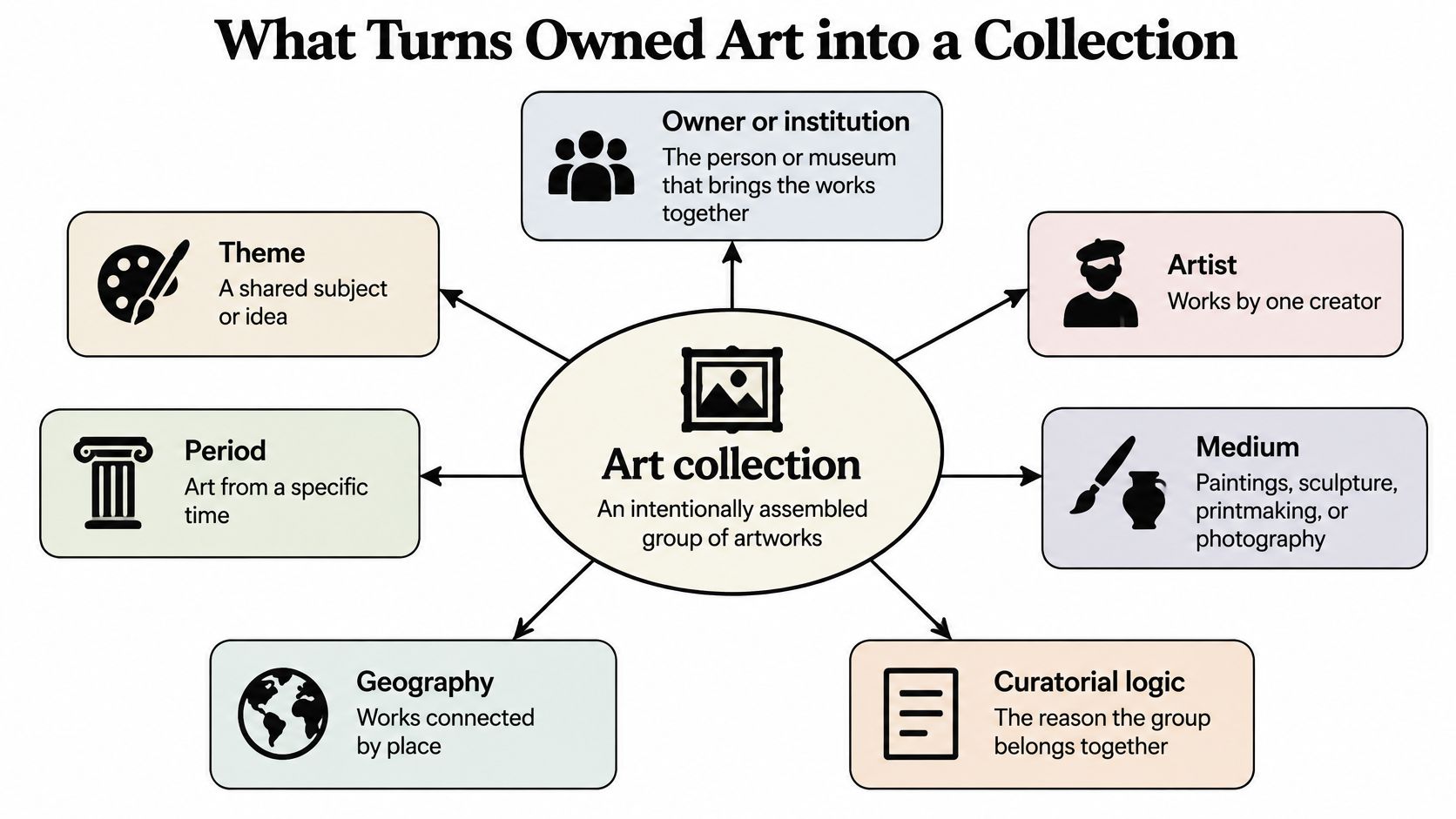
An art collection is an intentionally assembled group of works linked by an owner, theme, artist, medium, place, or purpose, not a random set of purchases.
If you already live with art you love, what turns those individual pictures into something more? The answer isn't a grand house, a famous signature, or an auction record. It's the relationships you recognize between the works, the information you preserve, and the attention you give them.
What Turns Owned Art into a Collection
What can a shoreline painting, a bird print, and a family photograph say together? They become a collection when you can explain the relationship among them, keep a record of what they are, and care for them as a group.
A useful definition of an art collection includes both the objects and the choices behind them. You select works, recognize their connections, preserve their histories, and look after them. A playlist offers a simple analogy: separate songs take on a shared meaning when someone brings them together around a mood or idea. Collecting adds responsibility for the physical works, too.
A group might tell a story about your family's connection to a particular stretch of shoreline. That story can guide future choices, even if the works differ in style or medium. The relationship need not be obvious to every visitor, as long as you can explain why the works belong together.
The practices that make the difference
A pile of art versus an art collection
| Practice | Random accumulation | Art collection |
|---|---|---|
| Selection | Bought because each piece was liked on its own | Chosen to fit a theme, artist, place, medium, or purpose |
| Documentation | Receipts may be missing | Title, maker, date, medium, size, and ownership are recorded |
| Interpretation | No shared story | Relationships among works are explained |
| Care | Display is ad hoc | Condition, location, and basic protection are tracked |
| Result | Decor or souvenirs | A body of work with more meaning than any single piece |
Decorating and collecting can go together. A work may first catch your eye because it suits a room; collecting adds the question of how it relates to the other works you keep. Try naming one connection, such as a shared subject, place, memory, or maker. If you can, that gives you a starting point for explaining the group.
Private collectors may use art to express identity, cultural affiliation, family memory, philanthropy, or investment goals. Museums preserve works for research, education, public display, and future generations. The setting differs, but deliberate selection and care help give the group coherence.
Value means more than a selling price
Art collections exist within an international network of artists, dealers, galleries, auction houses, museums, and buyers. The Art Basel and UBS Global Art Market Report 2024 estimated 2023 global art sales at USD 65 billion, down 4% from the previous year but above 2019's USD 64.4 billion.
Those figures describe sales across the market, not the meaning of an individual collection. A group can hold market value, cultural value, personal value, and educational value at once. An inherited drawing, for instance, may be modest in price yet help a family understand its own history. A collection's significance need not depend on its size, price, or investment potential.
Works also need not match visually. Different colors, materials, and viewpoints can make a group more revealing when you can explain how they relate.
The wall test: What do these works say together that none says alone?
Collection Types Collectors Actually Use
What common thread could make several artworks feel like a collection? It might be a subject, an artist, a material, a place, a period, or the reason you keep the works. A collection can be small and affordable; its identity comes from intentional relationships, records, and care, not size or investment goals.
Six ways to organize an art collection
| Type | Organizing link | Example | Best when |
|---|---|---|---|
| Thematic | Subject or idea | Endangered animals, climate, pets | A story matters more than a style |
| By artist | One maker over time | A regional painter across several years | You want depth in a single voice |
| By medium | How the work is made | Paintings, prints, or photography | Material and technique are the draw |
| By period | Era or movement | Contemporary works from a chosen period | Historical context guides buying |
| By geography | Place of making or subject | Louisiana coast and bayous | Place is the thread |
| By purpose | Why the works are kept | Memorials, teaching, display, gifts | Use should guide the next purchase |
Find the boundary of each approach
Thematic collecting works best when the subject has an edge. Endangered wildlife gives you a clearer selection rule than nature, which could include almost anything. Ask whether a new work strengthens the subject you have chosen.
The example below shows how a recognizable subject can support that approach.
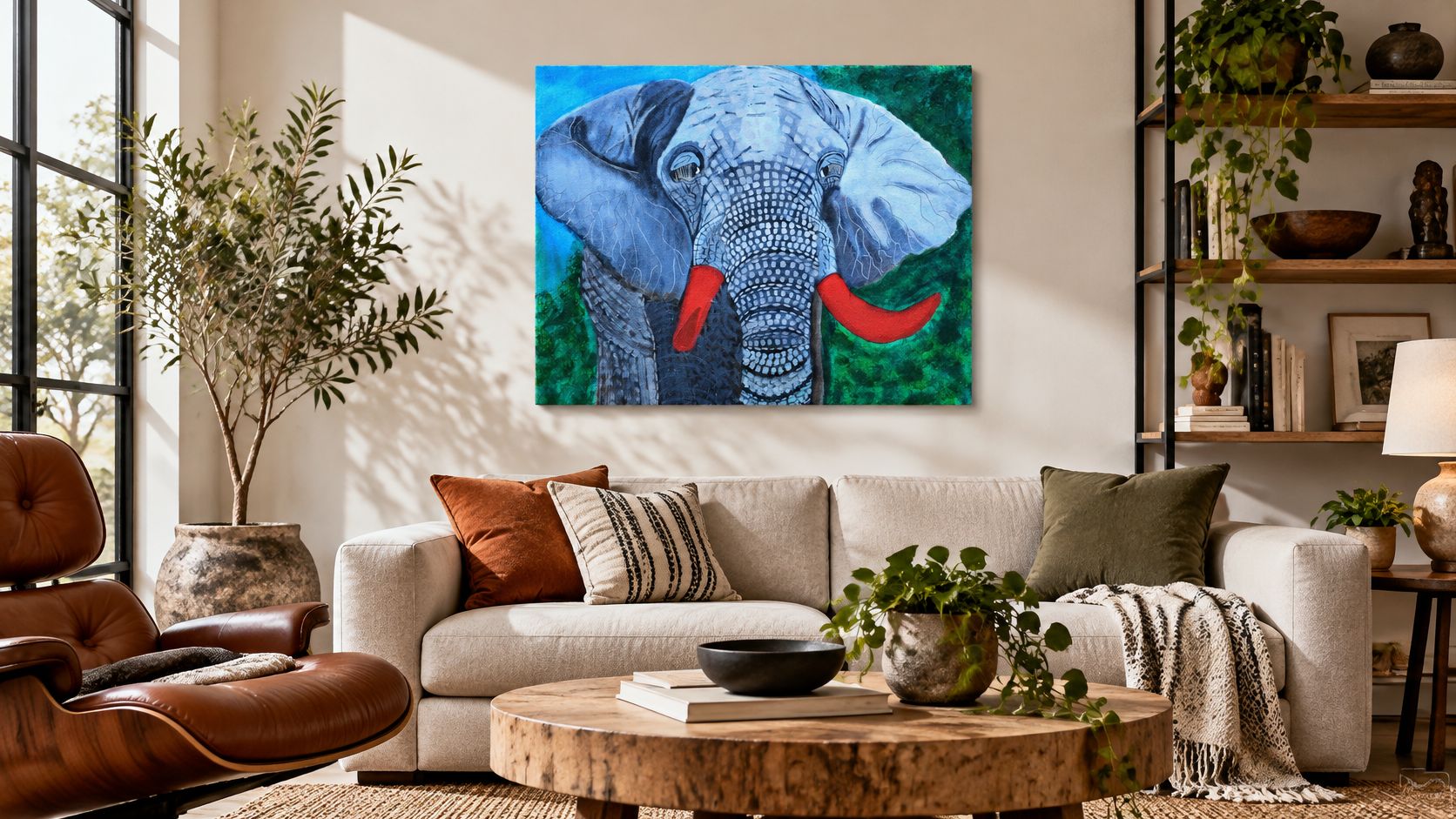
The William Tucker Wild Things Collection Endangered Animal Wall Art - Red Ivory offers a concrete starting point for someone collecting around endangered animals. The Wild Things Collection includes lions, tigers, elephants, butterflies, and more.
Collecting by artist means following a maker's work over time. Decide what you want to observe, such as changing approaches to natural scenery. That gives each acquisition a reason beyond the familiar signature.
For a medium-based collection, name the process or material that interests you. Knowing the difference between art prints and original artworks helps you decide whether your focus is printmaking, reproductions, paintings, or another form. A shared label can cover works made in different ways, so check how each piece was produced.
Decide which rule wins
A period collection needs a stated era or movement and a reason for that boundary. “Contemporary” can be a starting point, but its meaning shifts over time, so make your own selection rule clear.
With geographic collecting, choose whether the artist's location or the depicted place matters most. A Louisiana artist painting another country and a visiting artist painting a bayou would fit different rules.
A purpose-led collection names who the works are for and how they will be used. Art gathered for teaching about habitats may call for information that a private memorial grouping does not.
You can combine approaches when the connection remains easy to explain. Wildlife by living regional artists gives you two tests for each possible purchase: does the subject fit, and does the artist fit? Choose which rule matters more when a work meets only one.
How to Curate with a Simple Policy
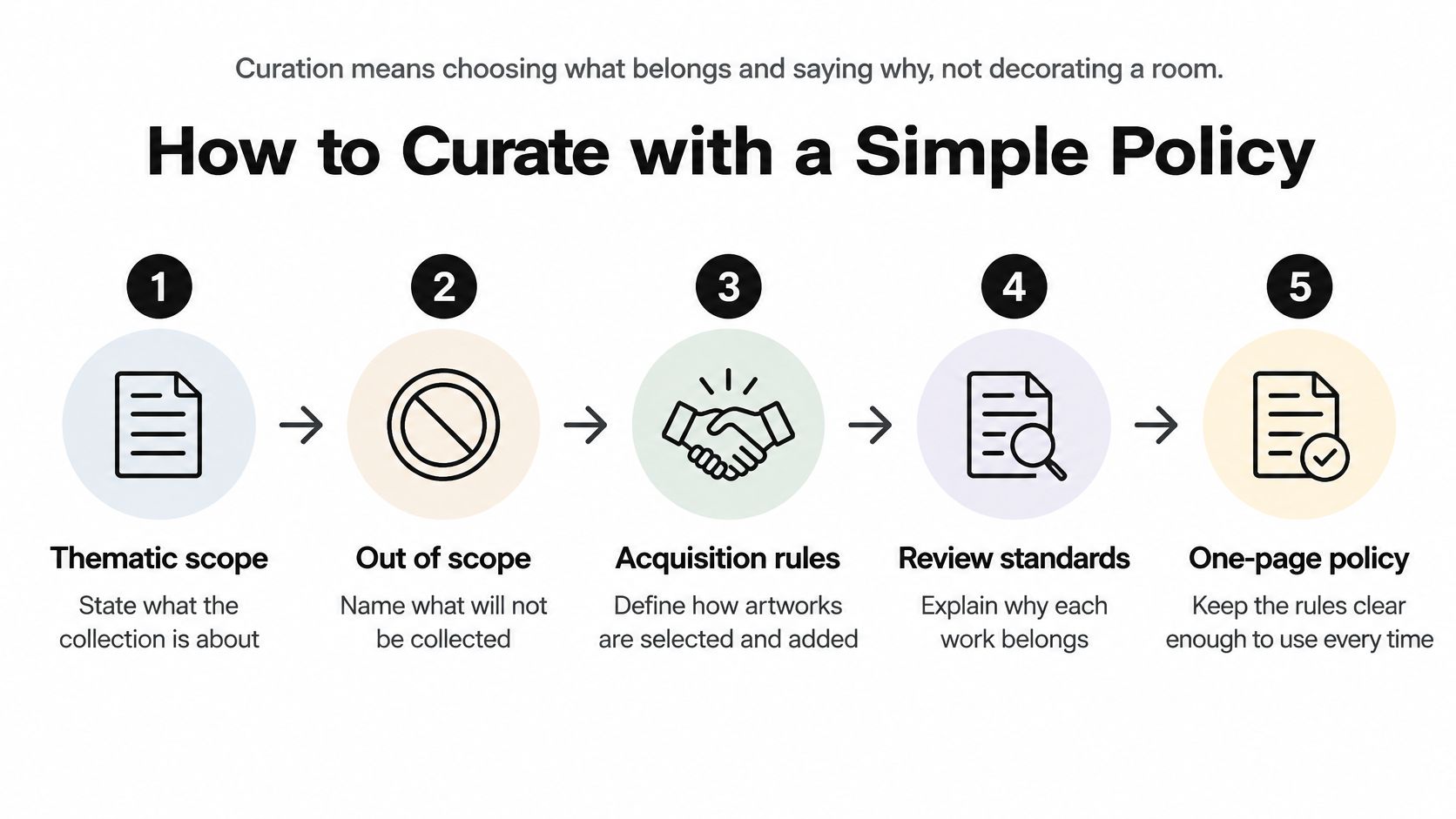
Curation means choosing what belongs and explaining why. Decorating asks how art works in a room. Curation asks how each work contributes to a connected group, whether displayed, stored, or loaned elsewhere. That connection can come from a place, species, memory, or living artist. A collection's meaning comes from its relationships and the care given to it, not its size or price.
A private collection policy can fit on one page. State its scope, exclusions, acquisition criteria, intended audience, and long-term purpose. These reminders describe what you want your collecting to accomplish. They also make decisions easier when a beautiful work is tempting but does not fit.
Turn an interest into usable decisions
- Name the scope in a sentence. For a coastal focus, you might write: “I collect depictions of Gulf wildlife and habitats to preserve my family's connection to the coast.” Say whether the collection is for your household, future heirs, or visitors.
- Set three yes-or-no tests. Does the subject fit? Does the work show the quality of making you value? Can you obtain a clear record of its maker, materials, and acquisition? Make quality observable by looking for purposeful composition and controlled handling of the medium.
- Pause when an impulse purchase fails two tests. An abstract work may appeal to you, but a sale price does not give it a coastal connection. If you still want it, buy it separately rather than stretching the collection's scope to justify the choice.
- Write why each acquisition belongs. A note that a marsh scene introduces nesting habitat explains its role more clearly than “I liked the colors.” Keep the reason specific enough for someone else to understand.
- Review the group regularly. Look for missing perspectives, not empty wall space. A collection may include many charismatic animals but few works showing the habitats they depend on.
Keep the policy nearby when considering a purchase. Use it as a simple test: can you explain how this work fits, and what it adds?
Give each artwork a retrievable identity
The International Council of Museums' Key Concepts of Museology describes collections management as legal, ethical, technical, and practical work that includes assembling, organizing, researching, interpreting, and preserving collections. A home collector can adopt the same care without turning a household into a miniature museum.
Give every work a stable identifier. Use it in your spreadsheet, image filenames, and document folders. A consistent label helps you find the right record even after an artwork moves.
Keep the detailed object fields together in your catalog. Record missing information as unknown, and distinguish an artist's statement from your own interpretation. This makes the catalog useful for insurance, loans, exhibitions, or later valuation. It also lets another person understand what you assembled and why, rather than seeing only a list of purchases.
Provenance Condition and Lasting Value
Provenance is the documented history of an artwork's creation, ownership, and custody. It helps readers assess authenticity, lawful title, and cultural heritage. A clear record also lets you distinguish what is documented from what is only believed.
A receipt from the artist can establish the beginning of your ownership history. For an older work, useful evidence may include earlier invoices, exhibition records, or correspondence. Keep the document and note what it supports. If you need help assessing a work, art authentication services can offer a route to further guidance.
Make the record useful to someone else
The ICOM Code of Ethics sets out principles for stewardship, including acquisition, documentation, protection, conservation, risk assessment, and responsible access. At home, focus on the evidence that explains how a work came to you and what has happened to it since.
Provenance evidence to keep
| Record | What to capture | Why it matters |
|---|---|---|
| Purchase document | Invoice, receipt, or bill of sale | Shows when and from whom you acquired the work |
| Prior ownership | Names or records of previous owners, when known | Helps trace the work's ownership history |
| Exhibition record | Exhibition name and any related documentation | Adds a dated record of the work's public history |
| Correspondence | Relevant messages with the artist, seller, or previous owner | Preserves claims and details connected to the work |
Keep digital copies somewhere other than the device used to photograph the artwork. Choose a folder that an heir or insurer can find and open; records only help when they remain accessible.
Prevent damage before arranging treatment
When a work arrives, photograph its front, back, signature, labels, and any existing damage. Repeat the check after transport, reframing, display changes, or treatment. Describe what you see, such as a lifted corner, without guessing at its cause.
Stable, material-appropriate conditions help protect artwork. Avoid damp walls, direct sunlight, heating vents, and abrupt environmental changes. Watch for dust, pests, loose hanging hardware, and signs of moisture behind frames.
For online purchases, retain certificates, invoices, edition details, artist statements, image metadata, and care notes. Before the work arrives, establish how it should be hung, stored, framed, and protected from light. These details connect its history to its ongoing care.
Materials shape how we interpret art, too. Comparing painted floral forms with natural mineral structures can add another thread to a collection's visual story. For instance, you can explore concentric amethyst flower patterns through Astro West. Record a mineral specimen and a painting separately, since each has distinct materials and care needs.
Could someone identify what you own if the artist became unreachable and your original invoice disappeared?
Use that question as a confidence test. Record gaps, protect the evidence you have, and make it easy to retrieve. A collection's lasting value includes the knowledge and care that let others understand its works.
How Real Collectors Build Over Time
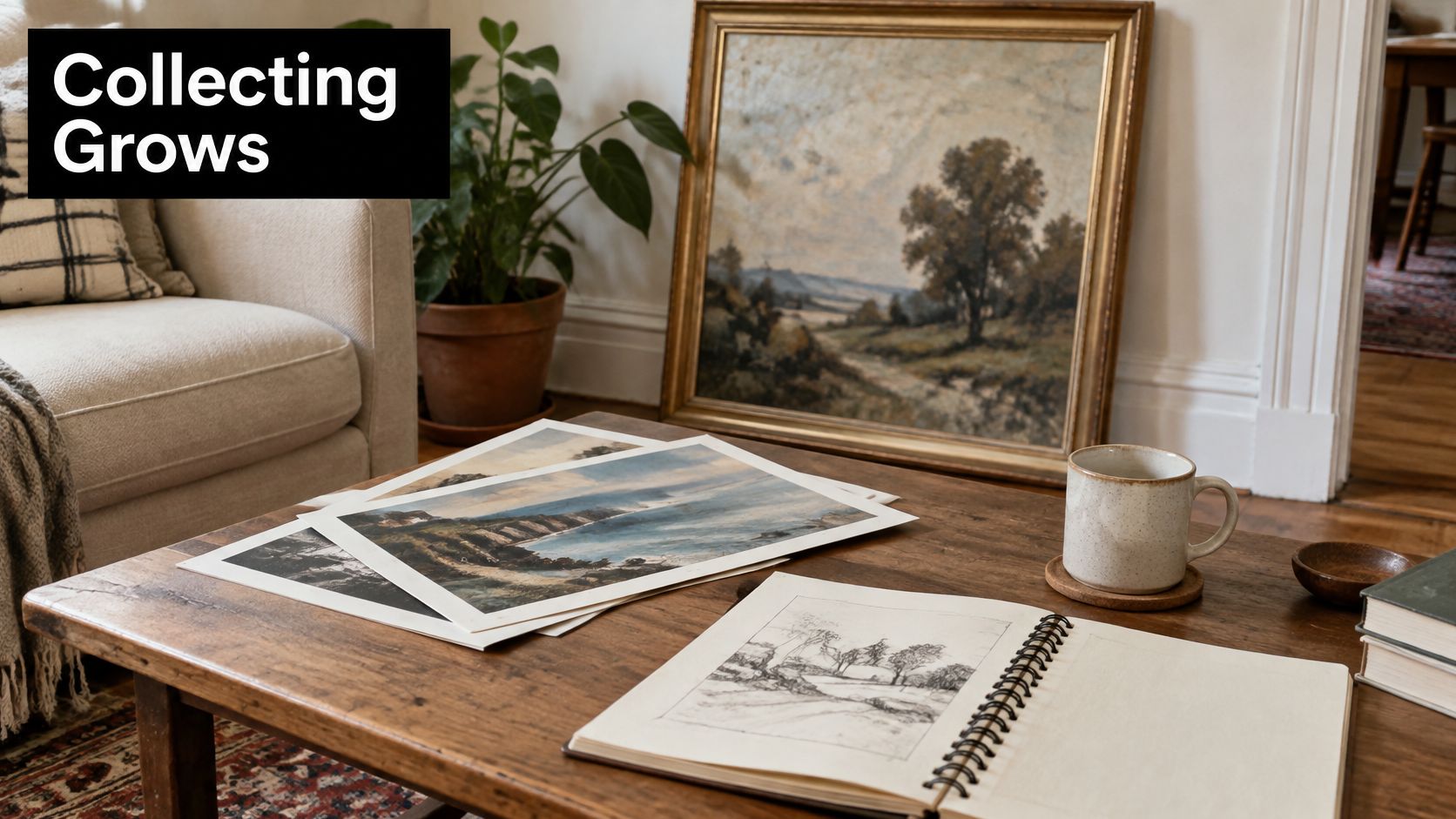
What makes a group of artworks feel connected as it grows? The answer is intention, supported by records and care, not a particular size, price, or investment goal. A collection can take shape around a place, a species, a memory, or an artist whose work you want to follow.
The Art Basel and UBS global market analysis estimated 40.5 million art-market transactions in 2024, up 3%, while sales fell 12% to approximately USD 57.5 billion. These figures describe the wider market, not a target for personal spending. They also show why transaction counts and total sales should be read as different measures.
Collecting can begin at home, with the simple act of comparing works and noticing what links them.
Art market figures at a glance
| Indicator | Value | Context |
|---|---|---|
| Art-market transactions 2024 | 40.5 million | Up 3% from 2023 |
| Global art market sales 2024 | USD 57.5 billion | Down 12% from 2023 |
| Global art market sales 2025 | USD 59.6 billion | Up 4% from 2024, according to the Art Basel and UBS report summarized in Ecclesiastical's art market review |
| Paintings share of collector holdings 2024 | 26% | Share of works held by surveyed collectors, according to UBS's Survey of Global Collecting |
Survey findings describe the collectors who took part, not every household with art. Use market reports as context for how art circulates, rather than as a measure of whether your own group qualifies as a collection.
Different routes into a lasting group
Direct buying gives you the chance to learn how an artist makes decisions. Ask what changed between related works and which materials the artist used. Over time, those answers help you see connections that a quick glance might miss.
Inheritance begins with another person's choices. Preserve names, relationships, and family recollections, and distinguish what can be documented from what remains uncertain. A work can carry family meaning even if it does not match the focus you are developing.
A collection can also grow from a question. For help putting your motivation into words, personal statement advice for foundation art applicants offers a writing exercise you can adapt. Explain what catches your attention and why it matters; the aim is clarity, not an application.
Consider a hypothetical five-work coastal collection assembled over two years: a marsh scene, a bird study, a shoreline photograph, a working-waterfront print, and a drawing connected to a storm memory. Record each work when it arrives, including why it belongs. When you look at the group together, you may notice that the missing perspective is underwater, rather than another appealing sunset.
A practical test is to name the relationship among the works in one sentence. If that sentence helps you decide what to seek, keep, or pass over, it is already guiding the collection. Documenting those choices makes the thread easier to follow as the group changes.
Works may later pass through donation, exhibition, inheritance, or resale. Keep records and care for the objects while they are at home, so their context can travel with them.
Myths That Shrink the Idea of Collecting
Does a collection need to fill a room or carry a famous name? A collection takes shape through intentional relationships among works, the records that explain those relationships, and the care given to the objects. Size and price alone do not settle the question.
Four beliefs worth testing
- You need many works. A small group can invite close comparison. If a friend asked why these works belong together, could you explain the connection without counting the frames? A shared place, species, memory, or artistic approach may give a few pieces a clear shape.
- It must be expensive or investment-led. Purchase price is one detail, not the whole story. A modestly priced work can contribute a distinct idea, while a costly piece may sit awkwardly beside the others. Ask what you notice in the work and how it relates to your chosen focus.
- Only museums or famous names count. A private group centered on a family home, a beloved animal, or a changing neighborhood can have a meaningful purpose without institutional recognition. A gallery's permission isn't required, but a label alone isn't enough. The relationships among the works should be understandable.
- Buying is the whole practice. A work's arrival can begin the collecting, rather than finish it. Keep the artist's explanation, note the work's condition, and make time to learn what changes as you live with it.
The 2025 Art Basel and UBS Survey of Global Collecting describes high-net-worth collectors buying directly from artists, visiting studios, and seeking authenticity and personal context. These examples show how collecting can involve attention and relationships alongside transactions.
Investment doesn't replace stewardship
Financial motivation can be part of collecting. Clear records matter when resale is a consideration, because expectations about future value do not establish authenticity, ownership, or condition.
Emotional attachment also deserves honest records. A family story may be meaningful even when an attribution is uncertain. Preserve both the story and that uncertainty, rather than turning affection into an unsupported claim.
A collection is a selected, explained, and maintained set of works, whatever it cost.
A practical measure is whether another person can follow your choices. Explain what connects the works, keep records that support what you know, and care for each piece. That standard leaves room for a collection built slowly, around interests that matter to you.
Choose a Focus and Start Collecting
What would make one artwork feel at home beside another? A shared subject, place, artist, or personal memory can provide the connection. A collection might begin with a coastal habitat, animals, or portraits of pets who share your home. Its meaning comes from the relationship between the works and the care you give them, not from size, price, or investment goals.
Make the focus workable
Choose a subject that leaves room to grow while still helping you decide what belongs. For prints, build a collection of iconic prints can be one way to explore a format that suits your interests. A print or an original can both fit a collection when it connects to the idea you are developing.
Set practical limits before browsing, including what you can spend on framing and care as well as on art. This guide to starting an art collection on a budget offers ideas for making a collection fit your circumstances.
A first commission can bring a personal subject into the collection. William Tucker Art offers commissioned pet portraits based on photographs and reference information supplied by the client. The finished painting is the artist's interpretation of the pet, rather than a mechanical copy.
Ask how a work is made, too. William Tucker builds depth and texture with multiple layers of acrylic paint, brushstrokes, and transparent glazes. Learning about the technique helps you notice the artwork's surface and understand what makes it distinctive.
Put the intention into practice
- Choose a starting point. Select an artwork or commission that connects to your subject and interests.
- Keep its record. File the invoice with a photograph of the work's condition when it arrives.
- Explain its place. Write a short note about what the acquisition adds to the collection.
These small habits give each piece context and make the collection easier to understand over time. You can explore wildlife art, Louisiana coastal imagery, and commissioned pet portraits at William Tucker Art, and consider which subject or place feels meaningful enough to return to.