
The global pet-clothing market reached USD 2.2 billion in 2025 and is projected to hit USD 3.2 billion by 2033 at a 4.6% compound annual rate from 2026 to 2033, according to Grand View Research. Dogs generate most of that revenue, apparel takes the biggest product share, and North America leads regional demand. That scale explains the sheer number of dog sweatshirts on sale. It says nothing about which ones hold up.
A sweatshirt with dog artwork works as wearable art when the print survives ordinary washing and the dog still looks like that dog after the first month. Soft inks that fade, stiff plastisol that cracks, and faces that turn generic at a glance all fail the same test. Check the print method and the likeness before you check the size chart.
Why Dog Sweatshirts Sell and Which Design to Choose
Start with why you will wear it. That reason picks the artwork, and the artwork later picks the print method.
Four buyers show up with the same two questions: will the print survive wear, and does the dog still look like the dog?
Owners after a tribute want their own dog, including a dog who has died or a rescue whose coat changed with age, grooming, or adoption. Gift buyers want a message without turning the animal into a punchline. Travelers want a place in the picture, a street, a marsh, a trail. Collectors want original art that happens to be wearable. William Tucker is known for depicting endangered animals, so wildlife-minded buyers often want that same seriousness on fabric, not a slogan tee.
Chewy reported that searches for "matching dog and owner outfits" became a breakout topic in its 2025 trend report. Other 2025 market notes point to more breed-specific designs and more interest in sustainable textiles. Treat those notes as directional. A breed label is not a portrait, and a matching set is not automatically good art.
Four ways to draw the dog
Abstract ground, detailed face. A loose field of color behind a careful head reads across a room. It suits gifts and everyday wear, and it stays honest when the dog's body changes but the face does not. This is the approach that fits wildlife-minded buyers who want wearable art. If you are comparing how a finished piece should look on a model before you commit, tools that create fashion product images with AI help you judge scale and placement, not replace the drawing.
Close facial portrait. This carries the most personal weight. It needs a sharp reference and a print method that can hold fur, eyes, and soft shading. It fails when the photo is dark, filtered, or shot from across a yard.
Dog in a place. Put the animal in a park or a street and you have a souvenir or a conservation piece. Detail lives in the setting as much as in the coat, so the composition has to stay simple enough that the dog is still the subject.
Silhouette. Bold, limited color, easy to print, and kind to repeat orders. It will not satisfy someone who needs this specific hound's crooked ear. It will satisfy someone who wants a clean shape and no text.
Skip "dog mom" lettering if the wearer dislikes it. A memorial can be quiet: the face, a color the dog loved, no dates screaming across the chest. For a deeper look at turning a photo into a painted likeness first, see this guide to custom pet artwork.
Decision rule: Choose the design from the reason you will wear it. Take the print method from the comparison that follows, not from whichever process is cheapest on the product page.
Print Methods and Styles Compared at a Glance
The method sets the look, the hand-feel, and what you can expect after a year of washes.
| Print method | Best for | Detail and color | Trade-off |
|---|---|---|---|
| Screen printing | Bulk runs with bold, flat colors | Crisp solid shapes; one screen per color | Best cost per piece at volume; minimum runs apply |
| Direct-to-garment (DTG) | Detailed portraits, one-offs, small runs | Full color, soft shading, fine fur | Dark fabrics need a white underbase; can soften after many washes |
| Embroidery | Simple silhouettes and premium texture | Textured thread; limited fine detail | Durable and textured; slow and costly over large areas |
Screen printing pushes ink through a stencil, one color at a time. Edges stay crisp. A two-color hound on a solid ground looks intentional. A photographic face does not, because each extra color is another screen and another setup fee. This is the method for a silhouette or a flat graphic you will reorder.
Direct-to-garment (DTG) behaves more like an inkjet on cloth. It is the usual choice for a detailed face, a one-off tribute, or a small run. Dark shirts need a white underbase so the color does not sink into the fabric and go muddy. Very heavy ink can feel a little softer, and a little less sharp, after many washes. That is normal, not a failed portrait.
Embroidery stitches thread into the garment. It lasts, it looks premium up close, and it cannot do photographic fur. Use it for a bold outline or a small mark. A full-chest stitched portrait gets slow, stiff, and expensive, and the dog turns into a cartoon of stitches.
What the style does to the art
A crewneck gives you the full chest. That is where a face belongs.
A hoodie crowds the upper front with the hood seam and drawstrings. Keep the dog lower and simpler, or the hood will cut the ears.
A zip-up splits the picture down the middle. A centered face lands on the zipper. Shift the dog to one side, or use a silhouette that can break cleanly.
Sellers who build a whole shop around one garment can study how others explore one-product shops with Skup before they lock a method that only works for a single colorway.
Match the detail in the artwork to the method, then check the style's print area before you pay for a sample.
Fabric Weight and Comfort for Real Wear
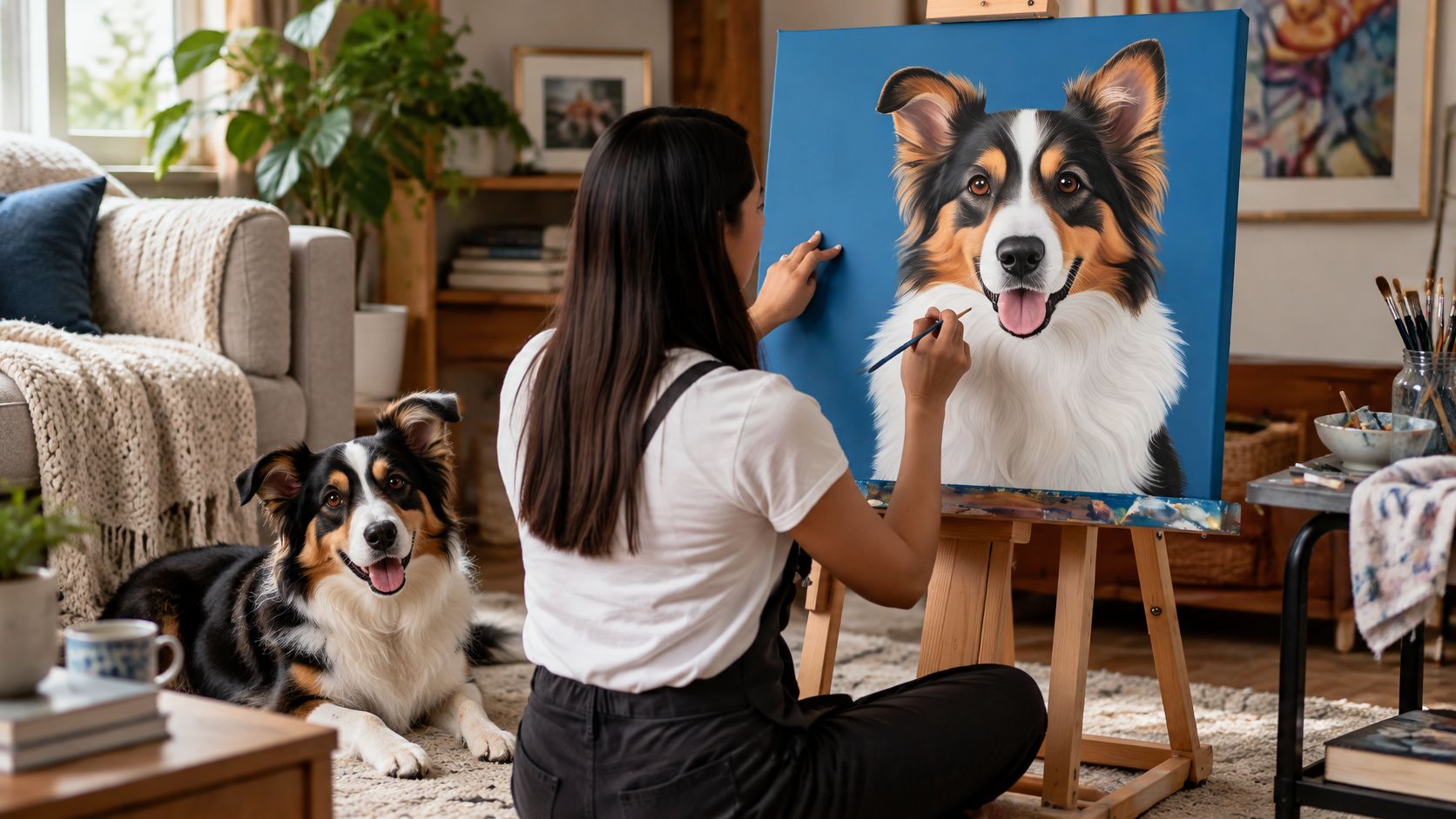
Comfort in a sweatshirt splits into two jobs that pull against each other. The fabric has to hold warmth when you are standing at a trailhead, and it has to let vapor out when you climb the hill. Dense fleece does the first and fails the second, which is why a heavy brushed pullover leaves you warm and damp at once on a heated train.
Fabric weight in grams per square meter predicts that balance better than any adjective on the label. Two shirts sold as "midweight" can sit far apart on that scale, and the heavier one runs warmer and holds moisture longer. Then read the inside finish. Brushed loops trap air and hold sweat against the back of a print. A smooth or lightly looped terry face releases both faster.
How the common fabrics wear
| Fabric | Best use | Trade-off |
|---|---|---|
| Lightweight French terry | Layering, indoor wear, spring | Breathable but less warm |
| Midweight cotton-polyester fleece | Daily walks, travel, mild weather | Balanced warmth and vapor release |
| Heavyweight brushed fleece | Cold climates, outdoor use | Warmest, but can feel clammy during exertion |
| Organic cotton blend | Soft everyday wear | Weight rarely published; check the listing |
French terry has loops on the inside and a smoother face. It layers over a tee and does not cook you indoors. It will not carry you through a windy evening.
Midweight cotton-polyester fleece is the daily driver. Cotton takes up moisture, polyester helps the shirt dry and hold its shape. This is the blend I would pick for travel and mild-weather walks when the art, not the insulation, is the point.
Heavy brushed fleece wins on a cold day and loses as soon as you move hard. The brushed inside traps sweat against the back of the print. Save it for standing around outside.
Organic cotton blends feel soft, and brands rarely print one standard weight. Read the grams per square meter, then compare two shirts by that number rather than by the word organic.
Reading the spec before you buy
Look for fabric weight in gsm, ribbed cuffs and a ribbed waistband that recover after a stretch, and whether the inside is brushed or smooth. Ribs that are thin and loosely knit bag out at the wrists and make a careful chest print look sloppy.
If the inside feels clammy within a short walk, drop to a lighter knit or a cotton-rich blend and save the heavy fleece for cold, low-effort wear.
Breathability also protects the picture. A shirt that leaves you damp gets washed more often and dried hotter, and repeated heat is what softens a printed face and blurs the fine edges around the dog's ears. Pick a knit you can wear without sweating through it, and the portrait holds its detail at arm's length for longer.
Sizing Chart for Dog Sweatshirts
A label letter is not a measurement. Two brands can call the same 40-inch chest a medium and a large, and the dog portrait lives or dies by where it lands on your torso.
Measure with a soft tape around the fullest part of the chest, under the arms, keeping the tape level all the way round. Do not pull it tight. Write the number in inches and centimeters, then set it next to the brand's own chart. The ranges below are typical for unisex adult cuts. They are not a substitute for that chart.
| Size | Typical chest (in) | Fit note |
|---|---|---|
| XS | 32–34 | Close fit; check room for layering |
| S | 35–37 | Slim; suits a shirt underneath |
| M | 38–40 | Standard fit; most common choice |
| L | 41–43 | Relaxed; good for layering |
| XL | 44–46 | Roomy; artwork sits lower |
| 2XL | 47–49 | Oversized; check print position |
| 3XL | 50–52 | Very roomy; confirm with brand chart |
One garment, measured
A midweight cotton-poly crew in size M with a 40-inch chest is the reference point I use when judging a chest print. The art lands across the sternum, the dog's head sits near collarbone height, and at that width the whole face reads cleanly from arm's length. Move up to a 46-inch chest and the same artwork sits lower and covers a smaller share of the fabric. The ears and the eye markings are the first details to go soft at that scale.
Between sizes, and what that does to the dog
Pick the larger size if you will layer over a shirt or wear the piece on long walks. Pick the smaller size for a close, clean fit.
The art sits on the chest. An oversized body drops that art lower and can make a detailed face look small, because the same print is now a smaller share of a wider shirt. A snug body keeps the face centered and large. It can also pull across the ink, which stresses a stiff screen print more than a light DTG print. If the design depends on fine markings, lean toward the size that lets the print sit flat rather than the one that stretches it.
This shirt is sized for the person, not the dog. Matching outfits need a separate measurement for each wearer. A child's chest and an adult's chest are not "the small and the large of the same cut" unless the listing says so. Confirm whether the listing is a unisex or a women's cut before you map your number onto it.
Before you order:
- Measure the chest with the tape level and the shirt you are wearing thin.
- Compare that number with the brand chart, not with a size you already own from another label.
- Confirm the cut, unisex or women's, and where the print will land.
- Read the return terms so a wrong chest is an exchange, not a lost portrait.
How to Order a Custom Pet Sweatshirt Step by Step
A custom sweatshirt with dog art fails in predictable ways: a soft photo, a rights gap, or a print method too coarse for the face. The sequence below blocks those failures in order.
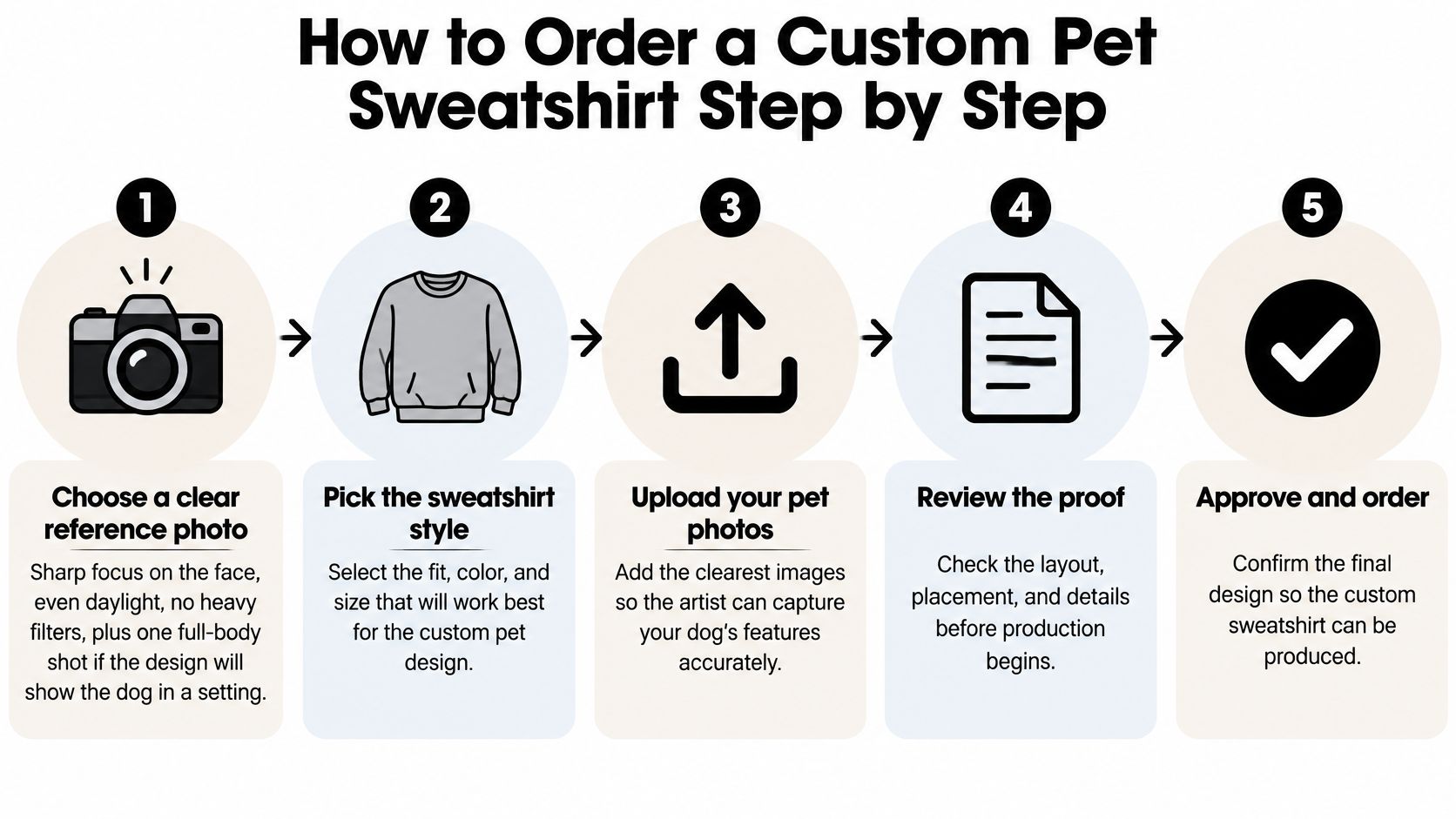
- Choose a clear reference photo. Sharp focus on the face, even daylight, no heavy filters. Add one full-body shot if the design will place the dog in a setting. A dark evening snapshot hides the markings you care about, and no printer can invent them later. For what makes a usable reference, read these notes on dog portrait photos.
- Send the photo with the style and size you want. Pet portrait reference photos can be sent by email attachment or by text to 910-273-2420. Name the sweatshirt style in the same message so the print area is part of the brief, not an afterthought.
- Describe the dog. Breed or mix, age, markings, personality, and any story you want kept. A pet portrait is the artist's interpretation of the subject, based on the pictures and information you provide. Say what must stay true, such as a white blaze or one folded ear, and what can be simplified.
- Confirm rights before any apparel use. This is a step often skipped. William Tucker Art holds the full copyright and reproduction rights to pet portrait paintings, so get written agreement before that painting goes on a shirt. A canvas commission is not automatic permission to print fabric. Commissioning a portrait also means agreeing to the terms in the Pet Portrait Order Agreement. A $50 non-refundable deposit starts the commission; final payment is due on delivery, and payments can be made online at williamtuckerart.com. If you want the painted portrait underway first, a William Tucker Art Personalized Pet Artwork Deposit starts that commission.
- Use the print-method comparison earlier in this guide. Pick a method that holds the face at arm's length, and skip embroidery for photographic fur.
- Check size and placement. Use your chest measurement, confirm unisex or women's cut, and mark where the design should sit so a hoodie seam or a zipper does not cut the head.
- Approve in writing before production. Review the proposed design, agree the print method, and say yes in writing. Changes after ink hits fabric are a new job, not a tweak.
The short video below walks through how a reference and a layout get checked before anyone commits to a run.
Each step prevents one ordinary mistake. A blurry photo cannot be sharpened into a likeness. An unclear rights note stalls the shirt after the painting is done. A coarse method turns fine fur into blobs. Lock those three, and the rest is fit and care.
Care and Safety Checks That Protect the Print
You wear this against your skin for hours, often over only a T-shirt. Safety is about the finished garment, not a single nice ingredient.
OEKO-TEX STANDARD 100 tests finished products and components, including yarns, dyes, buttons, and accessories, against more than 1,000 potentially harmful substances. Requirements get stricter as skin contact increases. Ask for certification of the whole sweatshirt, including the print system, not just a claim that the cotton is organic or the ink is water-based. One certified roll of fabric does not cover dyes, finishing agents, plasticizers, or trims that touch you all day.
Wash, dry, and iron by method
| Print method | Washing | Drying | Ironing |
|---|---|---|---|
| Screen printing | Inside out, cold water, mild detergent | Tumble dry low or hang dry | Iron inside out, never directly on the print |
| Direct-to-garment (DTG) | Inside out, cold water, no bleach | Tumble dry low or hang dry | Iron inside out on low heat, using a cloth |
| Embroidery | Inside out on a gentle cycle | Tumble dry low; avoid rough tumbling | Press from the back with a damp cloth |
Screen-print and DTG inks crack or fade when you use high heat, bleach, or harsh detergent. Embroidery thread holds color well and snags when it tumbles against zippers and towels. Turn printed shirts inside out, skip bleach on every method, and dry flat or on low. Iron from the back, with a cloth between the iron and a DTG print.
A well-cared-for print should keep its color and its edges through many washes. Cracking that follows a hot dryer is a care problem. Fading that shows up on a brand-new shirt, before any wash, is a production problem. Tell those two apart before you blame the drawing. If the dog still looks like the dog and the edges are intact, the design was fine. The laundry was not.
Choose Ready-Made or Custom Before You Order
Start with the job, then order one piece that matches it. Lock the print method first. Every later choice, from blank to fit, gets easier once you know whether the art needs screen printing, DTG, or embroidery.
Everyday and playful. A ready-made sweatshirt with a screen-printed or DTG graphic is usually enough. Size it from your chest measurement, and prefer a shirt certified for skin contact. You do not need a commission to wear a well-drawn hound to the grocery store.
A specific dog. Start with the artwork. The amount of detail decides the print method, and only then do you pick crewneck, hoodie, or zip, and a fabric you will keep on. A fine line or a brindle pattern tends to need DTG; a bold silhouette can survive screen printing. Pet portraits are offered as commissions in the Pet Portraits collection. A pet portrait requires a $50 non-refundable deposit to start. Final payment is due upon delivery, and payments can be made online at williamtuckerart.com. That sequence lets you budget the painting before anyone talks about blanks and ink.
A gift for a stranger's dog. Skip the commission. Without a clear reference photo, a custom portrait is a guess, and a generic ready-made piece is the kinder gift. If you want related outfits for you and your dog, this guide to matching dog and owner outfits covers separate measurements for each body.
For wildlife, the catalog includes an animal painting such as the Pelican Portrait. Prints are available alongside original paintings. That piece is wall art. Use it to judge the standard of likeness before a design reaches fabric: the bird has to read as a bird at arm's length, just as your dog has to read as your dog.
Sellers planning a small drop of one dog design, rather than a one-off tribute, can map timing and blanks with these merch launch workflows for ecommerce sellers. A drop still needs the same rule: bold art for screen printing, a real face for DTG, and a print area the style can hold.
One rule settles the order: after one gentle wash, look at the shirt from arm's length. If the dog still looks like the dog and the print edges are intact, you chose the right route. If the design only works in a product photo, it is not ready to wear.
William Tucker Art paints pet portraits and wildlife, including dogs rendered as wearable art rather than novelty graphics. If you want a likeness that still reads as your dog on a sweatshirt, start with a clear photo and a design you can live with after the wash cycle. Visit William Tucker Art to see the pet portraits and wildlife work and to begin a commission.