
The painting is on the table, the phone is beside it, and you keep looking from one to the other. The blaze is in the right place. The freckles on the muzzle are all there. So why does the dog in the painting look like a careful copy of your dog rather than your dog?
That gap is worth understanding. Realism in a dog portrait splits into two jobs, and only one of them is about copying a photograph. The other is about building a head that reads as alive: correct proportion, believable light, edges that describe fur instead of outlining it. When the second job is done well, the likeness tends to take care of itself.
Below are the features that carry realism, the science of how dogs see color, what makes a reference photo usable, the value work that sells a likeness, the commissioning steps and their costs, and how handmade portraiture differs from AI-generated pet images. Read it as a checklist before you commission anything.
What Realism Means in a Dog Portrait
An owner sets a finished portrait beside the photo it came from and waits for the click of recognition. Sometimes it doesn't come, even when every marking landed in the right spot. The piece is accurate and still doesn't feel like the dog.
That's because realism here has two meanings. The first is accuracy to the reference: the ear set, the blaze, the scatter of spots on one side of the muzzle. The second is truthfulness to the animal as a living subject, which a viewer reads through proportion, expression and light rather than through matching every pixel. The second meaning carries the first.
This isn't a modern commercial idea. Realistic dog portraiture has a documented history spanning at least 2,000 years, and the Wallace Collection's 2023 exhibition brought two marble Vertragus dogs dated to the late first century C.E. together with Rosa Bonheur's Brizo, a Shepherd's Dog from 1864, described in the Smithsonian's account of the exhibition as a lifelike and intimate portrayal of her French otterhound. Owners have always wanted an image that outlasts the moment, which is the same instinct behind weatherproof dog decals for trucks that keep a breed on a tailgate through rain, sun and highway miles.
Hold both meanings in view and the rest of the decisions, palette, reference photo, edges, budget, become much easier to judge.
The Realism Features That Matter Most
| Feature | What to check | Why it reads as real | Common miss |
|---|---|---|---|
| Proportion | Skull width and head-to-body ratio match the breed | Viewers recognize the dog at a glance | Breed stereotype averaging |
| Eyes | Lid shape and soft catchlights | Gives expression and life | Flat, glassy eyes |
| Nose and muzzle | Wet-looking nose with a soft highlight | Sells texture and light | Dry, matte nose |
| Fur edges | Broken, directional edges | Avoids a painted-on look | Uniform outlines |
| Value structure | Light-to-dark groups around the face | Keeps form readable at a distance | Even shading across every plane |
| Color temperature | Controlled warm and cool shifts | Stays stable under different lighting | Reliance on red-green contrast |
| Background | Clear separation from the subject | Keeps the silhouette sharp | Background competes with the fur |
| Expression | Ear, brow and mouth angles | Communicates personality | Generic happy face |
Proportion and value come first because they're the two things a viewer's eye settles fastest. You recognize a friend across a parking lot from posture and outline, long before you can see a face; the same shortcut applies to a dog on canvas. A portrait with a slightly narrow skull reads as "some dog" no matter how carefully each hair was rendered, while a correct, broad head shape forgives a lot of loose brushwork.
Fur texture is the last layer and the easiest to overwork. A dog's coat isn't a field of identical strokes. It changes direction at the cheek, the brow and the ear base, and it breaks into clumps where muscle pushes against skin.
Order of work: lock proportion, then value groups, then edges, then fur direction, then the small wet highlights on the nose and eyes. Reverse that order and you get detail that fights the structure under it.
If you want to train your eye on where a dog's likeness lives, the Setterfrens beginner sketching guide breaks the head into skull and muzzle masses, which makes it easier to judge proportion in a finished portrait.
The step-back test
Walk six feet away, or turn the canvas toward a mirror. If the dog is still recognizable and its expression is still clear at that distance, the portrait is working. If the face goes vague, the problem is almost always value structure rather than missing fur detail.
How Dog Vision Shapes Color Choices
A dog won't see your painting the way you do, and that fact turns out to be useful rather than sentimental. A peer-reviewed Royal Society study found that dogs have dichromatic color vision, with two cone types whose spectral sensitivities sit near 429 nanometers and 555 nanometers, and a second experiment in the same paper, run with eight previously untrained dogs, showed color information outweighing brightness when the animals chose between stimuli that differed in both (Royal Society Open Science). In practical terms, dogs sort blue and yellow information far more reliably than red and green, and they lean on hue even when brightness changes.
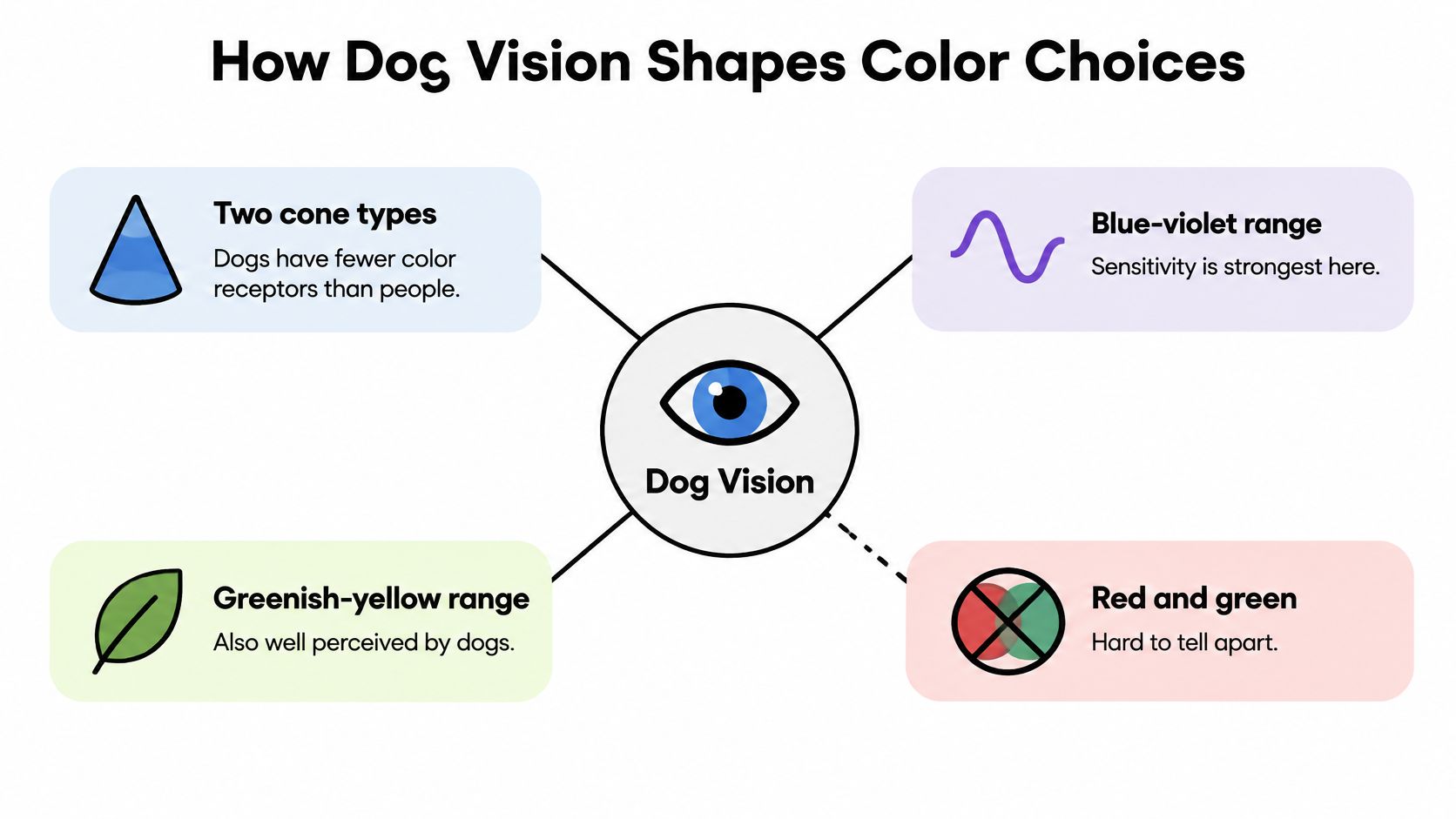
That's a strong signal about where color decisions deserve weight. Consider how you would design a sign that stays readable under streetlights and in daylight: you build the message around the contrast that survives every condition, then let finer color differences do the decorative work.
What that means on the easel
Say you're painting a warm brown retriever against a green lawn. To a human the two separate cleanly, because hue carries the difference. Shift the background toward a cool blue and add a clear value step, and the dog's outline survives even in a dim hallway where color has almost nowhere to go. Background choices in pet portraits carry much of that load, so the backdrop deserves the same planning as the head.
Quick check: reduce the saturation on a digital proof of the portrait. If the eyes, muzzle and facial planes still read, the image isn't leaning on fragile hue differences.
Paint for human eyes, which judge the portrait in a human room. The science hands you a sturdier palette: blue-yellow separation where you need a clean edge, value steps that don't depend on red against green, and temperature shifts doing work that hue alone can't. Those choices read as realistic to a viewer because they mirror how form holds up in changing light.
A restrained palette often ends up the more defensible choice and the more striking one. Maximum color is not automatically maximum realism.
Picking a Reference Photo That Works
| Criterion | Strong reference | Weak reference |
|---|---|---|
| Lighting | Soft, even light with visible catchlights | Harsh flash or deep shadow |
| Focus | Sharp eyes and face | Motion blur or soft focus on the eyes |
| Resolution | Large, uncompressed original file | Heavily compressed screenshot |
| Angle | Head at eye level, three-quarter view | Looking down from above |
| Expression | Relaxed and natural, ears in a typical position | Mid-blink or mid-sneeze |
| Coat detail | Texture and markings clearly visible | Coat washed out by overexposure |
| Background | Plain or easy to separate from the dog | Busy clutter behind the head |
The photo sets the ceiling on the finished portrait. You're responsible for supplying the photographs and other reference materials a portrait is built from, and the artist interprets what you send, so a blurry or heavily compressed file narrows the result no matter how skilled the brushwork. Send originals whenever you can.
Getting a usable photo in five minutes
- Use window light: stand your dog a few feet from a window in the morning or late afternoon, with the light coming across the face rather than straight into it.
- Get down low: crouch or sit so the camera is at eye level. A photo taken from standing height flattens the muzzle and lengthens the body.
- Shoot a burst: take ten or fifteen frames in a row. One will catch the ears relaxed and the eyes bright.
- Skip the flash: direct flash kills catchlights and flattens the planes you want to see.
- Don't crop on the phone: leave space around the head so the artist can judge the neck and shoulder line.
How to send them
Email attachments keep the file size and resolution intact, which matters more than expected. Pet portrait reference photos can be sent by email attachment or by text to 910-273-2420. If you're comfortable with the process, these notes on dog portrait photos cover what makes a shot easy to paint from.
Before you hit send, run the self-check. Can you see the dog's eyes clearly at full size? Does the coat show texture without blown-out white patches? If both answers are yes, the file is ready.
Value, Edges and Fur That Sell the Likeness
A black dog can still look alive in a portrait if the brow, muzzle and eye are separated by light instead of by outline. That is the test a likeness has to pass for a human viewer: the head reads quickly, the eyes look wet, and the fur breaks where it meets the air.
The image below is a shop product preview rather than a lighting reference, so judge the painting advice against the photo you supply.
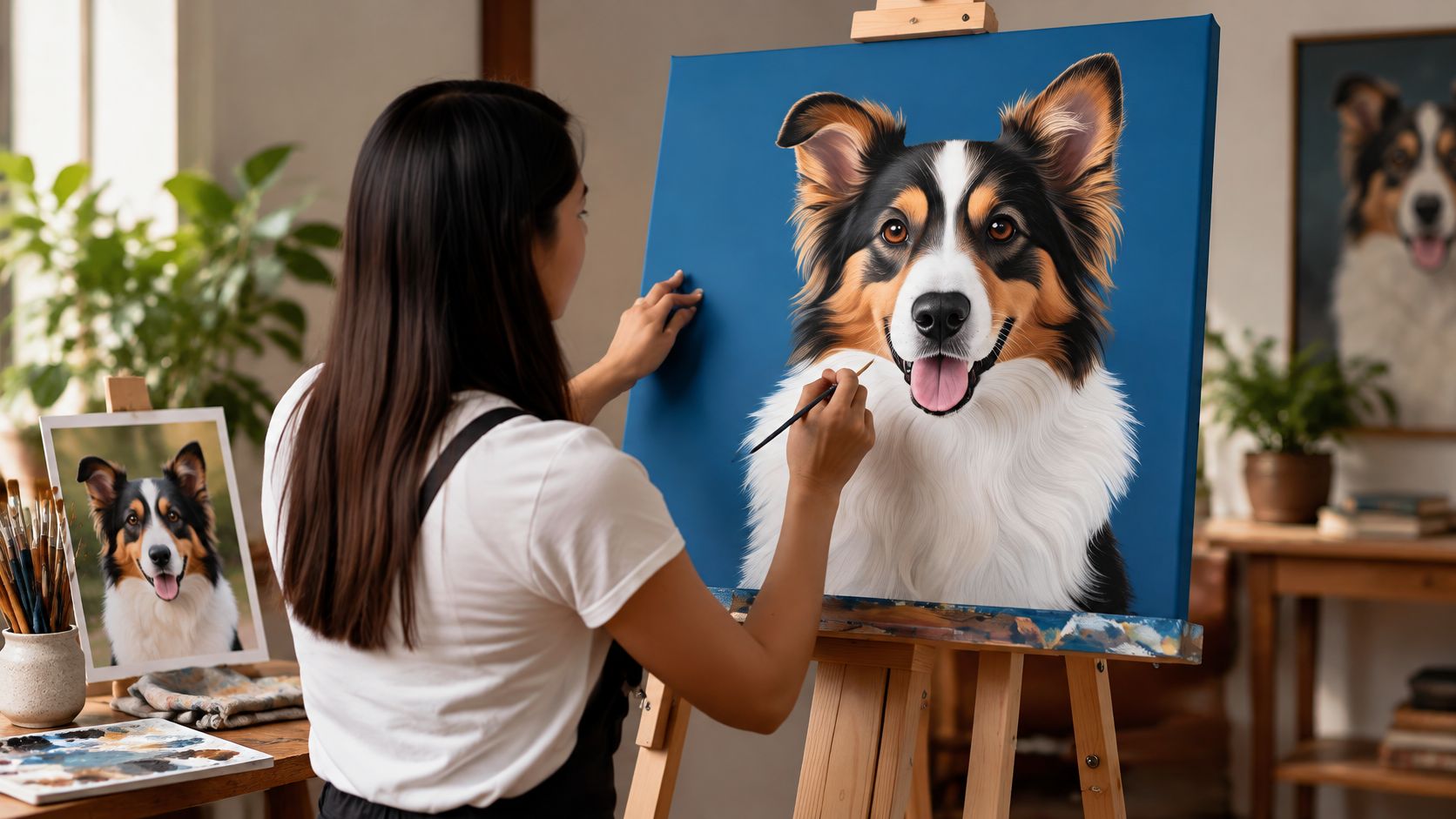
Veterinary ophthalmology sources estimate typical canine visual acuity at about 20/75 and describe canine brightness discrimination as roughly two times poorer than in humans (VIN veterinary proceedings). Those figures describe the dog, yet they underline why a portrait has to be truthful in value: fine hue differences are weak cues for shape, so value carries the form.
A five-step pass that fixes most weak likenesses
- View the reference in grayscale. Strip the color out and the head either holds together or it doesn't.
- Find the largest value groups. Group the face into three or four zones, not twenty. Forehead, cheek plane, muzzle front, shadow under the jaw.
- Preserve those relationships in the paint. If the muzzle is the lightest zone in the photo, keep it the lightest zone on the canvas, even if the local fur color seems darker to you.
- Save sharp highlights for wet surfaces. The cornea and the nose take crisp, high-value accents. Fur never does.
- Soften and break the outer edges. Hair against background should dissolve in places, with directional strokes at the contour rather than a continuous outline.
One worked example
Take a black-coated dog with a pale muzzle. The tempting move is to shade the whole face evenly and turn the contrast up at the end. The stronger move sets the muzzle and the brow ridge as the lightest zones from the first blocking pass, lets the black coat stay deep and flat in shadow, and uses the catchlight in each eye as the brightest note on the canvas. That portrait will read from across a room and under changing light, because the structure is in the values rather than in the fur.
When the values are right, small fur marks can stay loose. A few strokes in the direction of growth suggest length; a broken edge at the cheek keeps the head inside the light instead of pasted onto it. More techniques for building a head this way are collected in these notes on painting animal portraits. Keep the test simple: squint, remove the color, then look for a bright eye inside a believable head.
How to Commission Your Portrait Step by Step
A commission moves fastest when you know what the artist needs at each stage, so here is the order it follows and the reason behind each step.
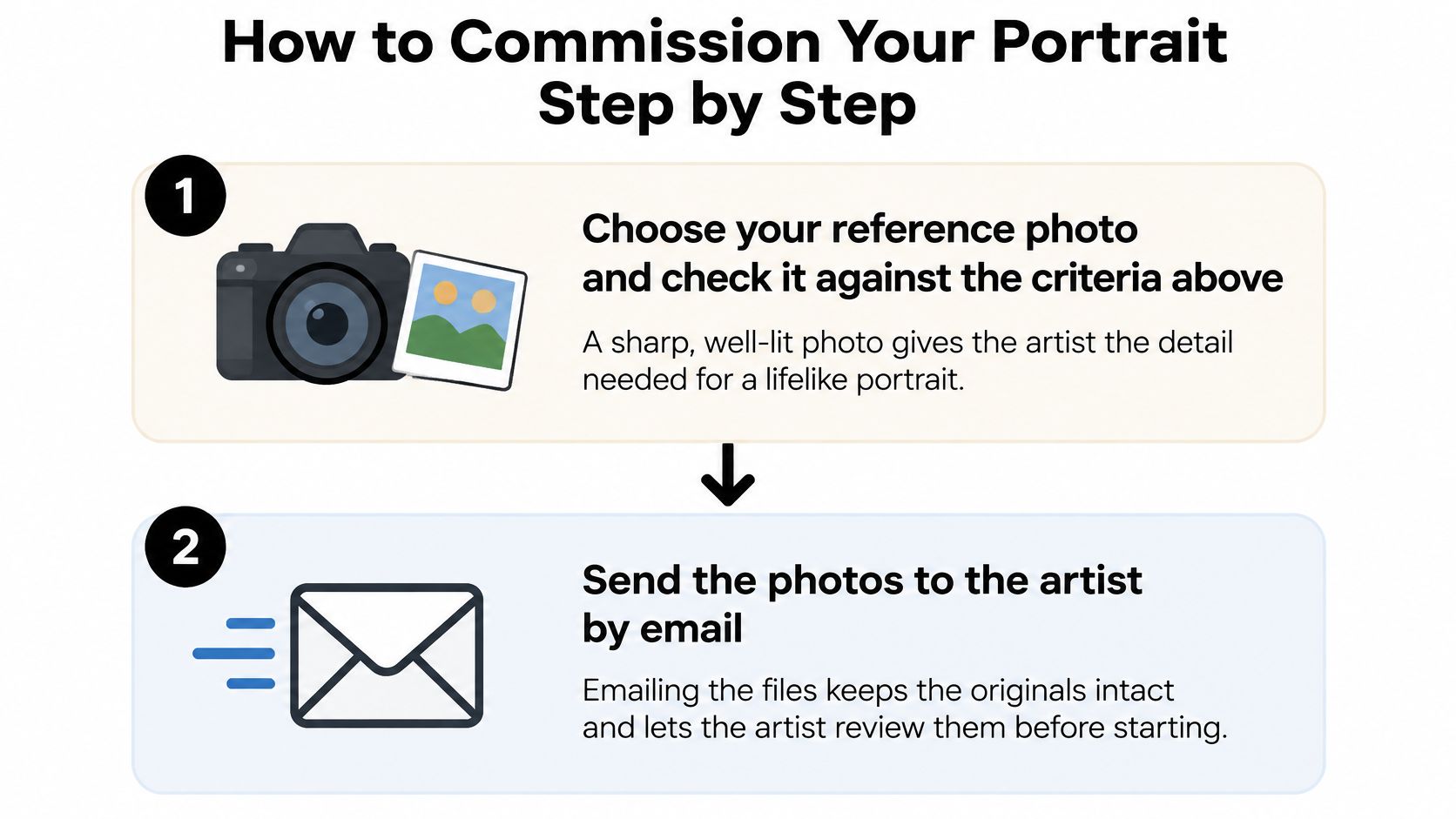
- Choose your reference photo and check it against the criteria above. The photo sets the ceiling on what can be observed, so a sharp, well-lit frame is the single biggest upgrade you can make to the finished piece.
- Send the photos by email attachment or by text to 910-273-2420. Original files keep the resolution intact; screenshots and forwarded thumbnails lose the detail that makes fur texture and eye structure readable.
- Talk through the subject, the size and any custom background. A pet portrait is the artist's interpretation of the subject, based on the pictures and information you provide, so this conversation is where you say what makes the dog yours: the scar on the shoulder, the ear that never stands up, the marking only one side carries.
- Wait for the artist's start date. No fixed timeline is promised, because completion time varies with the size of the piece and how quickly reference materials and payments arrive.
- Expect delivery 7-10 business days after all reference materials arrive. If there are no delays on your end, most pet portraits are completed and delivered within that window.
- Pay the remaining balance. The balance is collected at delivery, so plan for it once the finished piece is on its way.
- Sign for the package. Finished portraits ship packed and insured, and a signature is required on arrival, so plan to be home or have someone there.
Practical rule: keep every photo, message and payment confirmation in one email thread or folder. Most delays in custom work come from a missing file or an unanswered question, not from the easel.
Once the portrait is in your hands it is yours to hang and enjoy for individual use. Reusing its image beyond that, in print or online, requires written permission from William Tucker Art, which holds the copyright and reproduction rights to the painting.
If you'd like to see how the process starts, the William Tucker Art Personalized Pet Artwork Deposit reserves a commission slot and opens the conversation about style, size and medium, with each piece painted by William Tucker in acrylic, oil or mixed media. Booking early is worth the effort around birthdays, memorial dates and anniversaries, since the schedule depends on how quickly your materials arrive.
What a Commission Costs and What Drives the Price
| Item | Amount or effect | Notes |
|---|---|---|
| Deposit | $50 non-refundable | Starts the portrait |
| Final payment | Due upon delivery | Paid online through William Tucker Art |
| Size | Confirmed before the deposit | Larger formats take longer to paint |
| Medium | Confirmed before the deposit | Acrylic, oil or mixed media |
| Number of subjects | Adds to completion time | Each subject means more hours at the easel |
| Custom background | Adds to completion time | Confirmed before the deposit is paid |
A quote works like a recipe: the number on it only makes sense once you know what went in. Size and medium set how much surface and paint the work needs, and every added subject or custom background adds painting hours. Two "dog portraits" can carry very different prices and both be fair.
The shop's own range shows why. Bee Portrait with Purple Background is an 8x10 blending acrylic and oil on a cradled wood panel, while Adorable Fox is an 18x24 in oil on canvas, many times the surface area. Listed pieces in the Pet Portraits collection top out at $100, yet a custom portrait priced at $150 drew praise for the quality of its canvas and paint. The gap between those figures is the lesson: a commission is priced on what goes into it, so read any quote against the dimensions and medium it covers, not against a generic idea of what a portrait costs.
Ask for the full price in writing before the deposit goes out, since it can't be refunded once paid. Compare that figure with your budget and the wall the piece will hang on. If the number fits but the size feels small for the space, change the size rather than shopping for a cheaper artist.
One thing the price does not buy: reproduction rights. William Tucker Art holds the copyright to the finished painting, so enjoying the image yourself is fine, but any wider use needs written permission.
Handmade Portraits Compared With AI Pet Images
Buyers now ask a question that didn't exist a few years ago, and it deserves a straight answer rather than a defense of handmade work. Synthetic pet imagery has moved into intimate territory quickly: U.S. survey reporting based on 1,000 pet owners found that 31% of respondents familiar with an AI-pet trend said they would date an AI-generated version of their pet (The Independent).
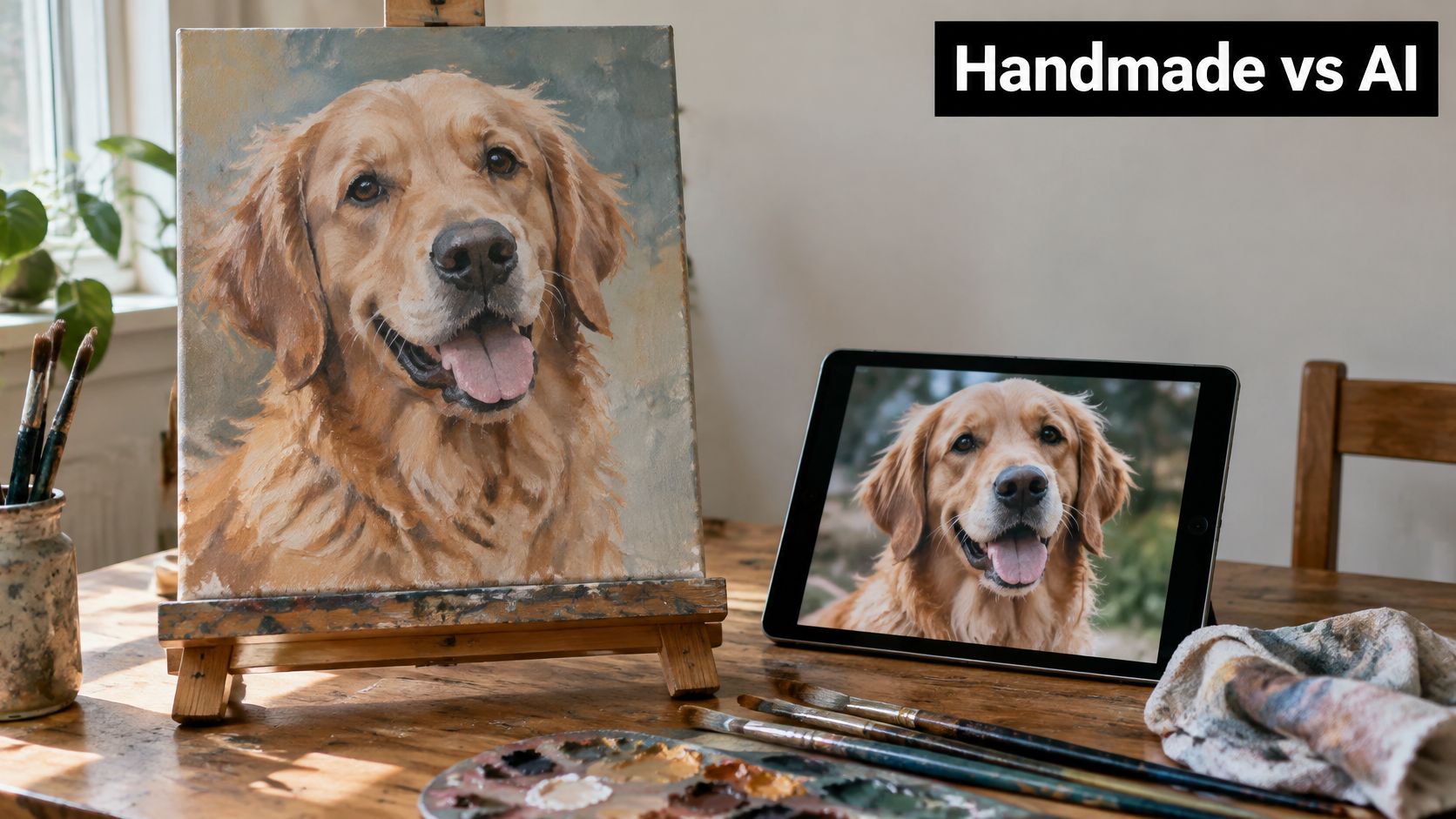
The honest position is that handmade isn't automatically better. A weak painting of your dog is worse than a good generated image, and a generator can organize references and explore compositions quickly. What separates the two isn't the tool. It's provenance, consent, likeness accuracy and whether anyone looked at your animal.
Where generators lose the dog
An image model is trained on what dogs in general look like, and it averages toward that middle. The details that make your dog yours are exactly the ones that get smoothed away: unusual markings, one ear that sits lower than the other, cloudiness in an aging eye, a healed scar, the specific way your dog holds its head when it wants something.
Ask this before you buy anything: "Which details did you deliberately preserve, and how did you check them?" A straight answer names your dog's oddities. A vague one describes the breed.
Three questions that settle it
What process was used? You want to know whether a person painted it, whether software assembled it, and where the line sits.
Was AI used for reference, exploration or final production? Using it to sketch compositional options is a different act from printing a generated file and calling it a portrait.
How will the likeness be checked? A preview stage, a revision, and a comparison against your own photos are the things that catch an extra toe or the wrong eye color.
For a look at how a painted portrait comes together by hand, this walkthrough is a useful four minutes.
Transparent authorship is the standard to hold any seller to, whether the final piece is oil on canvas or pixels on a screen. AI can help an artist organize references. It can't observe your dog, and observation is where the likeness comes from.
Book Your Portrait With Confidence
Before you send anything, settle three choices in this order: the size the wall can hold, the medium you want to live with, and whether a custom background helps the room or a quieter one keeps attention on the dog. Stand where the portrait will hang and ask what should read first from across the room. For realism, the answer is usually the eyes and the head shape, so let every choice protect those.
A short pre-send check keeps the commission truthful to the dog:
- Photos show the markings, ear set, eye clarity and posture that make this dog recognizable.
- Size leaves room for the muzzle and ears without crowding the edges.
- Background supports the value pattern instead of competing with it.
- Anything that matters, a scar, a graying brow, a favorite collar, is written down with the photos.
William Tucker Art holds the full copyright and reproduction rights to pet portrait paintings, and clients may not use an image beyond individual use without written permission. Plan for the original to be the piece you hang and enjoy.
If the portrait is for a dog you've lost, The Companion Project's grief resource guide is a thoughtful place to steady yourself before choosing photos. Take your time with that part. The painting will still be there when you're ready.
William Tucker Art paints original dog portraits from the photos and details you send, each one an original rather than a print. Visit William Tucker Art to see the Pet Portraits collection and start the conversation about your dog.