
Your camera roll is full of the dog you know by heart: the alert look at the park, the sleepy muzzle on the couch, the one perfect head tilt. But when you picture that face on a shirt, the photo that feels perfect on your phone suddenly seems less certain. Fabric changes the image, and a successful dog face on shirt design needs more than a good snapshot. It needs a clear focal point, deliberate contrast, and a print that suits the garment.
Treat the shirt as a small portrait, not a photo pasted onto cotton. Choose the image for the way it reads at a glance, prepare it for the fabric and print method, then check a real proof before committing. Those decisions are what separate wearable art from a muddy novelty print.
Why a Dog's Face Deserves More Than a Phone Snapshot
The camera roll usually holds several versions of the same dog: a lovely expression with the eyes in shadow, a sharp face with a distracting leash, and a bright portrait where the pale fur has lost its detail. The best memory isn't automatically the best shirt image. On fabric, the face has to read clearly from a little distance, and the eyes, muzzle, and silhouette need to survive both printing and everyday wear.
There's a good reason dog imagery feels at home on apparel. Dogs represented 65.9% of global pet-clothing revenue in 2023, while tops, shirts, and dresses made up 48.5% of the market by product type, according to Grand View Research's pet clothing market analysis. Those figures describe pet clothing broadly, not dog-face prints in particular. Still, they show how naturally dogs and shirts meet as ways to express affection, identity, and taste.

Before editing, decide what you want the portrait to say. A close crop with direct eye contact feels intimate; a side profile can feel calm and observant. A playful expression may suit a gift, while a more painterly treatment can make a shirt feel like something you'd choose for its design even if you didn't know the dog.
Start with the feeling, not the filter. Choose the expression and composition that capture your dog's character. The printing method comes later.
A reliable workflow follows that same order. Select a photo with legible features, prepare the art at the intended print size, choose a process suited to the garment and design, then review a physical proof. If the image feels crowded or flat before printing, a new effect won't fix the underlying composition.
Picking the Photo and Prepping the File Right
A printer can't restore focus that the camera never captured. Start with a photo where the eyes are distinct and the muzzle has enough separation from the rest of the face. Even lighting usually gives you more room to adjust than a harsh flash or deep shadow. For a black dog, a lighter background can help the silhouette stand out; for a white dog, watch for clipped highlights that erase fur texture.
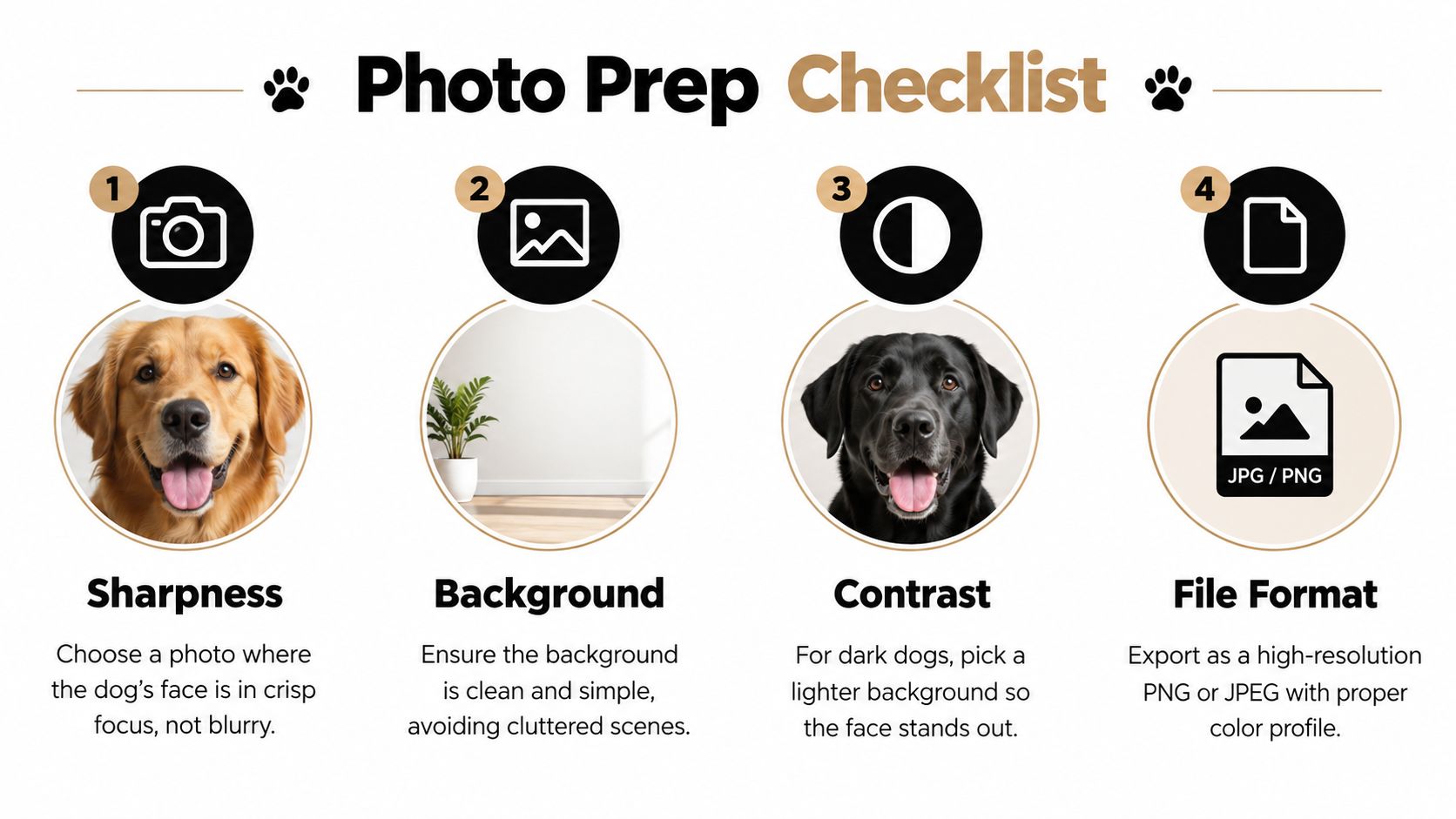
A clean background can help, but plain isn't always better. A busy scene may compete with the dog, yet a carefully chosen background can support the portrait's mood or help a dark coat separate from a dark garment. If you remove the background, inspect the edges closely. A faint halo or leftover rectangular field can become obvious when the artwork is printed.
Crop for the garment, not the screen
Decide how much of the dog's face you want to show before you resize. Leave breathing room around the ears and muzzle, and keep the eyes and nose away from seams or trimming. Textile-printing research identifies resolution and ink-drop volume as factors in fine fur detail and edge sharpness, and gives approximately 300 PPI at the intended print size as a practical benchmark. The same research emphasizes printer- and substrate-specific color profiles, equipment calibration, and spectrophotometer checks for consistent color reproduction (digital textile printing research).
Don't confuse a large pixel dimension with a print-ready file. Set the artwork to the actual size it'll appear on the shirt, then check that it retains enough detail at that size. Excessive sharpening can create bright outlines around fur, while a soft phone image may turn into a smudged face. Export in the format your printer requests and ask which ICC profile is appropriate for the printer, ink, and garment. If you're weighing layout choices alongside image preparation, Bulk Image Generation's t-shirt design tips offer useful context on planning artwork for apparel.
Use a dog portrait photo guide to think through which reference image best captures the dog's expression before you build the print file. Then request a physical proof, especially for a dark shirt. White underbase can shift shadows and saturated colors, so compare the print with the original under neutral lighting rather than judging only by a phone screen.
Choosing Between DIY Printing Methods
For a single detailed portrait, DTF is often a practical starting point. It can carry gradients and multicolored fur without the setup demands of preparing separate screen-printing layers. Its result still depends on application: poor heat, pressure, dwell time, pretreatment, or curing can lead to peeling. A transfer that looks crisp at first isn't automatically well bonded.
Screen printing makes more sense when you're producing a consistent design in quantity, especially if the artwork has a limited palette. It can produce a durable result, but photographic fur and soft gradients are more complicated than bold shapes and clean blocks of color. Iron-on transfer paper is accessible for a home experiment, but it's less dependable as a finished, frequently worn portrait. Follow the product instructions and test before you make a shirt you care about.
| Method | Best For | Durability Note | Detail on Fur |
|---|---|---|---|
| DTF | Short runs and colorful portraits | Application settings matter; wash-test the actual shirt | Good fit for gradients and fine features |
| Screen printing | Repeating a design, particularly with simpler colors | Can hold well under tested conditions, but results vary by process | Better suited to simplified shapes than subtle photographic transitions |
| Iron-on transfer | A low-commitment home trial | Follow the transfer maker's care instructions and check for lifting | Can work for a simple image, but small details may look less clean |
| Other heat transfers | Custom designs when a suitable transfer is available | Fabric compatibility and application settings still matter | Depends on the transfer and the amount of detail in the artwork |
Make the process fit the portrait
A textile study comparing DTF and screen-printed images used household washing at 40 °C for 30 minutes with an 800-rpm spin cycle. In that test, DTF samples showed minimal visible loss through roughly 15 washes, while screen prints held through about 10 washes (DTF and screen-printing study). Treat those findings as results from that tested protocol, not a guarantee for every ink, shirt, or home printer.
For a dog portrait with whiskers, soft shadows, and many colors, consider DTF for a short run, then validate it on the garment you will use. Stretchy rayon-spandex can crack under an unsuitable print; bleach and strong UV exposure can fade an image. Above all, do not mistake color fastness for adhesion. A print can retain its color while its edges begin to lift, so inspect both after washing.
Hiring an Artist for a Portrait That Reads as Art
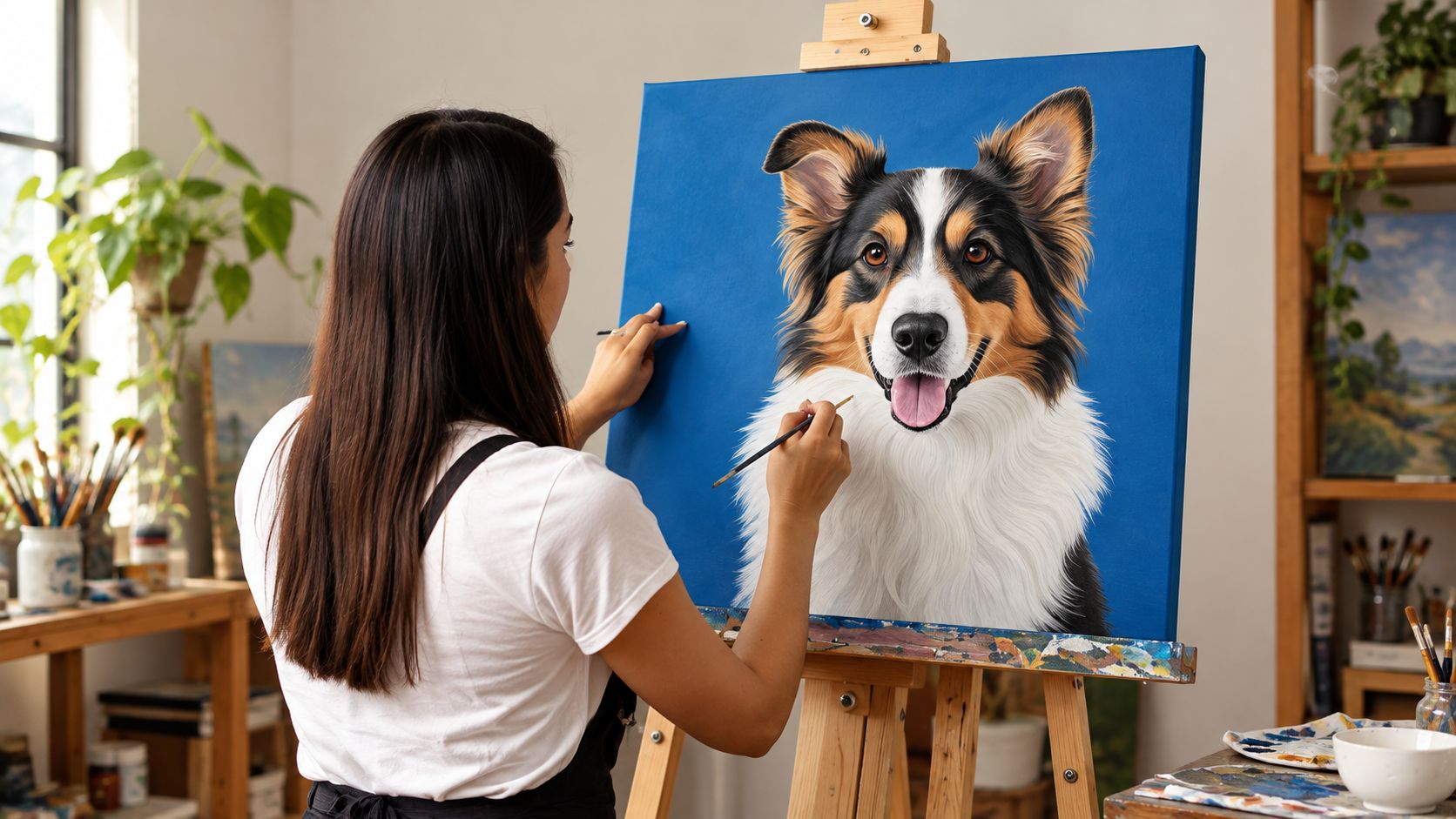
Choose an artist when the source photo has personality but isn't quite print-ready, or when you want the dog represented rather than reproduced pixel for pixel. An artist can simplify a tangled background, bring light back into shadowed eyes, or adjust the contrast so a black coat doesn't disappear on a dark garment. That isn't a shortcut around the photo. It's a design decision about what the portrait needs to communicate.
When you brief an artist, share more than the image file. Explain the dog's temperament, the features that make them recognizable, the shirt color, and whether you prefer a realistic or expressive look. Point out any details that matter, such as a distinctive ear, patch of fur, or crooked grin. If you're unsure whether a stylized treatment suits the reference, a photo to cartoon converter can help you explore a broad visual direction, though a generated preview isn't a substitute for an artist's judgment about the final print.
Judge the proof as a portrait
Ask to see the artwork at its intended size and placement, then assess what your eye notices first. The eyes should stay readable. The muzzle should have enough definition to distinguish it from the cheeks, and the crop shouldn't feel as if it cuts off an important feature by accident. A simplified, high-contrast interpretation can communicate personality more clearly and remain legible on fabric than a photograph overloaded with tiny details, a point also raised in guidance on pet-photo shirts.
Review the proof against the original under neutral lighting. A phone display can make colors look brighter than they'll appear in print, so check the eyes, coat highlights, and darkest shadows in the proof itself. If the printer uses a white underbase on a dark shirt, ask whether that affects the portrait's color or contrast before approving it.
Photographs are copyrightable, so get permission before reproducing an image someone else took. If you'd rather develop the reference as a standalone fine-art portrait, William Tucker Art's personalized pet artwork deposit begins a custom portrait process with a consultation about style, size, and medium. For more background on commissioning an artist, see this guide to choosing a custom pet portrait artist.
Mockups, Proofs, and Wash Testing the Final Shirt
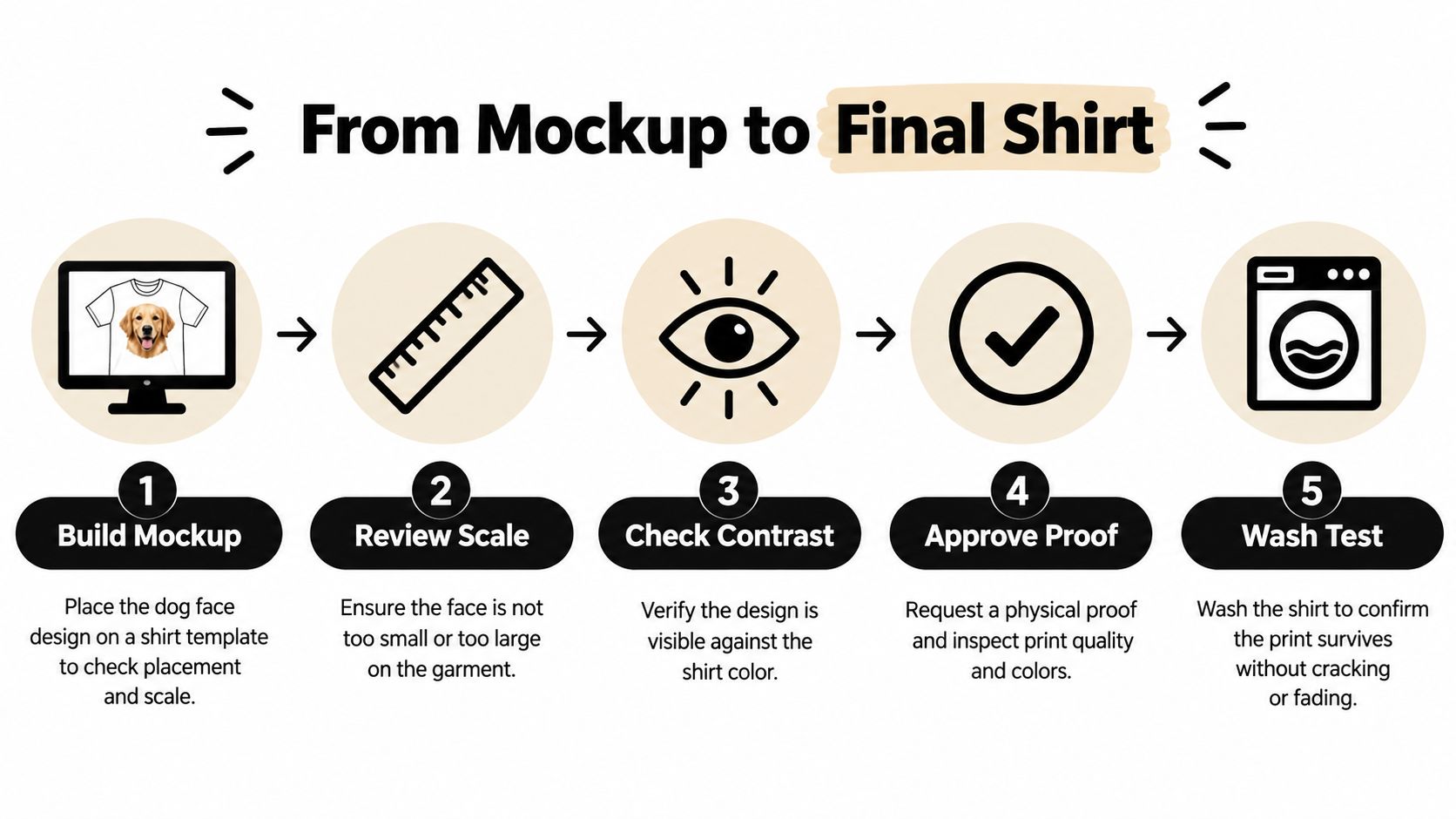
A shirt mockup helps you catch composition problems before printing, but it can't confirm the actual color, texture, or adhesion of a print. Place the design on a garment template and check its scale against the neckline, sleeves, and body. A portrait that looks balanced on a screen can feel oversized when worn, or too small to read once it's on the fabric.
Check the physical print, not just the preview
Ask for a physical proof before approving a larger run. Compare it with the original under neutral lighting, then inspect the placement, scale, and contrast while the shirt is flat and when it's worn. Pay close attention to dark shadow areas, fine whiskers, and the edges around the ears. On a dark garment, the white underbase can affect how colors and shadows appear.
A wash test turns a promise of durability into something you can assess. Wash one production sample inside out with mild detergent, avoid bleach and high heat, then look for peeling, cracking, fading, or loss of detail. Check the same areas after repeated washes, especially the edges and fine features that may show wear before the main image does.
Keep the test conditions consistent. If you change the detergent, drying method, or garment between tests, you won't know which change affected the print.
Use the care method you plan to recommend to anyone wearing the shirt. If the print begins to lift or crack, check the application process before blaming the artwork: insufficient heat or pressure can compromise bonding, while an unsuitable stretchy fabric can make cracking more likely. Store the shirt away from direct sunlight when it's not in use, since UV exposure can contribute to fading.
Making the Shirt Last With Smarter Material Choices
A shirt doesn't become sustainable just because a product description calls it “eco” or “biodegradable.” Consider the whole piece: fiber composition, print process, the garment's expected useful life, and how it'll be cared for or passed on. A durable shirt that stays in rotation can be a more thoughtful choice than a garment that sounds greener but wears out quickly.
There is consumer interest in eco-minded pet products. A source discussing the topic reports that 51% of pet owners in a 2021 APPA survey were willing to pay more for eco-friendly products (discussion of recycled and organic pet fashion). That finding doesn't tell you whether a particular shirt or printing method has a lower environmental impact. Ask the maker what the garment is made from, what the print process involves, and what evidence supports any certification or environmental claim.
Think beyond the label
Care choices matter because they affect how long the shirt remains wearable. Wash it inside out with mild detergent, avoid bleach and high heat, and follow the garment and printer's care instructions. For general fabric handling guidance, this article on how to avoid creasing shirt fabrics can complement the print-care directions you receive.
Before ordering, ask yourself whether the fabric suits the way you'll wear and wash the shirt, whether the process fits the artwork, and whether the seller can explain its durability claims. If it no longer fits your wardrobe, repair or donation may extend its useful life where those options are available. That's a more meaningful conversation than relying on a vague label.
Wearable art also belongs to a broader interest in animal portraiture and the natural world. William Tucker Art's Pelican Wall Art Print offers a separate example of animal imagery made for display, while a blanket with a dog picture uses a pet portrait on a different kind of textile. For a shirt, keep the same principle in mind: make the image readable, choose materials with care, and value a piece you'll want to keep wearing.
If you're ready to turn a favorite dog photo into a portrait with personality, explore William Tucker Art, where William Tucker creates custom pet portraits alongside wildlife and animal art. Bring your best reference photo and think about the expression, colors, and style you'd like to carry onto the shirt.