
You've found a painting that stops you mid-scroll. The colors feel right, the subject has a presence, and you can already see it on your wall. Then the practical questions arrive. Will the original look as rich in person? Will the packaging protect it? If you're commissioning a pet portrait, will the artist capture the familiar tilt of your dog's head or the expression that makes your cat unmistakably yours?
Customer reviews and testimonials help answer those questions because they describe what happened after the image on the screen became a real purchase. For original wildlife art, coastal scenes, and commissioned portraits, that lived experience matters. A review can show how communication worked, how the finished artwork compared with expectations, and how the piece felt in its final setting.
Why Reviews Matter When You Are Buying Original Art
A buyer can study a digital image carefully and still lack important information. You can't touch the surface through a screen, judge the scale beside your furniture, or see how color changes in morning and evening light. A commission adds another layer of uncertainty. You may wonder whether reference photographs will be enough for the artist to understand the subject you know so well.
That's why reviews act as a bridge between an artwork's presentation and the ownership experience. A collector describing the texture, the delivery, or the way a finished wildlife piece sits above a mantel answers questions a product page can't answer alone. A pet owner explaining the reference-photo process and the likeness of the final portrait gives another pet owner a more useful point of comparison than a general statement that the work is “beautiful.”
Research on local purchasing behavior supports the broader role of this kind of evidence. BrightLocal's 2024 Local Consumer Review Survey found that 75% of surveyed U.S. consumers read online reviews always or regularly. The same survey found that 77% consulted at least two review platforms when evaluating a local business. Buyers don't necessarily treat one glowing comment as a final verdict. They look for patterns across experiences.
Art is an experience purchase
Original art resembles other experience-based purchases because quality includes more than the object itself. The buyer assesses the artwork, the artist's communication, the accuracy of expectations, the care taken during delivery, and the emotional response once the piece arrives.
A 2022 Management Science study of independent restaurants found that doubling review activity increased revenue for high-quality restaurants by approximately 5% to 19%, while producing a similar negative effect for low-quality restaurants. The setting was restaurants, not art, so the result shouldn't be transferred mechanically. Its useful lesson is that reviews can help buyers discover quality sooner, especially when they can't fully assess an experience before purchase.
For someone comparing an original coastal scene, a wildlife painting, or a custom commission, a detailed review lowers perceived risk. The artist's work still has to speak for itself, but another customer's account can make the decision feel informed rather than speculative. For practical guidance on examining the work, provenance, and fit before purchasing, William Tucker Art's guide to how to buy original artwork offers a useful companion.
If you're also preparing images for a commission or documenting the artwork after it arrives, an offline RAW editor can help you review photographs without depending on a constant internet connection. That's a small practical detail, but clear reference and installation photos often make a testimonial more informative.
What Reviews and Testimonials Actually Are
A review is a customer's evaluation of a purchase or experience, usually posted on a third-party platform or a product page. The customer chooses what to say, including whether to mention a strength, a problem, or a detail the business hadn't anticipated.
A testimonial is promotional content a business selects and displays, often on its own website. It may begin as a review, an email, or a private message, but the artist chooses the placement and presentation. That selection doesn't automatically make it false. It does mean readers should understand that they're seeing a curated account.

Two forms of social proof
Think of reviews as conversations you overhear at an opening. Different visitors mention different things. One talks about the brushwork, another about the artist's responsiveness, and someone else explains how the painting changed a room.
Testimonials are more like thank-you letters framed on the studio wall. They're still personal accounts, but the artist has chosen which stories to feature and may group them by subject, collection, or purchase type.
Both have a place. Third-party reviews can feel less controlled, while on-site testimonials can provide context and images that are difficult to organize elsewhere. The strongest combination gives readers enough detail to understand the experience without pretending that every customer had exactly the same reaction.
For William Tucker Art, the distinction matters because a customer review section labeled “Let customers speak for us” can sit alongside curated stories about original artwork and commissions. Readers should ask not only whether the comment is positive, but what evidence it provides about the purchase they're considering.
The Five Drivers That Make an Art Testimonial Credible
A credible testimonial doesn't need theatrical language. It needs details that connect the reviewer's experience with the reader's concern.
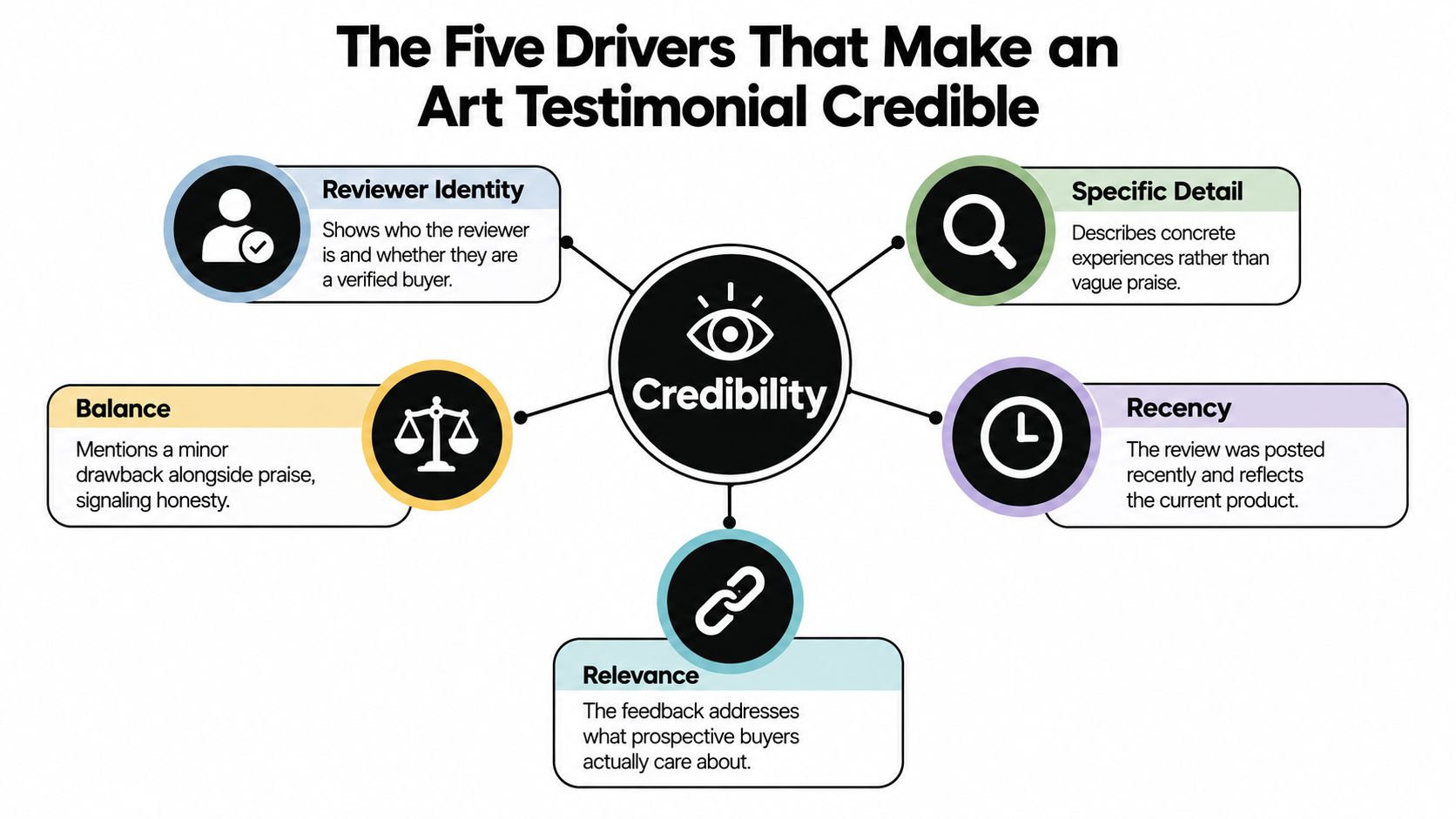
Identity answers who experienced the purchase
A first name, location, purchase type, and permission-based photograph give a comment a recognizable source. You don't need a full personal profile. “Maria, New Orleans, custom dog portrait” is more useful than an anonymous sentence because it tells you whose expectations shaped the account.
The systematic review of 69 empirical studies in the Journal of Business Economics research identified source characteristics as one of five major groups affecting review credibility. A reviewer's context helps readers judge whether the experience resembles their own.
Detail turns praise into evidence
“Beautiful work” expresses enthusiasm, but it doesn't answer much. More useful language describes the reference photos, sketch approval, color accuracy, communication, framing, packaging, or the recipient's reaction.
Specific detail is especially valuable for a commission. If a buyer explains that the artist captured a particular expression or adjusted a background after discussion, you learn how the collaboration worked, not only how the result looked.
Recency shows whether the experience reflects current practice
Recent feedback can help a buyer understand the artist's present communication, ordering, and delivery process. Older testimonials may still describe the artwork accurately, but practical details can change. Look for a visible date and consider whether the review addresses the type of purchase you're making now.
Relevance connects the story to your decision
A wildlife collector needs different information from someone ordering a memorial pet portrait. Product type changes how readers interpret credibility, which is why testimonials work better when organized around use cases such as custom pet portraits, wildlife collections, gifts, and collector purchases.
Balance prevents the page from feeling airbrushed
A wall of identical praise can make readers suspicious. A credible account may mention a small limitation, a revision, a color difference between screen and daylight, or a delivery complication that the artist resolved. Balance doesn't require a negative experience. It requires enough independence to sound like a real person remembering what happened.
A useful test: If a testimonial could describe almost any artist, it probably hasn't supplied enough evidence for a high-consideration purchase.
How to Read a Testimonial Like a Collector
Start by ignoring the star rating. Stars can tell you the reviewer felt positively, but they rarely explain why. Read the words for a sequence of events.
First, identify the buyer's original concern. Was the person worried about likeness, scale, color, delivery, or choosing a gift? Then look for the artist's action. Did the process include reference-photo discussion, a sketch, progress communication, or an opportunity to clarify the subject?
Read for nouns, not just adjectives
Words such as “stunning,” “gorgeous,” and “perfect” show emotion, but nouns carry the practical information. Look for:
- Subject: The dog, cat, bird, scene, or wildlife subject represented.
- Process: Reference images, proof stages, revisions, and communication.
- Physical result: Surface, color, scale, framing, and how the image compares with the approved concept.
- Delivery: Packaging, condition on arrival, and whether the piece was easy to install.
- Outcome: The recipient's reaction or the way the artwork works in a home, study, rental, hotel, or institutional setting.
A useful testimonial might explain that a portrait matched a dog's distinctive head tilt, or that the colors looked different in direct daylight but still suited the room. Those details don't weaken the account. They show the buyer paid attention.
Separate evidence from filler
A phrase like “excellent service” becomes meaningful only when the reviewer explains what the service involved. Did the artist answer questions promptly? Clarify a reference image? Discuss the intended room? Resolve a packaging concern?
For collectors weighing a larger commitment, the same reading habit applies to how to invest in art. Look for information that helps you understand the object, the transaction, and the relationship between expectations and the finished work.
Stories From Real Collectors and Pet Owners
The most useful testimonials read like small journeys. They name the starting concern, show what happened during the process, and describe the result in a setting that another buyer can understand.
A custom pet portrait might begin with a young Labrador named Cooper. His owner sends several reference photographs because one image shows his face clearly while another captures the familiar tilt of his head. During the commission, the buyer reviews an initial sketch and clarifies the expression before the acrylic painting is completed. The finished portrait preserves that particular tilt, and the owner says the likeness is strongest in the eyes. The value of this account isn't the adjective “beautiful.” It's the evidence about photographs, approval, subject accuracy, and the emotional response to the final painting.
A second story could come from a buyer choosing a hand-painted Southern coastal piece for a vacation rental. The buyer's concern isn't only whether the magnolia and fence imagery look appealing online. The practical question is whether the painting will hold its presence in a busy guest space. A useful testimonial would identify the artwork format, describe the communication around size and placement, and explain how the colors read once installed. If the reviewer notes that guests comment on the piece or that it gives the room a stronger local identity, future hospitality buyers gain context without being promised the same reaction.
Different buyers need different evidence
A wildlife collector commissioning a piece for a private study may focus on another set of details. The subject could be rendered with precise detail against an abstract background, creating contrast between natural observation and expressive color. The reviewer might describe how the background works with the room, whether the subject remains the visual anchor, and how the finished original compares with the approved concept.
These stories can include a buyer type, artwork format, approximate timeline, and outcome, provided the details are genuine and permission has been granted. The same principle applies when organizing image files for a family or event archive. Practical wedding photo upload tips can help people collect clear photographs, while a commission buyer needs images that show the artwork in its final setting.
For anyone considering a commission, William Tucker Art's guide to commissioning a portrait painting can help frame the questions that a detailed testimonial should answer. The account becomes useful when it helps the next buyer see the path from idea to finished piece.
Submitting Your Own Review
You don't need to write like a critic. A helpful review sounds like a customer describing what they noticed, what they needed, and what happened after the artwork arrived.
Start with the basic context. Name the type of artwork, the subject if it's a commission, and whether you purchased an original, ordered a portrait, or chose a gift. Then describe the process in plain language. Mention how you shared references, how communication worked, and whether the finished piece matched the approved direction.
A clear photograph can add more than another line of praise. If you're comfortable sharing one, photograph the artwork in its final setting and check that the room's light doesn't create glare. You can request identification by first name and city only if you prefer more privacy.
A simple four-part structure
- Context: Explain what you bought and why.
- Process: Describe communication, references, approvals, and timing in general terms.
- Result: Say what stood out about likeness, color, surface, packaging, or presentation.
- Outcome: Share the recipient's reaction or how the artwork works in its setting.
Don't include shipping labels, private order information, or details that identify someone without permission. A small criticism is acceptable when it's accurate and relevant. You might explain that you needed an extra clarification about color, then describe how the question was handled.
| Category | Worth Mentioning | Better Left Out |
|---|---|---|
| Artwork | Subject, format, likeness, color, and final setting | Unverified technical claims |
| Commission | Reference photos, approvals, revisions, and communication | Private messages or personal details |
| Delivery | Packaging, condition, and general arrival experience | Shipping labels and tracking information |
| Reaction | Gift recipient's response or the artwork's role in the room | Identifying someone without consent |
| Privacy | First name and city, if you're comfortable | Full address, phone number, or order details |
A review doesn't need to be flawless to help. Readers trust concrete experience more than polished slogans, and artists can learn from observations that reveal where a process feels unclear.
Honest Feedback as a Trust Signal
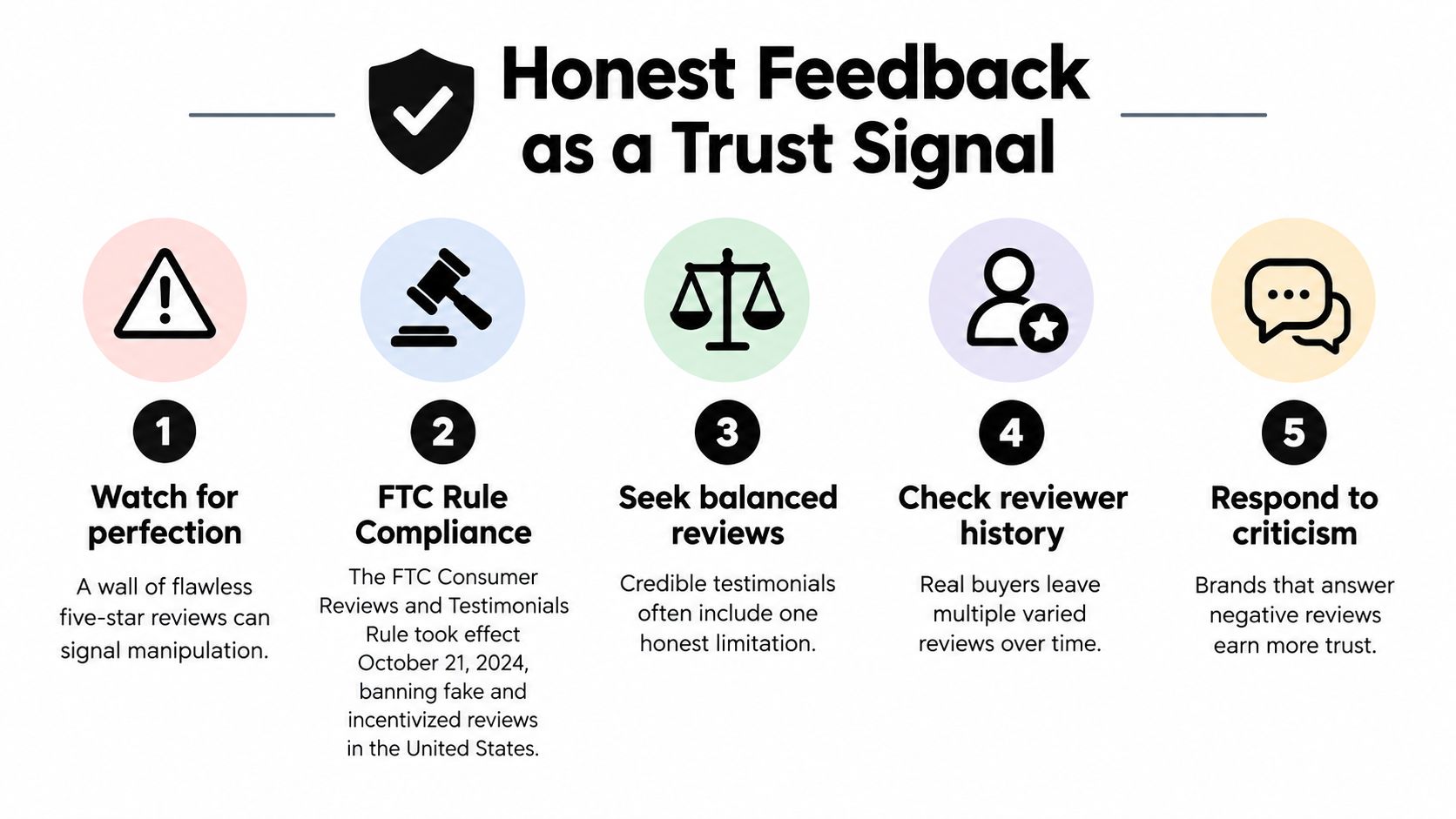
Perfect positivity can create the wrong impression. If every testimonial uses the same language and omits every inconvenience, readers may wonder whether they're seeing customer experience or advertising copy.
The FTC Consumer Reviews and Testimonials Rule, effective October 21, 2024, addresses deceptive conduct involving reviews and testimonials. It targets fake or materially misleading reviews and practices that create a misleading overall impression, including misrepresenting a controlled review site as independent.
For an art business, the practical response is straightforward. Keep the order or commission record, ask permission before using a name or image, preserve the customer's original wording, and disclose a material incentive or gifted artwork. Don't rewrite a customer's experience until it sounds like a marketing department wrote it.
Let the evidence remain visible
A negative comment shouldn't automatically disappear. Reviews can be excluded for clear reasons such as spam or abuse, but constructive criticism should remain eligible for publication. A factual response can explain what happened and what remedy was offered without arguing with the customer or altering the original account.
This approach also reflects what buyers increasingly need. Research included in the 2025 review authenticity survey reports that 89% of surveyed users rely on online reviews, while only 34% believe they can accurately identify fake reviews. The same source reports that 48% said deceptive reviews had led them to make poor decisions. Those figures point to a trust problem, not merely a demand for more praise.
A transparent review process can include verification labels, dates, purchase context, and occasional limitations. Tools and workflows that help teams organize feedback can be explored through Scanely review use cases, but no system can replace careful permission, accurate wording, and responsible moderation.
For William Tucker Art, customer reviews and testimonials are most useful when they help readers investigate the questions behind a purchase: likeness, communication, packaging, color, and the moment the artwork becomes part of someone's life. A balanced account gives collectors more confidence because it respects their ability to judge.
William Tucker Art offers original wildlife and coastal artwork alongside custom pet portraits, giving buyers a chance to explore both finished pieces and collaborative commissions. Visit William Tucker Art to view the collections, read customer experiences, and find an artwork or commission process that fits your story.