
You've found the photograph that still makes you pause. It may show a beloved dog at the end of a long day, a pelican on the Louisiana coast, or a family member in a moment you never want to lose. The question is no longer whether the memory matters. It's how to turn that image into an original painting that feels personal, convincing, and worth living with.
Commissioning a portrait painting is a collaboration, not a simple photo transfer. With William Tucker's abstract-meets-realism approach, the animal or person remains recognisable and carefully observed, while the surrounding color, movement, and atmosphere carry a broader story. That makes the reference choices and approval stages especially important.
Understanding the Commission Journey
The commission begins with a conversation about what the photograph means to you and what the finished painting should preserve. A cat watching the garden or a rescue dog alert at the door may provide the emotional starting point, while the painting gives that memory a lasting physical form.
William Tucker works from New Orleans, focusing on wildlife, pets, coastal imagery, and environmental storytelling. His abstract-meets-realism style keeps the subject carefully observed while allowing the background to carry atmosphere, habitat, movement, and memory. Choose references that support both sides of that balance. The photograph must show the subject clearly, yet leave room for an expressive interpretation around it.
The collaboration follows a practical sequence:
- Initial inquiry: Share the subject, preferred images, intended size, and planned location.
- Scope-setting: Confirm the composition, medium, background direction, deadlines, and how much interpretation you welcome.
- Agreement and booking: Record the brief, price, payment schedule, and approval process before painting begins.
- Reference development: The artist reviews the photographs and may prepare studies or working sketches. These early materials establish the subject's expression and the relationship between realistic detail and abstract surroundings.
- Progress review: Respond while the structure remains adjustable. Approval is more useful before every painted detail is finished.
- Final approval and delivery: Once the work follows the agreed direction, the artist completes, prepares, and ships the portrait.
Practical rule: Describe the memory, expression, and details you want preserved. Clear priorities give the artist room to interpret the background without losing the subject's identity.
Before contacting an artist, organise your thoughts with an AI book summary tool, especially when comparing ideas about memory, legacy, or collecting. William Tucker Art's guide to how to commission an artist offers practical preparation advice. Bring both references and questions to the first conversation. Clear communication at the start makes later approval more focused and protects the personal meaning behind the commission.
Selecting Reference Photos for Abstract Backgrounds
A strong reference photo must do two jobs. It needs to show the subject clearly enough for accurate observation, and it needs to suggest the atmosphere that can shape an abstract background.
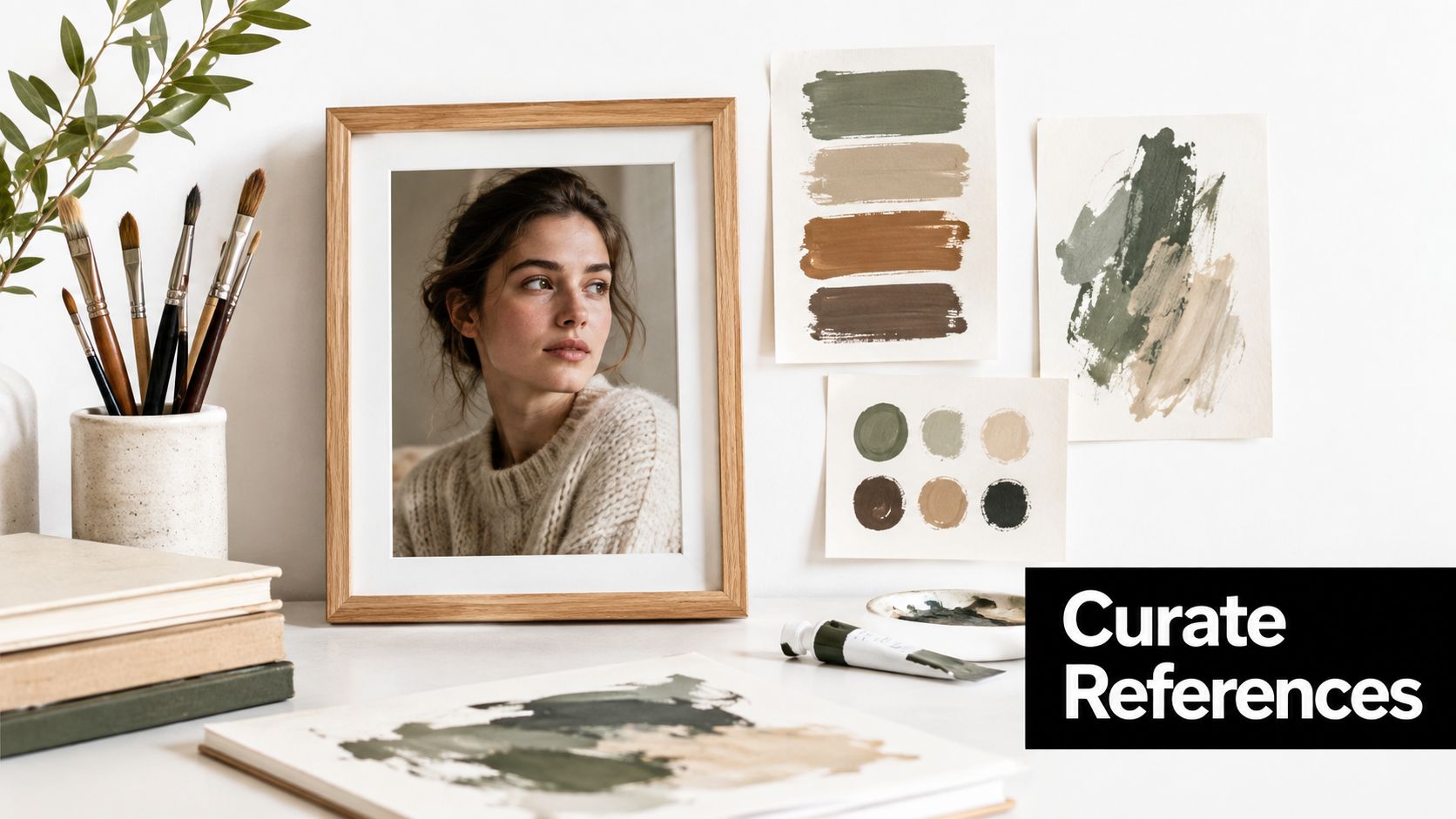
Start by gathering several images rather than choosing the first photograph that feels sentimental. Emotional importance matters, but the most meaningful image may have poor lighting, a blocked face, or an expression that doesn't translate well into paint. Give the artist options and explain what you remember about each one.
What to look for
Face and eyes come first. For a pet or wildlife subject, check that the eyes are visible, the muzzle or beak is unobstructed, and the head angle expresses the character you want to preserve. A clear expression gives the artist a firm anchor before the surrounding abstraction begins.
Look for directional light. Side light can reveal fur, feathers, wrinkles, and surface texture. Stronger light and shadow also give the artist visual information for building contrast between the realistic subject and the more interpretive background.
Choose personality over perfection. A slightly unusual tilt of the head, a relaxed mouth, or a distinctive posture may say more about the subject than a formally posed image. Tell the artist what makes the photograph feel like your animal or person.
Send the highest-quality file available. Small, compressed images hide the very details that make a portrait believable. Original files are especially important for eyes, fur patterns, feather edges, and subtle changes in color.
Consider the background before you approve the photo. A busy room, clipped ears, or harsh flash may restrict the composition. A simpler image gives more freedom to develop a background that feels atmospheric rather than mechanically copied.
William Tucker's approach allows the background to move beyond literal scenery. Colors can suggest water, marsh, foliage, sky, or emotional tone without competing with the subject. That means you should discuss whether you want a recognisable setting, a coastal feeling, a more dramatic color field, or an open interpretation.
Portrait projects often involve multiple reference sessions or preliminary studies to align composition and expression before final painting begins, which helps reduce late-stage revisions, as described in this portrait process guide. You can also explore Tucker's discussion of painting a portrait background before deciding how much environmental detail belongs in your brief.
Choosing Size and Medium Options
Size should follow the room, the viewing distance, and the subject's visual complexity. A small painting can feel intimate on a shelf or in a reading area, while a larger work gives a pelican, dog, or family group enough space for expressive detail and a more expansive background.
Canvas, paper, and wood panel each create a different ownership experience.
| Medium | Choose it when | What it contributes |
|---|---|---|
| Canvas | You want a substantial wall piece with a contemporary presentation | A familiar painting surface, visible texture, and the option of a gallery-wrapped finish |
| Paper | You prefer traditional framing or a lighter visual presence | Fine detail, flexible matting, and a more classic presentation behind glass |
| Wood panel | You value a firm, tactile surface with a natural character | A durable-feeling support and a grounded, material quality that suits expressive work |
Canvas works particularly well in modern interiors where you want the painting to sit directly on the wall without an elaborate frame. Its surface can support both precise subject detail and active brushwork in the background.
Paper makes sense when framing is part of the design. A mat and frame can separate the artwork from the wall, protect the surface, and let you coordinate the portrait with an existing collection.
Wood panel brings a more object-like quality. It can suit wildlife imagery, rustic interiors, and collectors who enjoy seeing a substantial support beneath the painted surface. Ask about the intended finish and display requirements before choosing it.
Scale also changes the balance between recognition and atmosphere. If the subject needs room for expressive feathers, fur, or distinctive markings, an overly small format may force the composition to become cramped. If the portrait is meant for a narrow wall or intimate corner, a compact design can work beautifully when the pose is simple and the background remains controlled.
Choose the display location before you request a quote. Measure the wall, note nearby furniture, identify the dominant colors, and decide whether the portrait should command attention or complement the room. A clear setting helps the artist recommend a proportion that serves both the artwork and your home.
Navigating Pricing and Payment Schedules
A quote should reflect the actual commission, not a vague starting price. Artists account for labor, materials, size, complexity, interpretation, and schedule. One subject on a modest surface requires a different commitment from a full-length composition with several figures, detailed clothing, environmental elements, or an urgent deadline.
Market comparisons show why you should ask how the artist calculates a fee. One commissioned oil portrait pricing comparison places a single-figure oil portrait at roughly $166 to $822 when ateliers price by canvas area. Independent artists using an hourly model may charge roughly $300 to $3,500 for a similar configuration. The same comparison gives examples around $214, $299, and $800 across different sellers and business models. A matching subject count does not guarantee a matching price.
At the luxury end, a 2025 report from Fast Company describes average painted portrait costs of approximately $13,000 to $20,000. Full-length portraits with additions such as a home and pets can reach $66,000 to $80,000. These figures illustrate the breadth of the market, from personal keepsakes to high-value fine art. They are market context, not a quote for William Tucker Art.
What your quote should make clear
Request written confirmation of:
- The exact subject: Name the person, pet, or wildlife subject, and state whether additional figures or animals are included.
- The format: Confirm dimensions, surface, medium, framing, and whether shipping is included.
- The background direction: Explain how much abstraction, scenery, and color interpretation you want. With William Tucker's abstract-meets-realism style, reference selection affects both the subject's likeness and the energy surrounding it.
- The schedule: Clarify when work begins, when progress images arrive, and what happens if the deadline changes.
- The payment stages: Confirm the deposit, balance, accepted payment method, and cancellation terms.
A 30% to 50% deposit is common among professional portrait artists, according to commission guidance from the Milan Art Institute. It reserves materials and working time. Ask how approval points are handled before paying, especially if the chosen references may require interpretation rather than direct copying.
For Tucker's acrylic pet commissions, review how much it costs to commission a painting, then request a project-specific quote. Compare like with like. A hand-painted original includes physical materials, artist time, and long-term ownership, so it should not be priced against a digital file alone. Agree on the payment schedule before work starts, and keep the written quote with your reference images and brief.
Reviewing Proofs and Approving Your Portrait
Your first proof is the moment to test the painting's overall direction. Reply with clear, specific feedback before William Tucker Art develops the surface further. Early decisions are easier to change than finished passages.
Start with the composition:
- Check the silhouette and placement. Confirm that the subject occupies the right amount of space, sits comfortably within the canvas or panel, and has enough breathing room.
- Check expression and identity. Review the eyes, head angle, mouth, ears, markings, and posture. These features carry recognition more strongly than small surface details.
- Check the background relationship. Decide whether the abstract colors support the subject or compete with it. The mood should match your brief, whether you want something coastal, quiet, energetic, or dramatic.
- Request specific refinements. Replace “it doesn't look right” with a precise instruction, such as “clarify the catchlight in the left eye.” Identify the location and describe the intended effect.
- Approve promptly. Delayed feedback can interrupt the artist's working rhythm and affect the agreed schedule.
William Tucker's abstract-meets-realism style makes the third step especially important. The background is an active part of the portrait, so your reference photos influence more than likeness. They also guide color, movement, atmosphere, and the space surrounding the subject.
A practical example helps. Asking for more open space around the head or a different background concept is a structural change. Asking to cool one color, clarify a marking, or soften an edge is usually a minor refinement. Approve the structure first. Fine detail cannot rescue a composition that feels wrong.
At the proof stage, approve the big decisions first. Fine detail can't rescue a composition that feels wrong.
Review each proof at its intended viewing distance, then inspect it more closely for identity and edges. Send one organized response rather than scattered comments. Mark the relevant area, describe the change, and distinguish required corrections from personal preferences.
Before approving, confirm which revisions are included and when additional work could affect the price. A written record of the approved composition, background direction, and remaining changes protects both you and the artist. Once those decisions are settled, give explicit approval so the painting can progress without conflicting instructions.
Shipping Logistics and Long-Term Care
Delivery isn't the end of the commission. Treat the painting as a physical object that needs a safe arrival, a suitable location, and consistent care.
When the package arrives, inspect the exterior before opening it. Photograph visible damage, keep the packing materials, and compare the painting with the agreed final image. If the work has a frame or glazing, check the corners, surface, hanging hardware, and glazing for movement or cracks before placing it on the wall.
Choose a location away from direct, intense sunlight, heating vents, damp areas, and abrupt temperature changes. A stable interior wall is generally safer than a bathroom, unconditioned porch, or spot directly above a radiator. Keep the artwork level, use suitable hanging hardware, and avoid placing objects where they can strike the lower edge.
Cleaning without causing damage
For a gallery-wrapped canvas, remove dust gently with a clean, soft, dry cloth or a very soft brush, without pressing into the surface. Don't spray household cleaner onto the painting, use water, or rub textured passages. Framed works may require separate care for the frame and glazing, and cleaner should never reach the artwork through the edges.
Keep records of the artist, medium, purchase details, photographs, and care instructions. Those records help with insurance, future conservation advice, and family stewardship. Portraiture has long functioned as both a personal record and a cultural asset, but survival isn't guaranteed. The National Portrait Gallery estimates that at least 60% of portraits from Tudor Britain have been lost over time, as documented in its research on the market for portrait painting.
Your responsibility is straightforward: store the documentation, control the display environment, and handle the painting carefully. That routine gives a commissioned portrait the best chance of remaining meaningful across generations.
William Tucker Art offers custom wildlife and pet portraiture shaped around detailed subjects and expressive, abstract backgrounds, making it a strong fit for collectors who want more than a literal copy of a photograph. Gather your reference images, decide where the work will hang, and visit William Tucker Art to begin a commission conversation.