
You've probably done some version of this already. You saw a painting online, or in a local gallery, or on Instagram. You kept coming back to it. Then the practical questions started. Is the price fair? Is it original? What paperwork should come with it? What happens if it arrives damaged, or doesn't match the photos?
That's the moment when buying art begins.
I've watched first-time buyers get hung up on the wrong things. They spend hours worrying about whether they're “qualified” to buy art and almost no time asking for an invoice, a condition report, or proof that the seller has the right to sell the work. If you're shopping in the under-$50,000 range, you're not in some side market. In the Art Basel and UBS survey, 64% of collectors bought works priced under $50,000 in 2023, and the most popular band was $10,000 to $50,000 at 41%. Only 3% bought an individual work above $1 million. The same report also found that 83% of collectors said they had purchased art online in 2021, up from 64% in 2019, and 76% reported buying art online in the past 12 months in 2022 (Art Basel and UBS survey).
That matters because most buyers aren't standing in blue-chip galleries with advisors at their elbows. They're buying from artists, smaller galleries, online platforms, fairs, and mixed-channel setups where discovery is easy but verification still takes work. If you want to know how to buy original artwork without overpaying, start with taste, but don't stop there. The deal itself is where good buying happens.
Finding Your Direction Before You Start Shopping
A lot of buyers begin with a blank wall and a vague sentence. “I want something meaningful.” That's honest, but it's not enough to shop well.
Original art isn't like buying a poster you can swap out next season. You're choosing a one-of-one object, or a distinct work within a limited edition, and every decision you make early changes where you should look later. Size, medium, subject, your tolerance for risk, and whether you want a finished piece or a relationship with a living artist all matter.
Start with the room, not the romance
The easiest mistake is buying with your phone screen instead of your house in mind. A piece that looks dramatic online may disappear on a tall wall or overwhelm a narrow room with low light.
Before you browse, pin down these basics:
- Wall and viewing distance: Measure the wall. Then measure the space from sofa, bed, or doorway to where the work will hang.
- Medium tolerance: Oil, acrylic, watercolor, pastel, mixed media, photography, and sculpture all live differently in a home.
- Subject matter: Wildlife, abstraction, portraiture, coastal scenes, and still life each set a different tone.
- Budget with extras: Leave room for tax, shipping, framing, and installation if needed.
Practical rule: If you haven't measured the wall and set a real all-in budget, you're not ready to buy yet.
Know what you want the artwork to do
Some people want a centerpiece. Others want a quieter work they'll grow into. Those are different purchases.
I usually tell first-time buyers to choose one primary goal:
- Anchor the room with one stronger piece.
- Mark a memory such as a place, animal, season, or personal story.
- Start a collection around a theme, medium, or artist.
- Support a living artist and buy from the primary market.
If you know which of those you're doing, the search gets cleaner fast. You stop comparing unlike things.
Build a short filter before you browse
The global art market was estimated at $59.6 billion in 2025, up 4% year over year, with auction turnover reaching $11.1 billion. 867,000 works sold out of 1.28 million offered, and the unsold rate was 32%, down from 33% in 2024 (market update). That tells you two useful things. First, there's a lot of work out there. Second, not everything offered gets bought.
So don't shop as if the first decent option is your only chance.
Use a pre-shopping filter like this:
- Artist stage: emerging, mid-career, established living artist, or secondary-market estate
- Buying channel: direct from artist, gallery, fair, auction, or online platform
- Medium and scale: for example, acrylic on canvas in a medium-to-large format
- Non-negotiables: original only, signed, documented, ready to hang, framed or unframed
That simple filter saves buyers from wandering into the wrong market. It also keeps you from falling for the oldest trap in art buying, which is confusing excitement with clarity.
How to Research Artists and Verify Provenance
Buyers either protect themselves or talk themselves into trouble. A charming seller, a polished website, and a nice certificate don't prove much on their own.
What works is a document-led process. You ask for the file, match it to the exact object, and verify the claims outside the seller's own materials.
What to request before you send money
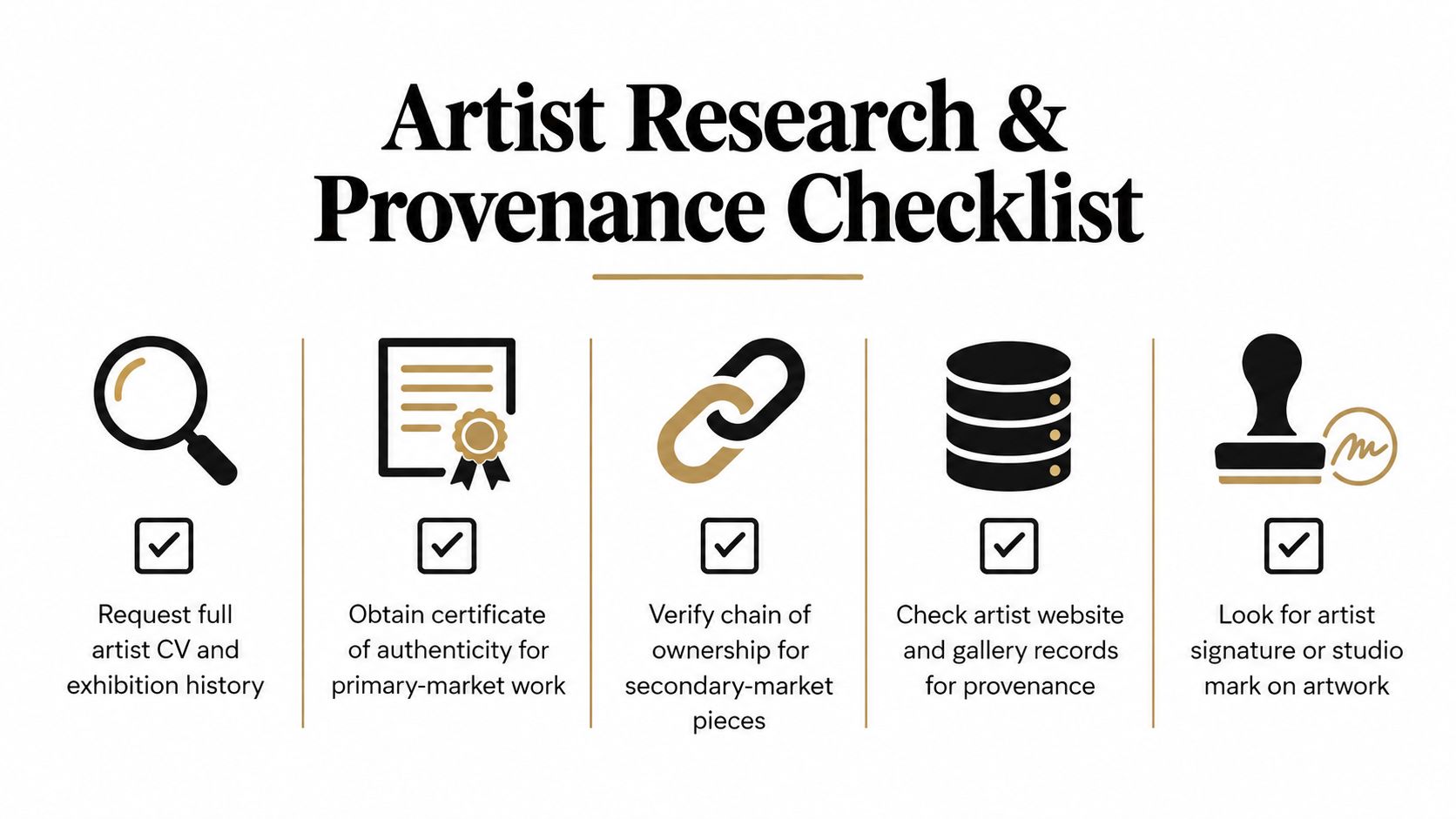
For primary-market work by a living artist, the minimum transaction file should include the artist's name, the title, date, medium, dimensions, price, seller, invoice, certificate or other authenticity confirmation, and provenance from the artist or authorized representative, based on the Responsible Art Market due diligence toolkit.
For work with prior ownership history, don't settle for vague phrases like “private collection” unless the seller can explain what that means in a way that can be supported. Specialist guidance says provenance should be traced through dated events and named parties, with supporting records such as export licenses, wills, inventories, photographs, and correspondence where possible. That same guidance also warns that provenance that looks “too clean” can be a red flag (specialist guidance on acquiring authentic artworks).
Match the paperwork to the object
This sounds obvious, but it's where people get sloppy. The record has to match the exact work. Title, medium, dimensions, date, and edition information if relevant should line up with the piece in front of you, or with current detailed images if you're buying remotely.
Use a short object check:
- Front image match: Compare composition, color areas, signature placement, and visible surface details.
- Back image match: Ask for the verso. Labels, stretcher bars, notations, and old inventory numbers matter.
- Medium consistency: If paperwork says oil, the surface shouldn't look like a digital print on canvas.
- Dimensions: Small discrepancies happen with framing, but the seller should explain them clearly.
A clean PDF isn't provenance. It's only a starting point.
Corroborate outside the seller's file
The strongest habit you can build is cross-checking. The Responsible Art Market guidance recommends confirming ownership claims against auction records, catalogues raisonnés, exhibition records, and stolen-art databases before committing funds. It also notes that forged provenance is a known fraud vector, and for major purchases buyers should verify certificates independently and obtain an independent examination when needed (due diligence toolkit).
That cross-check can be simple or deep depending on the work. If you're buying a contemporary painting from a living artist, you may only need the artist's own sales record, gallery history, and consistency across website, social channels, and invoice details. If you're buying older work, prior resale history matters much more.
Auction record infrastructure is stronger than many buyers realize. Institutional research libraries note auction databases covering sales from 1962 to the present and indexes for fine art and works on paper, which supports comparable research in markets where records are available (market note referencing database coverage).
If you want a plain-language overview of when outside expertise makes sense, this guide to art authentication services is a useful next read.
Research the artist like a buyer, not a fan
People often stop at “I like the work.” Keep going.
Look for consistency across these signals:
- Artist website and CV
- Exhibition history
- Gallery representation or past sales context
- Press, catalog mentions, or fair participation
- Signature or studio mark conventions
- Whether the pricing feels stable across channels
If your interest began with an object outside fine art, the same instincts still help. Collectors who buy natural history pieces or mineral specimens, for example, often ask about origin, condition, and labeling before they buy. Looking at a documented object like this vanadinite barite mineral can be a good reminder that provenance-minded buying isn't just for paintings. Serious buyers want the story attached to the object, not just the object.
One more point matters here. A neutral buyer-side guide has noted the need for clearer transaction-level due diligence in online art buying, especially around authenticity, provenance, payment protection, and delivery documentation (buyer-side collecting guides). That's exactly why this step deserves real time.
Understanding Pricing and Where to Buy With Confidence
Most overpaying happens in ordinary ways. A buyer falls in love fast, compares nothing, and assumes a polished sales channel means the price must be right.
It doesn't work that way. Price in art is part history, part positioning, part access, and part confidence. Two very similar works can be priced differently for reasons that are legitimate, and sometimes for reasons that aren't.
Read the market without getting hypnotized by it
Auction results can be helpful, but they're not a complete price list for the art world. They do show one important truth. A meaningful share of works don't sell. In 2025, the unsold rate at auction was 32% with 867,000 works sold out of 1.28 million offered (market update). That's useful because it reminds buyers that asking price is not the same as market acceptance.
For living artists in the accessible market, I look for internal logic more than hype. Does a larger work cost more in a way that makes sense? Do prices rise with complexity, medium, scale, or career development? Is the artist pricing similarly across direct sales, fairs, and gallery placements?
If a seller can explain the price clearly, that's a good sign. If they can only repeat that the artist is “hot,” keep your wallet closed.
Social discovery changed the front door
A lot of legitimate buying now starts on social media. Among collectors who bought from a gallery, 51% made at least one purchase through Instagram, and one market update says 63% of wealthy collectors bought directly from an artist in 2024-2025, with direct sales reaching 20% of total spending (Art Basel collecting update).
That doesn't mean Instagram is risky by definition. It means the first touchpoint is often informal while the transaction still needs to be formal. A direct message can start the conversation. It should not replace a proper invoice, documentation, and shipping terms.
For buyers who want a practical local starting point, this piece on where to buy local art lays out some of the most workable channels.
Where to Buy Original Artwork Compared
| Buying Channel | Best For | Price Transparency | Provenance Support |
|---|---|---|---|
| Direct from artist | Buyers who want access, conversation, and current work | Often good, but depends on how clearly the artist prices across sizes and series | Strong for new work if the artist provides invoice, certificate, and artwork details |
| Gallery | Buyers who want curation and a layer of vetting | Usually steady within the gallery program | Often stronger, especially when the gallery has a clear sales record and artist file |
| Online platform | Browsing across many artists and price points | Mixed. Easy to compare, but not all listings are equal in detail | Mixed. Read each listing carefully and ask for supporting documents |
| Auction | Buyers comfortable with comparables and bidding dynamics | High after the fact, less predictable in the moment | Can be useful, but buyers still need to review condition, attribution, and title carefully |
| Art fair | Seeing work in person across many sellers | Moderate. Good for comparison shopping in one place | Varies by exhibitor. Ask for the same paperwork you'd ask anywhere else |
What to ask about price
A few questions will tell you a lot:
- Has this artist sold similar works at similar prices recently?
- Is the piece part of a series, and are the prices consistent within that series?
- What's included in the listed price? Frame, crate, local delivery, certificate, or none of those?
- If it's secondary market, what supports the asking price? Auction comparables, exhibition history, or prior private sale context?
You don't need to bargain like you're buying a used truck. You do need to understand what you're paying for.
Commissioning Custom Work Versus Buying Existing Pieces
This choice is more personal than people expect. Some buyers want the spark of seeing a finished work and knowing instantly that it's theirs. Others want a piece built around a specific animal, memory, room, or mood.
Both paths can be great. They just solve different problems.
When a commission makes sense
A commission works best when the subject already carries emotional weight. Pet portraits are the obvious example, but I see the same thing with favorite birds, local marsh scenes, family hunting dogs, and wildlife that means something to the buyer beyond decoration.
The upside is specificity. You can choose size, orientation, palette direction, and sometimes the exact reference image. The trade-off is that you're buying a process, not just an object.
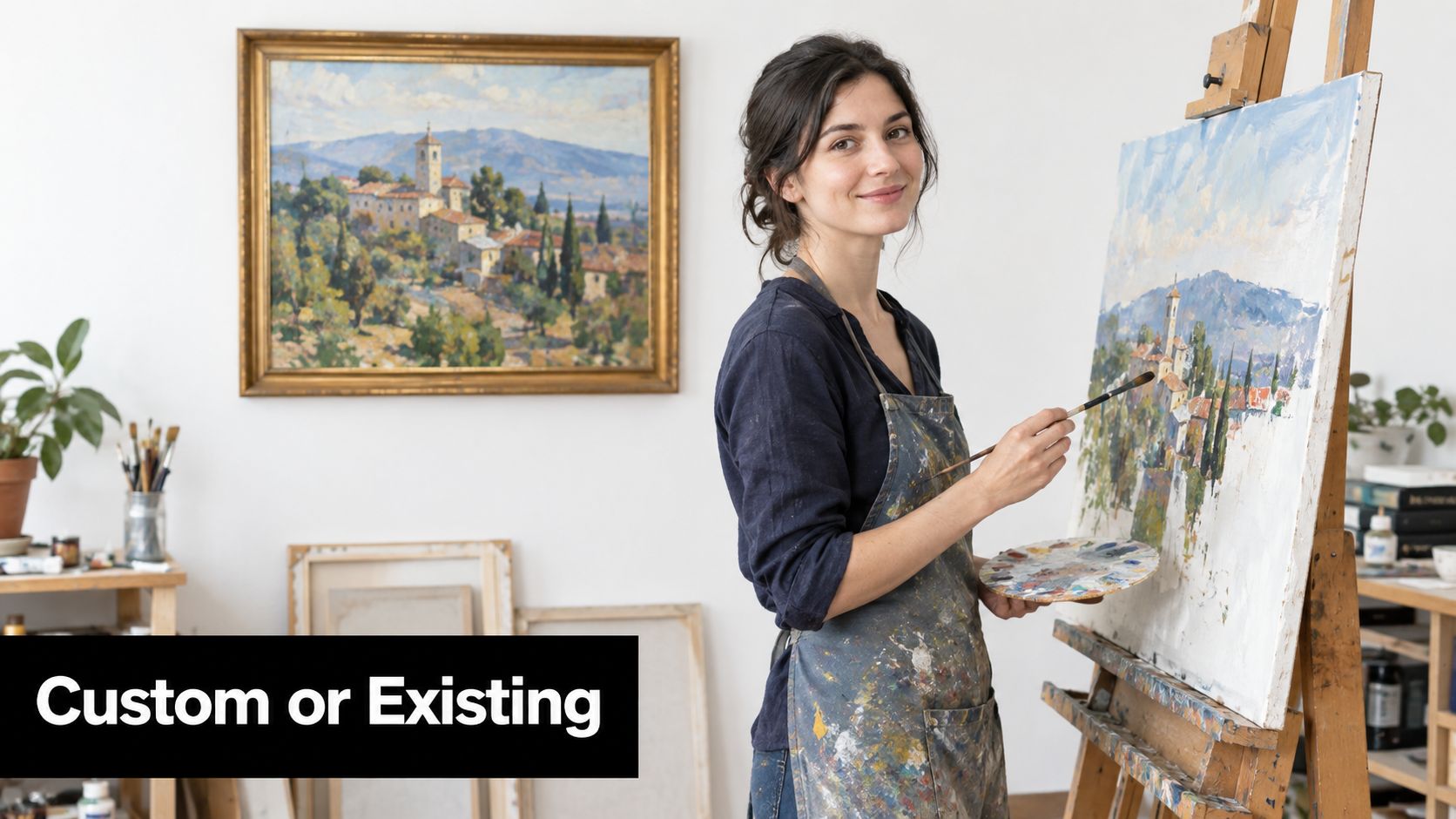
A strong commission conversation should settle these points in writing:
- Subject and references. Which photo or photos will the artist use, and who owns those images?
- Size and medium. Canvas, panel, paper, framed, unframed.
- Creative freedom. Are you asking for a close likeness, or are you hiring the artist for interpretation?
- Revision policy. What can change, and at what stage?
- Timeline and delivery. Especially important if the work is tied to a gift or event.
If you want a practical primer on the process, this guide on how to commission an artist covers the basics well.
When existing work is the better buy
Buying an existing piece is usually the easier move when you care most about immediacy, certainty, and surface quality as seen. There's no guesswork about whether the final piece will feel right. You can judge composition, color, texture, and emotional pull in the actual work.
Existing work also makes more sense when:
- You need the piece soon
- You're still learning your taste
- You fell for the exact painting already
- The artist's strongest work comes from spontaneity rather than custom structure
Buyer's test: If what you love is the artist's voice, commission might fit. If what you love is that exact piece, buy the finished work.
The real trade-off
Commissions can become too crowded with instructions. Buyers sometimes try to design the painting instead of hiring the painter. That usually leads to stiff work.
Existing work has the opposite constraint. It won't bend to your sofa, your wall color, or your favorite reference photo.
That's why the decision isn't just about customization. It's about whether you want collaboration or selection.
Handling Payment Contracts Shipping and Framing Like a Pro
Once you've chosen the work, the purchase should become boring in the best way. Clear terms, clear records, and no fuzzy assumptions.
A buyer wires funds with no written agreement. An artist ships without documenting condition. A seller says “insured” but can't explain what that means in transit. None of that is complicated to prevent.
Build a complete transaction file
For primary-market work, the paperwork should be complete enough that someone else could understand the transaction later without guessing. At minimum, keep the invoice, certificate or authenticity confirmation, seller details, artist details, artwork details, and any written provenance statement together in one file, consistent with the Responsible Art Market due diligence toolkit).
Your invoice should match the actual object and the actual agreement. If the work is framed, note that. If shipping is separate, note that. If the piece has existing condition issues, note those too.
Payment terms that protect both sides
A professional sale doesn't need pages of legal language, but it does need clarity.
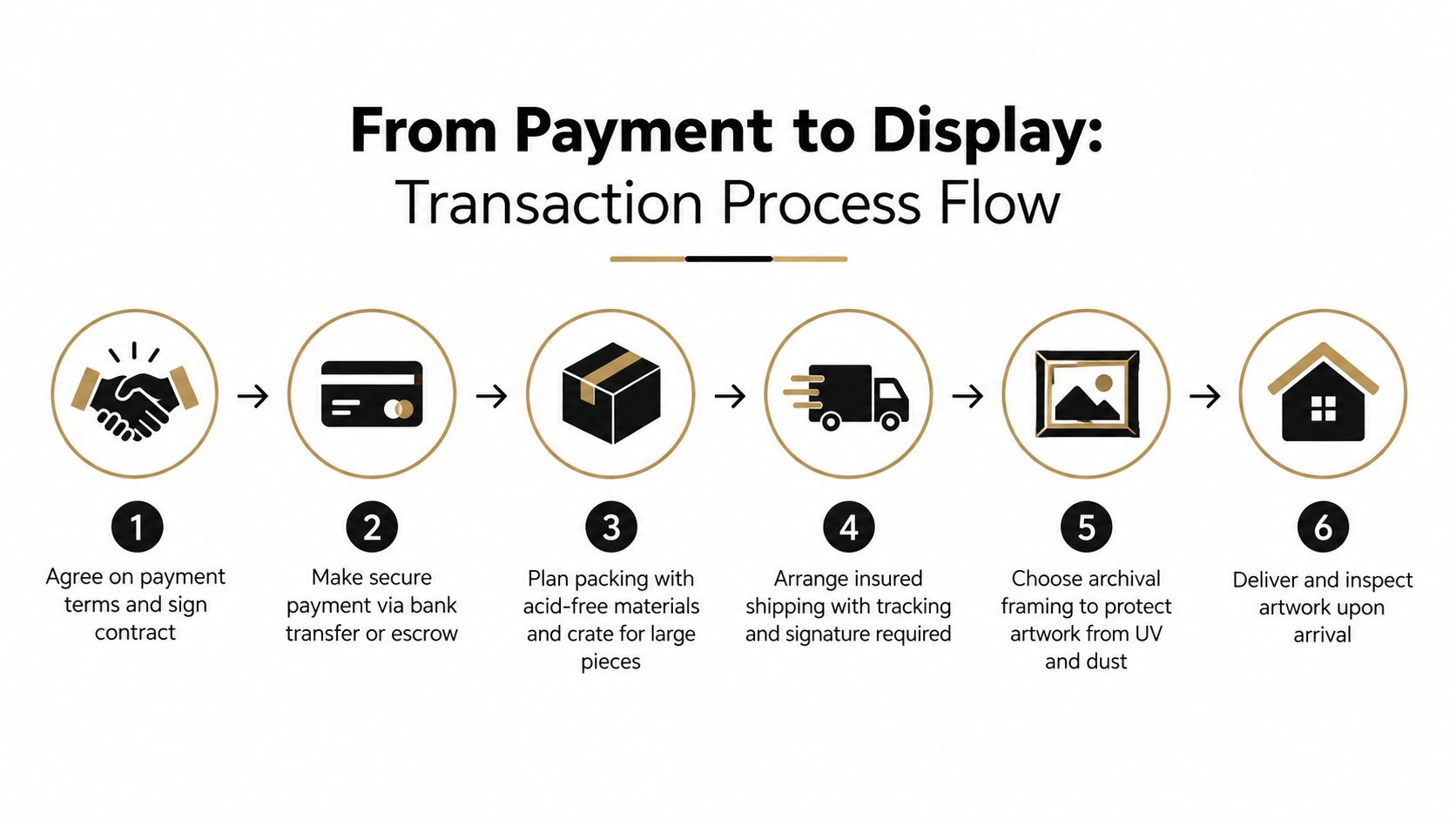
Use this handover sequence:
- Written agreement first: Spell out the work, the price, what's included, and estimated delivery timing.
- Secure payment method: Use a method that creates a record. For significant purchases, buyers often prefer a bank transfer to a verified business account or another documented payment route.
- Deposit terms for commissions: State whether it's refundable, when the balance is due, and what happens if references or scope change.
- Cancellation terms: Important for custom work and for any cross-border shipment already in process.
If you're buying from an artist-direct platform, one factual example in this space is William Tucker Art, which presents original works and states that each piece comes with a certificate. That's the kind of baseline disclosure buyers should look for from any seller.
Shipping is part of the artwork purchase
A lot of first-time buyers treat shipping like a side issue. It isn't. Packing quality affects condition, and condition affects value, insurance, and peace of mind.
Ask these questions before payment clears:
- Will the work ship framed or unframed?
- How will the surface be protected?
- Will large work be crated?
- Is signature required on delivery?
- Will you receive tracking and pre-shipment photos?
For buyers who want a practical look at packing standards, especially useful for understanding methods for prints and canvases, this guide on methods for prints and canvases is a helpful reference point.
Get photos before packing, during packing, and after boxing. Those images make claims and disputes much easier to handle.
Framing choices that preserve the work
Good framing is protection, not just decoration. Works on paper need different treatment from stretched canvas. Mixed media may need spacers. Acrylic surfaces scratch differently from oil.
When you discuss framing, ask about:
- Archival materials
- UV-protective glazing when appropriate
- Whether the frame touches the artwork
- How the hanging hardware is installed
- Whether the frame style can be changed later without harming the work
The right frame supports the piece. The wrong one can create conservation problems from day one.
Bringing Your New Artwork Home and Caring for It
The first job after delivery is inspection. Open the package carefully, keep the packing materials until you're satisfied, and compare the work to the seller's photos and written description. Check corners, surface, frame, hanging hardware, and the back.
Then make a home for the paperwork. Keep the invoice, certificate, shipping record, correspondence, and any condition notes together. If you ever insure, lend, donate, or resell the work, that file matters.
Hang it where the artwork can live well
Most art lasts longer when you avoid direct sun, high humidity, and heat sources. Kitchens, steamy bathrooms, and walls above radiators are tougher environments than buyers realize.
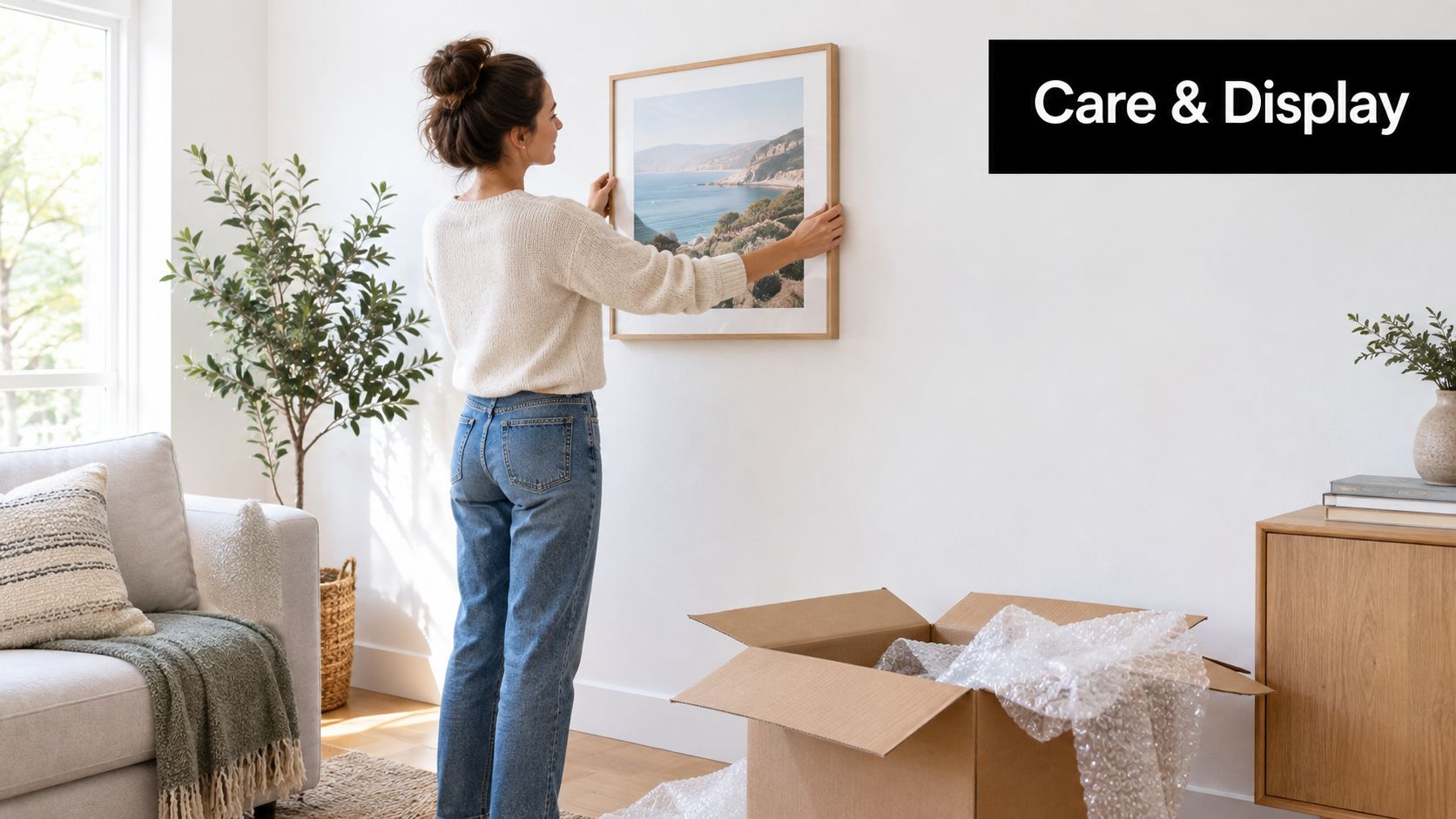
A few habits help right away:
- Use proper hardware: Match the hanging system to the wall and the weight.
- Dust lightly: Use a soft, dry cloth on frames. Don't clean painted surfaces casually.
- Watch the light: Rotate vulnerable works on paper if a room gets strong daylight.
- Save the crate or box if practical: It makes future moves much safer.
Live with it before you second-guess it
Original art reveals itself slowly. A good piece keeps giving you new things to notice. Texture changes with morning light. Color shifts when the room is quiet. Wildlife and conservation-themed work especially tends to deepen as you spend time with it, because the subject isn't just decorative. It carries feeling, memory, and attention.
That's the part people don't talk about enough. Due diligence protects the purchase. Living with the work is what justifies it.
If you're looking for original art with a clear artist-direct path, William Tucker Art offers wildlife, coastal, and pet portrait work from a New Orleans artist, along with custom commission options and articles that help buyers through the process. If that mix of subject matter and practical buying guidance fits what you're after, visit William Tucker Art.