
Your dog's best photo is already favorited, probably set as your lock screen. The wall above the sofa is still empty, and you've been through six artist pages tonight without getting any closer to a decision.
The gap between a good photo and a good piece of art on a wall is where most commissions wobble. A preview answers one question, whether the likeness is right. It tells you nothing about how the piece reads from eight feet away at seven in the evening, next to a lamp and a bookshelf. Style, size and placement get decided before you pay, and together they shape more of the outcome than the brushwork does.
Dog Wall Art Styles at a Glance
Stand in front of the bare wall with your phone in your hand and the question stops being abstract. Photo, painting or something stylised? Horizontal or tall?
Dogs are family in most households buying this work, and the numbers explain the demand. The American Veterinary Medical Association reports that 45.5% of U.S. households owned at least one dog, roughly 59.8 million dog-owning households and 89.7 million dogs, which is exactly why a portrait of one named animal outsells a generic pet print.
Five styles cover nearly everything on the market.
| Style | Best for | Typical medium | Wall fit |
|---|---|---|---|
| Classic oil portrait | Formal rooms and heirloom display | Oil on canvas | Traditional decor, wood and warm lamps |
| Bold acrylic portrait | Modern or colourful spaces | Acrylic on canvas | Stands out against neutral walls |
| Mixed-media with abstract background | Contemporary homes | Acrylic and oil on canvas or wood panel | Integrates the dog into the room |
| Tight face crop | Small walls and gifts | Any medium | Strong focal point, can feel heavy |
| Full-body scene | Hallways and open walls | Any medium | Shows setting and personality |
Classic oil portrait. Depth of tone and a finish that ages into an heirloom. It belongs in a dining room with wood furniture; put it in a white room with bright modern seating and it looks like it wandered in from another house.
Bold acrylic portrait. Acrylic holds saturated colour and a crisp edge, so one head on a pale grey wall becomes the focal point of the room. Two on the same wall compete.
Mixed-media with an abstract background. Detail in the dog, loose colour behind it, so the painting borrows the room's palette instead of fighting it. If your walls already carry weave, rattan or layered textiles, warm, textured wall art pairings show how much texture a single piece can sit beside before the wall gets noisy.
Tight face crop. The most identity per square inch, which makes it the safest small-wall and gift choice. Gift buying is routine now: the American Pet Products Association reports that 44% of dog owners purchased a birthday gift for their dog, up from 36% in 2022.
Full-body scene. Space for a chair, a garden or a favourite beach, and space for posture, which is where personality lives. It needs width, so give it a hallway or an open wall.
If you want the softness of a crop without the visual weight, dog watercolor portraits sit between the classic and the abstract.
Shortlist two styles before you read on. The sizing and lighting choices below depend on which two you're weighing.
Sizing and Cropping for Your Wall
Ordering too small is the most common mistake in this work. A 12 by 16 inch portrait above a three-seat sofa looks like a postcard that got lost on its way to the frame shop.
Start from the furniture rather than the frame. A piece above a sofa usually wants to run about two-thirds of the sofa's width, so a 90 inch sofa wants something in the region of 60 inches of artwork, either one large canvas or a group that totals it.
| Wall space | Suggested width | Crop to use | Viewing distance |
|---|---|---|---|
| Above a sofa | About two-thirds of sofa width | Head and shoulders or full body | 8 to 10 feet, from the opposite seating |
| Narrow hallway | 16 to 24 inches | Head and shoulders, vertical | 3 to 5 feet as you pass |
| Dining room wall | Centred on the wall, roughly 24 to 36 inches | Full body or setting | 5 to 8 feet |
| Bedroom headboard wall | Matched to the headboard width | Head and shoulders | 6 to 8 feet, from the bed |
Head and shoulders preserves identity best: eyes, nose, ear set, the exact markings. In a small room the same crop can feel heavy, because the face fills the frame and the eye has nowhere to rest.
Full body needs around 24 inches of width before it reads properly, and it rewards open space. It also lets you place the dog somewhere specific: the back steps, the beach you walk every Sunday, the chair it isn't allowed on.
Orientation follows the wall. A tall narrow hallway wants a vertical piece, a wide sofa wall wants horizontal, and it's better to re-crop a photo than to squeeze a wide scene into a vertical frame.
The crop is limited by your photo. No artist can paint a full body from a head shot, so check what makes a usable dog portrait photos reference before you commit to a size.
Practical test: tape paper outlines in two sizes to the wall, leave them up for a few days, and look at them from the sofa, the doorway and the spot where you drink your coffee.
If the portrait is part of a bigger room refresh, wall decor ideas for Virginia homes makes the useful point that one strong piece beats six small ones fighting over a single wall.
What Drives the Price of a Custom Dog Portrait
Commissioned work is priced by the hours it takes and the materials it consumes, so five drivers explain almost every quote you'll receive.
Size. Width sets the canvas cost and the working time, and the relationship isn't linear. Doubling the width roughly quadruples the surface to cover, which is why stepping up from 16 inches to 30 inches is the single biggest price jump.
Medium. Oil moves slower than acrylic: more mixing, longer drying, more layers. Expect that gap to show in the quote rather than disappearing into a rounding difference.
Number of subjects. Two dogs means a second set of markings, a second pair of eyes, and a composition that has to say something about how they sit together.
Background. A plain field of colour is the least expensive background and often the best looking. A specific garden, street or interior adds reference work and painting hours.
Framing and glazing. Frequently quoted separately, and worth asking about early, because a good frame package can account for a meaningful share of the total.
Compare quotes on equal terms rather than on the headline number:
- Ask every artist to price the same width, medium and crop.
- Ask whether framing, UV-filtering glazing and shipping sit inside that figure.
- Ask how many rounds of revision are covered, and what happens if your photos arrive late.
- Compare the deposit and final payment schedule, not just the total.
Published ranges won't help you much, because artists price differently by region, medium and workload. Get the quotes, then weigh the piece over its lifetime on the wall, since paying twice for the same subject rarely works out cheaper than paying once.
Timing matters too. "Personalized dog gifts" averaged 2,400 U.S. searches per month over the year ending in 2025 and climbed to 8,100 in December 2025, according to MEGA Management. If the portrait is a gift, order in the autumn, before everyone else has the same idea.
How the Commission Works and What to Confirm Before You Pay
A pet portrait is the artist's interpretation of your dog, built from the pictures and information you supply. That one sentence carries the whole risk of the project: the painting can only be as specific as the references are, and you're the one supplying them.
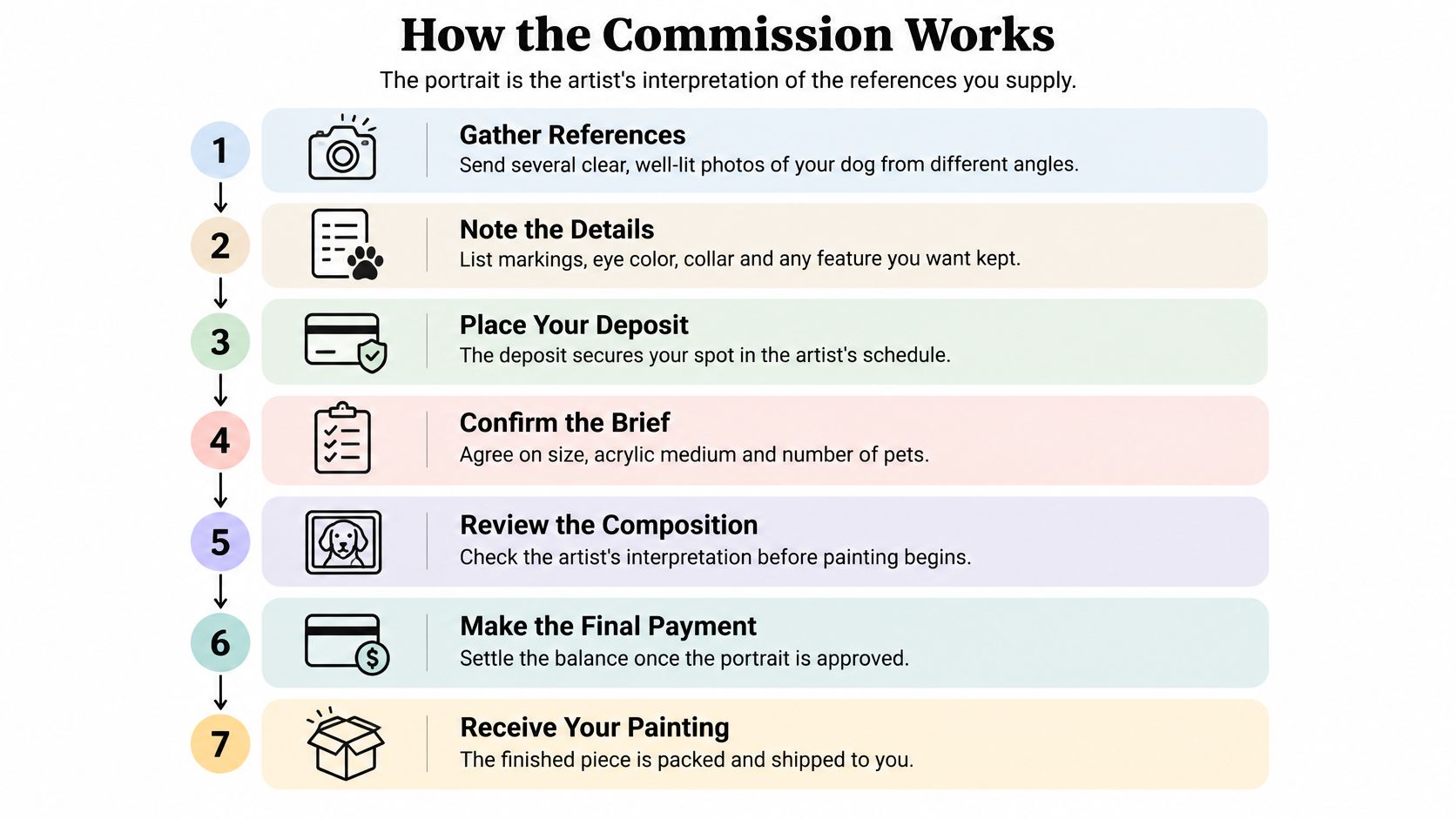
- Choose style and size. Lock these in first, because canvas cost, crop and background all follow from them. The usual slip is changing size after the deposit is paid.
- Send reference photos. Photos go by email attachment or by text to 910-273-2420, whichever is easier. Several angles in decent daylight let the artist read the structure of the face. The usual slip is three blurry phone shots taken at dusk.
- Agree crop, background and colour. Settle these in writing before a brush touches canvas. Ask how the crop reads at the size it will hang, since a tight head study that looks intimate on a phone screen can lose the dog entirely from across a room.
- Pay the deposit. A $50 non-refundable deposit starts the work and holds your place in the schedule, paid online through the William Tucker Art Personalized Pet Artwork Deposit.
- Painting begins. Timing varies with the number of subjects, custom backgrounds, and waiting on payments or references. The usual slip is late reference material, which pushes the whole job back.
- Check the preview and approve the finish. Judge it the way you'll judge the finished piece, at viewing distance rather than nose-to-screen. Check likeness, markings and eyes, and raise anything that feels off now rather than after varnish.
- Pay the balance on delivery. Final payment is due upon delivery, then the piece is packed and shipped.
Without delays on your end, most portraits are completed and delivered within 7 to 10 business days of receiving all your reference materials. No fixed delivery date can be promised, because the clock depends on the number of subjects, the background, and how quickly references and payments arrive.
Before you pay anything, confirm five things:
- The size and crop you settled on for the wall, so nothing changes after the deposit.
- When the references will be sent, and in what form.
- The timeline, described as an estimate rather than a guarantee.
- Final payment due on delivery, so there's no surprise invoice mid-project.
- How the finished piece will be lit and protected once it's hanging, since room light shapes how the colour reads more than the paint itself.
Commissioning a portrait means agreeing to the Pet Portrait Order Agreement, so read it before you commit. The artist keeps full copyright and reproduction rights to the painting, which matters if you're picturing prints later or a copy for a family member.
A commission that goes wrong rarely fails on likeness. It fails on the details nobody confirmed in writing: a size that shrank on the wall, a background that fought the room, a deadline that was never promised.
Frames, Glazing and Lighting for True Colour
A portrait can look perfectly balanced on a screen and still look wrong above the sofa. The file hasn't changed; the viewing conditions have. The International Color Consortium explains that output profiles compensate for the gap between a reference viewing condition and the actual environment, including how the eye adapts and how light flares off a surface. Translated to a living room: a file can be perfectly colour-managed and still read too warm, too cool, flat or contrasty under your lamps, because the profile wasn't describing that room.
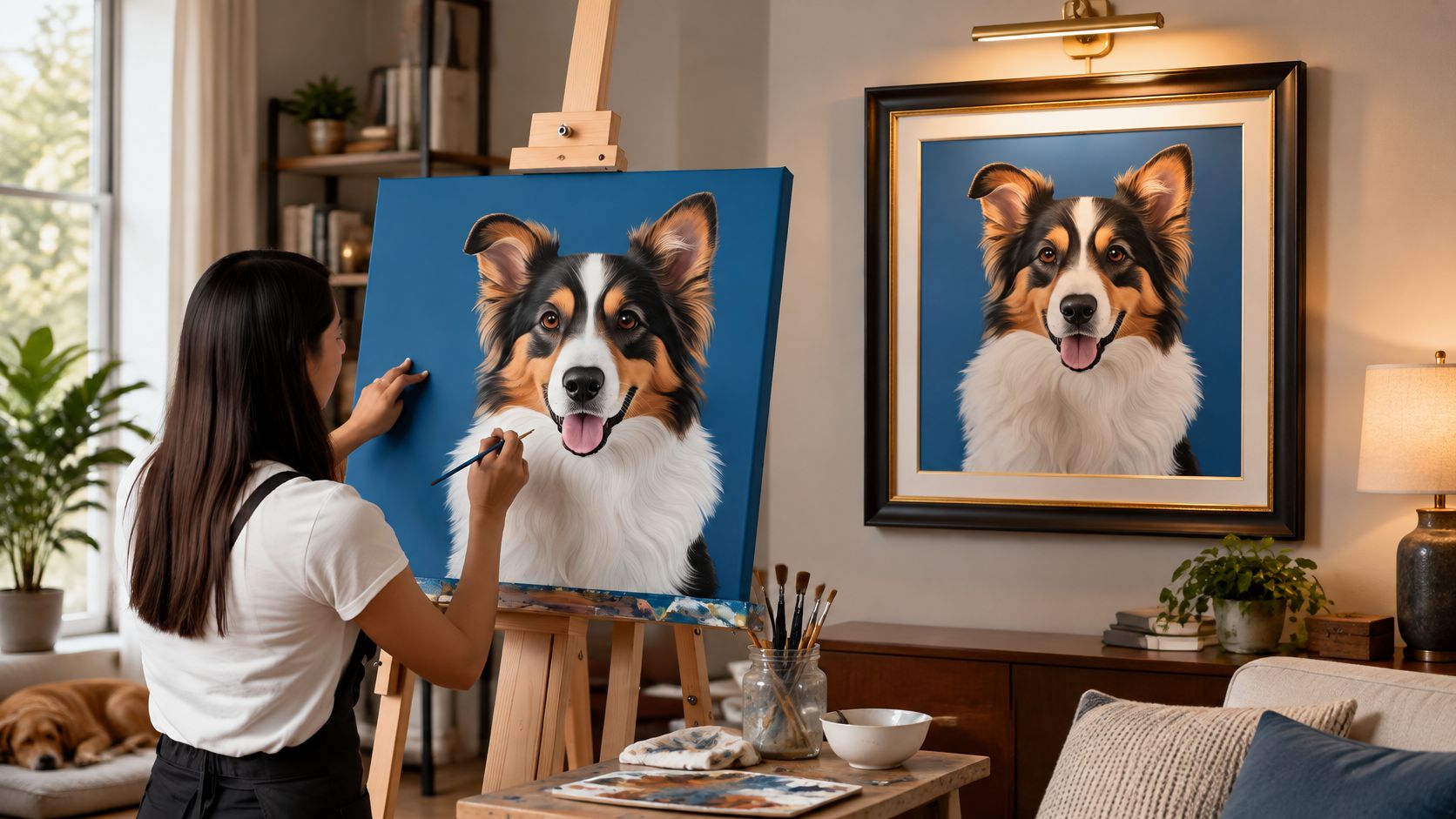
Three checks before the frame goes on:
- Ask for a proof under the right light. A proof judged under lighting close to the final spot tells you more than one judged on a calibrated display.
- Confirm the file is colour-managed for the paper or canvas you picked, rather than exported and printed without colour management.
- Choose lighting with high colour fidelity. The museum-lighting guidance cited by the International Color Consortium puts it around Ra ≥ 90 or TM-30 Rf ≥ 90, with glare kept under UGR 19.
Fur is the hardest part of a portrait to judge under poor light. A black dog's coat only shows its detail through subtle shifts in hue and value, and a white dog only reads clean when the light doesn't tint it. Spectrally uneven light flattens exactly those transitions, which is why the same portrait can look muddy in one room and vivid in another.
For glazing, matte glass or acrylic cuts reflections when the portrait faces a window or a busy wall, and it costs you a little sparkle. Match the frame to the painting's own colours rather than to the sofa. A frame that competes with the art pulls the eye away from the dog, which is the wrong outcome.
View the piece at dusk and again at midday before you decide on a frame or a lamp. Two viewings tell you more than any showroom.
If you're framing a print yourself, this guide to how to frame art prints covers the practical order of operations.
Where to Hang Your Portrait So It Lasts
That bright south-facing wall is the worst place in the house for a painting. Sunlight is intense and UV-rich, and the damage doesn't announce itself: a blue background drifts toward grey, a red collar dulls, and two summers later the whole piece looks tired.
The Canadian Conservation Institute guidance puts the trigger for UV-filtered glazing at indoor UV above 75 microwatts per lumen, or whenever windows and lamps carry no UV filters, and notes that such glazing screens roughly the 300 to 400 nm band responsible for fading or altering dyes and pigments.
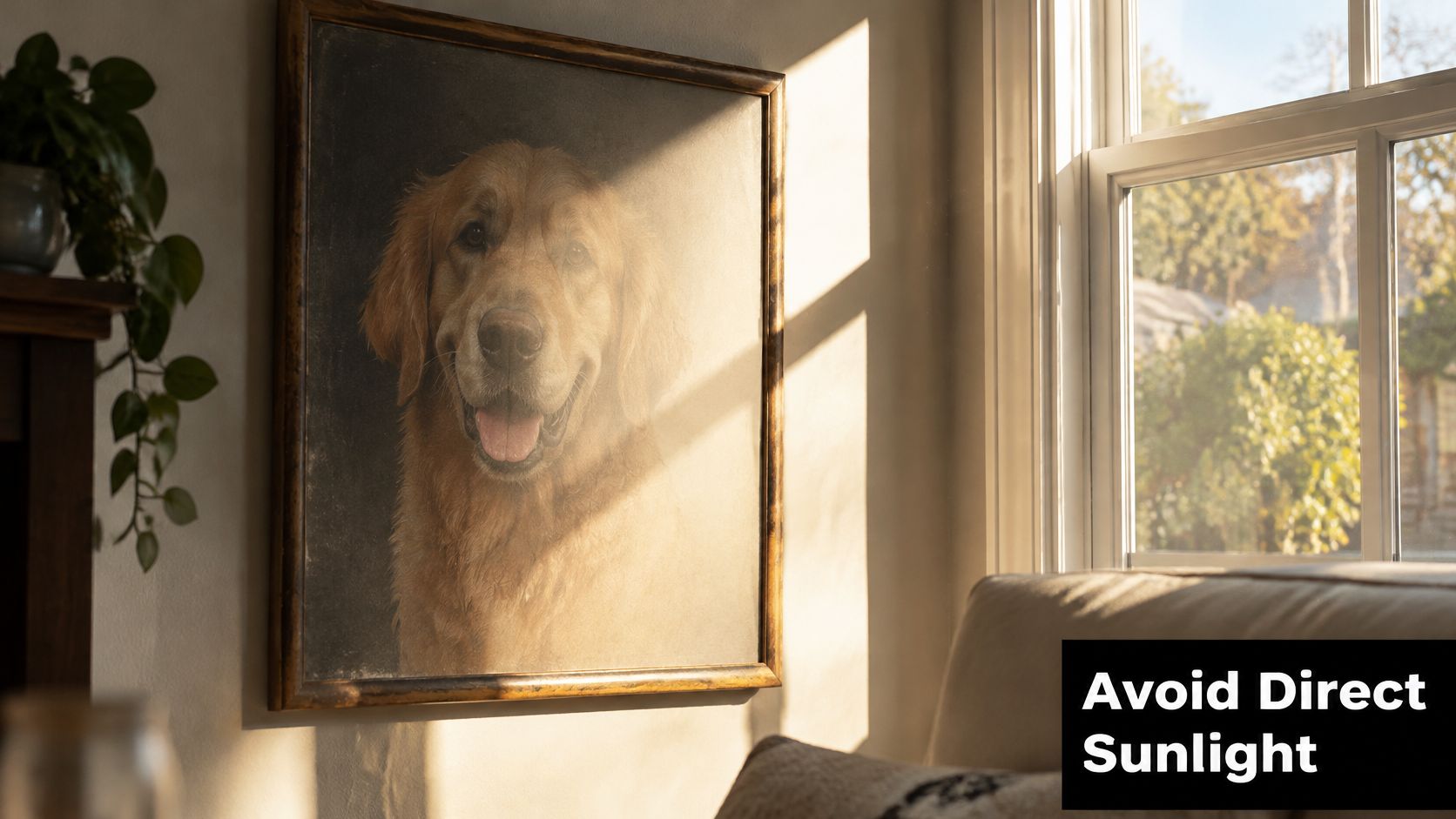
Saturated fur colours, dark backgrounds and mixed-media pieces are the most sensitive to this. Fading shifts the contrast between the dog and the ground behind it, and that contrast is what carries a portrait across a room. A piece that read crisply at viewing distance on day one can go soft and flat long before any single colour looks obviously wrong.
Four spots deserve a hard no before you even reach for the tape measure:
| Spot | Why it fails |
|---|---|
| Any wall that gets direct sun | UV exposure builds quietly over seasons |
| Kitchen | Heat, steam and cooking residue |
| Bathroom | Humidity swings stress paper and canvas |
| Above a radiator or beside a heating vent | Repeated heat cycling dries the surface |
Location is only half the job in a busy household. Fix into a stud or use a proper anchor rated for the weight rather than a single nail in plaster, because a well-placed portrait that falls is still a loss. This step-by-step picture hanging guide walks through the measuring and fixing in the right order.
Before the hammer comes out, watch the candidate wall for a full day. Check for direct sun at any hour, a heat source nearby, any dampness in the plaster, and whether a wagging tail or a passing shoulder can reach the frame at that height. The portrait earned its place in the preview. The wall is what decides whether it still looks like your dog in ten years.
Materials, Sustainability and Long-Term Value
A portrait that stays on your wall for thirty years has a smaller footprint than a cheap print replaced every few, and that lifespan matters more than the box it arrived in. Conversations about sustainable art tend to stall on packaging, which is the smallest part of the answer.
Buyer intent is clearly there. Recent pet-consumer research finds that nearly 70% of global pet owners try to make environmentally positive everyday choices, while sustainable-packaging claims in pet care grew 18.6% year over year, according to PetCareIns. That's a good reason to ask a seller real questions, and a bad reason to accept a green label as a proxy for quality.
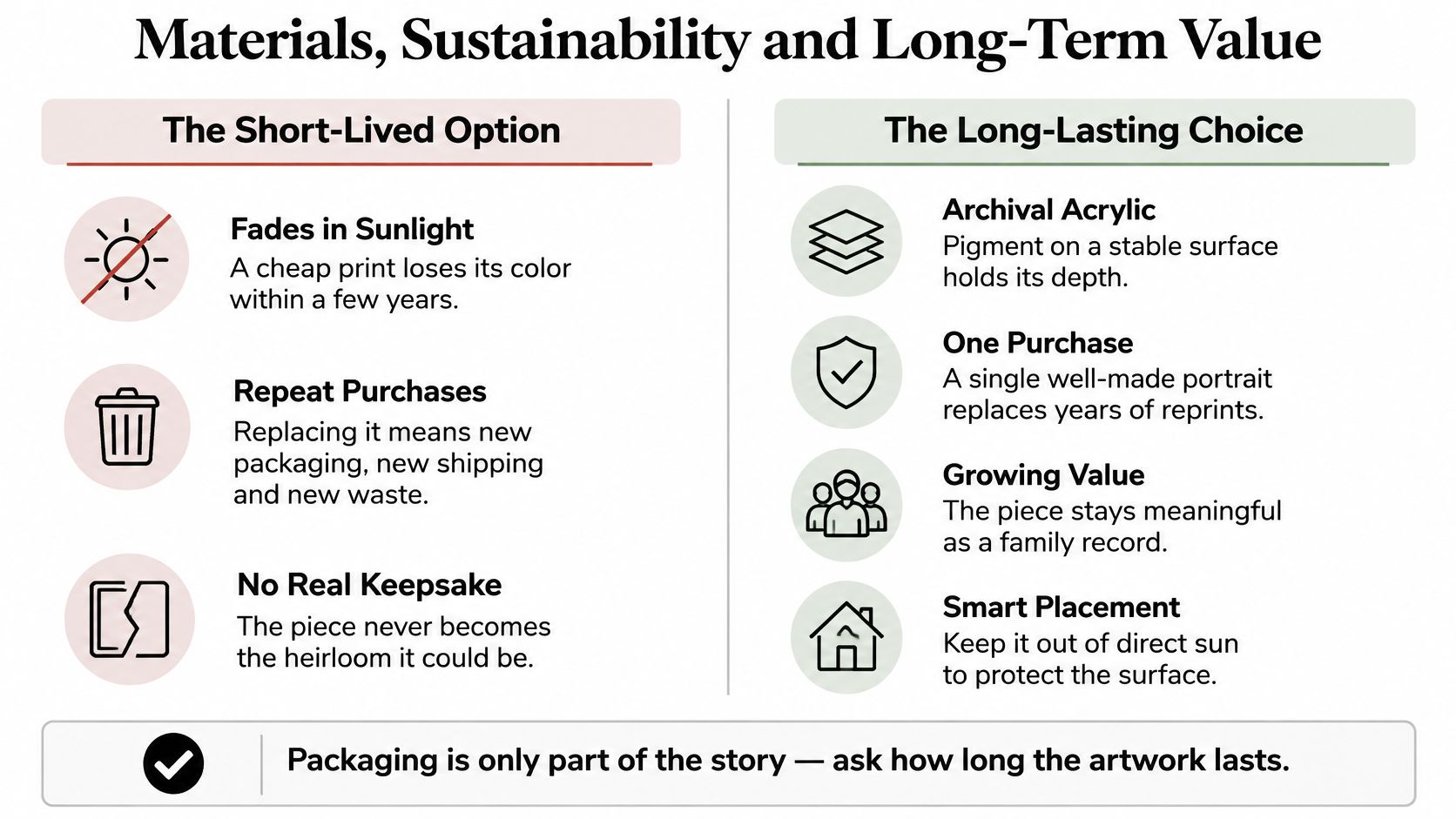
Here's where the trade-offs sit:
- Paper versus canvas. Paper needs glazing and matting to survive, which adds cost and material; canvas on stretcher bars is lighter to ship and can hang without glass.
- Paints and inks. Pigment-based paints and archival inks stay stable far longer than dye-based alternatives, and they cost more for that reason.
- Archival backing and stable mats. These are invisible and unglamorous, and they are what keeps a piece from yellowing or buckling after a decade.
- Local versus international fulfilment. A local frame shop or artist cuts shipping distance, but a specialist commission may travel further; ask which it is rather than assuming.
- Recyclable packaging. Worth having, small in impact compared with the artwork's lifespan, and easy for a seller to overstate.
An acrylic on canvas built up in layers and transparent glazes shows the durable path in practice. It hangs without glass, holds its depth at normal viewing distance under ordinary room light, and if your tastes or your wall change, it can be reframed rather than replaced. That is the whole argument in one object.
Ask any artist three questions before ordering: what substrate and paint or ink you're getting, how the finished piece is packed for shipping, and what happens at end of life if it's ever damaged or you no longer want it.
Choosing the style is the fun part, and it's only a third of the decision. William Tucker Art takes dog portraits as commissions and paints originals in acrylic, oil and mixed media on canvas and wood panel, with prints also available. Send clear reference photos by email attachment, or text them to 910-273-2420, and start the order at William Tucker Art.