
You walk into a room that feels pleasant but unfinished. The furniture is comfortable, the walls are clean, and sunlight moves across the floor, yet one carefully chosen coastal painting could change the entire atmosphere. A broad horizon might make the room feel quieter, while a close view of an oyster, seabird, or breaking wave could bring in a stronger sense of place.
Coastal themed artwork offers more than a familiar beach scene. It can hold memories of travel, record a working harbor, honor wildlife, or create a visual pause in a busy home. To choose well, it helps to understand the tradition behind the images, the subjects artists return to, and the emotional effect created by color, scale, and detail.
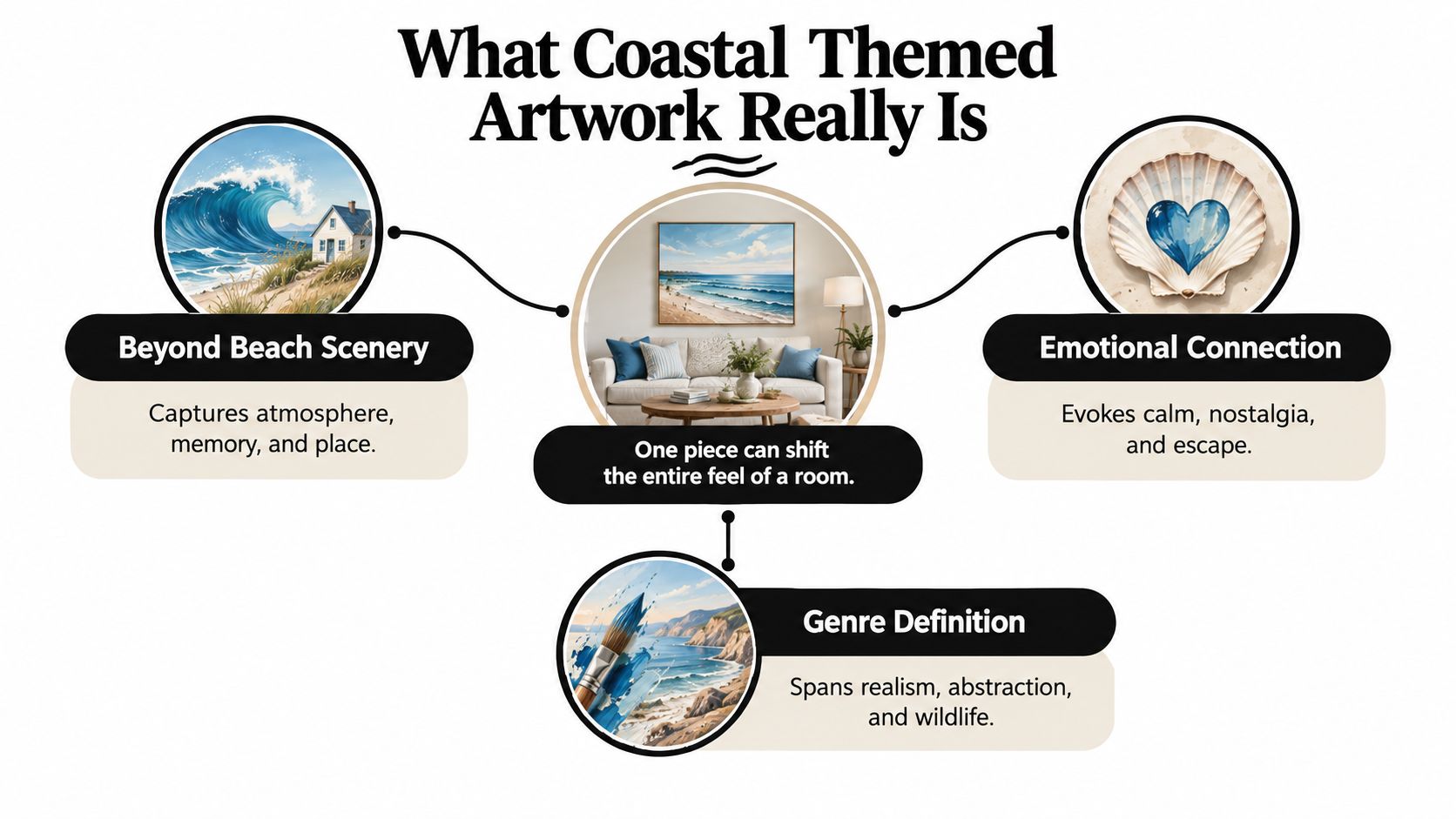
What Coastal Themed Artwork Really Is
Walk through a coastal collection and you'll quickly notice that not every work shows sand, sunshine, and turquoise water. One painting may present a storm over a fishing harbor. Another may focus on marsh grass, a wading bird, or the side of a working boat. A third may reduce the shoreline to a few horizontal bands of blue, gray, and ochre.
These works belong to the wider tradition of marine or maritime art, which includes seas, shorelines, harbors, ships, storms, fishing, naval conflict, and coastal leisure. The earliest known pure marine painting is generally identified as Portuguese Carracks off a Rocky Coast, created around 1540 and held by the National Maritime Museum in Greenwich, London. Marine painting became especially influential during the 17th century, when the Dutch Republic developed it into a major specialization shaped by commerce, fishing, shipping, and naval power. The history of marine art shows why coastal imagery has long carried both visual beauty and cultural meaning.
More than a view of the beach
A shoreline painting can suggest escape, but it can also describe labor, movement, weather, and belonging. A harbor may refer to trade and travel. A marsh may point toward habitat and vulnerability. A family may respond to the same scene through personal memory, perhaps recalling a holiday, a home region, or time spent near the water.
That range explains why coastal art works in different settings. A quiet horizon can settle a bedroom or reading corner, while a storm, regatta, or bird in flight can give a living room more energy. Even an interest in the coastal lifestyle can extend beyond wall art into experiences such as stylish paddleboarding in Florida, where movement, water, and outdoor identity become part of the visual story.
Working definition: Coastal themed artwork is art that uses shorelines, marine environments, coastal wildlife, human activity, or the atmosphere of the water to express a sense of place, mood, memory, or relationship with the sea.
That definition leaves room for realism, abstraction, historic imagery, and contemporary wildlife painting. It also gives you a better question than “Does this look beachy?” Ask instead, “What kind of coastal experience does this work ask me to feel or understand?”
Common Subjects and Visual Motifs
Artists return to certain coastal subjects because each one offers a different entry point into the environment. Start by identifying the main subject, then ask what it contributes beyond decoration.
Shorelines and beaches
A wide beach with a low horizon usually emphasizes openness and distance. It may create a restful feeling, especially when the artist leaves generous space around a small figure, boat, or bird. A closer shoreline view feels more tactile. Look for shells, wet sand, footprints, tide lines, and small changes in texture.
Dunes, seagrass, and marshes
Dunes and marshes introduce structure without relying on buildings or boats. Repeated grasses can guide the eye, while marsh channels create winding paths through the composition. These subjects also carry a stronger ecological identity than a generic stretch of sand. A Louisiana marsh, for example, speaks to wetlands, wildlife, storms, and human stewardship in ways a location-free beach may not.
Birds and shoreline wildlife
Seabirds, wading birds, oysters, fish, turtles, and marine mammals make the coast feel inhabited. A bird standing still can create quiet observation, while one lifting into flight adds motion. Pay attention to the animal's placement. A small subject surrounded by open water may communicate solitude, whereas a detailed close-up can encourage careful attention to anatomy, texture, and habitat.
Boats, harbors, and working water
Boats and ports connect coastal art to human history. A ship portrait may identify a particular vessel, while a harbor scene can suggest commerce, travel, or community life. The Kona Honu Divers photo gallery offers another useful visual reference for studying marine environments, reef life, underwater color, and the details that artists may translate into paint.
Tides, shells, and weather
Tide pools, oyster beds, shells, and reef forms reward close looking. Their patterns suit both realism and abstraction. Weather changes the emotional register most quickly. Pale haze and calm water create repose, while wind, dark clouds, sharp foam, or a tilted horizon can bring urgency without showing any human drama.
The same ocean can therefore support many stories. Before judging whether a painting is “coastal enough,” identify whether its center of attention is place, wildlife, weather, history, or atmosphere.
Coastal Color Palettes and How They Work
Coastal color isn't limited to blue. The most convincing palettes often depend on a relationship between cool water and sky tones, earthy shoreline colors, and one or two carefully controlled accents.
A painting built from pale blue, warm gray, and softened white tends to feel airy and quiet. Deep navy against bright foam creates stronger contrast and a more dramatic reading. Marsh greens, brown mud, ochre sand, coral, or oyster tones can prevent the work from becoming visually flat or anonymous.
A 2025 study of urban coastal visual environments found a positive relationship between perceived coastal openness and aesthetic perception, with a reported correlation of 0.516, while color diversity also showed a positive relationship at 0.431. The study also found that blue content, marine elements, and expansive views increased perceived distinctiveness, and its machine-learning model predicted perception of coastal-road imagery with 77% to 87% accuracy. These findings concern environmental imagery rather than paintings, so use them as prompts for composition testing, not as a formula for artistic quality. The PLOS ONE study provides the underlying context.
Coastal palette choices and the moods they create
| Palette | Typical Mood | Best For |
|---|---|---|
| Pale blue, soft white, warm gray | Quiet, open, restorative | Bedrooms, reading areas, calm interiors |
| Deep navy, bright foam, charcoal | Dramatic, energetic, weather-driven | Living rooms, entryways, statement walls |
| Sea green, marsh olive, sand | Natural, grounded, regionally specific | Homes with wood, linen, or botanical materials |
| Coral, shell pink, turquoise | Lively, warm, vacation-inspired | Informal rooms and sunny social spaces |
| Indigo, muted teal, rust, ochre | Reflective, historic, textural | Studies, libraries, and traditional interiors |
Use openness without losing character
A readable horizon or open negative-space zone can make a composition breathe. That doesn't mean the canvas needs to be mostly empty. A narrow strip of sky above a dense marsh, a bird interrupting a wide beach, or a warm shell color against cool water can create the contrast that gives the work its identity.
Practical rule: Ask whether the palette has a hierarchy. One color should lead, supporting colors should establish place, and accents should direct attention rather than compete for it.
When you're choosing artwork, don't match only the wall paint. Compare the piece with the room's wood tones, upholstery, flooring, and natural light. A blue painting may look crisp beside white walls but heavy beside cool gray furniture. A marsh-focused work with olive and umber may connect more naturally with walnut, rattan, or woven textiles.
Major Coastal Styles and Where They Fit
Collectors usually encounter coastal art through a handful of recognizable approaches. None is automatically more serious or more suitable. The right choice depends on whether you want the work to describe a place precisely, evoke a feeling, or invite a slower interpretation.
Realistic seascapes
Realistic seascapes concentrate on observable light, water, atmosphere, and weather. You might see the translucent edge of a wave, reflections beneath a cloud bank, or carefully rendered wet rocks. This approach suits collectors who enjoy technical observation and rooms with traditional furniture, where the work can function as a recognizable coastal scene.
Romantic coastal landscapes
Romantic coastal themed artwork heightens mood. The sunset may be richer than ordinary light, the cliffs more imposing, or the empty beach more emotionally charged. These paintings suit bedrooms, reading nooks, and spaces intended for retreat. Their strength is atmosphere, but their idealization may feel less appropriate if you're seeking a precise sense of local ecology.
Abstracted marine compositions
Abstracted marine work may keep only the essentials of coast and water, such as horizontal bands, layered marks, flowing lines, or the tension between open space and dense form. It can suit a modern office or a minimalist interior because color and structure carry the meaning. Look closely before buying. Some abstract work suggests the sea indirectly, while other pieces use marine color without referring to a specific coast.
Wildlife-focused coastal scenes
Wildlife-focused work makes the animal or habitat the central subject. A seabird, oyster, turtle, or marsh creature may receive detailed treatment against a looser background. This style suits natural wood frames, homes with organic materials, and collectors who want the painting to create a conversation about species and place.
Nautical and harbor scenes
Harbor scenes, ship portraits, and naval imagery emphasize human contact with the water. They can bring historical weight to studies, libraries, dining rooms, or spaces with an established maritime connection. The trade-off is that boats and ports may create a busier visual rhythm than a quiet horizon.
For a broader sense of how furniture and materials support coastal interiors, browse these examples of coastal looks from Indian River. The artwork should complement that environment without becoming a themed backdrop.
The following video can also help you observe how a coastal image is built through shape, light, and atmosphere.
How to Choose Coastal Artwork for Your Space
A good purchase starts with the room, not the trend. Before you browse, decide what you want the artwork to do. Should it lower the visual temperature of a bedroom, add movement to a living room, connect a home to a region, or create a focal point above a console?
Begin with function and light
A calm, low-contrast work can support rest. A brighter or more weathered painting can hold attention in a social room. Study the wall at different times of day before choosing. Strong daylight can reveal texture and color variation, while a dim wall may need lighter values to prevent the piece from disappearing.
Scale matters just as much as subject. Measure the available wall and consider the furniture beneath it. The infographic's 50% to 75% wall-width guideline can serve as a starting point, but the final decision should account for the frame, nearby objects, and the visual weight of the work. A narrow vertical wildlife painting may succeed where a wide seascape would overwhelm the wall.
Treat framing as part of the artwork
A frame changes how the coast is read. Pale wood can reinforce a natural, relaxed mood. Dark wood or black can add structure and make pale water appear brighter. A slim metal frame may suit an abstract composition, while a deeper frame can help a detailed wildlife work feel grounded.
Glazing deserves equal attention. In a bright room, non-reflective or UV-filtering glazing can improve visibility and reduce exposure to damaging light. For more guidance on proportions, placement, and practical wall-art decisions, use this guide to choosing wall art.
Protect the work in coastal conditions
Salt-laden air, humidity swings, heat, and flood-related dampness can accelerate deterioration. Museum conservation guidance identifies relative humidity above 70% as a condition that can encourage mould and corrosion, while levels below 40% can make paper, textiles, and other hygroscopic materials brittle. A practical target for many framed works is approximately 45% to 55% relative humidity, with limited daily variation. Museum conservation guidance explains these risks in greater detail.
Use a well-fitted frame with archival backing, place the work away from exterior dampness and direct sun, and avoid kitchens, bathrooms, and HVAC discharge. If the piece has high monetary or sentimental value, a combined temperature and humidity logger can show whether the wall offers a stable environment.
Use a simple buying checklist
- Room function: Choose calm, energetic, historic, or contemplative imagery according to how people use the space.
- Light conditions: Check the wall in morning, afternoon, and evening light.
- Scale and proportion: Measure both the wall and the furniture before you shop.
- Framing and glazing: Select materials that support visibility and long-term protection.
- Collection logic: If you're buying several works, vary scale or subject while repeating one color, frame material, or regional idea.
The strongest collection doesn't make every piece look identical. It gives different works a reason to belong together.
Inside William Tucker's Coastal Collection
William Tucker's coastal work offers a contemporary Louisiana-centered interpretation of marine art. Based in New Orleans and trained at the Milan Art Institute, Tucker combines abstract backgrounds with detailed subjects, including oysters, seabirds, and shoreline wildlife. His materials include acrylic, oil, and mixed media on wood panels, allowing broad atmospheric marks to sit beside more carefully described natural forms.
That contrast creates a useful tension. The background may suggest water, marsh, sky, or changing weather without describing every detail, while the subject gives the viewer something specific to study. You can read the work quickly as a strong color composition, then return to notice the animal, shell, or coastal reference.
Bleau Oyster as a close reading
Bleau Oyster makes that approach concrete. The oyster is an identifiable coastal subject, while the blue field carries the feeling of Gulf Coast water and atmosphere. The result isn't a literal harbor view or a generic ocean print. It places a recognizable form inside an expressive environment.
That combination continues the marine tradition rather than abandoning it. Earlier artists used ships, ports, storms, and shorelines to connect nature with human life. A contemporary work can make a similar connection through wildlife, habitat, regional color, and the marks of the artist's hand. You can explore the William Tucker Art Coastal Collection to see how these elements operate across related pieces.
Beyond Decoration Why Subject and Story Matter
A coastal painting can offer escape, but escape isn't its only emotional role. It may also hold ecological grief, regional memory, resilience, or an invitation to pay closer attention to a threatened habitat.
Recent museum programming has brought those possibilities into sharper focus. The Oceanside Museum of Art's 2024 to 2025 exhibition Transformative Currents combined art, science, and Indigenous knowledge while addressing Pacific Ocean degradation and coastal conditions. Research on underwater museums likewise describes art and science installations that discuss coral bleaching, climate change, citizen science, and reef protection. The exhibition overview shows how coastal art can participate in public understanding without losing visual power.
Before buying, ask three questions:
- What does this work represent? Is it a beach, a species, a wetland, a working community, or an imagined coastline?
- What feeling does it create? Does it offer calm, wonder, sorrow, urgency, or a mixture?
- Whose relationship with the coast is visible? Does the work honor a place and its communities, or reduce a fragile environment to a decorative symbol?
A meaningful coastal collection doesn't need to be gloomy, and it doesn't need to make environmental claims it can't support. It can pair beauty with specificity. Choose the work that fits your room, then give it enough context through the artist's statement, regional knowledge, or your own understanding of the habitat it evokes.
William Tucker Art offers coastal paintings that pair expressive abstract backgrounds with detailed Louisiana wildlife and shoreline subjects, including oyster imagery such as Bleau Oyster. Visit William Tucker Art to explore the coastal collection and choose a work that brings color, place, and a more thoughtful marine story into your space.