
Cats and dogs have whiskers because they're specialized touch sensors anchored in deep, nerve-rich follicles, letting them sense objects and air movement at close range.
If whiskers were just stiff hairs, why would brushing against something help an animal react before its face touches it? The answer lies beneath the skin, not in the visible strand. Understanding that difference helps owners make sensible grooming decisions and helps artists recognize why a few fine lines can change the expression of an entire portrait.
Whiskers Are Touch Sensors, Not Just Stiff Hair
Whiskers, scientifically called vibrissae, are specialized sensing hairs rather than ordinary coat hair. Think of them as a cane for the face: they extend beyond the skin, making contact with the immediate surroundings before more vulnerable parts of the face reach them.
That analogy has limits. A whisker isn't a rigid measuring stick, and it doesn't give an animal a complete map of a room. It contributes local information that the animal combines with sight, hearing, smell, and movement.
What whiskers help pets notice
Their main jobs fall into closely related categories:
- Nearby contact: An object brushing a whisker provides information about what's immediately beside the face.
- Small air movements: Deflection can provide additional clues about the immediate environment.
- Potential threats to the eyes: Facial sensing can contribute to rapid protective responses.
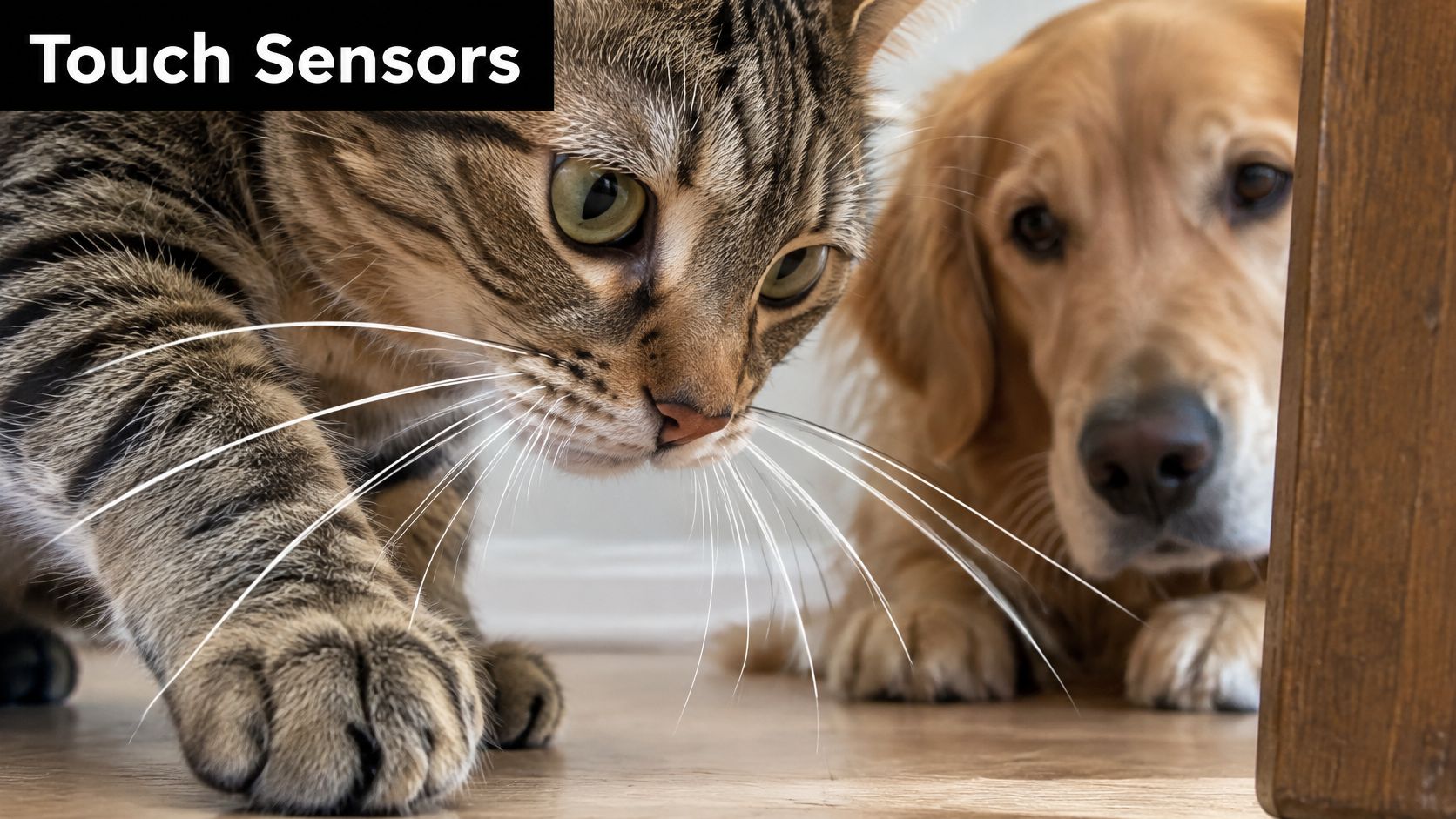
The longer, thicker strands around the muzzle are easiest to notice, but facial whiskers also occur above the eyes, beneath the jaw, and on the cheeks. Their placement matters: a face approaches objects from different directions, not just nose first.
Look at the facial areas visible in these close-up views.
Observe without testing their tolerance
You don't need to tap, pull, or repeatedly brush whiskers to appreciate them. Watch your pet investigate a familiar object at its own pace instead.
If you're curious about touch preferences more broadly, you can explore your cat's sensitive spots while keeping your cat's willingness to participate central. A cat leaning into gentle contact is a different situation from one turning away.
So, why do cats and dogs have whiskers when they already have eyes? Close-range touch supplies a different kind of information, especially when a surface is difficult to inspect visually.
Deep Follicles Built for Close-Range Touch
The important difference between a whisker and ordinary fur lies in its attachment. A whisker grows from a follicle–sinus complex, a deep structure containing blood-filled spaces and a dense network of sensory endings.
A useful analogy is a fine stem seated in a fluid-filled cushion. Movement of the stem affects the structure surrounding its root, where receptors can register mechanical changes. The cushion isn't a separate sense organ floating under the skin; it's part of the specialized arrangement supporting the whisker.
The comparative mammal review published through Wiley describes whiskers in nearly all mammalian species, placing this adaptation within a much broader mammalian history than domestic cats and dogs alone. It also describes specialized canine receptors, including Merkel cell–neurite complexes and lanceolate endings, within the follicle.
Where dogs' sensory follicles are concentrated
The reported 2025 canine study found approximately 60 ± 13 follicle–sinus complexes per dog, distributed across the facial regions shown below.
Whisker follicle counts by facial region in dogs
| Facial region | Average count per dog | Variation (±) |
|---|---|---|
| Muzzle | 28 | ±7 |
| Above the eyes | 9 | ±2 |
| Beneath the jaw | 16 | ±7 |
| Cheeks | 7 | ±2 |
| Total per dog | 60 | ±13 |
These are study averages with reported variation, not a fixed inventory every dog shares. The plus-or-minus values describe the reported spread around the averages; they shouldn't be treated as hard minimum and maximum counts.
The muzzle has the largest group. That concentration fits its position at the front of an investigating face, where a dog brings its nose close to unfamiliar surfaces.
Above the eyes, the smaller group sits near an especially vulnerable area. Beneath the jaw, the study recorded an intermediate average with a comparatively broad spread, while the cheeks held another smaller group. Each region adds sensing around a different part of the face.
Why the arrangement matters visually
For artists, this distribution is a reminder to observe the whole face rather than adding a symmetrical fan beside the nose. Whisker roots occupy real anatomical locations, even when fur conceals them.
A grounding in animal anatomy for artists helps connect those visible strands to the muzzle, cheek planes, and underlying facial structure. Accurate placement usually contributes more to a convincing portrait than drawing every individual hair.
How a Whisker Turns Touch and Air Into a Signal
A whisker doesn't feel along its visible length the way your fingertip feels a surface. The shaft has no sensory receptors of its own. Its job is to transfer movement to the sensitive structures at its base.
This process diagram uses a rodent to illustrate the mechanical sequence.
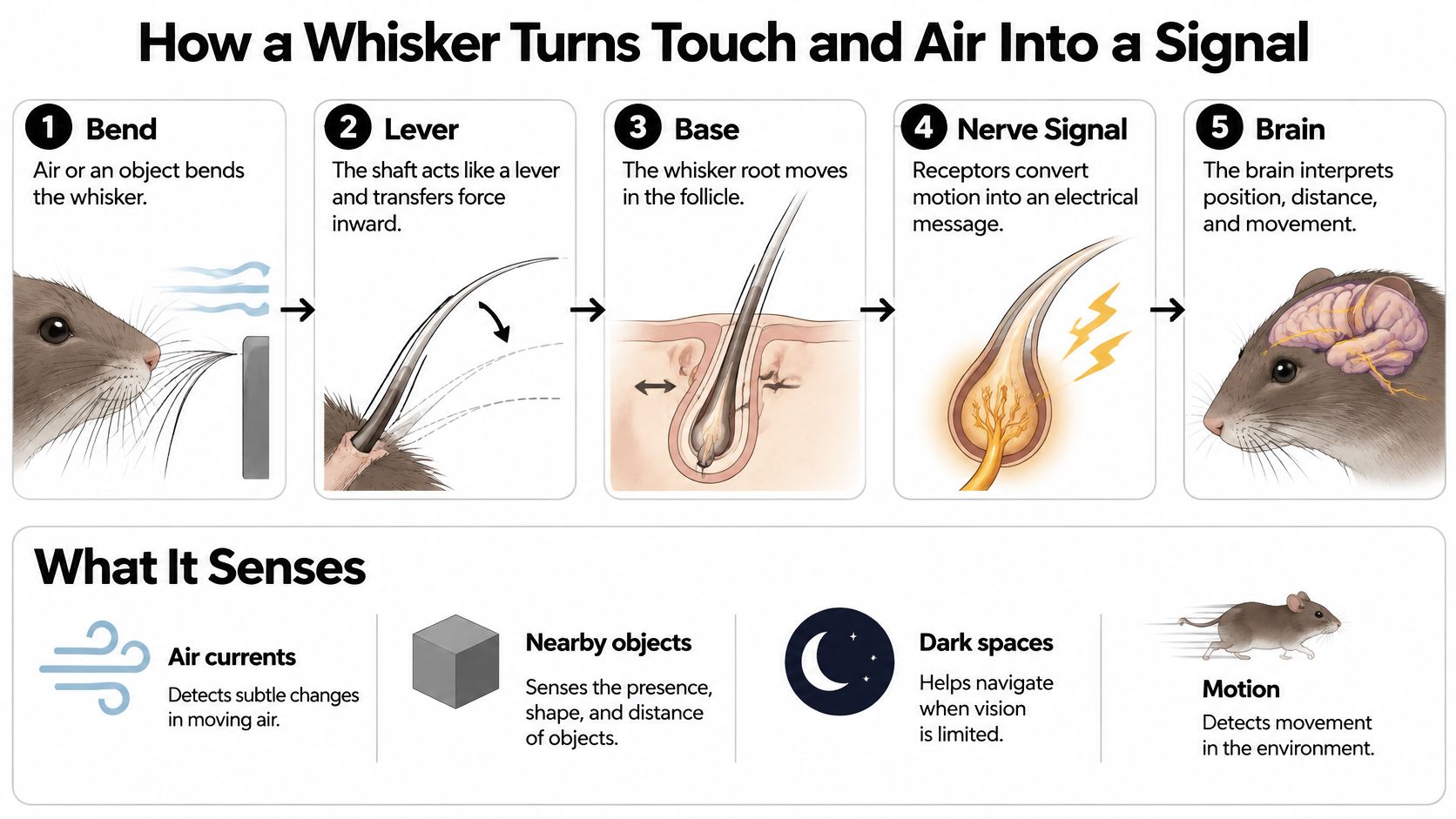
From a bend to a message
- The whisker bends. An object makes contact, or moving air deflects the shaft. The initial event is mechanical, not an electrical signal generated in the hair.
- The shaft transfers force. It acts as a lever, passing the movement inward. Think of a fishing rod transmitting a tug toward the handle, where the person holding it can detect the change.
- The base moves. Force reaches the follicle–sinus complex and deforms the structures around the root. The visible strand and its hidden attachment function together.
- Receptors respond. Merkel endings and other mechanoreceptors detect the mechanical change. The nervous system receives information associated with contact and movement rather than a picture of the object.
- The brain interprets the input. Trigeminal sensory neurons relay signals that help the animal estimate an object's presence, position, movement, and approximate shape.
The canine histological and ultrastructural study describes dense bundles of myelinated and unmyelinated nerve fibers, along with Merkel receptors, within muzzle whisker follicles. Those findings support treating canine whiskers as functional sensory organs, not decorative fur.
What that means in a dark hallway
Say a cat passes beside a chair in a dim hallway. A projecting whisker can brush the chair before the muzzle reaches it, supplying useful local feedback when the cat can't inspect the surface clearly. Small air movements can also deflect whiskers, although that doesn't turn them into a long-distance obstacle detector.
The distinction is important: whiskers help with near-field sensing. They don't replace vision or hearing, and they don't guarantee that an animal will avoid every obstacle.
Feline findings discussed in the PNAS paper on whisker-linked protective responses include slower movement through a dark maze after vibrissae removal and withdrawal and rotation of the eye on the stimulated side after muzzle-whisker stimulation. These observations connect whisker input with both movement under poor visual conditions and rapid protective responses.
The accompanying video offers another visual reference for considering whisker movement.
Why shortening changes the input
Cutting a whisker shortens the external lever while leaving the root sensors in place. It therefore changes the mechanical input rather than neatly switching the entire sensory system off.
Practical distinction: A receptor-free hair shaft can still be an important part of a sensitive organ.
Whiskers can regrow, but regrowth doesn't make cosmetic cutting useful. Preserving their natural length avoids unnecessarily altering a functioning sensory structure.
Where the Whisker Evidence Is Strong and Where It Is Thin
Calling whiskers a sixth sense makes an appealing headline, but it hides an important distinction. Knowing that an animal has complex sensory anatomy isn't the same as knowing exactly how much that anatomy contributes to every everyday task.
The canine vibrissae study available through PubMed Central supports their sensory role through detailed anatomy and responses to mechanical stimulation, including blinking when facial whiskers are touched and forward movement of muzzle whiskers during investigation. It doesn't establish every popular claim about balance, hunting success, or the consequences of grooming.
Compare like with like
Whisker evidence for cats and dogs
| Evidence area | Cats | Dogs |
|---|---|---|
| Receptor structures | Mechanoreceptors and Merkel endings described through the general sensing mechanism | Merkel cell–neurite complexes, lanceolate endings, and dense nerve bundles documented |
| Navigation in the dark | Slower maze movement when whiskers are removed | Contribution not well quantified |
| Eye-protection reflex | Eye withdrawal and rotation on the same side when stimulated | Blinking when facial whiskers are touched |
| Effect of trimming | Removal evidence doesn't establish the effect of a partial trim | Unknown; controlled comparison studies still needed |
The receptor row concerns what structures exist. In dogs, the anatomical detail is strong, but anatomy alone can't tell an owner how a particular dog would perform on a particular navigation task.
The navigation row concerns measured behavior under specific conditions. The feline maze finding is relevant to movement in darkness, not proof that every whisker alteration produces the same result in every environment.
The eye-protection row describes different observed responses in the species. Both are meaningful, but they shouldn't be flattened into a claim that every whisker triggers an identical reflex.
Finally, the trimming row separates complete removal from partial shortening. Treating them as interchangeable would erase a practical difference in the intervention.
The unanswered grooming question
Does trimming a dog's whiskers measurably impair welfare or performance? Does the effect change with breed, task, age, or visual ability? Those questions need controlled comparisons using consistent tasks and meaningful welfare measures.
Uncertainty about the size of an effect isn't evidence that the organ has no function.
The sensible position is cautious without being dramatic: preserve whiskers during cosmetic grooming, but don't assume an accidentally shortened whisker explains every change in behavior. Claims that trimming causes aggression, severe disorientation, or loss of balance go further than the available canine behavioral evidence supports.
Protect Whiskers and Check Your Pet's Food Bowl
Tell your groomer you want facial whiskers left intact. If a medical procedure might involve the area, ask your veterinarian what needs to be clipped and why, rather than trying to trim around it yourself.
At home, avoid pulling whiskers or repeatedly touching them to provoke a reaction. Ordinary observation gives you more useful information about your pet's comfort than deliberate testing.
Separate bowl preference from a diagnosis
Whisker fatigue is widely discussed online, but a veterinary explanation in the Irish Examiner notes that evidence hasn't established it as a genuine syndrome and that many cats use standard bowls without visible distress. Sensitive whiskers don't automatically make every contact with a bowl harmful.
Watch the animal rather than diagnosing the dish:
- Repeated backing away: Notice whether your cat approaches food, retreats, and repeatedly tries again.
- Leaving food despite apparent interest: Record whether your pet seems eager to eat but consistently abandons the meal.
- Pawing at the bowl: Observe the surrounding behavior instead of assuming a single movement reveals discomfort.
- A consistent dish preference: Compare willingness to eat from a shallow dish with behavior around the usual bowl.
Try a simple change without delaying care
Offer a wider, shallow dish, keeping the food and feeding location consistent. Note what you offer, what remains, and whether approaching and eating appear easier. This is a low-risk preference test, not proof of a medical syndrome.
Care reminder: A bowl change should never become a reason to postpone veterinary advice about reduced eating.
Contact your veterinarian if food intake falls, weight changes, or concerning behavior continues. Don't wait for a dish experiment to finish when your pet isn't eating normally.
Managing these small observations is part of the joys and challenges of pet parenthood: you're looking for patterns without assigning a diagnosis to every quirk.
At the next meal, record what your pet does. If you change the dish, note whether it helps, and keep a clear eye-level photograph of the face and whiskers as a visual reference.
How Whisker Position Changes a Pet Portrait
A portrait can have accurate eyes and coat markings yet still feel unlike the animal. Sometimes the mismatch sits in the whiskers: their direction, spread, and relationship to the muzzle alter how viewers read the face.
Forward-spread whiskers can suggest active curiosity, while whiskers held back can contribute to a wary or uncomfortable expression. Position is a clue, not a diagnosis. Read it alongside the ears, eyes, mouth, posture, and situation.
For dogs, learning what different tail wags mean offers a useful parallel: an isolated feature rarely explains the whole animal's emotional state.
Start with a reference that preserves expression
Photograph at the animal's eye level in soft natural light. Keep the outer whisker tips inside the frame, and choose a moment when your pet is comfortable rather than trying to arrange the whiskers by hand.
These tips for photographing pets can help you build a reference that preserves facial character. Check whisker angles before selecting an image solely for sharp eyes or an attractive background.
A pet-portrait reference also helps you assess how fine facial details relate to the finished composition.

Paint growing hairs rather than attached wires
- Taper the stroke: Use a fine liner or rigger brush, easing pressure toward the tip.
- Vary the strands: Follow the reference instead of repeating identical lengths, curves, and thicknesses.
- Select the light: Let some whiskers catch the window light while others remain subdued.
- Soften the roots: Avoid outlining every insertion point, which can make whiskers look pasted onto the muzzle.
On dark-coated animals, adjust value rather than making every strand bright white. A restrained light or dark stroke can reveal a whisker without competing with the eyes.
When reviewing a commissioned portrait, check these expressive details before approving the preview. For existing commissions, the William Tucker Art Acrylic Pet Painting Final Payment listing is used to finalize payment once preview images meet the client's expectations.
The guiding rule is simple: paint whiskers as part of the expression, not as decoration added at the end.
William Tucker Art offers custom acrylic pet portraits based on your photographs, capturing the facial details that make an animal recognizable. Visit William Tucker Art to explore pet portraits and choose a reference photograph that preserves your companion's natural whisker position and personality.