
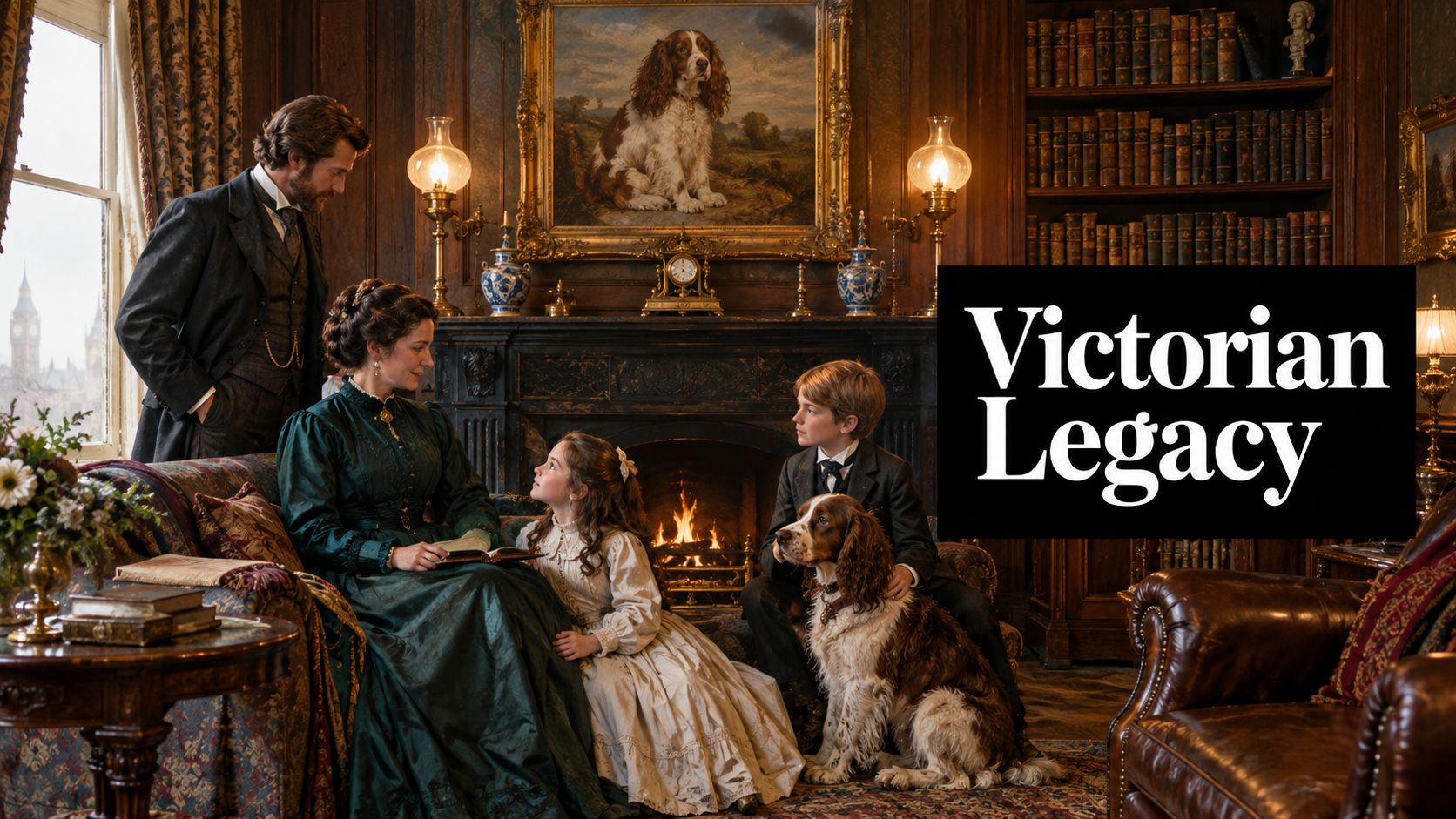
At the end of a London parlor, a spaniel rests above the mantel in a dark, softly glowing frame. Its head turns toward the family below, and the painting feels less like decoration than a quiet record of belonging.
Step Into a Victorian Parlor
The room might contain polished wood, patterned wallpaper, a coal fire, and the faint scent of beeswax. Above the hearth, the dog isn't shown as a generic animal. Its coat, expression, and posture identify it as one particular companion, remembered by the people who lived with it.
That distinction defines the enduring appeal of a Victorian pet portrait. The genre joins close observation with emotional storytelling. It can preserve a likeness, announce a family's taste, commemorate a prizewinning animal, or mark the absence left by a pet's death. The image belongs to the household, but it also speaks to the values of the period that produced it.
Victorian artists made choices about more than fur and facial structure. A hearth could suggest loyalty and domestic steadiness. A field could point toward sport, breeding, leisure, and social position. A velvet curtain or elaborate frame could turn a beloved animal into a subject worthy of the same visual attention given to a human sitter.
A useful starting point: Ask what the portrait should help someone remember before deciding how it should look.
That question remains practical today. A commissioner might want a dog shown beside a familiar chair, a cat placed near a window, or a horse presented with the calm dignity associated with a formal estate portrait. The period style supplies a visual vocabulary, but the animal's own personality must remain visible within it.
Contemporary pet owners can also use the genre in more personal ways. Someone caring for animals in a historic home may be interested in resources such as finding a housesit with cats, where the setting and daily presence of companion animals become part of the experience. That same sense of place can inform a commission, whether the final painting belongs above a mantel, in a library, or in a quieter memorial space.
This guide moves from the social history of Victorian animal imagery to its palette, lighting, symbolism, materials, and ethical questions. It also considers how a modern Jackson Square studio can keep the genre alive without copying its assumptions uncritically.
How Companion Animals Became a Subject Worth Painting
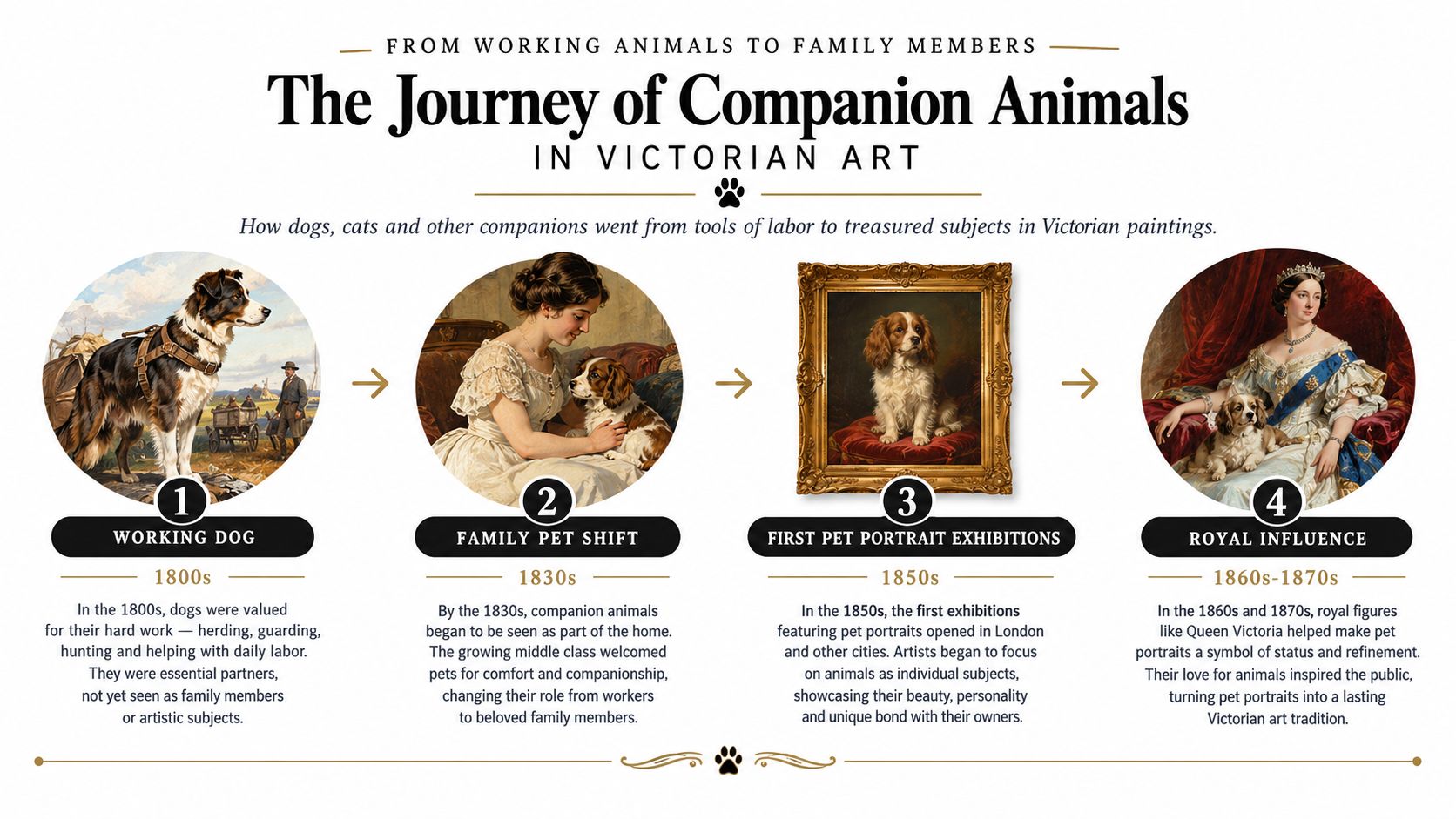
Around 1800, British society generally viewed dogs as working animals. A pet that did not serve a practical purpose could be criticized as an expensive luxury, so a portrait needed social meaning as well as visual appeal. During the nineteenth century, attitudes changed. By 1900, dogs were widely recognized as faithful companions and family members, giving artists a stronger emotional basis for portraying them as individuals. This cultural history is documented by Ohio State University's Origins publication.
Dogs were part of a broader shift in domestic life. By the middle of the nineteenth century, British households commonly kept cats, caged birds, rabbits, hedgehogs, and other animals. The home became a growing source of subjects, and owners increasingly treated animals as part of the household's identity. A portrait could therefore record affection, belonging, and family presence, even when the sitter had fur, feathers, or quills.
An early-twentieth-century estimate by canine authority Robert Leighton placed the dog population in Great Britain and Ireland at more than 4 million, or approximately 1 dog for every 10 human inhabitants. The estimate appears in the same historical account of dogs as family companions. That scale helps explain why animal imagery carried both commercial appeal and personal significance.
Royal attention changed the genre's reach
Royal patronage brought pet portraiture before a much wider audience. Sir Edwin Landseer's Queen Victoria's Favorite Dogs and Parrot, also known as The Royal Pets, was exhibited at the Royal Academy in 1838. A related version, dated approximately 1833 to 1834, measures 25 by 30 inches and centers on Victoria's spaniel Dash. The young queen had received Dash from her mother, the Duchess of Kent, in 1831. These details are recorded by the Victorian Web. As the same account notes, Landseer's The Old Shepherd's Chief Mourner, painted in 1837, used a grieving dog to explore loyalty, loss, and human-like feeling.
Landseer's animals appear alert, sensitive, and intelligent. His relationship with Queen Victoria and Prince Albert led to repeated royal commissions, while his academic recognition connected animal painting with institutional prestige. These works helped establish the pet portrait as more than a record of ownership. They presented an animal as a recognizable character with an emotional life.
Reproduction made private affection public
Dash's image circulated beyond the original painting and became a popular needlework subject during the remainder of Victoria's reign. Reproduction carried royal imagery into ordinary homes. A court pet could become a domestic pattern, and the practice of representing an animal as an individual could reach people far beyond the royal household.
Victorian pet portraiture grew from several conditions working together: a culture of companionship, a substantial domestic audience, royal example, academy exhibition, and reproducible imagery. The result served as both a personal object and a public statement about animals within family life.
For a commissioner, the distinction between likeness and interpretation remains useful. William Tucker Art's discussion of representational art offers a clear comparison. A portrait may record appearance, shape meaning, or do both at once. That balance also guides contemporary work at William Tucker's Jackson Square studio, where historical decorative ideas can frame an individual animal without replacing its character.
Collectors arranging a room around animal imagery may also consult Quote My Wall styling ideas. The surrounding furniture, architectural details, and artwork can support the portrait's historical language while keeping the animal at the center.
Hallmarks of the Victorian Pet Portrait Style
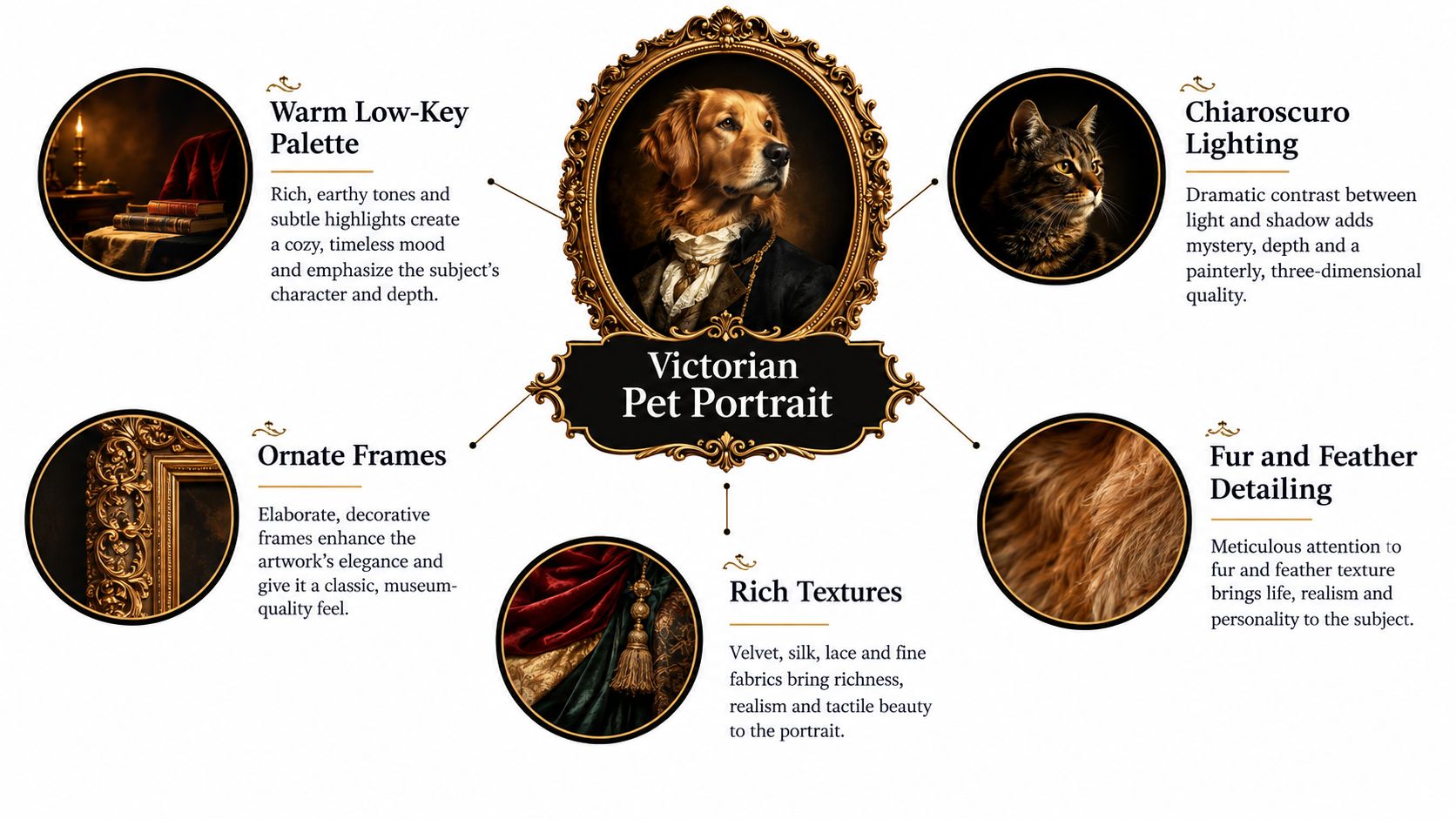
A portrait doesn't become Victorian merely because it has an ornate frame. The style depends on a coordinated set of decisions about light, surface, setting, pose, and finish. Each choice should support the animal's presence rather than bury it beneath period decoration.
Begin with anatomy and pose
The head is usually the first place a viewer tests likeness. A modern artist should establish the species and breed before adding theatrical accessories. Skull shape, muzzle length, ear carriage, shoulder structure, limb proportions, coat direction, and characteristic stance all influence recognition.
This priority has historical precedent. Victorian animal specialists pursued close observation and scientific knowledge, and painter Jacques-Laurent Agasse studied veterinary science to improve his anatomical understanding. The Victoria Gallery collection's curation on Art UK discusses Agasse's training and the relationship between animal art and observation.
A relaxed domestic dog needs a different pose from an alert sporting hound. A cat may communicate personality through the angle of its head, the curve of its back, or the direction of its gaze. The pose should feel plausible for that animal, not imposed by a costume or a decorative scheme.
Shape the atmosphere with light
Victorian-style portraits often use chiaroscuro, placing a strongly lit animal against a darker or more atmospheric background. This contrast sculpts fur and feather while giving the subject visual weight. A warm, low-key palette of umbers, ochres, deep greens, muted reds, and softened blacks can create the feeling of an old interior without making the image muddy.
Controlled brushwork also matters. Edges may soften into the background, while the eyes, nose, whiskers, or distinctive markings receive sharper attention. The viewer's eye moves first to the parts that carry identity.
Add objects with restraint
Props should frame the animal's story. A hearth, domestic chair, hunting accessory, field, stable, or velvet drapery can establish context, but each object needs a reason to be present. Too many symbols make the painting feel staged rather than intimate.
Commissioning rule: Choose one dominant setting and a small group of supporting details. Let the animal remain the subject.
Frames contribute to the impression, too. A carved or gilded frame can echo Victorian interiors, but the support and protective finish matter more to long-term stability than ornament alone. For a contemporary contrast in material and movement, William Tucker Climate Change Art Painting Abstract Collection, Cyclones uses acrylic, oil, and mixed media on canvas, with layered blue and gold forms that evoke swirling natural forces. Its abstract surface demonstrates how texture can carry energy even when the subject isn't rendered through nineteenth-century realism.
The strongest Victorian-inspired work combines accurate structure with controlled atmosphere. The result should feel historically informed, not trapped in a formula.
Reading the Symbols, Pets Portrait Signs
A Victorian pet portrait operates on two levels. It records the animal's appearance, and it communicates something about the household that chose to display that animal in a particular way.
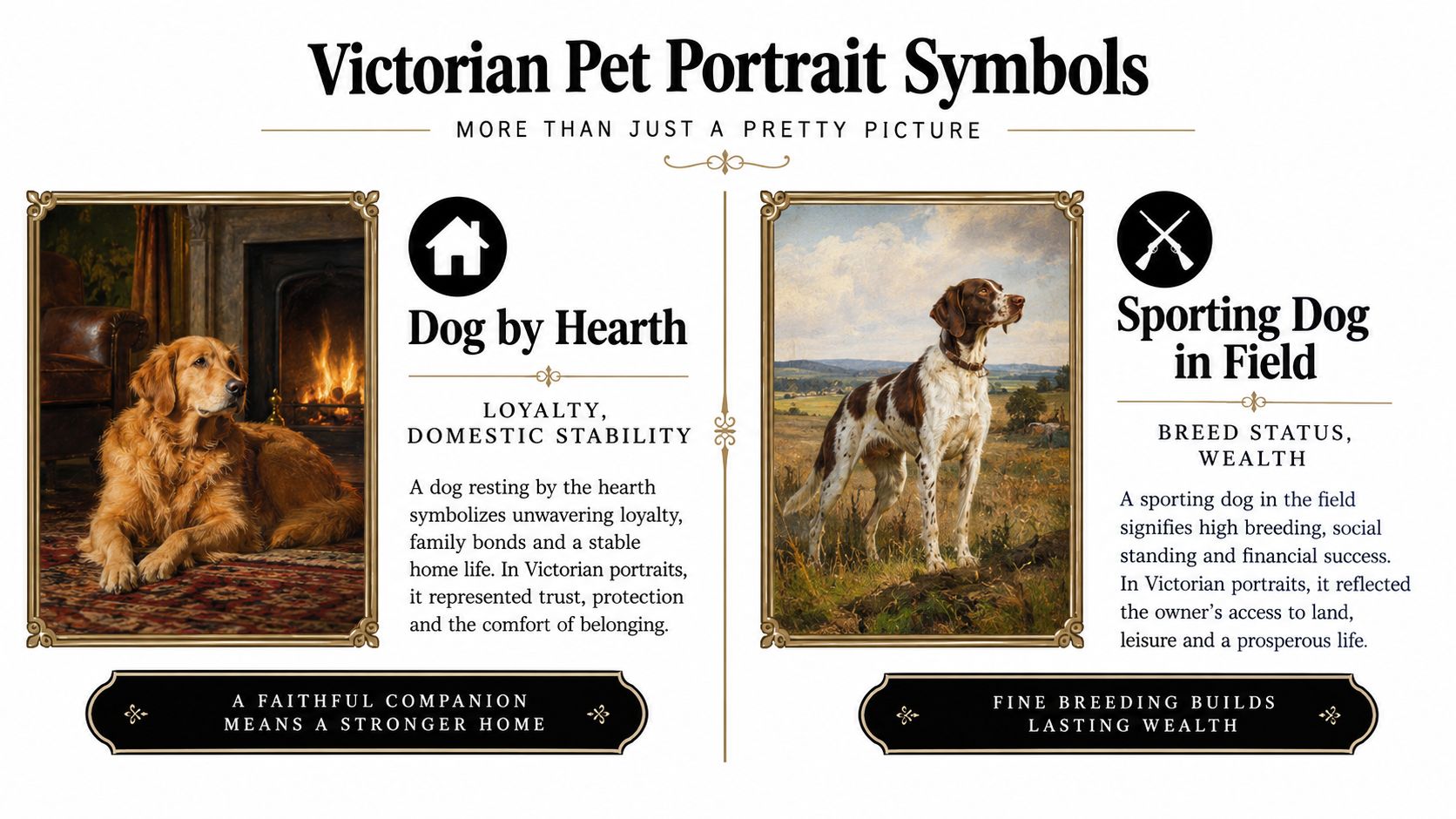
The setting is often the clearest clue. A dog beside a domestic hearth can suggest loyalty, protection, and household stability. The hearth doesn't fill empty space. It places the animal within the emotional center of the home.
A sporting dog or hound shown alert and outdoors carries a different message. The pose can point toward breed identity, wealth, leisure, hunting culture, and the owner's relationship with land or sport. The animal's alertness becomes social language as well as anatomy.
Likeness comes before symbolism
Museum scholarship describes animal imagery as a way to encode identity, class, morality, domestic order, and human control over nature. That doesn't mean every object carries one fixed interpretation. Symbolism depends on pose, surroundings, accessories, scale, and the commissioner's intention.
A useful briefing process separates two questions:
- What makes this animal unmistakably itself?
- What should the surrounding composition say about the relationship?
The first question protects the likeness. The second gives the artist a narrative direction. If the owner wants a memorial portrait, the artist might use stillness, restrained lighting, and a familiar domestic reference. If the aim is to celebrate a working breed, anatomy and stance may take priority over sentimental expression.
This two-layer method avoids generic anthropomorphism. A dog doesn't need human clothing or a human facial expression to appear emotionally legible. Its real posture, gaze, and physical habits can convey character more truthfully.
Use objects as readable language
Consider a simple comparison:
| Composition | Likely visual message |
|---|---|
| Dog near a hearth | Loyalty, domestic stability, belonging |
| Sporting dog in an open setting | Breed status, wealth, leisure, outdoor culture |
| Quiet animal in a familiar interior | Memory, continuity, affection |
| Alert animal with restrained background | Individual character and physical presence |
These meanings aren't rigid rules. They act as starting points for discussion between artist and commissioner. A field setting might celebrate freedom for one owner and a hunting tradition for another. The artist should ask rather than assume.
Victorian animal imagery also reflected broader concerns about identity, class, morality, and control over nature. The V&A's examination of pet portraits and animal objects provides useful museum context for understanding why animals appear as more than decorative accessories. A contemporary commission can acknowledge that history while giving the present-day owner authority over the portrait's meaning.
Commissioning Your Own Victorian-Style Pet Portrait
A successful commission begins with a conversation, not a frame selection. The artist needs to understand the animal's physical identity, the relationship it has with the household, and the visual atmosphere the owner wants to live with.
Prepare the reference material
Choose photographs that show the animal from several angles. Include a clear view of the eyes, muzzle, ears, coat pattern, paws, and full-body stance. Informal images can be valuable because they reveal how the pet sits, watches, stretches, or rests.
Write down a few descriptive observations before the consultation. “She always leans toward the window” is more useful than “make her elegant.” “He sleeps beside the library hearth” gives the artist a concrete setting and a personal detail.
Decide what the painting must carry
Size and support influence both presence and longevity. Canvas can support a substantial wall piece, while paper or wood panel may suit a different scale or surface preference. Ask the artist which material matches the intended finish and display location.
Discuss the pose, background, palette, frame, and symbolic objects together. A memorial painting may benefit from quiet restraint. A breed portrait may need an uncluttered setting so the head, coat, and stance remain legible. A family portrait with several animals requires careful planning so each subject has visual space.
For a practical overview of the artist's approach to custom pet portrait commissions, look for guidance that treats consultation and reference images as part of the creative process rather than administrative details.
Confirm the review stages
Ask whether the artist provides a preliminary sketch, compositional study, or preview before completing the final surface. This is the point to correct a pose, adjust the background, or clarify which feature carries the animal's identity.
A written commission record should identify the agreed subject, medium, support, dimensions, framing expectations, delivery arrangements, and payment stages. William Tucker Art's catalog includes separate deposit and final-payment items associated with commission workflows, so those entries can be discussed as practical examples during a consultation.
Protect the finished work
Conservation evidence makes material questions important. A nineteenth-century dog portrait treated by The Conservation Center had canvas delamination from a paperboard support, causing warping and convex distortion. Treatment involved consolidation, reversible inpainting, protective varnish, and reframing.
That history suggests a sensible modern checklist:
- Support: Ask whether the canvas, paper, or panel is stable and suitable for the intended display.
- Pigments: Request information about lightfast materials.
- Varnish: Confirm whether an isolating or protective layer is appropriate.
- Frame: Choose framing that limits ultraviolet exposure and supports the work safely.
- Location: Avoid direct sunlight, heat sources, and areas with large humidity fluctuations.
- Documentation: Keep records of materials, finish, framing, and any conservation advice.
A beautiful commission should remain a usable object, not become a preventable restoration problem.
Historical Accuracy Without Romanticizing the Past
Historical accuracy means understanding Victorian choices, not copying every assumption in Victorian imagery. Artists valued close observation, yet they also idealized breeds, heightened emotion, and worked within social ideas about ownership, display, captivity, and control.
Agasse's study of veterinary science illustrates the period's respect for anatomical knowledge. John Charles Dollman reportedly found zoo wolves difficult to paint because the animals were overfed. Art UK's curation of the Victoria Gallery collection records both details alongside accounts of Victorian zoo painting. The contrast matters: an artist may understand anatomy precisely, while an artificial setting still alters the evidence in front of the brush.
Separate observation from convention
A responsible modern commission can borrow Victorian composition and brushwork while retaining accurate anatomy. Contemporary reference photography helps preserve natural posture, coat condition, physical proportions, and species-specific behavior. Lighting, framing, palette, and setting can then create a period atmosphere without disguising the animal beneath it.
This distinction matters most with exotic animals, zoo subjects, and working animals. A dramatic pose may appear historically convincing while suggesting behavior the species would not normally display. A formal interior may celebrate individuality, or it may remove the habitat and welfare conditions that shape the animal's life.
Ethical question: Does the composition honor the animal's individuality, or does it make the animal fit a human fantasy?
Commissioners should discuss these decisions openly. Ask whether the background reflects the animal's actual environment, whether the pose is physically plausible, and whether a symbolic object adds meaning rather than serving as period decoration.
The commission record can state this interpretation clearly. “Period-inspired interior with contemporary anatomical reference” gives an artist more useful direction than “old-fashioned.” For comparison with earlier approaches to animal likeness, William Tucker Art's article on Renaissance pet portraits offers historical context without asking a modern artist to reproduce the past.
A strong Victorian-inspired portrait keeps the genre's emotional intelligence while leaving behind assumptions that no longer deserve protection. That balance connects decorative art history with responsible commissioning: the past supplies visual language, while observation and care determine how the animal is represented.
A Modern Studio Keeping the Genre Alive
In a Jackson Square studio in New Orleans, a contemporary animal portrait can carry Victorian concerns into a different visual world. William Tucker works with detailed animal subjects and more expressive, sometimes abstract backgrounds, allowing the recognizable body and face to remain grounded while color and movement create a present-day sense of place.
That approach keeps the historical emphasis on individuality but doesn't treat the Victorian palette as a boundary. Archival acrylics on gallery-wrapped canvas, expressive client-directed poses, and Southern wildlife references can make the portrait feel connected to its owner and region.
William Tucker Art presents pet, wildlife, coastal, and environmental work through an online catalog. Deposit and final-payment catalog items also provide practical entry points for clients considering a commissioned process, while the studio context connects the work to New Orleans and Jackson Square.
Memorial commissions often need a different pace from celebratory portraits. Owners considering how to preserve a pet's presence may find additional reflection in these in-home pet hospice memorial ideas, particularly when deciding whether the finished work should feel quiet, intimate, or openly commemorative.
A modern Victorian-inspired portrait succeeds when history guides the conversation rather than dictating the result.
Your Victorian Pet Portrait Checklist
Bring these decisions to the first artist conversation:
- Story: Decide whether the portrait celebrates companionship, breed, achievement, place, or memory.
- Likeness: Gather photographs showing the animal's structure, markings, gaze, and natural posture.
- Composition: Choose the setting, pose, props, lighting, and palette together.
- Materials: Ask about support, pigments, varnish, framing, and display conditions.
- Responsibility: Make sure the image reflects plausible anatomy and respects the animal's life and welfare.
- Review: Confirm how sketches, previews, revisions, delivery, and documentation will work.
A Victorian pet portrait can honor the past without becoming a costume. When historical atmosphere meets accurate observation and genuine affection, the finished work becomes a lasting record of one particular animal.
William Tucker Art offers pet and wildlife artwork shaped by detailed animal subjects, expressive backgrounds, and a New Orleans studio perspective. Visit William Tucker Art to explore the collections and begin considering how your companion's character could become a thoughtful, period-inspired portrait.