
71.1% of U.S. households owned at least one pet in 2024, according to the American Pet Products Association. That makes family pet portraits more than a niche interest. They're a way to decide how the animals who share our homes belong in the family picture.
The most useful starting question isn't which paint to choose. It's who should appear, how they relate to one another, and what you want to remember. A portrait of a lively mixed-species household calls for different decisions than a quiet tribute to a pet who has died, even when both begin with favorite photographs.
Family Pet Portrait Styles Compared
Two families can send the same snapshot of the same beagle and end up with two entirely different paintings. Style is the set of decisions made before a brush touches the surface: the panel or canvas, the paint, the background, and how much of the scene the animal shares with other subjects.
A family pet portrait is an original artwork interpreting one pet or several, built from the photographs and information the client supplies. The artist reads that material and shapes the expression, color, background, and overall mood. You are commissioning an interpretation, which is why the conversation about style carries as much weight as the quality of the photograph.
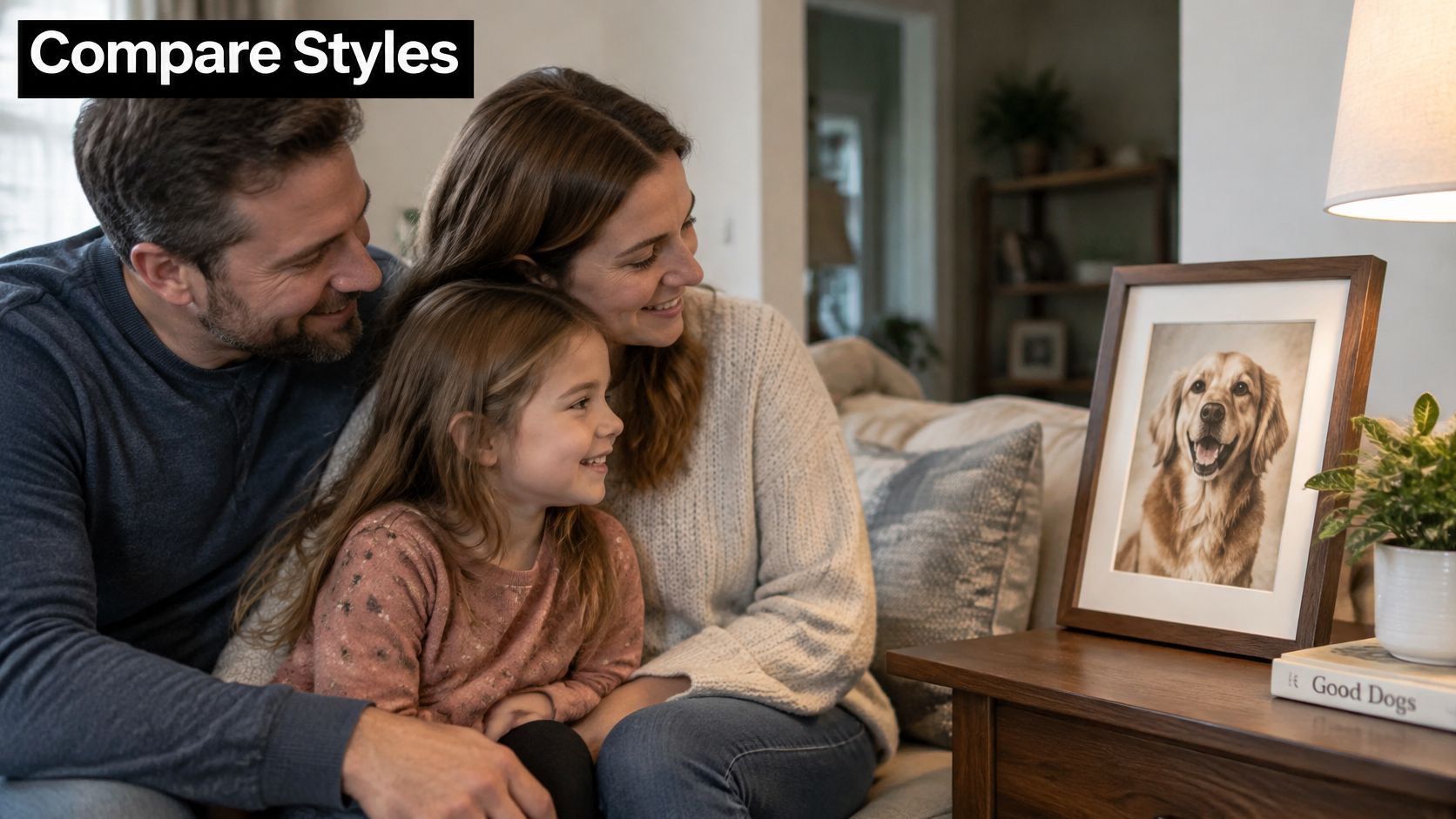
A framed portrait can become part of the room's everyday setting.
Family pet portrait styles at a glance
Treat each row as a starting point for that conversation. The finished appearance gets agreed before any paint is mixed.
| Style | Typical Medium | Best For | What to Expect |
|---|---|---|---|
| Classic single-pet portrait | Oil on canvas | One dog or cat | A realistic likeness on a plain or softly toned background |
| Abstract background portrait | Acrylic and oil on canvas or cradled wood panel | Pets who suit a bold, layered look | A detailed subject against an expressive colored background |
| Multi-pet family scene | Oil or acrylic on canvas | Households with two or more animals | Animals grouped with balanced size and placement |
| Large-format statement piece | Oil on canvas, 18x24 or similar | A wall with room to spare | More surface for background, posture, and expression detail |
| Memorial tribute | Oil or acrylic on canvas | Remembering a pet who has died | A quiet composition built around a meaningful photo, alone or with living pets |
Choose for the wall and the subjects
Canvas and wood panel behave differently under paint. Canvas works like a woven textile, so paint sits on a visible texture that softens edges slightly. A cradled wood panel gives a firmer, smoother surface that holds crisp detail and lets a color such as deep purple stay flat and saturated.
Viewing distance decides more than medium does. A close-up face stays readable from across a room, while a composition holding three animals and a favorite garden needs enough scale for every element to register. Note the hang position first, then choose the size, the way you would choose a rug for a hallway you walk down.
Practical rule: Choose the style by who belongs in the picture and where it will hang.
Owners often ask whether a smoother finish signals a better likeness. Visible brushwork and a blended surface both appear in commissioned work, and the more telling test is whether the artist's interpretation keeps the features and expression you would recognize at a glance.
Two rows in that table carry particular weight for families. A multi-pet scene and a memorial tribute each ask the artist to solve a composition problem, arranging animals so the relationships between them read clearly, rather than reproducing a single face.
Choosing a Layout for Multiple Pets and Mixed Families
Visual prominence doesn't have to mean favoritism. A larger animal may occupy more space naturally, while a smaller pet draws attention through posture or contrast. Transparent consultation helps everyone understand that arrangement before paint reaches the surface.
ADM's 2025 global pet-owner report says 91% of owners consider pets part of the family, as summarized in the report's publication record. But family membership doesn't imply identical size, matching poses, or a conventional household.
Layout choices for complex households
| Household Situation | Suggested Approach | Trade-off to Discuss |
|---|---|---|
| Mixed species, such as a dog and a cat | Share the frame evenly or place one animal slightly forward | Balance can tip toward the animal with the stronger pose |
| Rescued pet with an uncertain history | Use the clearest recent photo and note the traits you know | Some background details will remain unknown |
| Pet with a disability or mobility aid | Show the aid as part of the animal's everyday look | Some owners prefer it omitted, so agree early |
| Animals photographed years apart | Blend references and match lighting and pose | Exact age matching may not be possible |
| Living and deceased pets together | Consider a lighter, secondary position or a separate panel only if the family wants that distinction | Viewers may read placement as ranking |
| Pets with very dark or very pale coats | Choose a background that contrasts with the coat | Dark coats can lose detail against dark backgrounds |
| Several family members in one scene | Use separate panels or one group frame | A group frame gives each face less space at the same overall size |
Decide what togetherness should look like
A single scene works well when you want shared space, such as animals gathered near a familiar chair. Separate panels can preserve individuality when the available poses won't combine convincingly. Our guide to a family portrait with pets offers another starting point for considering people and animals together.
Say a cat's clearest photograph shows it looking upward, while the dog's reference shows a straight-on face. Forcing both into a tightly matched pose may introduce guesswork. Several references let the artist understand each animal before proposing a believable arrangement.
Background choice deserves its own conversation. A pale coat needs enough tonal separation to keep its outline readable, without making every edge look sharply cut out. A dark coat needs visible changes in light and shadow rather than an entirely black shape.
Put the arrangement in writing before the first sketch. Identify left-to-right placement, relative scale, preferred ages, mobility aids, and any culturally meaningful details. Don't invent a rescued animal's past to fill empty space; use a setting connected to the life you know.
A fair portrait isn't necessarily symmetrical. It's one where each person and animal remains recognizable, and the family chose the arrangement deliberately.
Preparing Your Pet and Reference Photos
The most common reference mistake is a single photograph, taken from standing height while the pet looks up at a phone, with a bright window behind it. It holds the expression you love, yet it gives an artist very little to work from. The eyes read as two dark shapes, the coat flattens into one tone, and the pose becomes a foreshortened guess.
Build a useful reference set
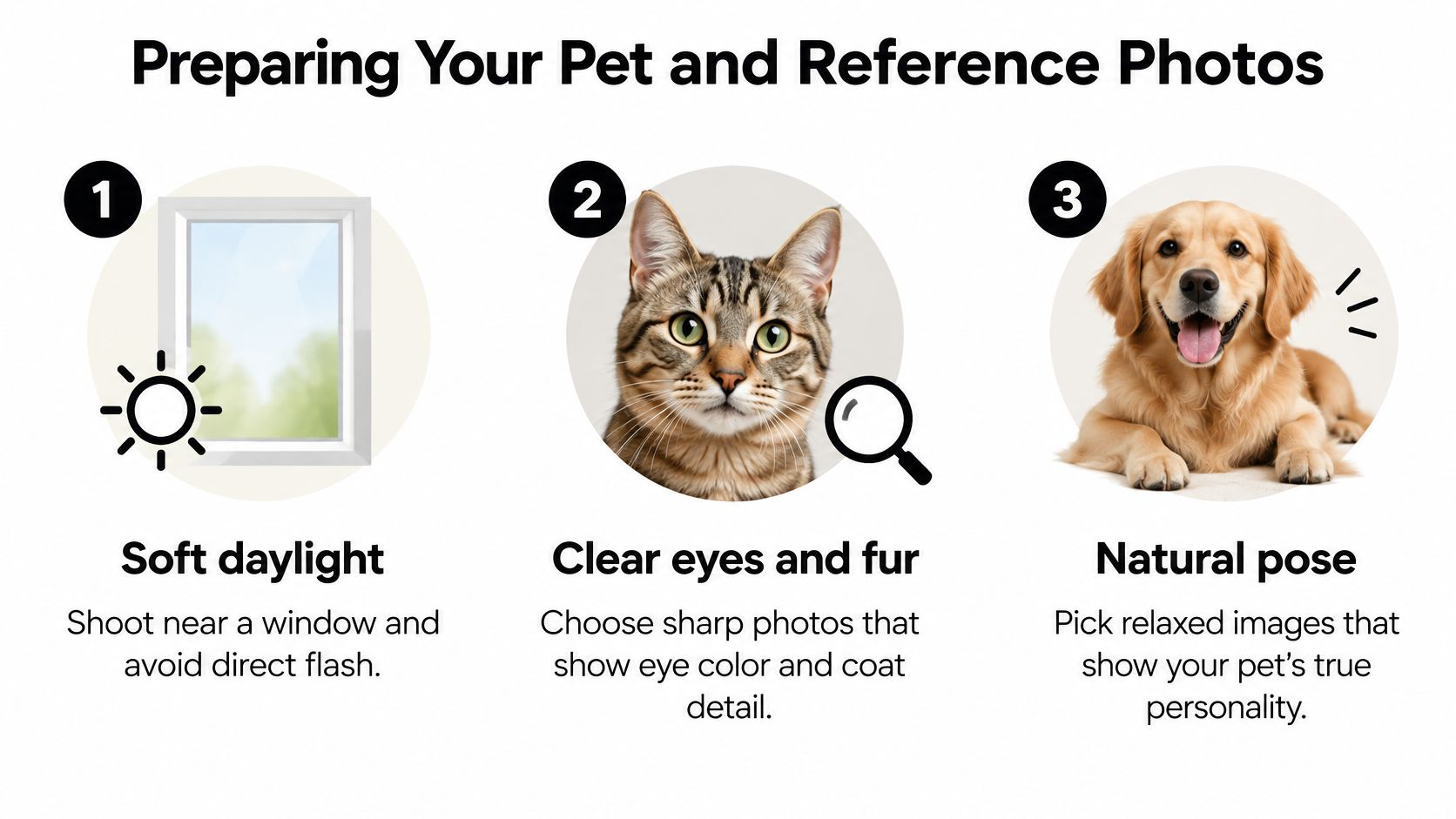
- Use soft daylight. Stand near a window but out of direct sun. Direct flash flattens fur texture and can leave a bright reflection over the pupil.
- Meet your pet at eye level. Crouch or sit rather than shooting down from standing height. Focus on the eyes and check they are sharp at full size.
- Include different views. Send a face shot, a full-body pose and a relaxed candid, and say which one should guide the main expression.
- Record distinctive details. Photograph coat markings, a notched ear, collar color or an uneven white patch, and name the features that must stay.
- Keep the room simple. Move laundry or a bin out of frame when you can. If your pet settles only in a cluttered corner, take the photo anyway. A natural pose is worth more than an empty room.
- Send original files. Screenshots, heavy filters and copies saved from social media can hide detail or shift color.
A single frame locks in one angle. A small set works like the measurements a tailor takes before cutting cloth. Each one answers a different question, and together they let the artist build a likeness instead of tracing a silhouette.
For a visual companion to your photo preparation, watch the video below.
Make color and comfort part of preparation
Fur, eye color and a bright collar can look different on your phone, on a monitor and in a print. The International Color Consortium's guidance on color management explains how input and destination profiles carry color between devices. A calibrated monitor, an embedded working profile such as sRGB or Adobe RGB, and a preview made against the intended paper all help keep a cream coat from drifting toward yellow.
When you review a preview, switch off night-shift or blue-light filters, open it on the display you trust most, and describe differences plainly. "The chest looks more orange than in life" is easier to act on than "the color seems off."
Photos of a pet who has since died often come from older cameras and can look soft or grainy. Send them anyway, along with the clearest image you have of the markings. A portrait is the artist's interpretation of the subject, based on the pictures and information you provide, so a slightly imperfect photograph still contributes real information.
Prepare the animal gently. Choose a time when your pet is rested and fed, keep the session brief, and use treats or a familiar toy without pushing through distress. A second person can hold attention while you operate the camera.
Light grooming is enough. The goal is your animal as it normally looks, not a show-ring version. Reference photos can be sent by email attachment or texted to 910-273-2420.
How to Commission a Family Pet Portrait Step by Step
A clear commission separates decisions about the artwork from the paperwork and shipping that follow. Before work begins, settle what is being painted, who supplies the reference photos, and how the finished painting will be received. For a household with several animals, that first conversation also decides whether the portrait is a group scene or a smaller pairing, and whether one pet is being remembered from older photographs.
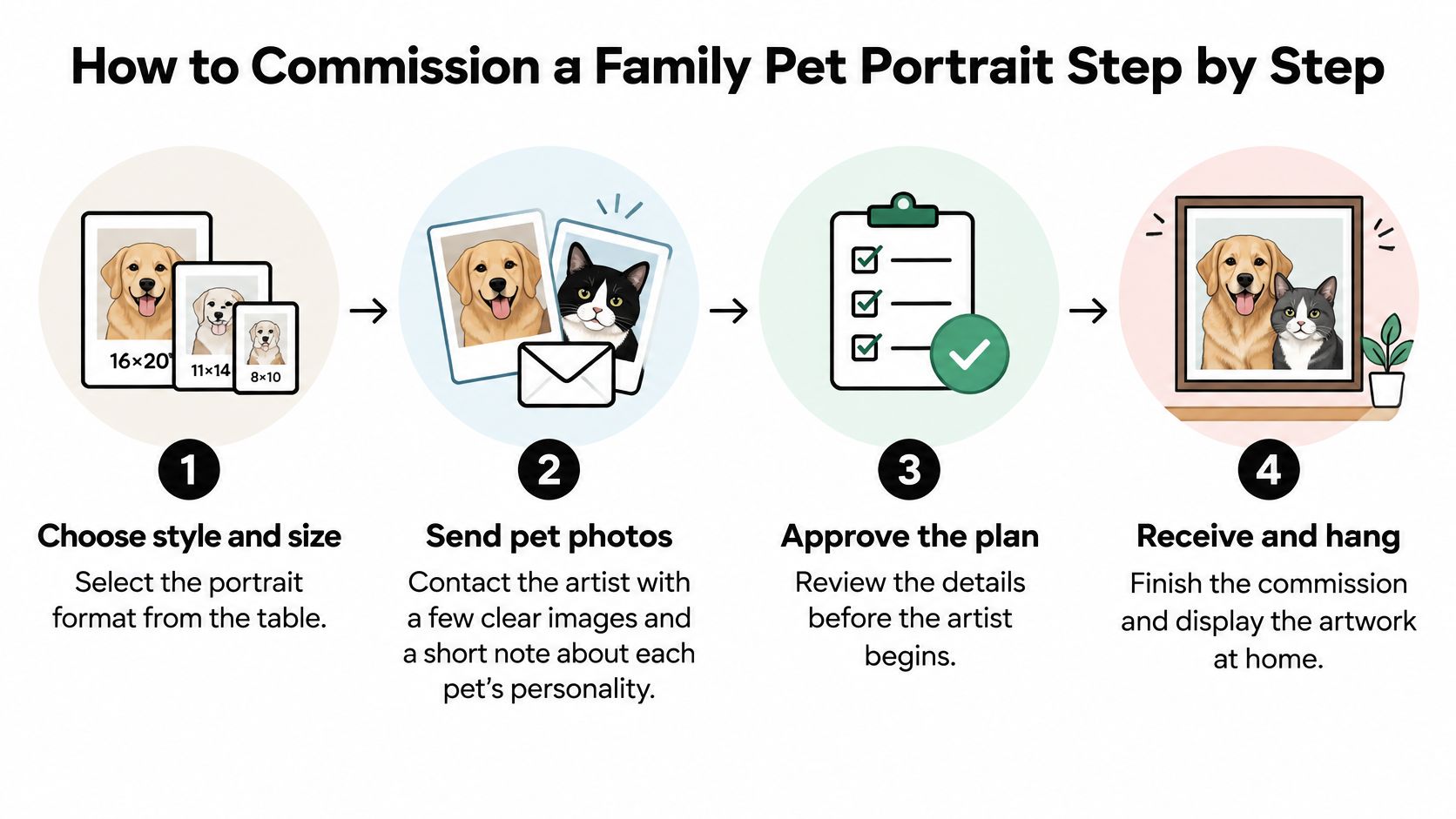
This overview shows the main stages of a commission.
From first message to delivery
- Choose a direction. Contact us with your preferred style, the wall space you have in mind, and a short description of each pet's personality. That gives the composition a practical frame before details are locked in.
- Confirm the scope. Settle the number of subjects, surface, background, and overall dimensions. Spell out whether a familiar blanket, garden, or piece of furniture belongs in the painting. Mixed households should confirm which animals appear together and whether an absent pet will be included from separate references.
- Submit the reference materials. Supply the agreed photographs and identify their roles, such as the main pose, accurate coat color, or collar detail. Tell us which file takes priority when images show conflicting features.
- Pay the starting deposit. A $50 non-refundable deposit starts the work and secures your place in the schedule. Read the Pet Portrait Order Agreement, since commissioning a portrait means agreeing to its terms and conditions.
- Let the artist interpret the references. A pet portrait is the artist's interpretation of the subject, based on the pictures and information you provide. Clear references and a settled composition do more for the finished painting than a list of changes after work begins.
- Settle final payment on delivery. Final payment is due upon delivery and can be made online at williamtuckerart.com. The finished painting is packed, insured, and shipped to you, and the recipient must sign for delivery.
- Check the delivery address. Use an address where someone can sign during the delivery window. A workplace or secure building lobby may be more reliable than a porch if you are away during the day.
Understand the timing conditions
If there are no delays on your end, most portraits should be completed and delivered within 7-10 business days after we receive all client-supplied reference materials. That's a conditional expectation, not a guaranteed deadline.
Size, the number of subjects, custom backgrounds, and time spent waiting for materials or payments affect completion. We can't be held to a specific timeline, so allow flexibility for a complex composition or date-sensitive gift.
Reference check: Look for the familiar expression first, then compare proportions, markings, and color across the whole group. A polished background can't compensate for a face that doesn't feel like your pet.
Choose references that show the group together if you want a shared scene, then add close-ups for each face. For a memorial portrait, gather the clearest older photos and note which markings matter most.
What a Family Pet Portrait Costs
A quote describes a particular job, not the category “pet portrait.” A single animal against a plain background and a group with a custom setting require different amounts of drawing, composition, and finishing.
What shapes the quote
- Number of subjects. Each animal or person adds likeness work and changes the balance of the composition.
- Style complexity. Layered backgrounds and mixed-media treatments call for different processes than a restrained likeness.
- Size and surface. Canvas, wood panel, and paper require different preparation and presentation.
- Backgrounds and props. A recognizable garden or patterned blanket adds specific details to resolve.
- Blended memorial references. Reconstructing a useful view from incomplete photographs may require additional likeness checks.
- Rush requests. A compressed schedule leaves less flexibility for discussion and revisions. Don't assume rush work is available.
Get comparable written terms
Our starting requirement is a $50 non-refundable deposit. The final balance is due upon delivery, with payments available online through our website.
Ask for a written quote identifying what's included rather than comparing headline totals alone. It should address preview rounds, framing, shipping, insurance, and what happens if reference materials arrive late. Although we insure shipped paintings, the quote should still make the associated charges clear.
A useful quote describes the finished object and the approval process, not just the amount payable.
This guide doesn't publish a portrait price list. Your written quote is the reliable source for the cost of your specific composition, and it's the right place to resolve uncertainty before committing.
Remembering a Pet Who Has Died
A collar still hangs by the door, and the blanket on the couch keeps a shallow dent. Those ordinary reminders can make a memorial portrait feel urgent and impossible at the same time. You can take your time. No part of the process requires you to choose photographs today, and a memorial portrait should not become another deadline to manage.
The technically strongest image may not be the most meaningful. A sleepy couch pose, a worn collar, or an uneven ear can recall your companion more faithfully than a formal, idealized likeness. Ask the artist to preserve the quirks you recognize. In a household with several animals, decide whether the portrait remembers one pet alone or places that pet back among the others. That choice shapes which photographs you gather and how the composition balances each animal.
In a 2025 UK survey of 5,387 pet owners, 94% of those who had lost a pet said the animal would live on in their memory, according to ADM's pet-owner insights report. That figure describes remembrance. A portrait can give that remembrance a visible place in your home.
Make review emotionally manageable
- Allow pauses. Take breaks between drafts rather than reviewing while overwhelmed.
- Invite trusted support. A person who knew your pet can help check likeness without overruling your preferences.
- Expect an unfamiliar first impression. Seeing a loved animal interpreted in paint may feel strange before it feels right.
Browse pet memorial portrait examples when you want to see how other families have handled the choice. A portrait can honor a relationship while you protect your own pace. If grief feels heavy, pair the portrait with counseling or a pet-loss support group.
Caring for and Displaying Your Portrait
A portrait hung directly above a radiator or on the wall of a steamy bathroom is being asked to survive conditions no painting should face. For photographic prints, the Library of Congress recommends temperatures at or below 70°F (21°C), relative humidity around 30% to 50%, and humidity changes below about 5 percentage points within 24 hours. Its guidance also warns that humidity above 60% can encourage mold and warping, while very dry conditions can contribute to curling, flaking, and cracking. A stable wall matters more than a perfect single reading, in the same way a houseplant does better in one consistent spot than in a series of dramatic moves.
Protect the finished surface
- Choose a sheltered wall. Keep the portrait out of direct sunlight and away from radiators and heating vents.
- Match framing to the medium. Ask about UV-filtering glazing and archival backing where appropriate. Our framed pet portrait guide can help you prepare framing questions.
- Keep conditions stable. Check damp basements, kitchens, and bathrooms before choosing them for display.
- Inspect gently. Look periodically for distortion or surface changes without touching the painted face.
For installation, Willis Furniture & Mattress explains how to hang your picture straight. Choose hardware suited to the wall and the framed weight, and have a second person confirm the level before you tighten the final screw.
Know what ownership permits
We retain full copyright and reproduction rights to pet portrait paintings. Clients may use an image of a commissioned painting for individual use only; any broader use requires our written permission. Clarify social-media sharing, extra printed copies, or reproduction in memorial-service materials before you proceed. That permission rule applies even when the painting itself hangs in your home.
Start Your Family Pet Portrait Commission
Begin with a short message and your selected photographs, not a perfectly polished design brief. Include the number of pets, the style you prefer, and a sentence about each animal's personality.
Add any layout decisions that matter emotionally. Perhaps the cat should sit forward because that's how the animals relaxed together, or perhaps a deceased companion belongs in a separate panel. Say what you know, and identify what you'd like help deciding.
Prepare your first message
- Name the subjects. Include people as well as animals if they belong in the portrait.
- State your priorities. Identify the expression, relationship, or memory that matters most.
- Attach the references. Make it clear which photograph is your preferred starting point.
We offer commissions through our Pet Portraits collection. Settle the scope and gather your materials before taking the payment step that holds your place in the schedule.
The payment-stage image below accompanies the commission process.
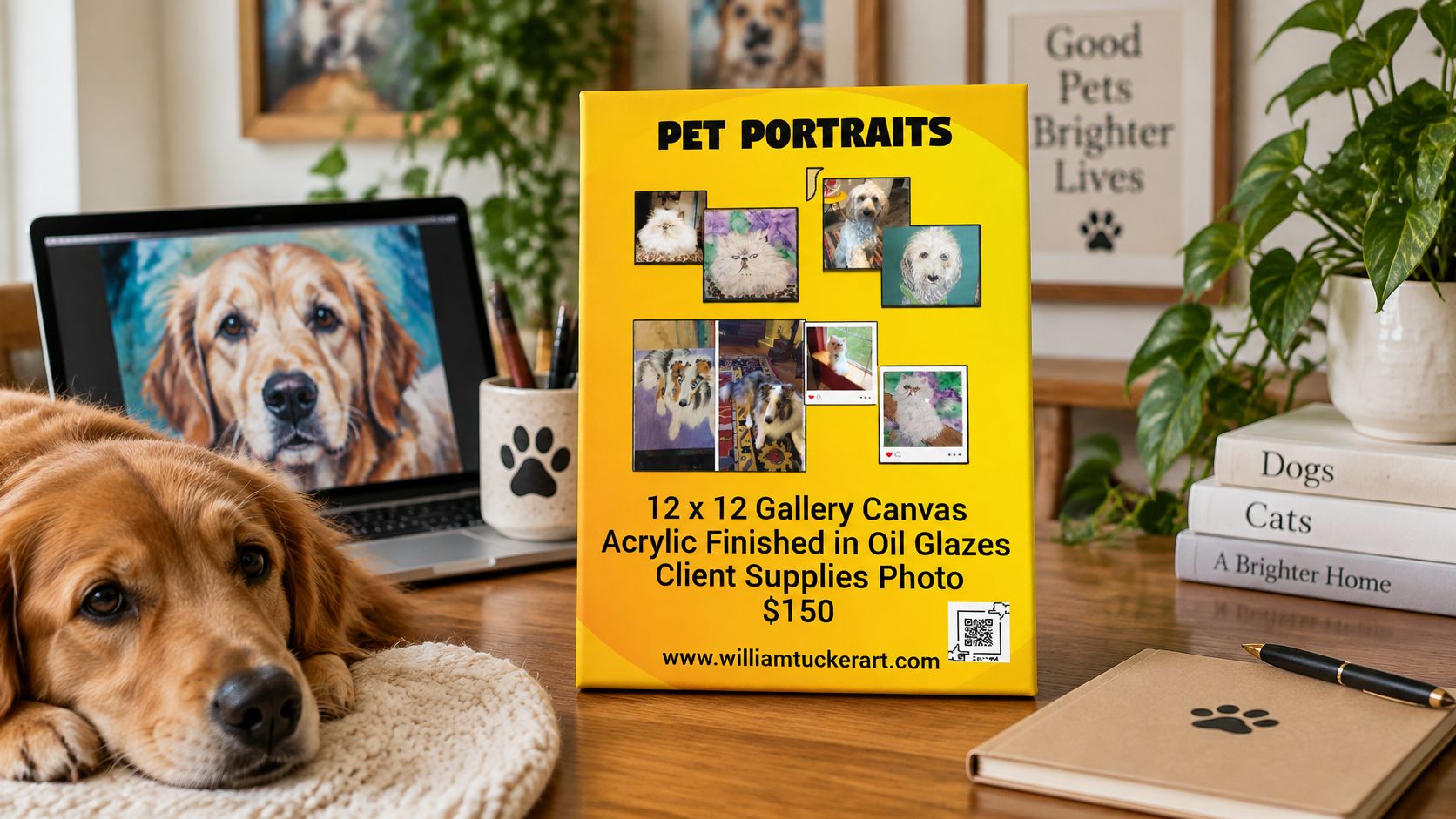
Use the first conversation to clarify the written quote, likely timing, usage rights, and any question that still feels unresolved. You don't have to know every artistic answer before getting in touch.
William Tucker Art offers commissioned pet portraits built from your photographs and the details that make your animals recognizable. Visit William Tucker Art to begin a conversation about a family composition or a thoughtful remembrance portrait, with your preferred images ready to share.