
You've found a photograph where everyone looks happy, except the dog is halfway out of the frame. In another, the cat looks perfect, but someone's face is blurred. You want a portrait that feels like your household, not a formal lineup with an animal added at the edge.
Good family and pet portraits begin with a different question: where does this pet belong in the family? The answer shapes the pose, the reference photographs, the background and even whether everyone should appear in the same painting.
Combined or Separate Portraits at a Glance
A combined portrait is the natural starting point when you want to show the family's relationship with its pet. Everyone shares a frame, and the animal belongs within the group rather than beside it as an accessory. It answers the question: what do we look like together?
Pet-inclusive compositions reflect a substantial part of household life. The American Veterinary Medical Association's 2024 sourcebook reported that 45.5% of U.S. households owned at least one dog, while 32.1% owned at least one cat.
Choose the relationship you want to show
Separate, paired portraits answer a different question: how can each subject have enough room? A family painting and a pet painting can share a palette, background treatment and framing style without requiring identical poses. This works particularly well when a pet's expression deserves close attention or the family group would otherwise make the animal very small.
A pet-only portrait asks what makes this animal unmistakably itself. Without a human lineup to arrange, you can concentrate on the tilt of an ear, a familiar resting position or the expression that greets you at the door. It's also a straightforward option for a memorial.
Portrait formats compared
| Option | Best when | How it is composed | Main trade-off |
|---|---|---|---|
| Combined portrait | The pet is a daily presence in the household | Family and pet share one frame in a single session | Everyone must be available at the same sitting |
| Separate portraits, paired | Each subject deserves depth of its own | A family piece and a pet piece hung as a matched pair | Separate briefs or sessions mean more planning |
| Pet-only portrait | The pet has a strong personality or the piece is a memorial | The animal is the sole subject | Simplest to schedule, but the family is implied rather than shown |
For a shared photographic session, combined means coordinating everyone's availability. A painted composition can also bring together separate references, provided the artist can reconcile scale, viewpoint and lighting. Paired pieces allow different session days, but they need a coordinated brief if they're going to hang together.
Quick test: If the pet is central to how you picture the family together, choose combined. If the animal needs visual space of its own, choose separate.
How to Plan and Pose a Family and Pet Session
Plan around the pet's comfort before choosing the perfect outfit. A relaxed animal gives you useful expressions; an uncomfortable one leaves you managing restraint instead of making photographs.
Use this visual guide to organize the preparation.
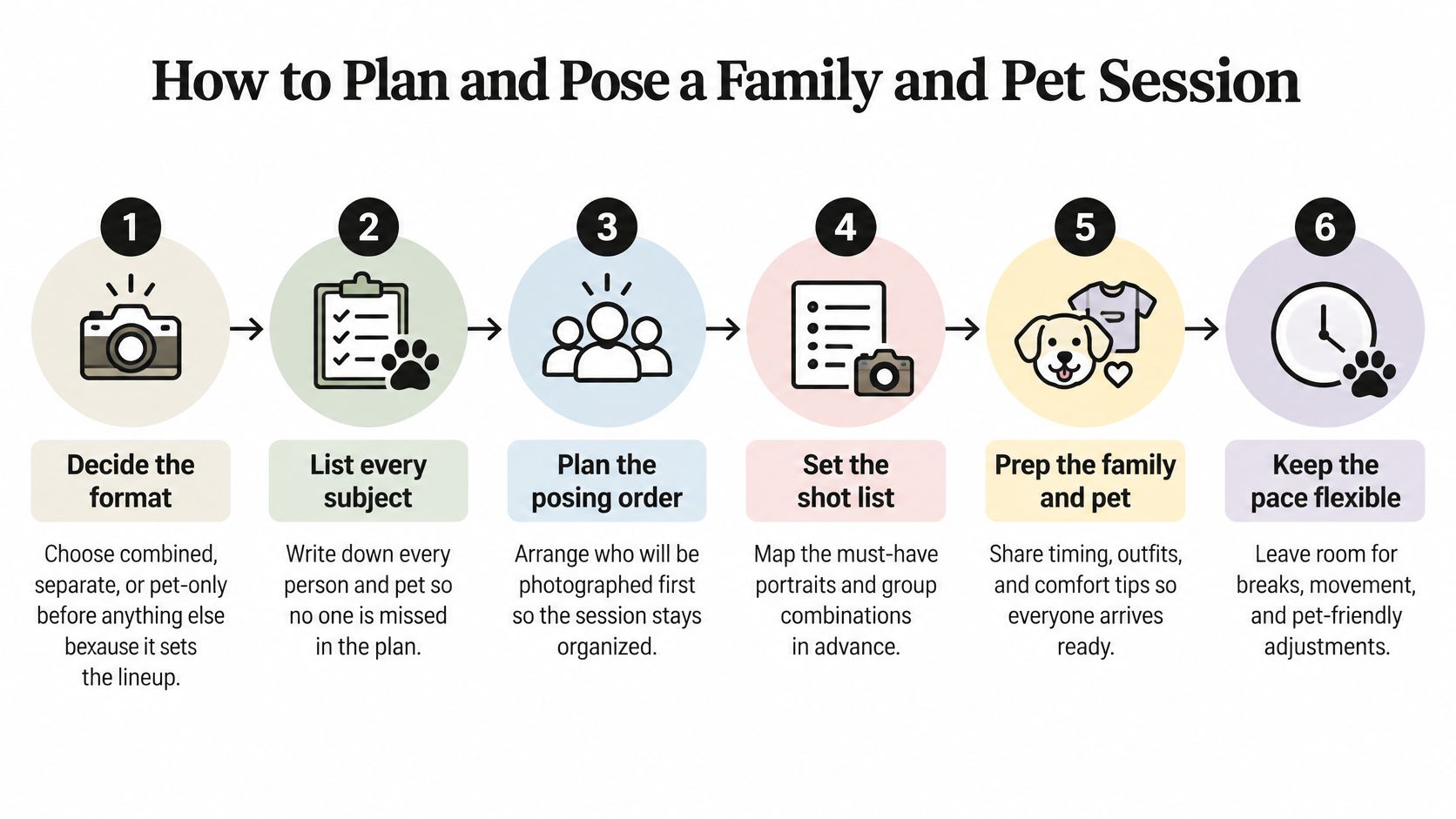
Build the session around comfort
- Decide the format first. Choose combined, paired or pet-only before arranging the session, because that determines who needs to attend. Don't gather the entire household if the finished piece will feature only the animal.
- Write down every subject. Sketch who sits where and note anyone who won't be present. This prevents an absent family member from becoming a late addition that forces the artist to rebuild the composition.
- Choose a calm moment. Set a clear start time in a quiet room, away from visiting relatives and household activity. If your pet usually becomes restless or tired toward evening, don't expect a late session to produce a patient pose.
- Rehearse briefly at home. Use a familiar cue and an appropriate reward, then release the pet before it becomes frustrated. The rehearsal should make the arrangement familiar, not wear the animal out.
- Build the pose from the floor upward. Begin with the pet and a seated adult, add standing adults, then bring children into their places once the arrangement is ready. Keep children beside the animal only when that interaction is comfortable and safely supervised.
- Capture useful alternatives. Photograph the group, then collect side views, individual expressions and face close-ups. Several usable references are better than forcing everyone to hold a single pose until the pet disengages.
- Review the selection with the artist. Identify the preferred expression and any features that must remain faithful before painting begins. This is the moment to resolve an obscured paw, an awkward hand or uncertainty about which photograph shows the correct coat colour.
Keep clothing comfortable and relatively quiet around the faces. A broad collar, busy sleeve or bright toy directly beneath a muzzle can become more visually prominent than the expression you wanted to preserve.
For an additional visual reference while planning the session, use the video below.
Starting poses by pet type
| Pet type | Typical pose | Human placement | Preparation tip |
|---|---|---|---|
| Medium or large dog | Seated or lying at the family's level | Adults seated or kneeling beside the dog, children at its eye level when safe | Practise the cue and reward before the session |
| Cat | Settled on a lap, shelf or sill | Adult seated beside the cat or supporting it loosely, never gripping | Choose the cat's calm hours |
| Rabbit or small mammal | Low on a blanket or in the owner's lap | Adult seated low, with hands visibly supporting the animal | Keep the session brief and have a carrier nearby |
| Bird | Perched on a hand, shoulder or stand | Familiar adult's hand or shoulder serves as the perch when appropriate | Use a familiar perch and keep the room quiet and secure |
Choosing Abstract Backgrounds With Detailed Subjects
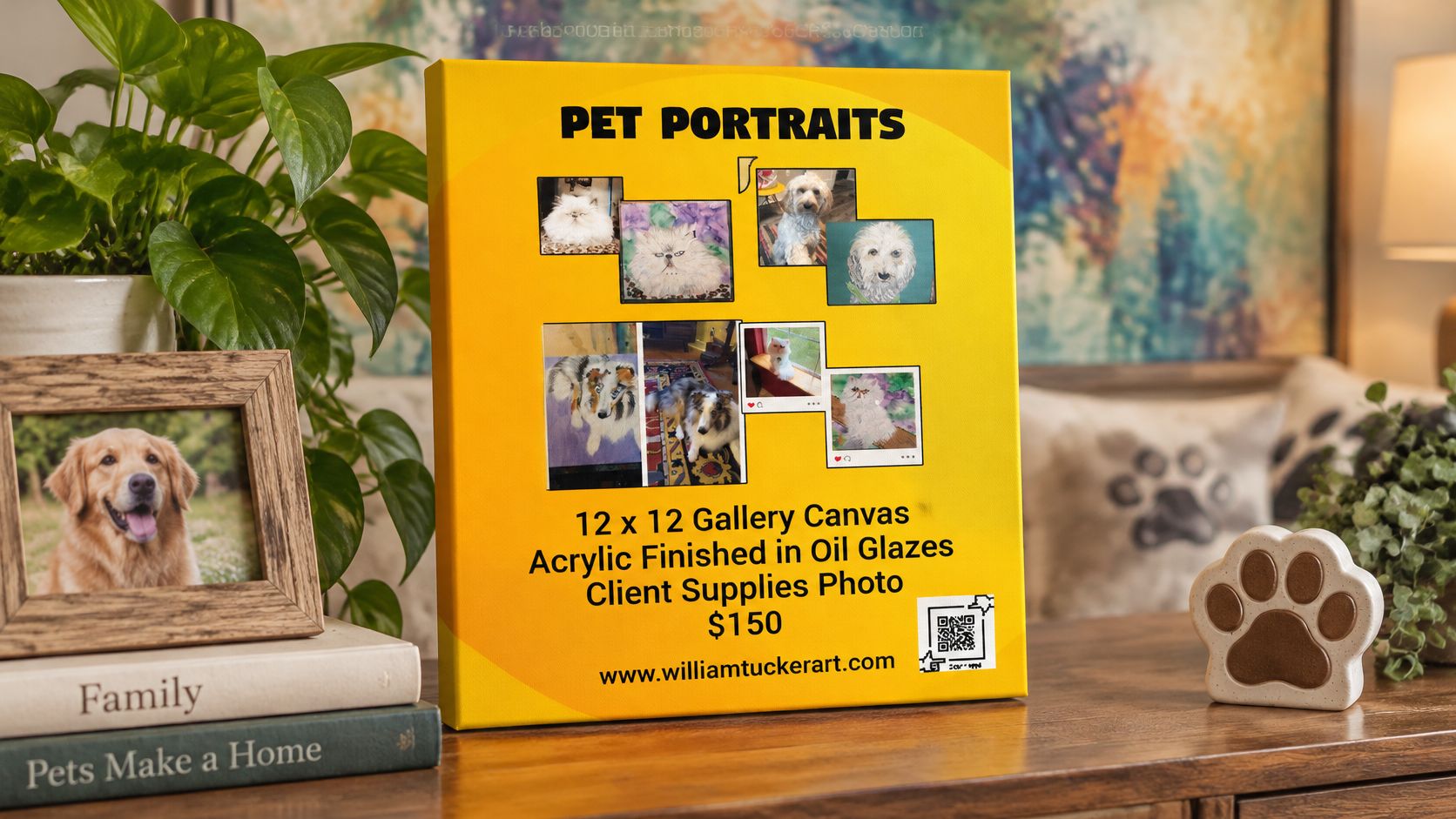
A family can love a cluttered living-room photo and still want a portrait where the dog's eyes read from across the room. An abstract background with a detailed subject solves that tension: colour fields and textured brushwork set the mood, while carefully rendered faces preserve recognition. The background can echo your room without requiring everyone to pose inside a perfectly decorated interior.
William Tucker Art combines abstract backgrounds with detailed subjects in pet and wildlife work. Treat the animal as a full sitter in that decision, not as an accessory at the edge of the group. The example below shows the balance: a calm field behind a face that stays sharply observed.
Decide where detail earns its place
Put the closest attention into eyes, muzzle proportions, coat-pattern boundaries and hands. These features explain identity and contact. A loosely painted background is forgiving; an incorrectly placed eye or an awkward hand resting on a pet isn't.
The trade-off is visibility. Heavy abstraction around a dark ear can make it disappear, while energetic marks behind a patterned coat can compete with the animal's silhouette. Ask for enough tonal separation to read the face from your intended viewing distance. For a memorial portrait, use the same test: the expression should remain legible first, with colour supporting the coat rather than performing around it.
Portrait styles compared
| Style | Background | Subject treatment | Best for |
|---|---|---|---|
| Detailed realism | Simple or real setting | Fur, eyes and textures rendered closely | Formal hallways and documentary keepsakes |
| Abstract background with detailed subject | Colour fields or textures that set mood | Sharp, precise face and coat | Living-room focal pieces and gifts |
| Loose painterly | Brushed, gestural field | Soft edges, key features only | Relaxed homes and casual gifts |
| Minimal graphic | Flat colour or simple outline | Simplified shapes | Modern offices and small spaces |
Detailed realism suits a meaningful location, such as a familiar porch. Loose painterly work suits families who value movement and gesture over a close description of every marking. Minimal graphic treatment works when the silhouette is distinctive, though it gives up subtle expression.
Research on using RGB displays to portray imagery to animal eyes explains that species differ in photoreceptors and spectral sensitivity. A human-viewed portrait does not need to reproduce the pet's visual experience. The design lesson is simpler: prioritise readable shapes and contrast rather than depend on subtle blue-green differences in fur.
For more context on balancing loose fields with faithful features, read the studio's guide to abstract and realistic painting.
Choose abstraction for the background and enough detail in the faces to preserve recognition.
Preparing Photos for Print-Ready Portraits
The artist needs clear reference photographs of every subject, not merely your favourite group picture. A photograph can be emotionally important yet technically incomplete, so send supporting images rather than expecting the artist to guess a hidden marking.
You're responsible for supplying photographs and other reference materials. Our portrait is the artist's interpretation of the subject, based on those pictures and the information you provide. Tell us which image best represents personality and which most accurately shows appearance.
Prepare files without losing information
- Check resolution against the intended output. For high-quality print preparation, work toward approximately 300 pixels per inch at final size, while following colour-management guidance such as the U.S. National Archives' technical guidelines. For painting references, prioritise genuine facial detail rather than artificially enlarging a small file.
- Preserve the original master. Keep the camera original, RAW file or lossless scan untouched, and make adjustments on copies. A screenshot or social-media download may discard the texture the painter needs to understand fur and facial structure.
- Use soft, diffuse light. Position the subject near indirect window light rather than in harsh sunlight. Avoid beauty filters and strong colour effects, which can change skin tones, eye colour and coat markings.
- Inspect pale and dark areas. Look for white fur that has become a featureless bright patch and black fur that has collapsed into solid shadow. Supply an alternative exposure if the camera hasn't retained the detail.
- Send complementary angles. Include close-ups of eyes, unusual markings and scars, with notes explaining anything that photographs inconsistently. Don't crop away ears or paws just because they aren't central to the expression.
For a print workflow, the artist or print provider should retain a suitable wide-gamut master and soft-proof using the intended printer-and-paper ICC profile. Changing a file's colour-space label isn't the same as recovering missing colour information. Export a print-specific copy rather than overwriting the master.
Your reference-photo send checklist
- Each pet's full body: Show proportions, posture, paws and tail where possible.
- A clear face close-up: Include both eyes when the chosen angle allows it.
- The family together: Provide a guide to relative heights and natural relationships.
- Distinctive features: Include coat boundaries, scars, ear shapes and identifying details.
- A short written note: Explain the preferred expression and anything the photographs don't communicate.
Memorial Portraits When a Pet Has Passed
Is it too soon to commission a portrait? There's no correct waiting period after a loss. You can begin when choosing photographs feels manageable, or leave the decision until you're ready.
Say a family wants to remember a dog who always lay beside the children during reading time. One person prefers a cheerful outdoor picture; another wants the familiar blanket included. Rather than choosing the most solemn image, they can begin by agreeing on the memory they want to live with.
Choose remembrance rather than a prescribed mood
A celebration-of-life portrait might show the dog alert on a favourite walk or resting contentedly at home. An explicitly memorial composition might use a quieter setting, restrained colour or a meaningful backdrop. Neither approach is more respectful than the other.
The 2025 PDSA Animal Wellbeing Report found that 94% of owners who had experienced pet loss expected their animal to live on in their memory. That finding supports taking remembrance seriously, without assuming that every family needs to purchase something to express it.
Decide who belongs in the frame before selecting symbolic details. The pet might appear alone, with living family members or beside a deceased animal companion. When subjects come from different photographs, agree whether the painting should suggest a shared everyday moment or openly present an imagined gathering.
- Choose recognisable photographs: Select the expression that feels most like the pet, even if another image is technically sharper.
- Discuss meaningful objects: Include a collar, blanket or toy only if it adds something personal.
- Agree on the tone: Tell the artist whether you want warmth, stillness, playfulness or a more formal tribute.
- Set a comfortable pace: Allow room to pause decisions rather than treating grief as a deadline.
Our guide to pet memorial pictures can help you consider these choices without making the image overly elaborate.
A gentle boundary: A portrait cannot replace the animal. It can preserve a particular story about the life you shared.
If you're commissioning a memorial as a gift, ask whether the recipient wants a portrait before arranging it. A surprise shouldn't take away their choice of image, tone or timing.
Commissioning Timelines and What to Expect
With no delays on the client's end, most pet portraits should be completed and delivered within 7 to 10 business days after all client-supplied reference materials arrive. Treat that as a typical range, not a guaranteed arrival date. The artist cannot be held to a fixed timeline.
The biggest practical distinction is between starting an enquiry and supplying an actionable brief. A conversation can begin with a favourite photograph. Painting needs a settled lineup, usable references and a clear background direction.
What moves the schedule
What changes the commission timeline
| Factor | How it changes delivery | What the client can do |
|---|---|---|
| Standard portrait with no delays | Most portraits finish and arrive within the typical range stated above | Send complete references in one batch |
| More than one subject | Adds composition and painting time | Confirm the lineup before the deposit |
| Custom background | Adds planning and painting time | Choose the background style early |
| Waiting for payment or photos | Pauses progress until the required items arrive | Send payment and references promptly |
We're based in New Orleans, and William Tucker paints pet and wildlife subjects on canvas or wood panel. Our pet portrait commissions guide provides context for planning a commission. Agree on the frame or mounting and the intended display location before work begins, particularly if you're coordinating the painting with an existing collection.
Portrait timelines vary with the size and number of subjects and whether a custom background is required. A close pet study and a family group with a custom setting demand different amounts of composition work, so don't assume they'll take the same time. A memorial portrait sits inside the same schedule: the subject's absence doesn't shorten the painting, only the planning conversation around it.
Understand ownership and delivery
Commissioning a portrait means agreeing to the Pet Portrait Order Agreement. William Tucker Art retains full copyright and reproduction rights to the painting. Clients may not use an image of the commissioned painting beyond individual use without written permission, so raise any intended commercial application before proceeding.
Once complete, the painting is packed, insured and shipped, and the recipient must sign for delivery. Make sure someone can accept the parcel at the delivery address.
If the portrait is intended for a gift occasion, share that information at the outset. Keep the occasion separate from a promised completion date, and avoid organising an unveiling around an unconfirmed arrival.
Book Your Family and Pet Portrait Today
Start by gathering your strongest reference photographs into a single folder. You don't need a perfectly posed image of everyone together to begin the conversation. You need enough clear information to explain who belongs in the portrait and what makes the pet recognisable.
Make these decisions in order:
- Choose the format. Decide whether the household belongs in a combined painting, a matched pair or a pet-only portrait.
- Pick the visual treatment. Choose the background approach and the amount of detail you want, with the intended wall space in mind.
- Complete the reference selection. Add the photographs, subject list and notes that explain the expression or relationship you want preserved.
Begin with a clear brief
A pet portrait requires a $50 non-refundable deposit to start. Final payment is due upon delivery, and payments can be made online through our website. The deposit begins the work; the photographs and accompanying information give the artist the material needed to interpret your subject.
Reference photos can be sent by email attachment or by text to 910-273-2420. When sending several messages, identify the preferred photograph and explain which additional images show supporting details.
For readers coordinating portrait appointments for a studio, organisation or group, AmaJova's resource to compare booking and payment systems can help with the administrative side. Keep appointment arrangements, payment records and the creative brief organised so practical details don't interrupt decisions about the artwork.
Gather your best photographs this week if that feels comfortable, write down the subjects' names and decide what you want the painting to remember. Then get in touch to plan the references or first session around the pet, rather than asking the pet to fit an inflexible plan.
William Tucker Art offers commissioned pet portraits that give your companion a considered place in your family's story, whether you're celebrating daily life or creating a memorial. Visit William Tucker Art to begin a conversation about your photographs, preferred style and the portrait you'd like to bring home.