
The popular advice says you must choose between realism and abstraction. A realistic painting should describe the subject faithfully, we're told, while an abstract painting should abandon recognizable forms and trust gesture, color, and sensation. That division is convenient for labels, but it doesn't describe how many compelling paintings actually work.
An abstract and realistic painting can give viewers two experiences at once. A sharply observed animal, person, or scene offers immediate recognition. Around it, expressive color and broken marks can suggest weather, memory, habitat, movement, or environmental pressure. The subject welcomes the eye, while the surrounding abstraction gives the mind room to participate.
That combination matters especially in wildlife and pet portraiture. Collectors often want a likeness they can identify instantly, but they also want an artwork with a distinctive visual identity rather than a photographic copy. The strongest hybrid paintings use technical accuracy as an emotional doorway, not as a limit.
Rethinking the Divide Between Styles
Realism and abstraction aren't opposing teams. They're different ways of organizing attention and meaning.
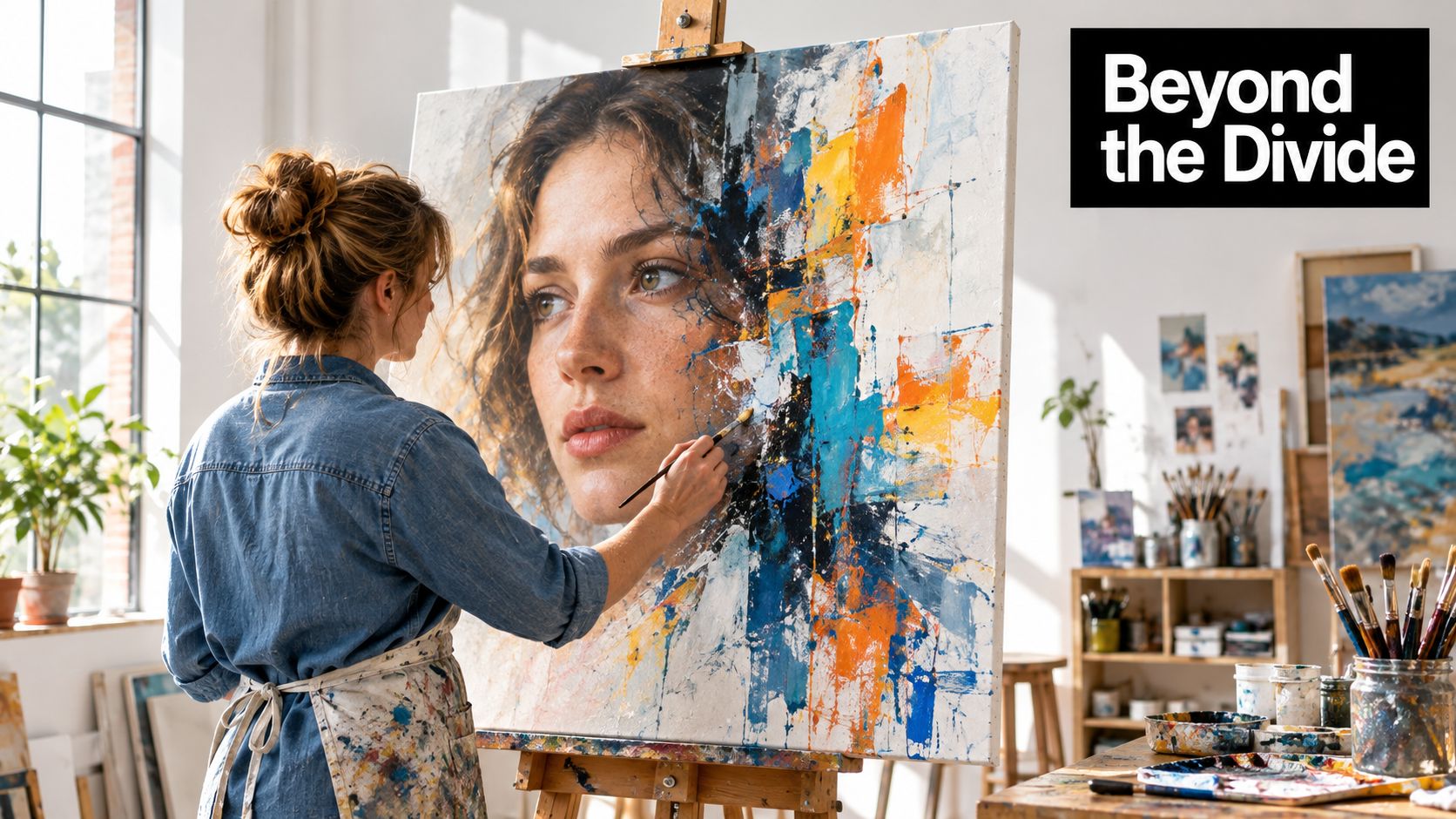
Realistic painting depends on recognizable structure. An artist may carefully observe the angle of a dog's muzzle, the weight of a horse's head, or the pattern of feathers around a bird's eye. Abstract painting can shift the viewer toward color relationships, rhythm, texture, and ambiguity. When these languages meet deliberately, the realistic subject provides a stable point of entry while the abstract field expands the emotional setting.
Recognition is only the beginning
A pet's eyes might be rendered with controlled edges and subtle tonal shifts, while the space behind the head breaks into cobalt strokes, warm ochre planes, or marks that resemble moving grass. The viewer recognizes the animal first, then begins to read the atmosphere surrounding it. That second stage can suggest personality and place without spelling out a single fixed interpretation.
This is why hybrid work can feel more personal than either strict realism or unrestricted abstraction. A purely realistic portrait may communicate likeness with great clarity. A fully abstract composition may create a powerful mood without identifying its subject. A blended composition allows recognition and interpretation to reinforce each other.
For artists and collectors who want to explore this relationship further, this discussion of abstract realism offers a useful point of comparison. The important distinction is intention. An abstract background shouldn't function as decorative noise added after the portrait is finished. It should help define what the subject means within the painting.
A useful test: If you remove the abstract surroundings, does the subject lose emotional context, or does the image remain exactly the same? The stronger hybrid works make the environment necessary.
Why the combination holds attention
Research comparing representational and abstract art found that realistic imagery tends to produce more localized, object-focused scan paths, while abstraction encourages more globally distributed viewing patterns (PNAS research on visual art perception). That difference gives painters a practical compositional tool. They can place the most concentrated information in the animal's face or figure, then use looser passages to move the viewer across the wider surface.
The result isn't just “realism plus abstraction.” It's a visual conversation between certainty and possibility. The eye knows where to begin, but it doesn't receive every answer immediately.
The Evolution of Observation and Expression
The modern history of realism begins with a refusal to idealize ordinary life. In mid-nineteenth-century France, realistic painting emerged partly in reaction to Romanticism's preference for imagination, drama, and idealized subjects. Artists turned their attention toward contemporary workers, rural labor, urban environments, and recognizable social settings.
The movement is generally dated to approximately 1840 to 1870, with 1848 often treated as a key starting point because political and social upheaval encouraged artists to address present-day society rather than rely on mythological or historical subjects (historical overview of realism). This shift changed more than subject matter. It changed what counted as worthy of sustained observation.
Courbet, Bonheur, and the authority of looking
Gustave Courbet became a foundational figure because his work helped establish realism as an independent artistic position. His 1855 exhibition in Paris became an institutional milestone after the official World Fair rejected one of his paintings. Courbet's challenge was direct: contemporary life deserved serious scale, seriousness, and attention.
Rosa Bonheur's Ploughing in the Nivernais, completed in 1849, made a related argument through agricultural labor and animal subjects. The painting shows how close observation can turn working scenes and animals into major art-historical themes, rather than treating them as incidental decoration.
Those principles remain central to wildlife and pet portraiture. Anatomical specificity gives an animal presence. Accurate proportions, weight, posture, and gesture allow viewers to sense that the painter has paid attention to a living subject rather than assembled a generic symbol.
From observed body to expressive environment
Contemporary artists don't need to abandon those observational skills in order to work abstractly. They can preserve the animal's structure while allowing the surrounding environment to become more interpretive. A heron may remain clearly legible, while water is described through horizontal color movement instead of literal ripples. A fox can hold a precise silhouette against a field of fractured reds and greens that suggests autumn, pressure, or a habitat in transition.
This approach treats realism as a foundation rather than a cage. The painter observes what must remain convincing, then decides where visual facts can give way to sensation. For a broader explanation of recognizable imagery and its role in painting, this guide to representational art provides helpful context.
The historical lesson is simple. Careful looking and expressive interpretation have never been true enemies. Hybrid painting extends realism's attention to the lived world into a visual language capable of showing not only what an animal looks like, but what its environment feels like.
How the Eye Moves Through Hybrid Compositions
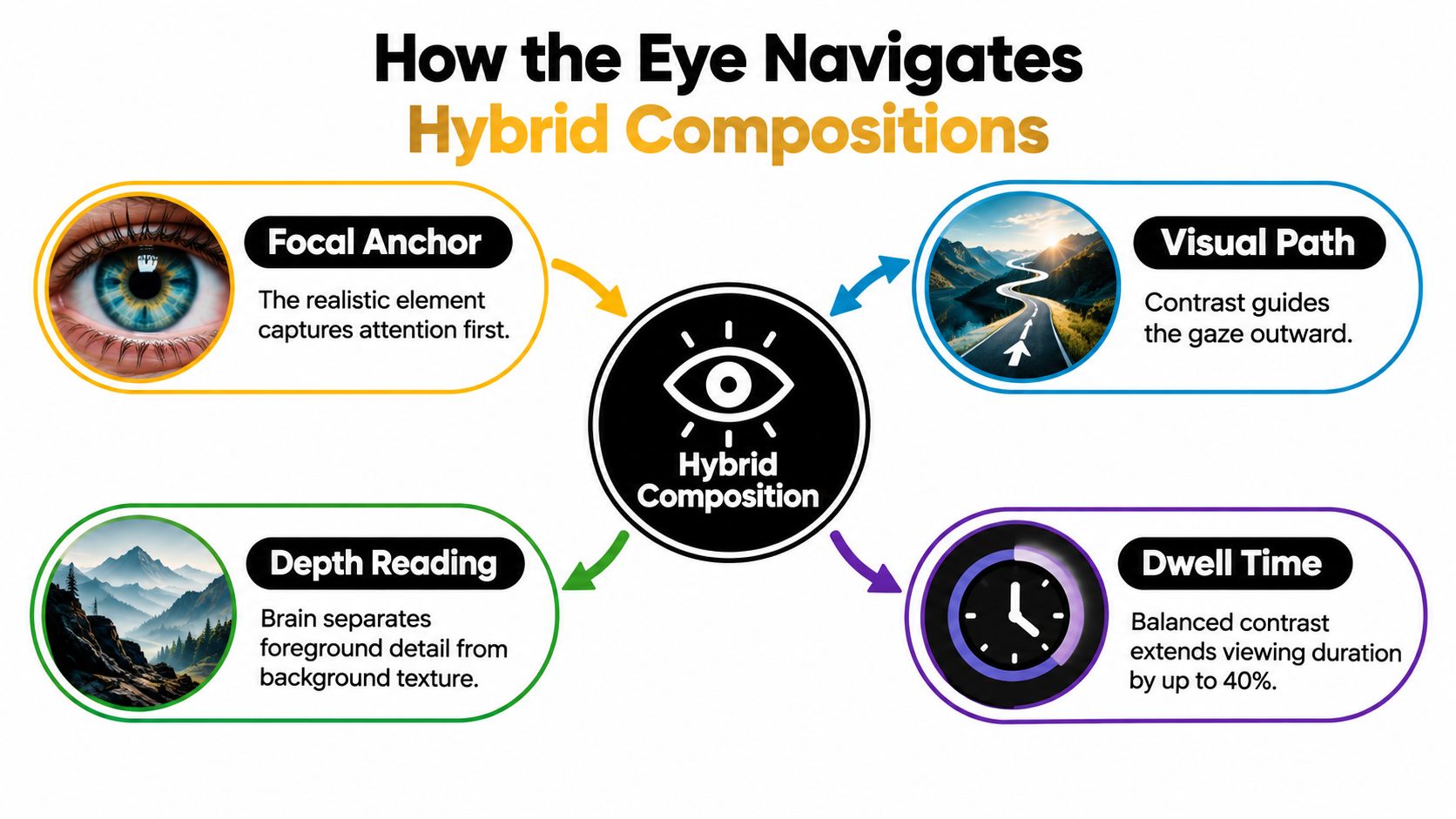
Hybrid paintings often hold attention longer than fully realistic or fully abstract works because they ask the brain to do two things at once. One part recognizes a subject quickly. Another part keeps searching the surrounding paint for mood, motion, and meaning. That exchange is what gives these compositions their charge.
A viewer does not study every inch of a canvas with the same intensity. Attention gathers around recognizable forms, strong contrast, clean edges, and shifts in value. The artist shapes that experience by deciding where visual information will be concentrated and where it can stay open, atmospheric, or unresolved.
In a wildlife portrait, the eyes, muzzle, beak, or silhouette often become the focal anchor. These passages may carry sharper edges, quieter transitions of light, and more exact anatomy. Around them, the background can open into broader shapes, broken contours, simplified color fields, and visible brush movement. The result is visual hierarchy that feels natural. Your eye finds the subject first, then begins to roam.
Detail creates an anchor, not a prison
A perception study involving 115 university students found that realistic paintings were understood more readily than abstract paintings and were viewed slightly longer, averaging 4.0 seconds compared with 3.6 seconds (study of figurative and abstract painting perception). That does not make realism automatically richer. It suggests something simpler and more useful for collectors. Recognition gives viewers an easy point of entry, while abstraction keeps the experience open after that first recognition has occurred.
In practice, a dog's face may hold attention first. Then loose strokes in the surrounding field pull the viewer toward color echoes, peripheral shapes, and emotional cues carried by the paint itself. The realistic subject answers the question, “What am I seeing?” The abstract setting keeps asking, “What does this feel like?”
For collectors: Stand close enough to inspect the surface, then step back until the subject reads as a single shape. A strong composition works at both distances. Detail rewards close viewing, while the larger silhouette still holds together across the room.
Four questions for reading the composition
- Where does your eye land first? The first point of attention should usually hold the painting's clearest emotional signal, such as an animal's eyes or a person's hands.
- What carries your gaze outward? Repeated colors, angled brushstrokes, and directional shapes can connect the subject to the rest of the canvas.
- Where does the image become ambiguous? Ambiguity usually works best in secondary areas. If the face becomes uncertain while the background turns highly descriptive, the hierarchy starts to collapse.
- Does the atmosphere add meaning? Color, gesture, and spacing should suggest place, mood, or tension. They do not need to describe a literal setting, but they should deepen the painting's emotional logic.
Artists often borrow ideas from cinematic storytelling composition tips when shaping framing, visual pathways, and the relationship between a central figure and its surrounding space. A successful hybrid painting keeps recognition and mystery in balance, so the viewer continues moving through the image instead of stopping at the first identifiable detail.
Techniques for Balancing Detail and Atmosphere
The balance begins before the final brushwork. Artists often establish the subject's proportions and silhouette early, then decide which passages deserve precision and which can remain energetic. That order protects recognition while leaving room for atmosphere.
Build the subject in controlled zones
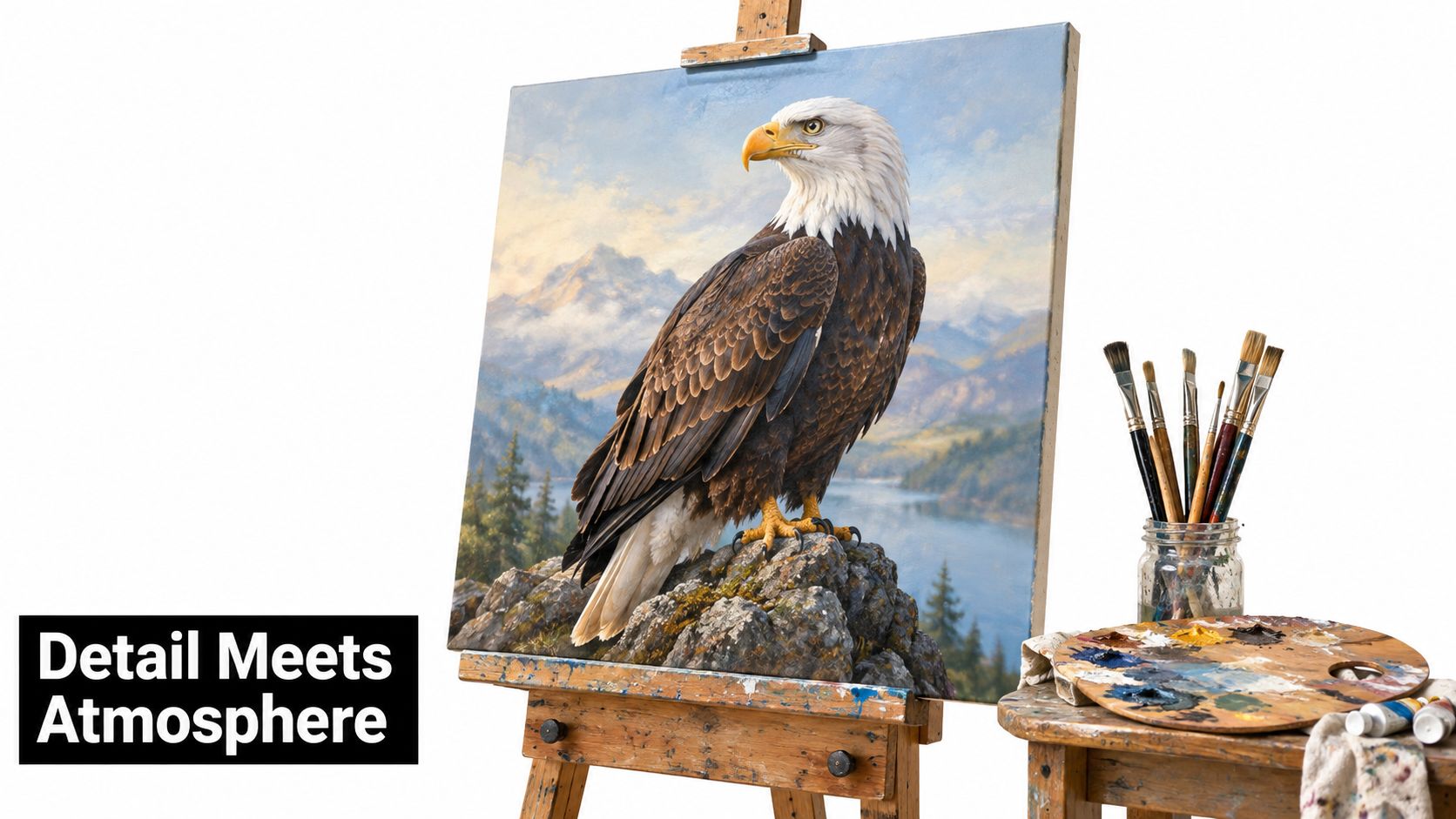
For a wildlife or pet portrait, begin with the large anatomical relationships. Check the head shape, eye placement, shoulder or chest mass, and the angle of the body before adding fur or feather detail. A convincing silhouette carries recognition even when the surrounding paint becomes loose.
Then concentrate refinement where viewers naturally look. The eyes may need crisp edges and nuanced reflections, while fur can transition into broader directional strokes near the neck or body. This variation prevents the entire painting from becoming equally sharp and equally static.
Acrylics can support layered color fields and quick changes, while oils allow slower blending, transparent glazes, and soft transitions between observed form and expressive mark-making. Mixed media may introduce granular surfaces, collaged fragments, or materials that reinforce a coastal, forest, or urban setting. The material should serve the visual idea, not compete with it.
Let the background describe movement
Loose marks work best when they have direction. Horizontal strokes can imply water or wind, vertical passages can suggest reeds or tree trunks, and broken diagonal gestures can bring energy to a stormy field. A background becomes distracting when every stroke points somewhere different or carries the same visual weight.
Use color relationships to connect the subject with its environment. A cool reflection in a bird's feathers might reappear in the surrounding field, while a warm accent near a dog's collar might echo across the background. These repetitions create cohesion without requiring a literal setting.
Artists who are setting up a young studio or family painting activity may also find practical protection in children's smocks. Keeping materials and clothing manageable helps preserve attention for the actual decisions, especially when experimenting with expressive application.
The process is easier to understand when you can watch the order of decisions, from block-in to surface refinement:
A final adjustment often determines whether the painting feels integrated. Soften or simplify background marks that rival the face, strengthen one or two edges that have disappeared, and check the work from a distance. The goal isn't equal detail. It's a deliberate exchange between clarity and sensation.
Preserving Material Contrasts in Your Collection
Collectors sometimes assume a painting has one conservation profile. A hybrid work rarely does. A misty abstract field, a sharply observed face, a glossy varnish, and a ridge of impasto can each react differently to light, humidity, and touch, so the safest display choice is usually set by the most sensitive material on the surface.
The National Gallery recommends approximately 150 ± 50 lux, annual exposure below 650 kilolux-hours, relative humidity near 55 ± 5%, and UV radiation below 10 microwatts per lumen for paintings in its care (National Gallery guidance for paintings and their environment). These figures are useful reference points. They do not replace advice specific to one object.
Light affects more than brightness
Light changes how a painting reads before it causes obvious physical damage. Pigments can fade. Oil-paint binding media can darken. Varnish can discolor. In a hybrid composition, those shifts matter because the abstract zone often carries the painting's atmosphere through strong color relationships, while the finely modeled realistic passage depends on subtle tonal shifts. If nearby colors drift, the eye reads form differently, and the balance between sensation and recognition starts to weaken.
For medium-specific limits from the same guidance, oil, tempera, and acrylic works display at up to approximately 200 lux, while watercolor and dye-based works generally require around 50 lux and tighter UV control. Ask the artist or a conservator what the work is made from, whether it is varnished, and how they expect it to be lit. That short conversation can prevent a poor placement choice.
A practical care routine
- Avoid direct daylight: Keep the work away from windows, or use suitable UV-filtering glazing when appropriate.
- Keep conditions stable: Sudden swings in temperature and humidity can stress paint layers and supports, even if the room seems comfortable.
- Document the materials: Save notes on medium, dimensions, framing, and surface treatment with the purchase record.
- Handle the surface carefully: Do not touch impasto, textured passages, or unglazed areas. Dust only in line with professional guidance.
- Plan display rotation: Works with light-sensitive materials may benefit from time away from exhibition lighting.
Acrylic passages need their own caution, especially when matte and glossy surfaces sit side by side. this preservation guide for acrylic paintings offers a useful starting point. Good conservation protects more than the object. It preserves the visual conversation between saturated abstraction and observed detail, the very contrast that keeps the viewer's eye alert and the painting emotionally alive.
Evaluating Transparency When Buying Art Online
The hardest part of buying art online is not taste. It is verification. A screen can show composition and subject, yet it flattens the very things that often make a hybrid painting persuasive: the drag of a dry brush, the crispness of an edge, the shift between matte and gloss, and the way color breathes differently as light changes. Online buying works best when the artist or gallery treats documentation as part of the artwork's presentation, not as an afterthought.
That starts with a simple distinction. Factual transparency gives you dimensions, materials, condition, framing, provenance, shipping terms, and return policies. Interpretation has a different role. It can clarify the artist's intention, but it should never push you toward a single symbolic reading.
What responsible documentation includes
A reliable listing should let you study the work the way your eye would study it in person, first at a distance, then up close. Look for:
- Consistent photography: The full work should be shown in neutral, even light, with close images of texture, edges, and focal passages.
- Clear measurements: Dimensions should state whether they describe the support alone or the framed piece.
- Material disclosure: The medium should be named, along with varnish, mixed media, raised texture, or other surface features that affect appearance.
- Scale references: A room view or an accurate comparison helps you judge how the piece will sit on your wall.
- Color context: Screens vary. A plain disclaimer is more useful than a promise of exact color matching.
- Condition and provenance: Buyers should be told whether the work is new, previously exhibited, signed, dated, and accompanied by supporting documentation.
- Delivery details: Ask how the painting will be packed, whether it ships framed, and what happens if damage occurs in transit.
Collectors are buying online, but hesitation remains. An Artsy collector survey reported that 69% of respondents had hesitated to buy art because of insufficient transparency. The same survey found that 59% purchased art online in 2024, and among those online buyers, 73% purchased as much or more online than in the previous year (Artsy's 2025 art market trends). Analysts at Art Basel and UBS also estimated the global art market at $57.5 billion in sales in 2024, down 12% year on year, and the same report puts the United States at 44% of global sales by value, about $26 billion, with the United States, United Kingdom, and China together accounting for 76% of worldwide sales (Art Basel and UBS Global Art Market Report 2025). Those figures explain why online access matters. They do not remove the need to examine an individual work carefully.
Assess likeness without demanding a photograph
This matters most with commissions and animal portraiture. A buyer often asks, “Does it really look like them?” That is the right question, but likeness is broader than exact replication. Compare the source photos with the finished work, then check expression, posture, gaze, and the small habits that make one animal distinct from another. A lifted chin, a guarded stare, or a relaxed shoulder can carry recognition more powerfully than copied markings alone.
Hybrid painting asks the eye to do two jobs at once. It anchors itself in the known, a recognizable face, body, or gesture, while the abstract field around it supplies mood, motion, and memory. That combination tends to hold attention because the brain gets both certainty and openness. The realistic subject gives you something to grasp. The abstract background leaves room for feeling, which is often where attachment begins.
William Tucker Art offers wildlife, coastal, and pet paintings that pair detailed subjects with expressive backgrounds, alongside custom pet portrait services. If that approach suits your collection, visit William Tucker Art to review available works and discuss a portrait that preserves recognition while allowing atmosphere to do its share of the emotional work.