
Your phone is full of dog photos, but the one you love most may be badly cropped, slightly blurred, or lit by the worst possible lamp. That doesn't automatically disqualify it. A successful dog portrait from photo depends less on technical perfection than on whether the image preserves the features and expression that make your dog unmistakably yours.
A commissioned portrait is a small creative project, not a button you press. You supply the visual evidence and the story. The artist decides what to preserve, what to simplify, and how to turn a moment on your phone into an object that can live on a wall.
Why the Photograph Matters More Than the Style
Most commissions begin with the same problem. An owner scrolls through a crowded camera roll, stops at a dozen almost-right images, and wonders whether any of them can become a painting. One photograph shows the dog's best expression, another has clearer fur, and a third includes the familiar garden where the dog spent every afternoon.
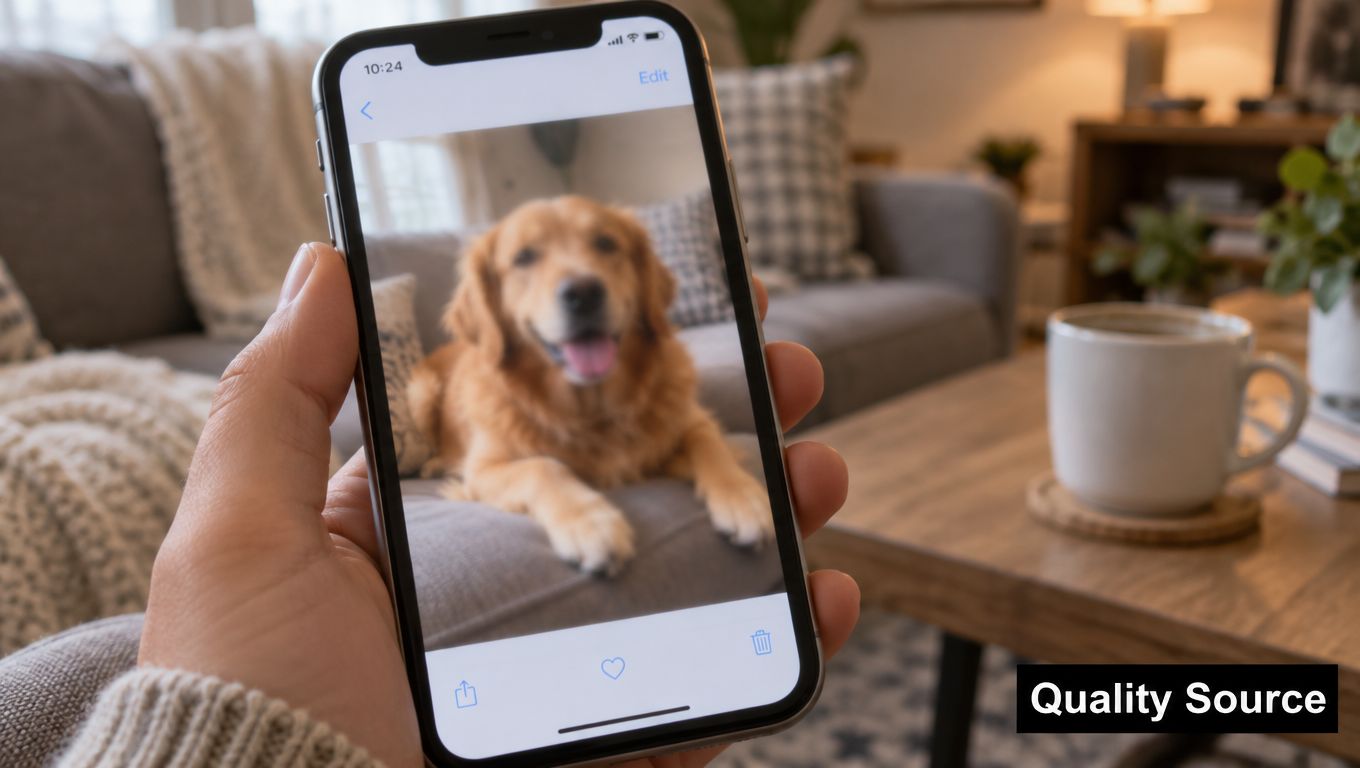
The strongest choice usually isn't the sharpest file. It's the photograph that carries personality and identity. A slightly imperfect image can reveal the head tilt, relaxed mouth, uneven ear, or direct look that family members recognize instantly. A technically polished photograph with a blank expression may produce a less convincing portrait.
What the artist is really using
William Tucker's hand-painted process begins with your reference image, but it doesn't end with copying pixels. The photograph gives the artist the dog's structure, expression, coat pattern, and visual presence. The painting then interprets those facts through mark-making, color, contrast, and background.
That distinction matters. Medium, canvas size, and background can all change the mood, but none can rescue a reference that hides the eyes or changes the muzzle through distortion. Before discussing style, review how dog portrait photos affect the finished artwork. The early decision determines the quality of every later decision.
Practical rule: Choose the photograph your family would recognize first, then use additional images to clarify anatomy and coat details.
Photography has been connected to pet remembrance almost since photography began. The daguerreotype process was publicly introduced in 1839, and the National Science and Media Museum records that Mary Mitford brought her dog to Nicolaas Henneman's studio in 1847 for an individual portrait. The dog reportedly remained still for approximately four minutes while the image was made, an early example of an owner deliberately preserving a relationship through a portrait National Science and Media Museum.
That history gives the modern commission extra meaning. Your photograph is documentary evidence of a particular moment, while the painting adds interpretation that a camera can't provide. Treat the upload as the beginning of a collaboration, not as an administrative formality.
Reading Your Reference Photos Like an Artist
Start by diagnosing the image in layers. Don't ask only, “Is this high resolution?” Ask whether the photograph contains enough information to reconstruct the dog's identity-bearing structure.
Look first at the face. Both eyes should be visible whenever possible, the nose shouldn't be blocked, and the camera should sit close to eye level. Check the pupils, catchlights, nose edges, whisker placement, and fur direction separately. Those small areas carry more likeness than a large expanse of sharply recorded fur.
Separate fixable flaws from missing information
An artist can often remove a leash, simplify a messy background, adjust distracting color, and interpret a small amount of uncertainty. An artist can't reliably invent the correct eye shape, missing nose structure, or an obscured marking without risking a generic result.
Use this diagnostic:
- Motion blur: If the face is soft but another image shows the same features clearly, submit both. If every facial reference is blurred, request a replacement close-up.
- Flash-flattened eyes: Harsh flash can erase depth and catchlights. Keep the image if the expression is important, but pair it with a naturally lit photograph.
- Leash across the muzzle: This is usually a workable obstruction when another image reveals the nose and mouth. Don't ask the artist to guess what lies underneath.
- Heavy shadows: A dark coat can lose tonal separation. Supply a second image taken in open shade or balanced indoor light.
- Wide-angle distortion: Extreme phone lenses can enlarge the nose and narrow the sides of the head. A three-quarter image from farther away is a better structural guide.
- Filters and screenshots: Social-media processing may shift coat color, sharpen edges artificially, or remove subtle texture. Send the original file whenever you can.
Research on automated dog identification distinguishes facial and full-body recognition and examines localized facial information, including color histograms and SIFT descriptors research on automated dog identification. For a human artist, the practical lesson is straightforward: eyes, muzzle geometry, and distinctive markings deserve the highest fidelity.
Build a useful reference set
Two to five well-chosen images can establish more than one supposedly perfect photograph. Use one primary image for expression, then add a side or full-body view to resolve ear shape, body proportions, coat pattern, or a distinctive tail.
Your submission should answer these questions:
- Are both pupils sharp enough to compare?
- Can the artist see the nose shape and mouth?
- Are highlights in white fur still visible?
- Does the coat show color in both shadow and light?
- Is the expression representative of the dog?
- Is there any perspective distortion that changes the head?
A sentimental photograph may still be the right starting point. This guide to animal reference photos for artists is useful when you're deciding which image should lead and which should support it. Send the emotionally important photograph, but don't hesitate to include clearer evidence alongside it.
Choosing a Style That Fits Your Dog and Your Home
Style should support the dog, not compete with it. William Tucker's signature approach places a detailed subject against an abstract background, creating energy around a carefully observed face. A fully realistic treatment keeps more of the surrounding environment and asks the viewer to read the portrait as a complete scene.
Neither option wins automatically. A working dog with an intense gaze may benefit from a restrained background that directs attention to the eyes. A senior rescue with soft, cloud-like fur might suit a quieter realistic treatment with gentle tonal transitions. A sporting dog photographed in motion can carry a more active composition, provided the reference preserves the posture.
Compare the main choices
| Style | Best For | Typical Mood | Works Well With |
|---|---|---|---|
| Detailed subject with abstract background | Dogs whose face and markings carry the story | Energetic, contemporary, expressive | Modern rooms, bold collections, colorful furnishings |
| Traditional realistic portrait | Dogs with a meaningful setting or calm presence | Intimate, composed, commemorative | Classic interiors, family galleries, quiet reading spaces |
| Environmental scene | Working dogs, outdoor companions, and place-based memories | Narrative, spacious, grounded | Homes where the landscape or setting matters |
| Simplified color-field portrait | Strong silhouettes and distinctive coats | Graphic, direct, modern | Minimal interiors and statement walls |
The background changes how the portrait reads from across the room. An abstract field can make the subject feel immediate and collectible. A familiar outdoor scene can preserve the dog's routine, while a plain color field prevents environmental detail from stealing attention.
For a quick visual exploration of generated directions, the starryai pet portrait tool can help you compare broad concepts before discussing a human-made commission. Treat those outputs as mood references, not as a substitute for deciding what physical artwork you want to own.
Match the visual language to the reason
Choose a quieter treatment when the commission is primarily a memorial. Choose stronger abstraction when the portrait needs to hold its own among other artwork. If the dog's personality comes through in movement, don't force a stiff head-and-shoulders pose just because it appears conventional.
You can also use dog watercolor portraits as a reference point when considering how much texture, transparency, and looseness you want. The useful question isn't “Which style is most impressive?” It's “Which treatment preserves why I want this dog on my wall?”
Ordering, Sizing, and Background Choices
Once the reference and style are clear, the order becomes much easier. Start by explaining three things in plain language: what the dog looks like, what the dog means to you, and where the finished work will live. Mention whether the piece is a memorial, a gift, a family portrait, or part of a wider collection.
Then provide the primary photograph, supporting images, the dog's name, and any essential details. Say if a crooked ear, scar, mixed-color eye, worn collar, or unusual marking must remain exactly as shown. Artists can interpret a background, but they shouldn't accidentally “correct” the feature that makes the dog yours.
Let the wall determine the scale
An 8x10 portrait reads as a quiet, personal image. It suits a shelf, bedside table, narrow wall, or small grouping. A 24x30 work or larger asks for breathing room, a clear viewing distance, and lighting that allows the face to remain legible without glare.
Don't choose size from the crop alone. Hold a sheet of paper or painter's tape against the intended wall and stand where you normally view it. A close face can tolerate a smaller format, while a full-body composition or complex background needs more room to resolve.
Canvas is practical for an unglazed presentation and can carry an assertive painted surface. Paper usually benefits from a frame and glazing, which adds protection but can introduce reflections. Ask about archival materials, surface sensitivity, and whether the work arrives ready to hang. A portfolio pricing guide can also help you think through how artists commonly present investment and format choices, even when you're comparing different kinds of commissions.
Keep the background purposeful
William Tucker's abstract treatments are one option. You might instead request an environmental scene, a simple color field, or a restrained suggestion of the dog's favorite place. Be specific about what you don't want, too. “No busy toys,” “keep the garden impressionistic,” or “let the face dominate” gives the artist useful boundaries.
A good brief leaves room for interpretation while protecting the emotional center. Tell the artist where you want the eye to land first. The background should support that destination.
Turnaround, Revisions, and the Question of AI
Before paying, ask how the studio communicates, when you'll see a preliminary stage, what a revision includes, and how delivery is handled. A clear process is more reassuring than an optimistic promise with no milestones.
A typical commissioned workflow may move from an initial sketch to client review, then revisions and final delivery. The supplied process visual describes Initial Sketch from Day 1 to Day 3, Client Review on Day 4, Revisions from Day 5 to Day 7, and Final Delivery on Day 10. Treat those points as a process illustration rather than a universal promise. Medium, queue, size, shipping, and the complexity of the request can change the actual schedule.
Define a revision before you need one
A reasonable revision corrects an agreed detail, such as an ear angle, coat marking, eye color, or background intensity. It shouldn't mean asking the artist to abandon the approved composition and begin an entirely different portrait.
Send consolidated feedback rather than scattered messages. Identify the exact area, describe the desired change, and explain whether the concern is factual likeness or personal preference. “The left ear needs to sit higher because it always folded that way” is actionable. “It doesn't feel right” needs a conversation before the artist can respond.
Here is a useful question to ask: Does the studio retain uploaded photographs, and may those images be used elsewhere? Also clarify whether you own the final physical artwork, whether reproductions are allowed, and how recognizable details such as collar tags, house numbers, or background locations are handled.
Human interpretation changes the object
AI-generated pet images offer speed and easy experimentation, but convenience isn't the same as provenance. A generated image may be reproducible, while a hand-painted portrait records a particular artist's selection of detail, color, anatomy, and symbolism.
The U.S. Copyright Office explains that AI output may receive protection where a human determines sufficient expressive elements, while prompts alone aren't enough U.S. Copyright Office guidance summarized in the provided research. That doesn't settle every ownership question, so buyers should read the studio's terms instead of assuming that an uploaded photograph or generated result carries unrestricted rights.
This short video offers another way to think about the movement from reference to finished artwork:
Choose AI when rapid concept testing is your priority. Choose a human commission when authorship, physical presence, selective interpretation, and a traceable relationship with the maker matter more.
Displaying and Caring for Your Portrait
Protect the finished piece from extremes rather than treating it like a fragile museum object. Hang it away from direct afternoon sun, radiators, damp exterior walls, and kitchen steam. Strong ultraviolet exposure can fade pigments and alter paper, while repeated humidity swings can stress paper, canvas, frames, and adhesives.
A stable indoor environment is preferable. If your home experiences unusually damp or dry conditions, ask the framer or artist which materials suit the room before installation. Bathroom walls, unventilated kitchens, and conservatories are demanding locations for original artwork.
Match the hardware to the wall
Use a hanging method rated for the artwork's weight and suited to the wall itself. Drywall, plaster, brick, and masonry each require different anchors. For larger work, use two secure points where appropriate so the frame stays level and doesn't swing when a dog brushes past it.
Keep the work clear of doors and narrow passages. Your dog may be the subject, but a curious nose, wagging tail, or enthusiastic visitor can still knock a frame from a weak hook.
Clean the surface gently
Dust a framed work with a clean, dry, soft brush or microfiber cloth, keeping pressure light. Don't spray glass cleaner, water, or furniture polish directly onto the frame or surface. Liquids can migrate beneath glazing, stain paper, soften finishes, or damage painted texture.
Unframed canvas needs a different routine. Avoid rubbing the surface, pressing on raised paint, or placing objects against it. Framed paper should remain behind its glazing, with the frame inspected periodically for dust, loose corners, or signs of moisture.
Care habit: Keep the original artwork out of direct sun, and photograph the front and back when it arrives. Those records help if you move, reframe, insure, or eventually pass the portrait to someone else.
The portrait will outlast the phone that held the reference image. Give it a sensible wall, safe hardware, and occasional gentle attention, and it can move with your household rather than remaining trapped in a camera roll.
Putting It All Together
A strong dog portrait from photo comes down to four decisions:
- Reference: Choose the image that captures the dog's character, then add supporting views for anatomy.
- Style: Match abstraction, realism, environment, and color to the dog and the room.
- Format: Decide on size, material, framing, and viewing distance before the artwork begins.
- Process: Confirm communication, revisions, privacy, rights, and delivery expectations.
The best commissions feel personal because they preserve more than appearance. They preserve a recognizable expression, a chapter of family life, and the artist's human interpretation of both.
Don't wait for a flawless photograph. Gather the clearest expression you have, add the images that explain the missing details, and submit them while the memory is fresh.
William Tucker Art creates custom pet portraits from customer reference photographs, combining detailed subjects with expressive background treatments. Visit William Tucker Art to review the available work and begin a conversation about turning your dog's photographs into a lasting painting.