
You're scrolling through your phone, looking for a photo that would make a good portrait, and the same ridiculous picture keeps winning. Your dog's ear is inside out, there's mud on their nose, and their expression looks suspiciously like a complaint about dinner. It isn't a polished photograph, but it feels unmistakably like them.
If you've been searching for dog funny portrait ideas, start with that feeling rather than a costume. The best joke comes from recognizing the dog, not just noticing what they're wearing. A thoughtful portrait can turn an everyday habit into affectionate comedy while keeping your dog's comfort, character, and likeness intact.
Funny Dog Portrait Styles Compared
A funny dog portrait is a comic treatment of a real dog that keeps the animal recognizable. You can organize most ideas into these five practical styles, then choose the one that suits your dog's personality.
Funny dog portrait styles at a glance
| Style | What It Does | Best For | Watch Out For |
|---|---|---|---|
| Caricature | Exaggerates head size, ears or expression | Owners who want a laugh first | Distortion can stop the face looking like the dog |
| Humorous props | Adds hats, glasses, costumes or a scene | Playful gifts and social posts | Props can hide the eyes and muzzle |
| Anthropomorphism | Puts the dog in a human role, such as playing cards | Storytelling and personality | The scene must be clear or the joke will not read |
| Candid comic moment | Captures a real head tilt, yawn or ear flip | Dogs with strong personality | Needs patience and good light |
| Pun or theme composition | Ties the dog to wordplay or a setting | Themed rooms and gifts | Can overpower the subject |
Match the style to the character
Caricature and props are easy starting points because their humor is immediate. An oversized ear or an absurdly formal bow tie needs little explanation. Candid moments, however, can feel warmer when the dog already supplies the comedy through familiar habits.
Anthropomorphism works differently: the dog stays canine while taking on a human activity. According to My Modern Met's history of dogs in art, Cassius Marcellus Coolidge began his Dogs Playing Poker series with Poker Game in 1894. The joke comes from the mismatch between recognizable dogs and a serious human pastime, not necessarily from distorted faces.
Say your dog watches every meal with solemn concentration. A restaurant-critic theme could suit them better than a superhero costume. A dog who carries socks everywhere might inspire a laundry-room scene instead.
Breed descriptions can help you find language for a commission, but they shouldn't replace observation. Pure Paw Labs' guide to Boston Terrier Corgi mix temperament can provide context for an owner describing that mix, while the portrait should still reflect the individual dog's actual behavior.
Choose one primary style and one supporting element. A candid expression with a small prop is usually clearer than a caricature, elaborate costume, pun, and busy scene competing for attention.
Keeping the Joke and the Likeness Together
A funny portrait succeeds when you recognize your dog before you notice the joke. For the artist, that means establishing the face before adding comic extras: the spacing of the eyes, the slope of the muzzle, and the particular way an ear meets the head.
In gaze-tracking experiments involving 31 domestic dogs, the eyes were the most likely location of the first fixation and received longer viewing durations than the mouth across different expressions, according to the published canine face-perception study. These were canine observers, not human portrait buyers, so the finding isn't a direct test of human recognition. It does provide a useful reason to treat the eye region carefully rather than regarding every facial feature as equally expendable.
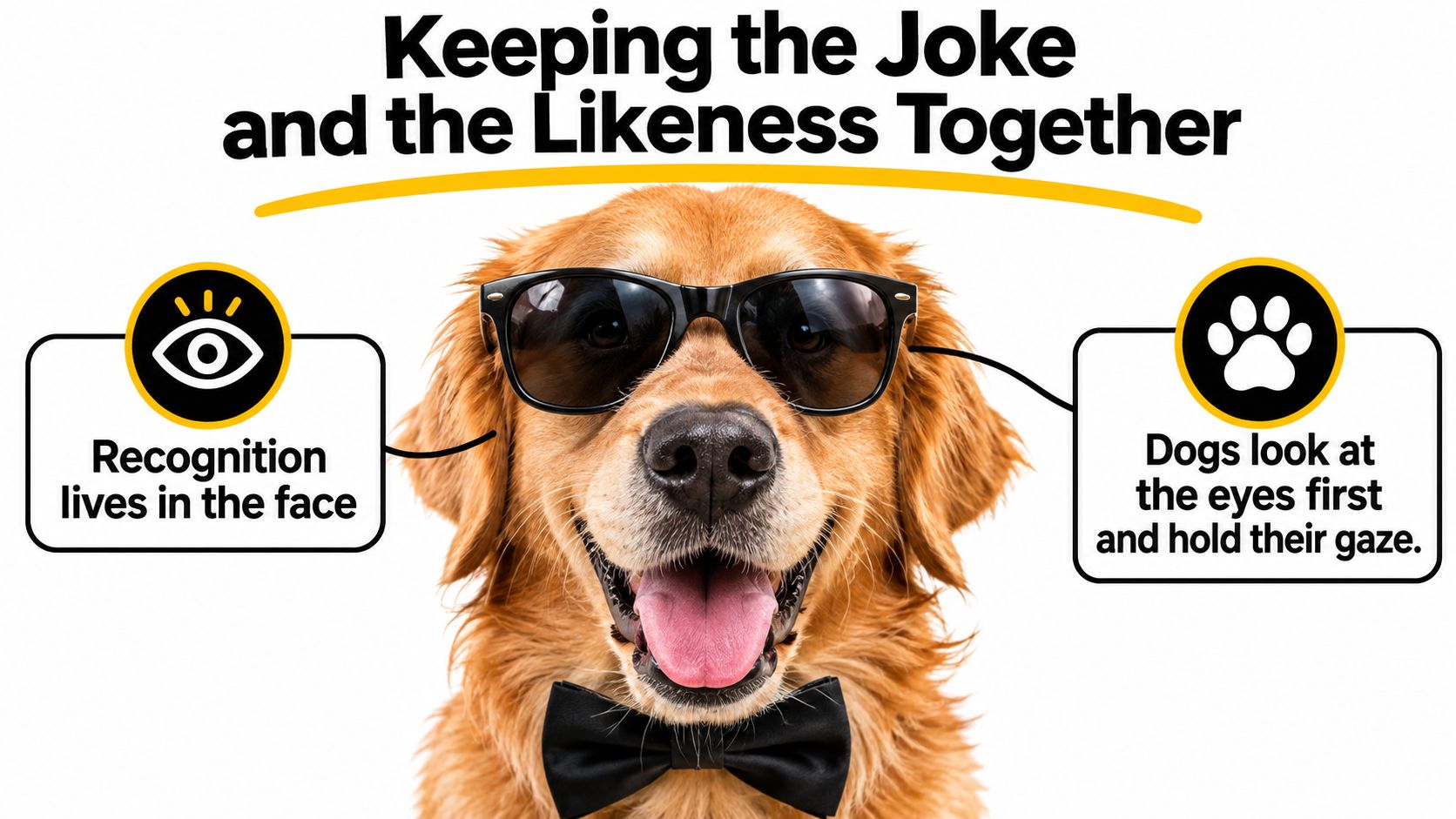
The visual below offers a playful example, but sunglasses also illustrate a design trade-off: they conceal the very features that help establish a recognizable gaze.
Exaggerate selectively
A useful workflow is to preserve eye placement, eyelid shape, pupil direction, and brow-area tension, then exaggerate a secondary feature. An already crooked ear can become more pronounced without changing the entire skull.
Consider a dog with close-set eyes, a narrow muzzle, and a large upright ear. Enlarging that ear can strengthen the character. Widening the eyes, shortening the muzzle, and rounding the head simultaneously may produce an amusing dog, but not your dog.
William Tucker Art's discussion of abstract and realistic painting offers context for balancing expressive treatment with recognizable detail. Our pet portraits are the artist's interpretation of the pictures and information you provide, so notes about distinctive features matter alongside photographs.
Describe appearance without diagnosing emotion
A visible tongue or upturned mouth can suggest a playful look, but it doesn't prove that a dog is laughing or feeling happy. Keep the description affectionate without turning a facial shape into a medical or behavioral conclusion.
That distinction also keeps portrait decisions separate from care decisions. For a Pug owner budgeting for those independently, PetCostEngine's Pug veterinary costs by state is a separate planning resource, not a way to interpret health from a comic photograph.
Before approving an exaggerated treatment, protect these landmarks:
- Eyes: Preserve their spacing, shape, and characteristic direction.
- Muzzle: Keep its recognizable length, width, and relationship to the nose.
- Coat pattern: Retain distinctive patches, masks, and markings.
Then try the across-the-room test: does the image still look like your dog when small details disappear?
Colors and Composition That Read as Funny
Dogs have two color-sensitive cone types, supporting blue-yellow discrimination but limited red-green separation, as described in the Visual Neuroscience paper on color vision in dogs. That's useful context for palette choices, although the finished portrait primarily needs to communicate with its human viewers.
Colour pairs and how they read for dogs and people
| Colour Pair | How Dogs Likely See It | How People Read It | Best Use |
|---|---|---|---|
| Blue and yellow | Clearly distinct | Bright and cheerful | Focal accent behind the dog |
| Red and green | Hard to separate by hue | Festive or cartoonish | Human-only symbols such as a bow or sign |
| Dark coat on dark background | Edges become difficult to distinguish when tones match | Flat and muddy without sufficient contrast | Add tonal lift behind the silhouette |
| Neutral beige base | Subtle when neighboring tones are similar | Calm and warm | Base layer that lets accents stand out |
Give the joke a focal point
Blue and yellow can create a lively contrast around the subject without requiring a crowded background. Try a muted blue field with a yellow toy beside the dog, rather than alternating bright colors across every surface.
Red and green remain useful for human-oriented storytelling. A red bow or green sign can support a holiday scene, but don't rely on that color difference alone to separate important shapes. Dogs' color discrimination also doesn't tell us whether they understand an illustrated joke.
A neutral base gives the artist room to emphasize a facial expression or prop. Beige isn't automatically low contrast: a dark muzzle against beige may be very clear, while pale fur against a similar beige may need a darker surrounding shape.
Separate the dog from the setting
For a dark-coated subject, avoid matching the background too closely to the fur. A lighter area behind the ears and shoulders can reveal the silhouette without inventing a harsh outline. Preserve smaller shifts of light around the muzzle so the face doesn't become a dark block.
Use this composition check before settling on a layout:
- Eye position: Try placing the eyes near the upper third rather than leaving excessive empty space above them.
- Silhouette: Make sure the ears, cheeks, and shoulders separate from the background.
- Punchline space: Leave room for the prop, sign, or scene detail that completes the joke.
- Reproduction: Check that text, dark details, and accent colors remain legible in print and on screens.
A cheerful palette supports the comedy. It shouldn't be doing all the work.
Funny Moments That Work and When to Stop
The funniest picture doesn't have to require the most effort. A voluntary head tilt, an extravagant sleeping position, muddy paws after a walk, or ears pointing in different directions can provide all the material an artist needs.
The important distinction is whether the dog is comfortable, not whether the scene looks elaborate. A canine-welfare article examining photographs and stress-related signs supports taking observable discomfort seriously when planning and assessing images. A photograph can offer clues, but it can't explain the whole situation on its own.
Let the artwork carry the costume
If you like the idea of a detective portrait, your dog doesn't need to wear a hat for the reference photo. The artist can interpret the theme from a clear, comfortable pose. Place a safe prop nearby instead of fastening it to the dog, or describe the imagined accessory in your notes.
This portrait reference is a reminder to plan an artwork around the animal, rather than making the animal perform for the artwork.
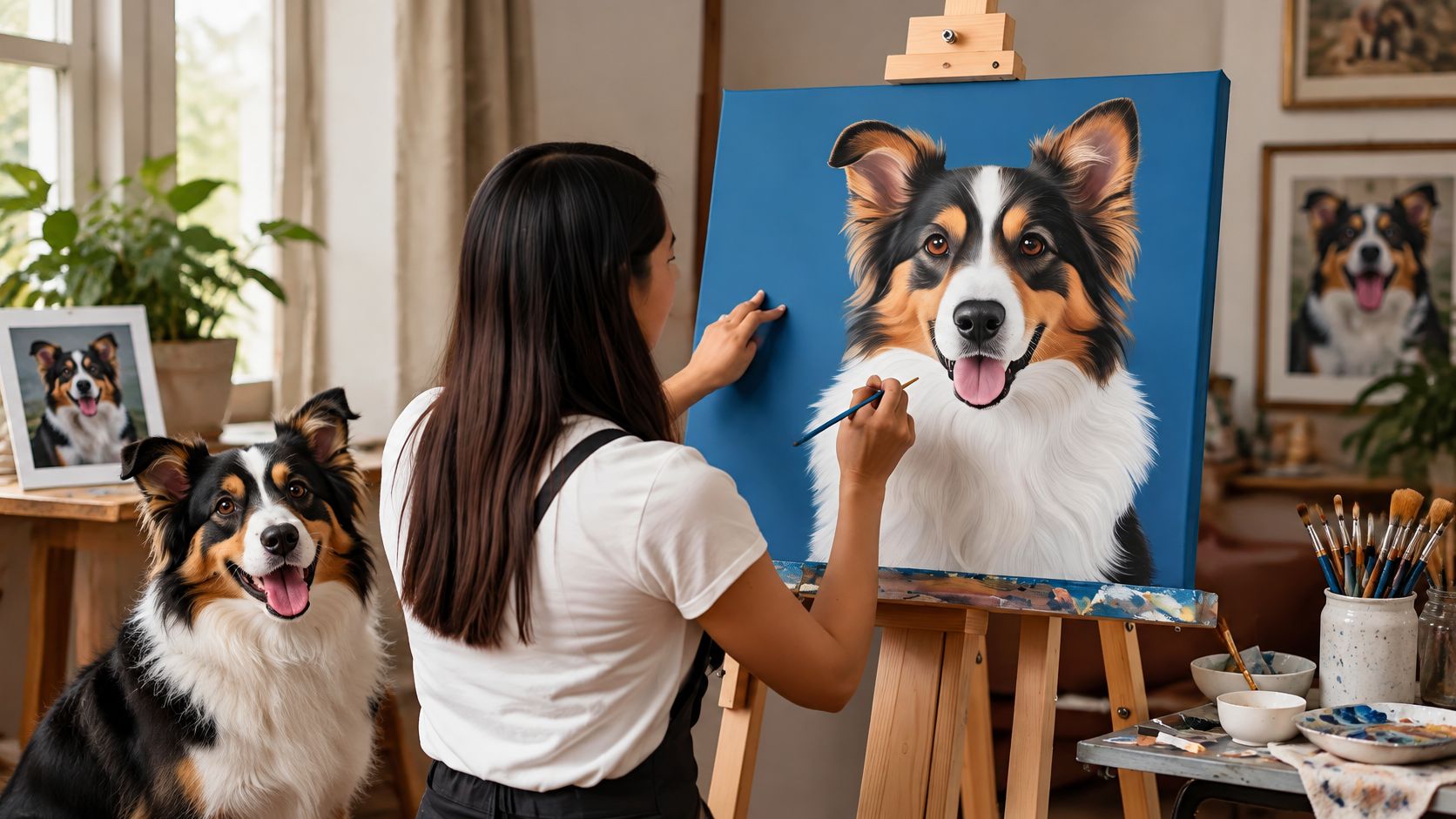
Keep the session brief, offer treats your dog already enjoys, and allow them to leave. Don't repeatedly reposition a dog who keeps turning away or trying to move elsewhere.
Stop the session when you see:
- Sustained fear: The dog remains worried rather than settling after a pause.
- Escape attempts: They repeatedly try to leave or avoid the setup.
- Freezing: They become rigid or stop responding normally.
- Defensive behavior: Growling, snapping, or other warnings appear.
- Physical discomfort: The surface, clothing, position, or activity appears painful or difficult.
Read the whole dog
A bouncing body and loose movement may accompany playful excitement. A tucked tail, repeated lip licking, or tense posture can signal a need for space, but no isolated movement supplies a complete emotional diagnosis. Read the combination of behavior, setting, and your dog's usual responses.
Comfort comes first: You can invent a comic setting on canvas. You don't need to manufacture an uncomfortable moment in real life.
Before taking pictures, check that your dog is rested, has eaten normally, has water available, and can stand or lie comfortably on the chosen surface. Most of all, ask whether they're willing to stay near the camera. If not, use an existing photograph.
Photo Tips for Imperfect Owner Pictures
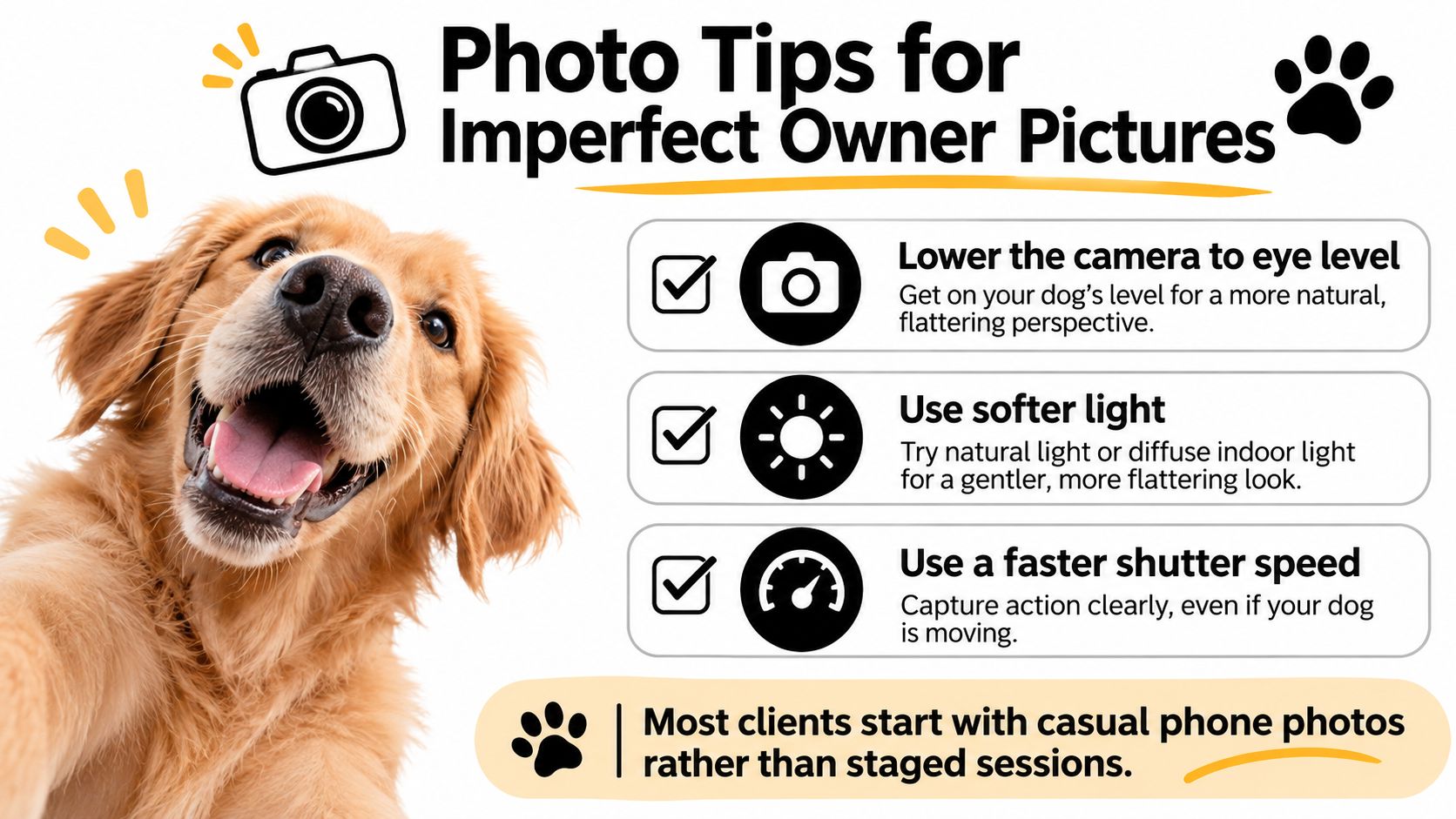
You don't need to begin with a studio photograph. Start with your phone, lower the camera to your dog's eye level, and look for soft light beside a window or in open shade. The Alan Ranger guide to dog photography explains practical techniques including eye-level positioning, softer light, and faster shutter speeds for moving subjects.
Use these reminders when gathering fresh reference pictures.
Decide what needs replacing
A messy kitchen behind the dog usually isn't a serious problem. The artist can separate the subject from household clutter. A slightly tilted head may even be part of the appeal.
Missing facial information is different. Motion blur can obscure eyelids and markings, while a toy across the muzzle may conceal its shape. In those cases, send another image that reveals the hidden detail rather than expecting the artist to guess.
Close phone photographs can also exaggerate the nose and shrink the apparent size of features farther from the lens. Step back and crop later if you want a more natural reference. If that enormous-nose snapshot is the joke you love, include it, but add an undistorted view so the exaggeration can be intentional.
For more preparation guidance, use our tips for photographing pets. You're responsible for supplying the photographs and other reference materials for your portrait, so send original image files where possible rather than screenshots with interface elements covering the picture.
Build a useful reference pack
Copy this checklist into your phone:
- Face-level eyes: A sharp view showing both eyes clearly.
- Body shape: A full-body photograph showing build and proportions.
- Muzzle detail: An unobstructed view of the nose, mouth, and chin.
- Coat pattern: A natural-light image without a color-changing filter.
- Favorite expression: The picture that captures the habit or look you want celebrated.
For a multi-dog portrait, gather a separate set for each animal. Add a shared photograph if available, or explain their relative sizes, so a small dog photographed close to the camera doesn't accidentally appear larger than their companion.
If you prefer a video reference alongside the checklist, use the player below.
The funniest snapshot and the clearest likeness reference may be different photographs. Send both, with a short note explaining what each image contributes.
Pricing and Turnaround
A custom commission needs a clear quote and a realistic schedule. The table separates the starting payment from the full portrait price, so you don't mistake a deposit for the total cost.
Pricing and turnaround at a glance
| Item | Amount or timing | Note |
|---|---|---|
| Deposit | $50 | Non-refundable, paid to start the portrait |
| Final balance | Agreed total less the deposit paid | Paid online at williamtuckerart.com on delivery |
| Standard turnaround | 7-10 business days | Most portraits should be completed and delivered within this period after all references arrive, with no client-side delays |
| Several subjects or custom background | Additional time assessed for the commission | Can extend completion beyond the standard estimate |
| Custom pet portrait price | Individual order quote | Confirm the total for the agreed scope |
Plan around complete references
The working schedule starts once all client-supplied reference materials have arrived. Time spent waiting for photographs or payments can extend completion, so tell us about a gift date before committing to it.
The artist cannot be held to a specific timeline. Size, the number of subjects, and a custom background affect the work involved, so treat the standard window as an estimate rather than a guaranteed arrival date.
For help preparing your request, our pet portrait commission pricing guide provides additional context. Send your intended style, dog count, background idea, and reference pack together so we can quote the actual scope.
If you're also considering a separate poster project, Power Print's poster printing advice can help you think about print preparation. Printing is a separate consideration from an original painting, and any reproduction plans must respect the artist's retained rights.
Commission Your Funny Dog Portrait
A useful order request tells the artist what you love about your dog and what you want the finished picture to communicate. It doesn't need art-school terminology. A clear description of a familiar habit is more helpful than a long list of unrelated themes.
This visual summarizes the initial decisions before the commission moves into painting and delivery.
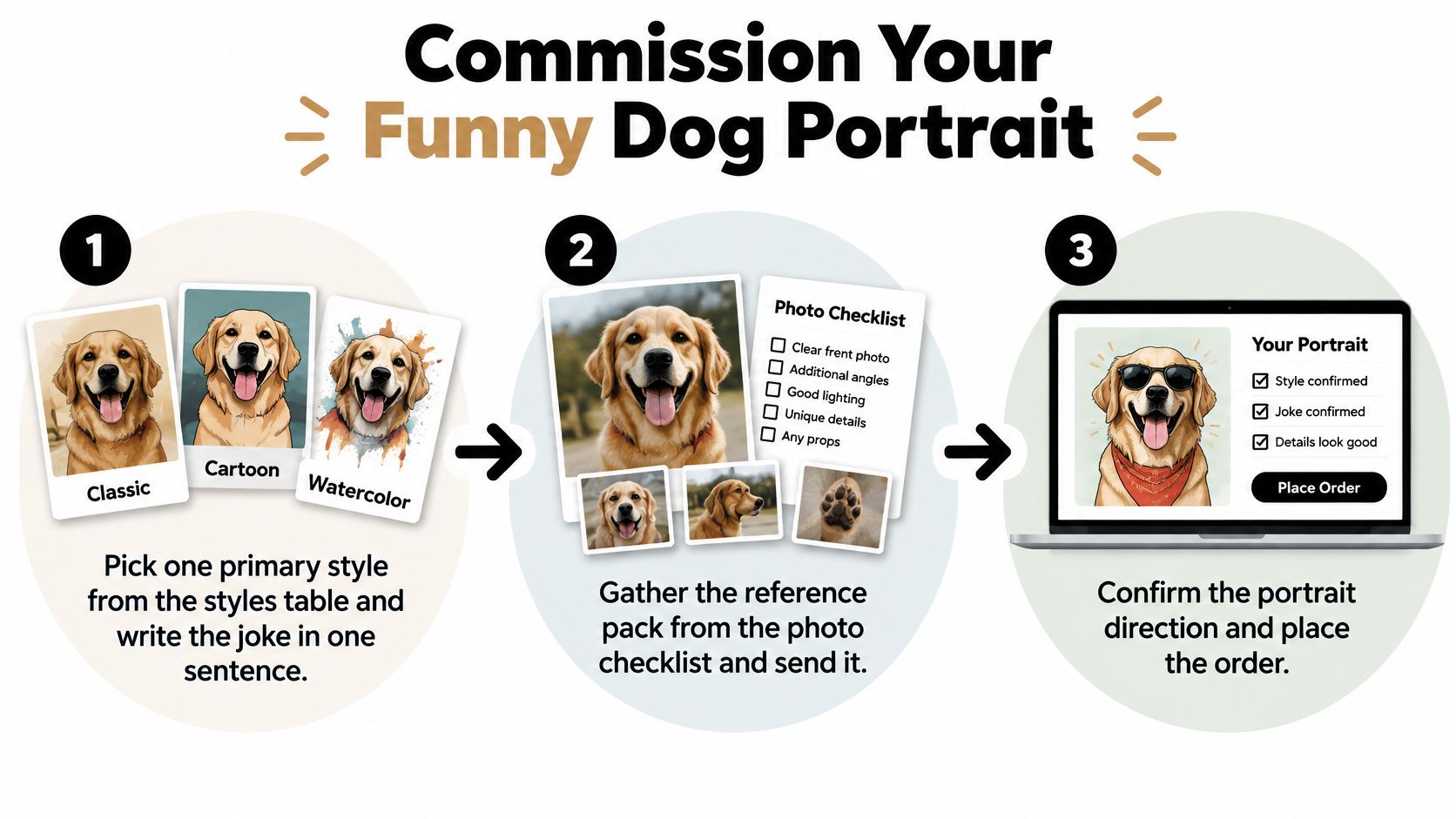
- Choose the main idea. Pick a primary style and describe the joke in a sentence. For example, you might want your dog portrayed as a stern librarian because they always sit beside your reading chair.
- Send the reference pack. Photographs can be sent by email attachment or by text to 910-273-2420. Identify the main likeness reference and explain which picture supplies the comic moment.
- Confirm the direction and arrange the deposit. The William Tucker Art Personalized Pet Artwork Deposit starts the commission process and includes a consultation to discuss style, size, and medium. Confirm your intended scope before proceeding.
- Include personality notes. Tell us about favorite activities, familiar poses, and details that shouldn't change. If an ear always folds or a particular marking matters to you, say so explicitly.
- Allow for the agreed working schedule. Supply outstanding references and payments promptly. A composition with several animals or an elaborate setting needs its own timing assessment, especially if you're planning a gift.
- Pay the final balance on delivery. Payment can be made online through our website. Keep the agreed order details available so the payment and delivery arrangements are clear.
- Arrange to sign for the painting. Once complete, the portrait is packed, insured, and shipped. The recipient must sign for delivery, so consider who will be available to receive it.
Understand ownership before ordering
Commissioning a portrait means agreeing to the Pet Portrait Order Agreement. William Tucker Art retains full copyright and reproduction rights to the painting, so owning the physical artwork doesn't transfer those rights.
Keep your request focused on the dog you know, not an idealized performer. A specific habit, clear references, and an affectionate idea give the artist a stronger foundation than a complicated scene with no personal connection.
William Tucker Art offers custom pet portrait commissions that interpret your dog's appearance and personality from your photographs and notes. Visit William Tucker Art to browse the artwork, then send your reference pack and a sentence describing the funny habit you'd love to preserve.