
If a certificate of authenticity for art is only a signed page that says "this is real," what happens when the page and the painting part ways? Most collectors treat that page as a guarantee. It is closer to an index card for a file you have to keep updating. I would start by deciding which facts the paper must carry, then write nothing until those facts match the object in front of you.
The Fields Every Certificate Needs
Fill this table before you write a single sentence of wording. Every later choice depends on these fields matching one physical work. Artquest's art-law guidance says a useful certificate is signed and dated by the artist and given to the first collector, and that it can record title, medium, dimensions, production date, edition or series information, and confirmation that the work is original.
| Field | What to write | Example |
|---|---|---|
| Artist name and contact | Full legal or professional name and a verification email | Jane Example, jane@example.com |
| Unique artwork ID | Permanent number assigned once and never reused | ART-2026-014 |
| Title | Exact title as the artist uses it | Low Tide at Dusk |
| Year of creation | Year the work was completed | 2026 |
| Medium and materials | Medium, support, and finish | Acrylic on gallery canvas, varnished |
| Dimensions | Height by width, inches and centimetres, orientation noted | 16 x 20 in (40.6 x 50.8 cm), landscape |
| Image reference | Front and reverse photo file names and dates | front_ART-2026-014.jpg, reverse_ART-2026-014.jpg, 14 March 2026 |
| Signature location | Where and how the work is signed | Lower right, front, in ink |
| Edition details | Impression number and total run, or unique work | Unique work |
| Issue date and issuer | Date signed and the issuer's role | 14 March 2026, artist |
That table is the minimum. Artist name and contact tells a future buyer who can confirm the record. The unique artwork ID, such as ART-2026-014, stays with the work for life, even if you retitle it. Title, year, medium, and dimensions have to be copied from the object, not from memory. Image reference names the front and reverse files so the paper points at photographs, not at a vague description. Signature location, edition details, and issue date and issuer close the loop: who signed the work, what kind of work it is, and who signed the certificate.
A certificate that misses the ID, the dimensions, or the image is hard to tie to one object. Two canvases can share a title. A frame can hide the true size. Without a named photograph, a later owner is left matching a story to a picture.
Write the table first, on paper or in your studio register. If a cell is blank, stop. Wording written before the fields are fixed tends to drift, and a drifted certificate is worse than a late one.
What a Certificate Proves and What It Cannot
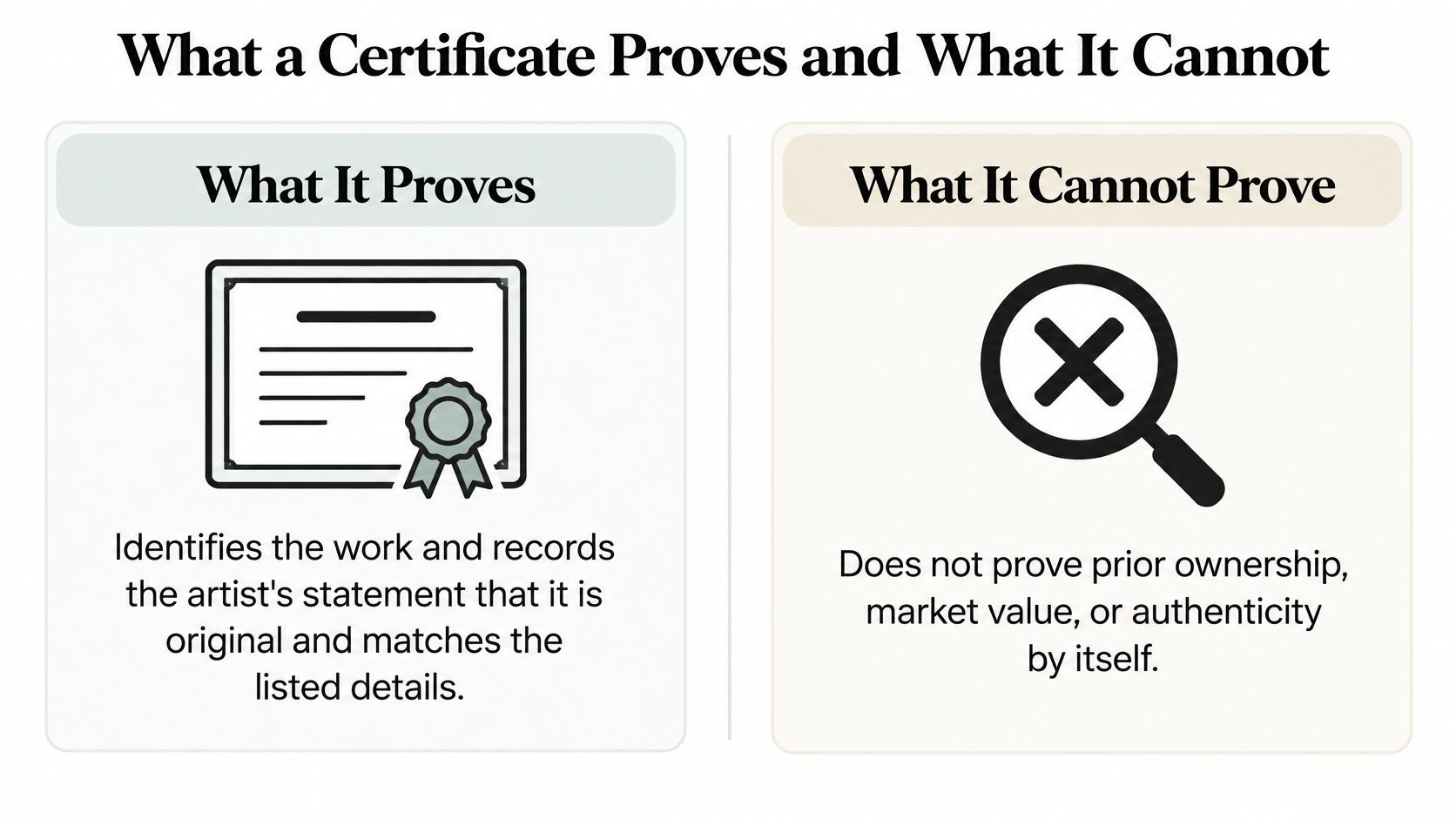
What question is the paper answering? A certificate identifies one work and records the artist's statement that the piece is original and matches the details listed. Treat that sheet as the index to a record you keep current: the same ID, the photographs, later transfers, and condition notes. It does not prove who owned the work before, that the seller has good title, or that the work is free of legal problems.
A study of auctioned oil paintings, watercolors, and prints examined four dimensions of provenance: ownership history, exhibition history, literature coverage, and certification, including artist statements and expert opinions. In that sample, provenance information increased the probability that a work would sell by as much as 4%, generated hammer-price premiums of up to 54%, and was associated with annualized returns between 5% and 16%. Those figures do not mean every certificate raises the price. They show that specific, checkable information can steady buyer confidence when the buyer cannot watch the work being made, as in online sales, cross-border deals, limited editions, and later resales.
The premium attaches to a file a stranger can check, not to a signature on a loose page. A buyer who matches the certificate to an archive entry is using it as a pointer. A buyer who treats the same page as proof of ownership is asking a question the certificate was never written to settle. I would keep the certificate in the file and refuse to let it stand in for a chain of title.
What each paper actually answers
| Document | What it establishes | What it does not establish | Who usually holds it |
|---|---|---|---|
| Certificate of authenticity | Identity of the work and the artist's statement that it is original | Ownership history or good title | Buyer, with a copy in the artist's archive |
| Sales invoice or receipt | That a sale took place, with date, price, and parties | That the seller owned the work or that it is authentic | Buyer and seller |
| Provenance record | Ownership chain, exhibitions, and published references | Authenticity on its own | Current owner and prior owners |
| Exhibition or auction record | That the work was shown or sold at a named event | Who owns it today | Galleries, auction houses |
| Appraisal | Estimated market value at a stated date | Authenticity or ownership | Owner, insurer, or estate |
| Condition report | Physical state, damage, and any restoration | Origin, authorship, or title | Owner, conservator, or insurer |
A genuine painting can still have a fight over ownership. A certificate signed only by the person selling it adds little on its own, because that person is describing their own goods. If you are weighing a paid opinion, it helps to understand artwork verification costs before you treat one letter as the last word. Set that opinion beside the artist's papers. How an outside authentication review sits next to the artist's own record is a comparison of documents, not a transfer of title.
Practical rule: Ask what question each document answers, and whether any question is still open. If nobody's paper answers "who owned this, and on what date," the file is not finished.
Write and Issue the Certificate Step by Step
A stable identity is the whole point. UNESCO's judicial toolkit on customs controls and provenance defines provenance as the documented history of an object from creation or discovery through the present, and it treats provenance documents as support for authenticity claims and as possible legal protection if someone challenges an object's legality. The certificate is one piece of that package, not proof by itself. Original dated documents are stronger than photocopies or an unsupported list of owners.
The sequence I would not reorder
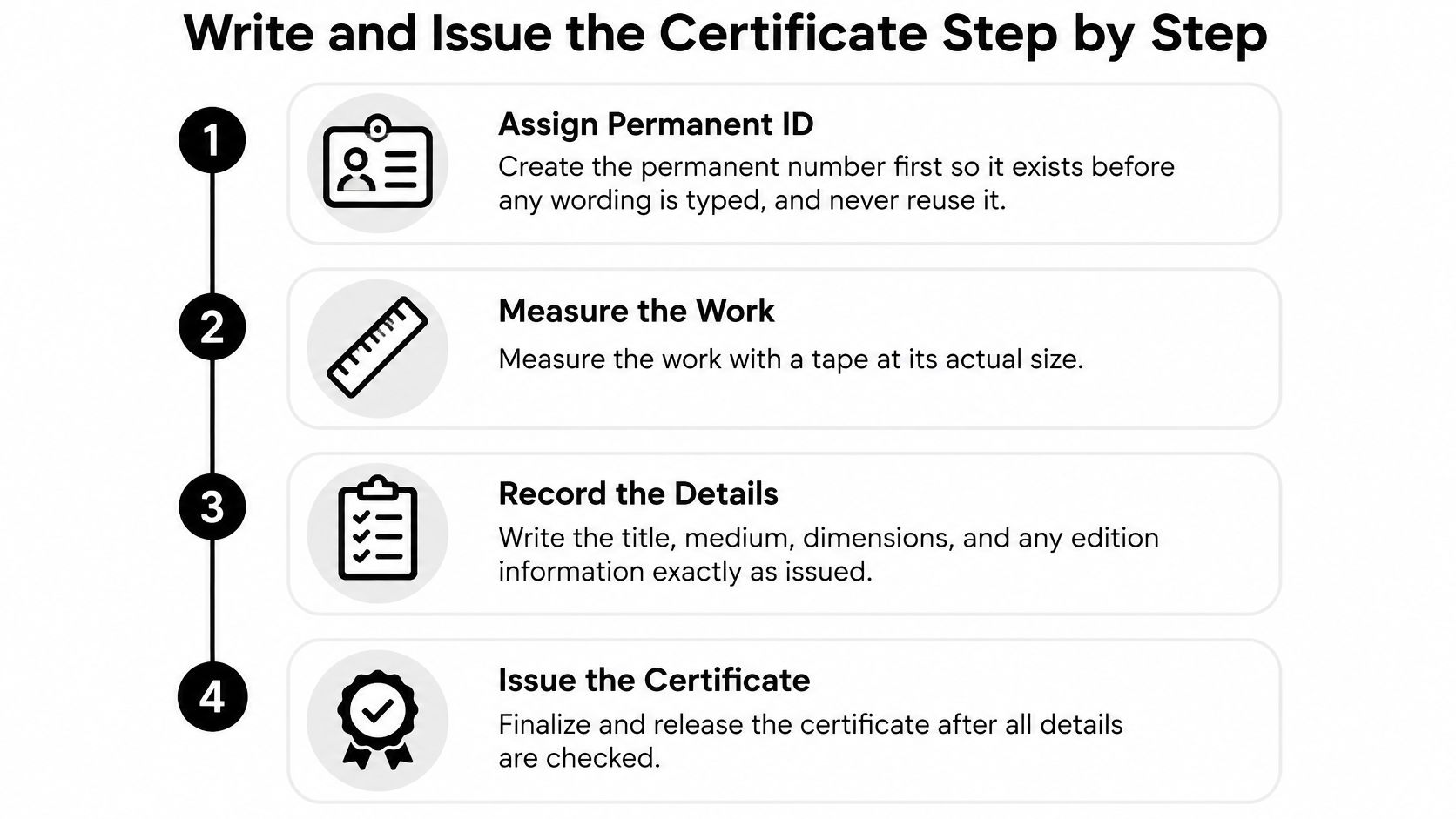
- Assign the permanent ID first. The number must exist before any wording is typed, and you never reuse it. The common mistake is recycling an ID after a retitle, which makes two works look like one.
- Measure the work, not the frame. Use a tape at the widest and tallest points of the support. Record height before width, and note portrait or horizontal orientation. Measuring the frame is the error that shows up at insurance time.
- Photograph front and reverse. Include labels, stamps, and the signature. Name both files after the ID. A clear front shot with no reverse leaves the next owner guessing.
- Write from the field table. Keep each field to one factual statement. For an edition, write the impression and the total run, such as 3/25. For a multi-part work, attach a component list.
- Describe the signature, then sign the certificate in ink and date it. Pencil on the work and ink on the paper is fine if you say so. An undated signature is easy to dispute.
- Make two copies. The original goes to the buyer. You archive a copy with the invoice and the photographs. A scan is a backup, not the record.
- Read the certificate beside the work. Confirm every field before it leaves the studio. If one line is wrong, reprint. Do not correct in the margin and hope.
Traceability is the mechanism. A future buyer, insurer, curator, or estate should be able to line the certificate up with the object, the studio register, the invoice, the photographs, and any later transfer. A generic sheet with no ID, no image, no dimensions, and no issuer contact cannot be matched to one work, so it has little weight.
When ownership changes, record the transfer date in the same file. Finished paintings are packed, insured, and shipped, and the client signs for delivery. Keep that dated delivery note with the certificate. If you store the buyer's PDF in a shared folder, Upfling's guide to uploading PDFs is a plain walk-through of getting the file up without losing the original paper in the process. Questions about a commission or the paperwork can start at williamtuckerart.com.
Editions, Commissions and Unique Works
The certificate has to reflect what you made. A print, a one-off painting, and a commissioned portrait do not carry the same facts, and forcing one form onto all three is how numbering and titles get muddled.
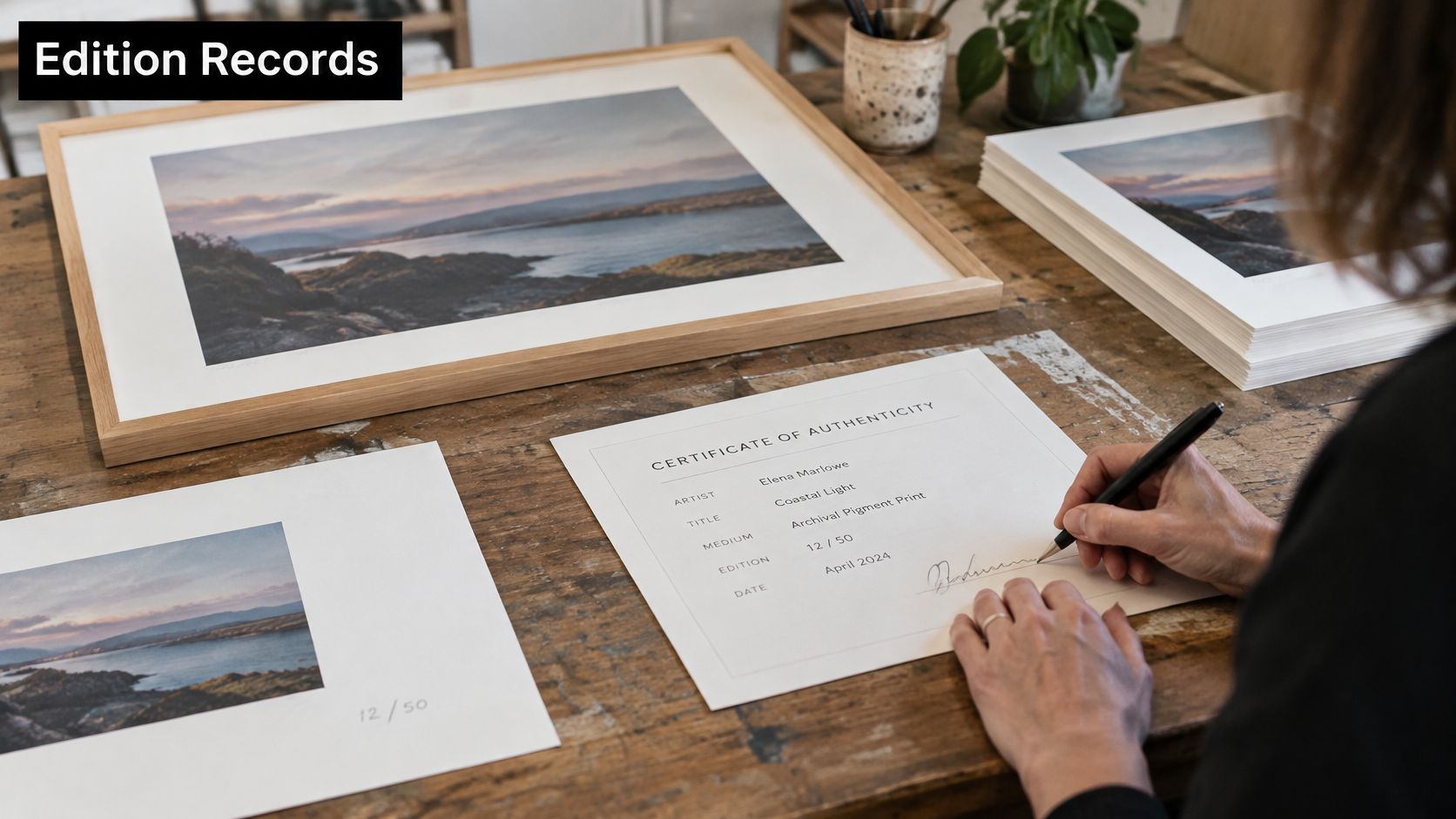
Lyon & Turnbull's saleroom notes on provenance and condition separate a certificate's narrow job, identifying the work and recording title, medium, dimensions, date, and edition, from the ownership chain. A real work can still have disputed ownership or a thin history, and a certificate issued only by the seller may add little. Checks that sit outside the seller include prior invoices, exhibition records, auction records, reverse-side labels, stolen-art databases, and condition notes. Resale, insurance, donation, or a loan to an institution may still need an invoice, an appraisal, a condition report, or a provenance record. Whether a small edition holds its price is a separate market question, which is why it helps to read whether limited edition prints increase in value on its own terms.
| Work type | Add to the certificate | Common error |
|---|---|---|
| Numbered print edition | Impression number, total run, date signed | Changing the total run after release |
| Artist proof | Label as artist proof, count kept separate from edition | Mixing proofs into the numbered run |
| Unique original painting | Medium, support, finish, reverse-side description | Silent swap of title or dimensions |
| Commissioned pet portrait | Subject name, commission order number, list of reference photos | No record of which photos the client supplied |
| Multi-part or installation work | Itemised component list, specifications, install notes | Components missing when the work is resold |
| Work with no catalogue raisonné | Studio register entry and archived images | No independent reference for later buyers |
A pet portrait as the worked case
Say a client commissions a portrait of a dog named Moss. The client supplies the photographs, which is how a commission of this kind is built. The certificate should name Moss, carry the commission order number, and list the reference files you used, such as "Moss_yard_03.jpg, supplied by the client." Without that list, a later dispute about likeness has nothing to point at.
Wildlife and environmental pieces often have no catalogue raisonné and no estate. For a living artist, the artist's own certificate is often the most direct primary record. It gets more credible when the format stays the same, the studio register matches it, and someone else can check the ID against the photographs.
For a numbered edition, lock the denominator on the day you release it. Artist proofs get their own label and their own count. A unique painting needs the support, the finish, and a short note on what is on the reverse. A multi-part work needs every component listed, or the next owner may sell an incomplete set and never know it.
Wording That Holds Up Under Scrutiny
"Guaranteed authentic forever" feels strong and ages badly. A certificate is persuasive evidence, not a binding ruling. Chambers' comparative practice guidance notes that courts may weigh provenance records, scientific analysis, and expert opinions, and that certificates are generally not binding on the court even when they carry real market weight. Strength depends on who signed, how specific the text is, how independent the signer is, and what else corroborates it.
Bound the claim to what you checked
An absolute guarantee that later turns out wrong can support a contractual or misrepresentation claim. Bounded language is safer because it states what you know and which records you kept.
Based on my studio records and inspection on this date, I confirm that this work is original and matches the details below.
Put observations and conclusions in different sentences. An observation is "acrylic on gallery canvas, 16 x 20 in, signed lower right in ink." A conclusion is "this work is by the named artist" or "this impression is within the stated edition." Mixing them makes a measurement look like a legal promise.
What you do not change in silence
No title, dimension, medium, or edition number gets swapped after issue without a paper trail. If something was wrong, issue a corrected certificate in the open, with a new date and a stated reason, and keep the old copy in the archive marked superseded. For editions, the recorded total stays fixed, and a master edition register stops duplicate numbers. Duplicate numbering hurts buyer confidence and complicates insurance, estates, and later checks.
The certificate should also say who holds copyright and reproduction rights. William Tucker Art holds the full and complete copyright and reproduction rights to commissioned paintings, including the right to copy, exhibit, publish, display, or distribute copies. A buyer of the physical painting does not pick those rights up by default, and the certificate should not imply that they do. Many commission agreements already say the artist keeps them. Write the same rule on the certificate so the two documents do not argue with each other.
A Certificate Template You Can Copy
Copy the block, then replace every bracket before you sign. Leave no bracket blank, and do not invent a field you did not measure.
CERTIFICATE OF AUTHENTICITY
Artwork ID: [permanent ID]
Artist: [full name], [verification email]
Title: [exact title]
Year of creation: [year]
Medium and materials: [medium, support, finish]
Dimensions: [height x width in inches (cm)], [portrait or horizontal orientation]
Images: [front file name], [reverse file name], dated [date]
Signature: [location, ink or pencil]
Edition: [impression number and total run, or unique work]
Statement: Based on my studio records and inspection on [date], I confirm that this work is original and matches the details above. Records checked: [for example, studio register entry, invoice number].
Rights: Copyright and reproduction rights remain with the artist unless the commission agreement states otherwise.
Issued by: [name, role], on [issue date]. Signature: ______
Replacement or correction: any change is issued openly as a new certificate with a new date and a stated reason.
Lines that have to be finished first
Artwork ID, dimensions, images, and edition come from the object and the register, not from the sentence you like best. Records checked should name a real entry, such as a register line or an invoice number. If you have not checked it, do not list it. Rights stays unless a written agreement transfers them. Issued by needs a role, artist or studio, and a date you can defend. Sign in ink on the buyer's original.
Print it on paper you can file, not on a design that hides the text. Fancy borders do not make a thin certificate stronger. A plain page with every line filled does.
Keeping the Paper Trail With the Work
Three years on, the buyer still has the painting and has lost the envelope. The certificate number, written the same way on the paper and in the file name, is only an index. What it points to has to still exist: the signed original, the invoice, dated photographs, and a register line that records later transfers. A digital copy is a useful backup. It is not a substitute for the original paper, the sales invoice, or high-resolution photographs, and it does not prove who holds the work now.
File each ID the way you wrote it on the certificate. Keep front and reverse images with the shoot date in the metadata, and copy medium and dimensions from the certificate instead of retyping them from memory later. One signed studio register entry per ID should include the edition total, where there is one, and every change of owner with the date. Leave the invoice in that packet. A receipt or proof of purchase is what a return needs, so do not separate it from the certificate to tidy the folder.
Check the archive before you promise a replacement. Issue a new certificate that says it is a replacement, name the reason, and date it. Do not pretend it is the first issue. Note the replacement in the register so two originals are not both in circulation. In 2024, Italian and European authorities seized approximately 500 forged certificates and stamps of authenticity connected to a counterfeit-art network, according to Newsweek. A replacement that does not say it is a replacement is the gap that kind of confusion uses.
Heirs, insurers, and later buyers start with the contact on the certificate, then compare the ID, the images, and the dimensions with the work itself. The certificate confirms identity against your record. It does not transfer title, and a missing transfer line leaves ownership open. If you are buying, the same habit belongs with how to buy original artwork: match paper to object before you match paper to price. Once a year, confirm the email on the certificates still reaches you. Studio moves and dead inboxes are how good records disappear.
Finished paintings are packed, insured and shipped to the client, who must sign for delivery. If you are commissioning a portrait or collecting wildlife and coastal pieces, keep that delivery signature with the invoice and any paper that names the work, the size, and who can confirm it later. Visit William Tucker Art to see current originals and how a commission is handled.