
You've commissioned a portrait of your dog, cat, horse, or favorite wild animal. The deposit is paid, but practical questions remain. Is the reference photo clear enough? Will you receive the original, a print, or a digital file? Who can reproduce the image? What happens if the artwork arrives damaged?
Good art guidelines answer those questions before confusion becomes a dispute. They aren't there to bury a collaboration in legal language. They give the artist and buyer the same working reference, with clear expectations about photos, size, approvals, ownership, delivery, and care.
A useful guideline should be practical enough to consult during the commission, not just polished enough to publish on a website. It should tell you what to send, what to approve, what you own, what the artist retains, and what to do when something goes wrong.
Why These Art Guidelines Exist
A custom artwork succeeds when both sides know what happens next. The client supplies suitable references and makes decisions at agreed milestones. The artist interprets those materials, confirms the scope, creates the work, and documents delivery. Without those checkpoints, small assumptions turn into expensive friction.
Start with the questions that affect the project most:
- Reference photos: Which image shows the subject clearly, and can the artist use it?
- Artwork format: Will the piece be an original canvas, a print, or another format?
- Approval process: When can you request changes, and what counts as a new request?
- Ownership: Do you own the physical artwork, the copyright, or both?
- Delivery: How will the work be packed, insured, tracked, and inspected?
- Returns: What happens if a ready-to-ship piece is unsuitable or a commission arrives damaged?
Practical rule: If a buyer has to guess what happens after payment, the guidelines are incomplete.
These questions matter just as much for a wildlife painting as they do for a pet portrait. A collector may want to know whether a wolf image came from a licensed archive, a captive animal, or a field photograph. A pet owner may care more about revision limits, framing, and whether the final image can appear in a family announcement.
The strongest approach treats guidelines as a contract-grade reference, written in plain language and used before, during, and after the commission. The sections that follow cover photo submission, sizing, workflow milestones, rights, shipping, ethical wildlife references, and accessible catalog presentation. Together, they turn a creative collaboration into a documented process without removing its personal character.
Professional Standards Behind the Guidelines
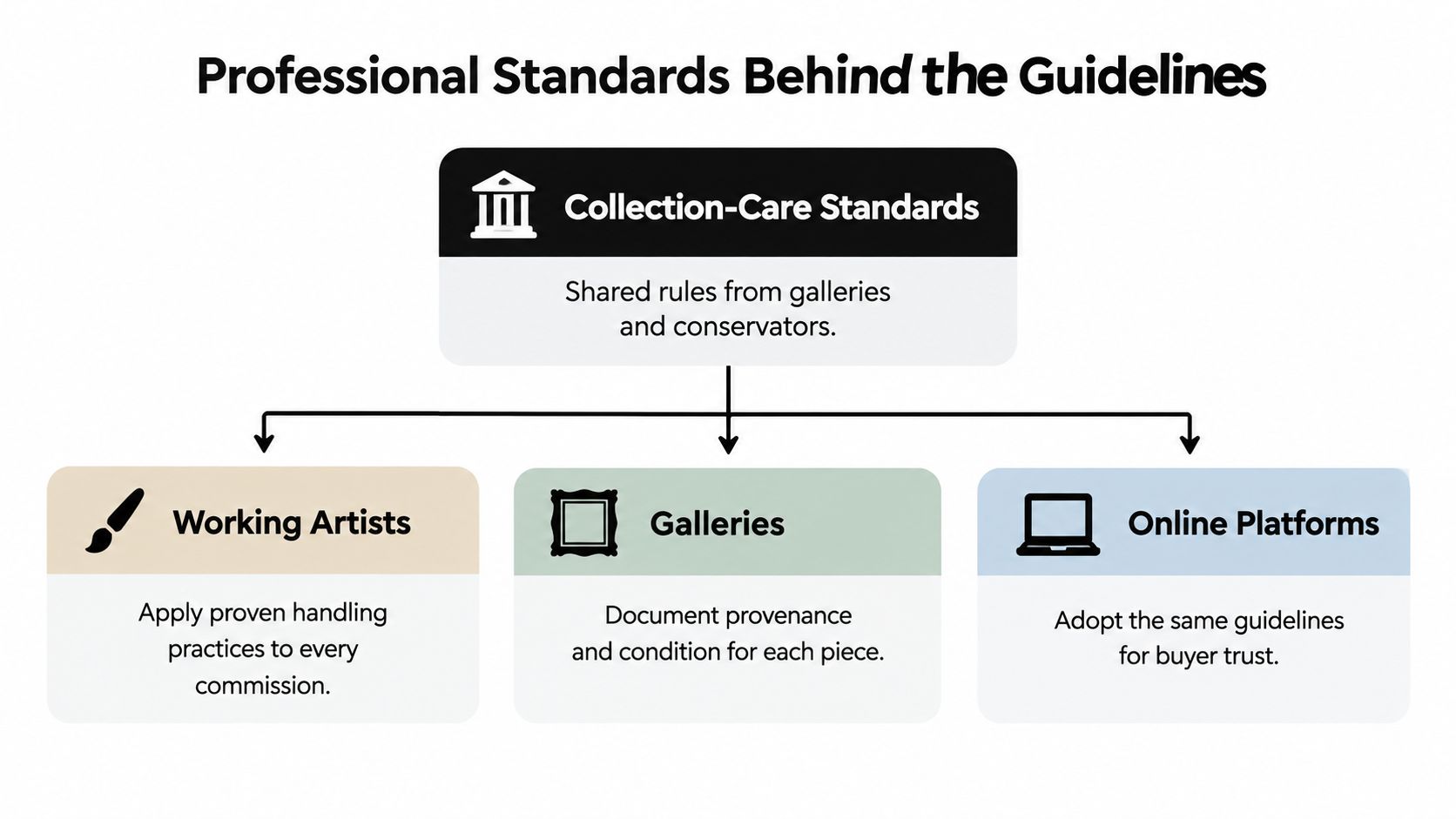
Working artists don't need to imitate a museum's entire administration system, but they should borrow its discipline. The International Council of Museums Code of Ethics calls for written collections policies and records that identify an object, document its provenance and condition, record treatment history, and track its location. It also emphasizes protective environments, condition monitoring, and responsible care during storage, exhibition, and transport.
That logic applies to a small studio. A commission doesn't become easier to identify years later just because it began as a personal request. Records protect the buyer when ownership changes, when a print is ordered, or when a conservator needs to understand the materials and condition.
The studio record that matters
For every original or commission, keep a concise record containing:
- Identity: Artist, title, date, medium, dimensions, orientation, and collection category.
- Reference history: Supplied photographs, licensing information, source notes, and any composite references.
- Condition: Surface observations before packing, visible marks, repairs, varnish, and treatment history.
- Process: Deposit status, approvals, agreed revisions, and any scope changes.
- Delivery: Packaging method, tracking information, delivery address, and photographs taken before dispatch.
Those notes don't make the work impersonal. They give the work a reliable history. If a collector later commissions a reproduction, sells the original, or asks about a surface detail, the studio can answer from a record instead of memory.
UNESCO's 2005 Convention on cultural expressions also frames art as more than a commercial product. It connects cultural expression with identity, public participation, access, and sustainable development, while calling attention to groups whose participation may be limited. For an online art business, that supports guidelines that recognize context, artist identity, public access, and responsible representation alongside appearance and sales.
A wildlife example is William Tucker Wolf Painting for Sale - Original Artwork - Ghost of the Forrest, described as a hand-signed canvas using acrylics and mixed media, with print options available. A responsible catalog record would preserve those descriptive details, along with dimensions, condition, ownership status, and delivery notes.
Photo Submission Specs for Pet and Wildlife References
A good painting starts with a usable reference. The artist can change the background, combine references, adjust the crop, and build a stronger composition, but they can't reliably reconstruct an eye hidden by blur or a muzzle swallowed by shadow.
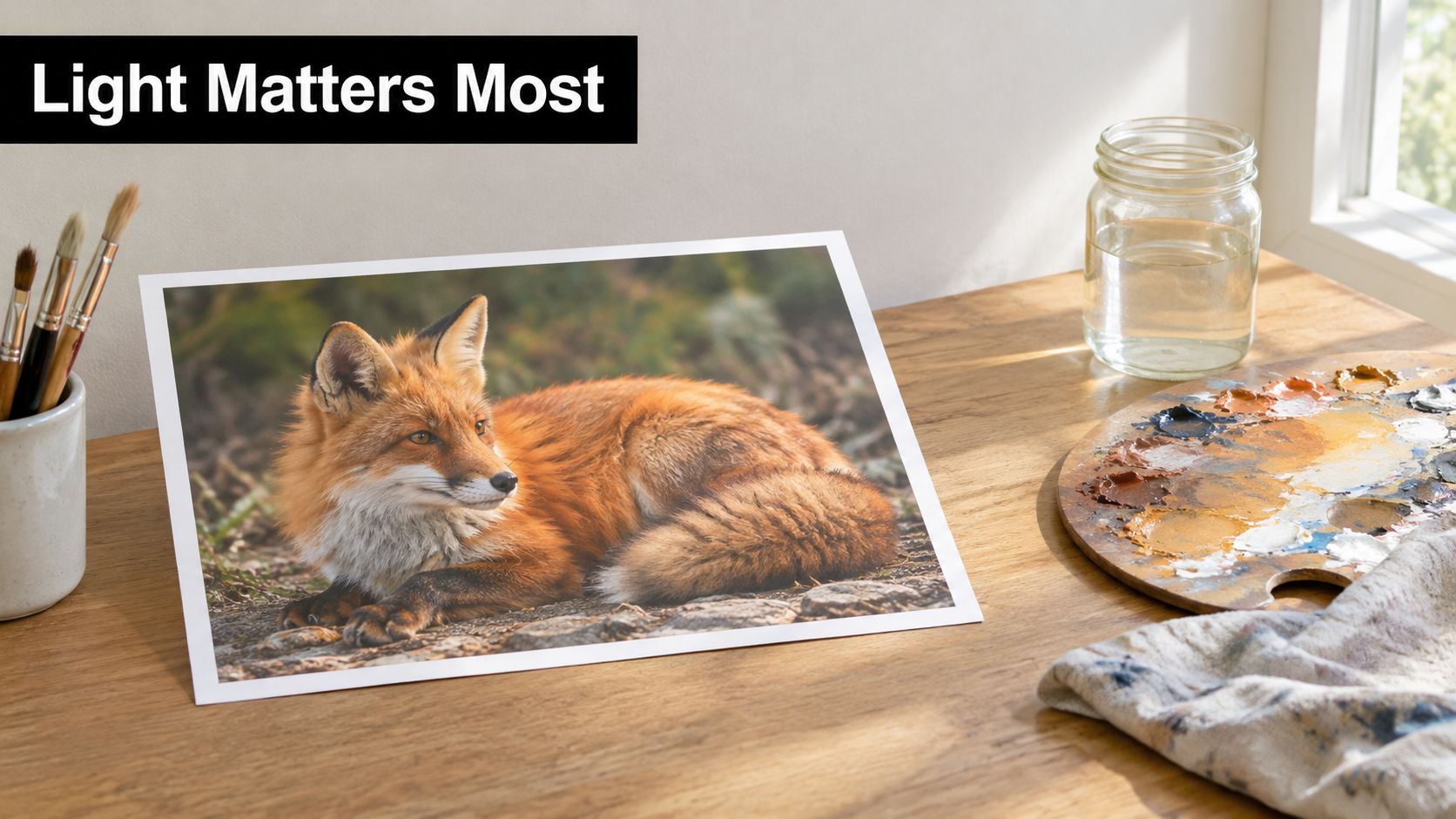
Send the largest original file you have, not a screenshot downloaded from social media. The eyes should be sharp, facial features should be visible, and the subject should be large enough for the artist to study texture and expression. Natural daylight usually gives the clearest information. Avoid harsh flash, colored indoor lighting, and mixed light from windows and lamps.
For a dog, photograph at eye level and take several frames while the dog is relaxed. For a shy cat, step back and use optical zoom rather than moving close enough to make the animal tense. Never stage a wildlife encounter for a better image. Use a licensed archive, an existing field photograph, or another reference with clear permission.
What to send and what to avoid
- Send several viewpoints: Include a preferred image plus supporting views of markings, eyes, ears, fur direction, or distinctive features.
- Keep the subject readable: One animal should be clearly identifiable in each reference. Group photographs can work, but identify each subject and explain the intended composition.
- Leave composition decisions open: The background in your photo rarely determines the painted background. Tell the artist what atmosphere you want instead.
- Avoid filters: Filters conceal natural color, texture, and proportion. Send unedited files whenever possible.
- Reject weak images early: Blurred eyes, severe facial shadows, extreme angles, heavy cropping, and distorted perspective should be flagged before the quote is finalized.
For more practical shooting guidance, see tips for photographing pets. The artist should tell you quickly if a reference can support the requested result. If it can't, ask for another photo before the work begins, rather than hoping paint will solve missing information.
Sizing and Framing Options
Choose the wall before choosing the canvas. Measure the available area, note nearby furniture and doors, and leave visible breathing room around the finished work. A piece that looks generous in a studio can feel cramped above a console or disappear on a large wall.
Use the table below as a planning framework, then confirm exact dimensions and framing with the artist.
| Format | Dimensions (in) | Best For | Frame Options |
|---|---|---|---|
| Small | 8 × 10 or 12 × 16 | Shelves, desks, bedside spaces, and intimate groupings | Thin frame, simple wood frame, or unframed gallery edge |
| Medium | 18 × 24 or 24 × 30 | Hallways, consoles, offices, and single-feature walls | Traditional frame, float frame, or gallery-wrap presentation |
| Large | 30 × 40 or larger | Main walls, entry spaces, and statement displays | Float frame, shadow-box frame, or custom framing |
Match the format to the artwork
Portrait orientation suits a single standing animal or a narrow wall. Wide orientation gives a subject room to move through the composition and works well above furniture. Square formats create balance in a gallery wall or when the subject's face is the central focus.
An original canvas carries surface texture and physical presence. A museum-quality print gives you more flexibility in size and placement, while a limited-edition reproduction requires clear edition and usage information before purchase. A rolled print in a sturdy tube can be practical for long-distance delivery, but it needs careful flattening and framing after arrival.
Abstract backgrounds deserve frame choices that don't flatten the surface. Float frames and shadow-box frames leave visual separation around textured originals, while a conventional frame can give a print a more finished architectural edge. For presentation planning, batch mockups for wall art can help you compare how a work might sit in a room before committing to a format. For canvas-specific decisions, review how to frame canvas paintings.
Commissioning Workflow From Inquiry to Delivery
A commission should move through named milestones. That gives the buyer a clear place to ask questions and gives the artist a clear point at which the brief becomes final.
- Initial consultation and reference review. Send the subject, preferred references, intended size, orientation, medium, destination, and desired mood. The artist identifies unsuitable photos and confirms whether the concept is realistic.
- Concept confirmation and quote. The written quote should state the format, subject count, background treatment, included deliverables, payment schedule, estimated timing, shipping method, and revision terms. Multiple subjects, complex environmental details, hand-painted backgrounds outside the artist's normal abstract approach, or an expedited request may change the scope.
- Deposit and scheduling. The deposit reserves production time and should be acknowledged in writing. The artist confirms when the commission enters the working schedule and what the client must provide before that date.
- Sketch and composition approval. Approve the arrangement before detailed painting begins. This is the right time to correct crop, pose, orientation, and background direction.

- In-progress updates. Agree on how progress will be shown. A useful update should identify what is complete, what remains adjustable, and whether the client needs to make a decision.
- Final approval and revisions. Define the included revision allowance before painting starts. A change to color balance or a small detail is different from replacing the subject, changing the pose, or adding a new animal after approval.
- Crating and shipping. The artist photographs the finished piece and its packaging, confirms the destination, and provides tracking information. Originals need protection suited to their surface, corners, frame, and dimensions.
- After-delivery follow-up. The buyer inspects the package, reports damage promptly, and follows hanging or acclimatization guidance. The artist retains the final record and resolves documented delivery problems.
Watch the embedded workflow reference for a visual overview:
A plain-English guide to commissioning an artist can help buyers prepare before they request a quote. The most important habit is simple: approve one decision before the next stage begins. That keeps creative feedback useful and prevents scope creep from appearing at the end.
Ownership, Rights, and Usage
Buying an artwork usually gives you ownership of the physical object, not automatic ownership of its copyright. Those are separate rights, and the commission agreement should say so directly.
The buyer normally receives the right to display the original or print privately. The buyer may also be able to photograph and share the work for personal, non-commercial purposes, subject to the written terms. The artist generally retains reproduction rights, portfolio rights, and the ability to offer prints unless the parties negotiate exclusivity.
A practical usage matrix
| Intended use | Default position to confirm in writing |
|---|---|
| Private display | Included with ownership of the physical work |
| Personal printing | Confirm whether personal copies are allowed and in which files |
| Social-media sharing | Usually permitted for personal use with artist credit where practical |
| Commercial reproduction | Requires a separate license covering purpose, territory, duration, and formats |
| Cropping or modification | Ask permission before materially changing the image |
| Resale | The physical work may be resold, but copyright does not automatically transfer |
A family may want to use a pet portrait in a private announcement. A charity may want the same likeness on fundraising merchandise. A publisher may request it for a book, while a company may want it on packaging. Those uses need separate permission because the audience, commercial value, distribution, and context have changed.
The agreement should also state whether the artist may show the finished work in a portfolio, exhibition, website, or social channel. If privacy matters, negotiate that restriction before production begins. If exclusive commercial rights are needed, describe exactly what is exclusive and what remains available to the artist.
Ownership is not a vague feeling of control. It's a list of permissions attached to a physical work and its image.
Shipping, Returns, and Damage Policies
Shipping terms should read like practical customer instructions. Before dispatch, the studio should confirm the delivery address, packaging method, tracking, and whether a signature is required. Originals need protection appropriate to their surface and structure, while prints need a rigid mailer or sturdy tube that prevents bending.
Archival wrapping, protected corners, cardboard layers, and custom crating may be appropriate for originals. Prints need clean sleeves, rigid support, and a tube when rolling is safer than folding. Anyone preparing a package can also consult guidance on how to pack fragile items safely, especially when the work includes glass, a deep frame, or vulnerable surface texture.
What the buyer should do
- Inspect the outside first. Photograph dents, punctures, crushed corners, wet areas, or torn tape before opening the package.
- Document the opening. Photograph the internal protection and the artwork in place before moving it.
- Do not discard materials. The packaging may be needed for an insurer, carrier, replacement shipment, or inspection.
- Contact the studio promptly. Send the tracking number, delivery date, photographs, and a concise description of the problem.
- Follow the studio's instructions. Don't repair, clean, reframe, or discard a damaged work before the claim process is clear.
The studio should handle the carrier or insurance claim when the shipment was arranged and insured by the studio. The buyer shouldn't have to negotiate separately with multiple parties while trying to protect the artwork.
Custom commissions are usually non-returnable because the work was created for a specific buyer. The agreement should still state the remedy for shipping damage, material failure, or a result that materially differs from the approved brief. Ready-to-ship prints may follow a separate return policy, with a stated return window, condition requirement, and responsibility for return shipping. Never leave those terms to an assumption that “all sales are final” explains everything.
Ethical Wildlife References and Conservation Framing
Wildlife art carries a reference question that buyers should ask directly: Where did the image come from, and what happened to the animal while it was made?
A reference may come from an ethical field photograph, a licensed archive, a captive animal, or a composite assembled from several sources. Captive and wild references can both support legitimate art, but the label must be accurate. Calling a zoo reference a wild encounter, or presenting a composite as a single observed moment, weakens collector trust.
The College Art Association's guidance on the use of animals states that art creation should not cause animals physical or psychological pain and asks whether the same artistic purpose can be achieved with fewer animals or without animals. That principle gives wildlife artists a clear working rule: never stage a dangerous encounter for visual drama when an existing ethical reference can do the job.
A useful disclosure might identify the source as:
- Ethical field photograph
- Licensed wildlife archive
- Captive animal reference
- Composite of multiple references
- Reference with habitat details reconstructed from research
Transparency strengthens the artwork. It allows the artist to focus on expression, anatomy, habitat, and conservation context without pretending that every image records a direct encounter.
For wildlife work focused on endangered animals, accurate habitat details matter. A responsible painting can encourage attention to a species without inventing a false story about its behavior, location, or circumstances. Buyers, zoo audiences, and environmental advocates should treat source labeling as a quality signal, not a limitation.
Accessibility and Metadata for Online Catalog Images
An artwork catalog should serve people who can see the image clearly and people who rely on text alternatives. The W3C guidance for informative images recommends concise alternative text that communicates an image's purpose and essential content. It also recommends empty alternative text for purely decorative images and fuller nearby descriptions for complex visual information.
Use a three-layer system:
- Alt text gives immediate access. Describe the subject, medium or format when relevant, and the image's role. For example: “Oil portrait of a brown Labrador against an abstract blue background.”
- The caption adds interpretation. Explain the title, artist, setting, materials, or conservation context in natural language.
- Structured metadata supports catalog control. Preserve the artist, title, date, medium, dimensions, orientation, collection, copyright status, and meaningful description.
For a coastal scene, alt text might identify a village on rocky cliffs above blue water. For a wildlife portrait, it might identify the animal and the visual treatment without claiming a wild encounter that hasn't been documented. For a custom pet piece, it should name the subject and explain the image's function in the catalog.
Decorative textures, background washes, and ornamental thumbnails should use an empty alternative so screen readers don't announce content that adds no information. If an artwork includes a complex diagram, conservation map, or dense visual narrative, place a fuller text equivalent beside the image instead of forcing users to infer the meaning from a short alt attribute.
For further practical context, RankEngine on alt text SEO discusses how descriptive alternatives can support search visibility without turning accessibility text into keyword stuffing. The priority remains accuracy. A catalog description should tell the truth about the image first.
Quick Reference Checklist
Keep this checklist open while requesting a commission, approving a proof, or unpacking a delivery.
- Send usable references: Provide original, clear files with visible eyes, natural color, and enough detail for the artist.
- Identify the source: State whether wildlife references are licensed, captive, field-based, or composite.
- Choose the format: Confirm dimensions, orientation, medium, print or original status, and framing.
- Approve the scope: Get the subject count, background treatment, timeline, deposit, and revision allowance in writing.
- Track milestones: Confirm the consultation, concept, sketch, progress update, final approval, and dispatch stage.
- Separate rights: Record what you own physically and which personal, commercial, reproduction, and modification rights apply.
- Prepare for delivery: Confirm packaging, tracking, insurance, signature requirements, and the damage-report process.
- Inspect immediately: Photograph the package and artwork before moving anything if damage appears.
- Request accessible files: Ask for useful alt text, captions, and stable metadata for online catalog or display use.
If a question falls outside this list, ask before paying the deposit or approving the final work. Clear answers are part of a professional commission, not an inconvenience.
William Tucker Art offers original wildlife paintings, pet portrait commissions, and related print options with a process built around reference review, approvals, and documented delivery. Visit William Tucker Art to explore the catalog or begin a conversation about a custom piece.