
Animal pollination supports crops that make up about 35% of global crop volume, according to the FAO's pollinator overview, and adds an estimated $235 billion to $577 billion a year in crop output, according to the IPBES pollinators assessment. So, why are bees important? Their work shows up in fruit, nut, vegetable, and wild-plant quality.
Bees move pollen like couriers between blossoms. Grain calories can remain while diets lose variety, and a wild bee can do more in one visit than a managed honey bee.
The Numbers Behind Why Bees Matter
Three out of four crops that bear fruit or seed depend at least partly on animal pollinators. That is the headline number; the mechanism is pollen moving from one flower to another at the right time.
How much of food and wild plants depends on pollinators
| Measure | Figure | Source |
|---|---|---|
| Fruit or seed crops depending at least partly on pollinators | Three out of four | FAO |
| Share of global crop volume from pollinator-dependent crops | About 35% | FAO |
| Leading food crops supported by pollination | 87 of 115 | FAO |
| Extra annual global crop output from animal pollination | $235 billion to $577 billion, in 2015 U.S. dollars | IPBES |
| Share of global crop production tied directly to animal pollination | 5% to 8% | IPBES |
| Leading global crop types visited by bees | More than 90% of 107 | IPBES |
| Wild flowering plant species depending at least partly on animal pollination | Nearly 90% | IPBES |
| Yield gain on small, diverse farms from better pollination | Median 24% | FAO-cited study |
The crop counts measure how many crops depend on pollinators. The share of each meal is a separate question. A crop can gain from animal pollination and still keep part of its harvest when visits become scarce, because dependence runs from “helpful” to “almost required” across different plants.
The crop-volume measure asks a broader question: how much of the world's harvest comes from crops that benefit from pollinators? It counts the whole production of those crops, including the portion that wind, self-pollination, or other conditions would still produce.
That is why a pollination statistic can sound like a calorie statistic when it is really a quality and variety statistic. Bees shape how well many fruit, nut, and vegetable crops set seed, fill out, and become saleable. They underwrite the dependable part of a diverse diet more than they supply every calorie.
Harvest value and wild plant reproduction
The IPBES assessment of pollinators and food production estimates that animal pollination adds $235 billion to $577 billion annually, measured in 2015 U.S. dollars, equal to roughly 5% to 8% of global crop production. The same assessment reports that bees visit more than 90% of 107 leading global crop types, and that nearly 90% of wild flowering plant species depend entirely or partly on animal pollination.
These measures answer different questions. Crop value reflects farm output. Flower visits show reach: a bee arriving is only a delivery until compatible pollen lands on a receptive stigma. Wild plant dependence reaches beyond fields into reproduction for the plants that feed and shelter other wildlife.
A flowering shrub beside a field is working habitat. When pollinators help it set seed, they help maintain food and cover for insects, birds, and mammals. The workforce is also wider than the managed hive: honey bees get the attention, while wild bees often accomplish more per visit.
Pollination is both an agricultural service and part of the machinery that keeps flowering plant communities reproducing.
What better pollination can change
The small-farm finding concerns improving pollination where farmers already grow crops. It points to a median gain, and real results still depend on soil, water, crop variety, weather, and the pollinators already active nearby.
For a grower, the useful question is whether flowers receive enough effective visits during bloom. More blossoms alone do not guarantee more saleable fruit; compatible pollen has to reach them while they are receptive.
Hold two ideas side by side: crop volume from pollinator-dependent plants counts all harvest from crops that benefit, while production directly attributable to pollination counts only the added output from animal visits. Bees help determine how well many crops produce; the world's calories also come from staples that need no bee at all.
How One Bee Visit Becomes Fruit
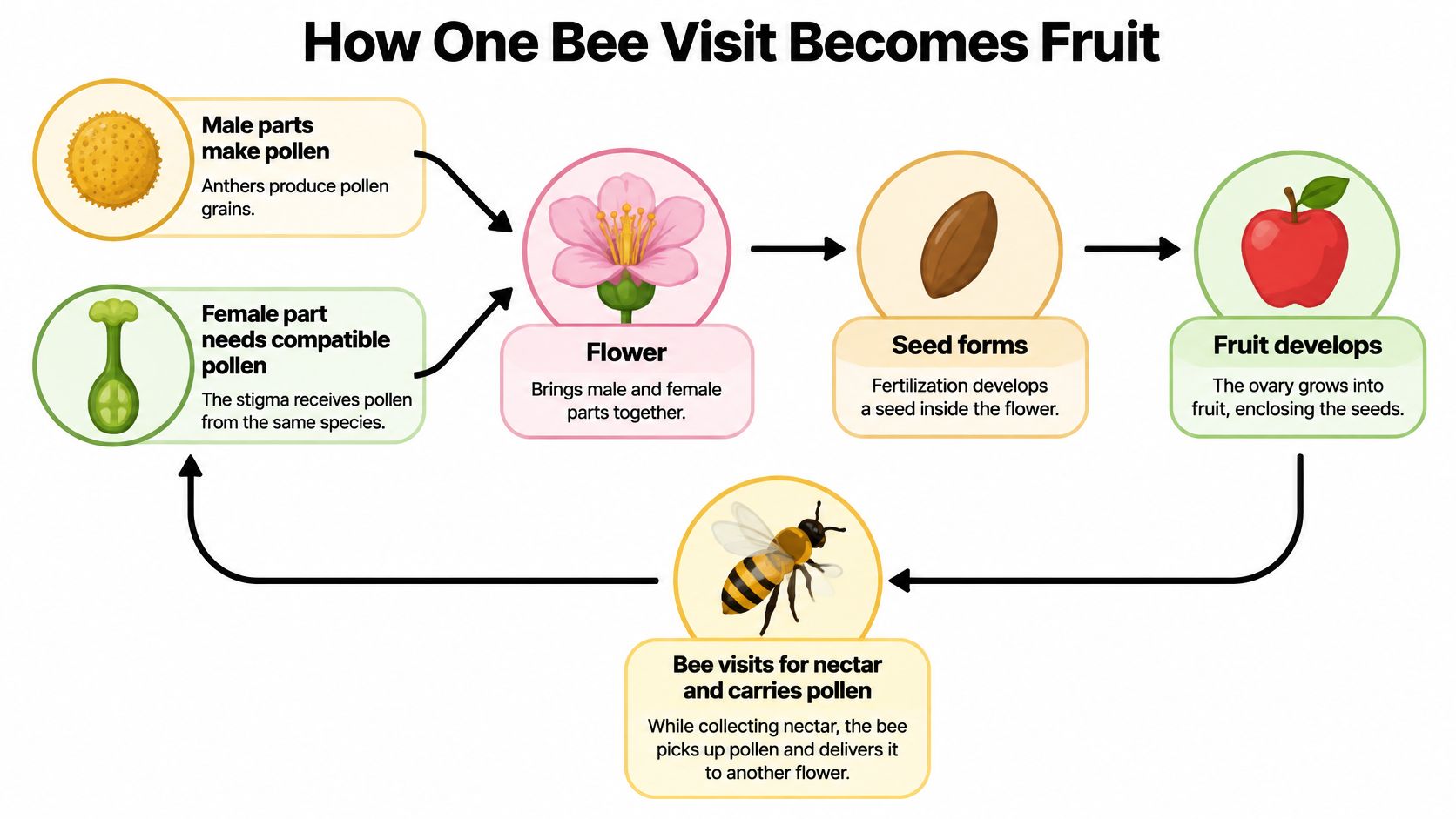
A bee lands on an apple blossom looking for food. The flower offers nectar and pollen, and as the bee feeds, grains of pollen cling to the hairs on its body. It flies off carrying a dusting it never intended to collect.
At the next compatible blossom, some of those grains brush onto the flower's receptive surface, called the stigma. Under suitable conditions, the pollen germinates, fertilization becomes possible, and seeds can develop along with the fruit surrounding them.
The diagram follows that delivery from flower to developing fruit.
A delivery job, not plant magic
Pollination is the transfer of pollen; fertilization follows afterward. What the bee moves is raw material, and the plant completes the reproductive step itself. One brief visit can start a chain that ends in a harvest.
Wind-pollinated grains release pollen broadly into the air and leave delivery to chance. Crops such as apples, almonds, blueberries, and squash benefit instead from animals moving directly among their blossoms, although their particular pollination needs differ.
The Food and Agriculture Organization's explanation of pollinator contributions describes more than 20,000 bee species contributing alongside other animals and cites a median 24% yield increase from improved pollination on small, diverse farms. The same overview reports that three out of four crops producing fruits or seeds for people depend at least partly on pollinators, that these crops account for approximately 35% of global crop-production volume, and that pollination supports 87 of 115 leading food crops.
Bees share the courier work. Flies, butterflies, beetles, birds, bats, and other animals also move pollen, and which visitors deliver most effectively depends on the plant and its surroundings.
Better delivery can mean better fruit
Successful pollination affects more than whether a fruit appears. The FAO publication on pollination and agricultural production explains that pollination can improve fruit shape, seed set, uniform ripening, and, in some oilseed crops, oil content.
Uneven seed development can leave an apple lopsided. The practical result may be fewer apples overall, or fruit that is harder to grade and sell.
For an accessible companion explanation connecting flower visits with harvests, the pollinator article from Topanga Quality Honey offers another way to approach the topic.
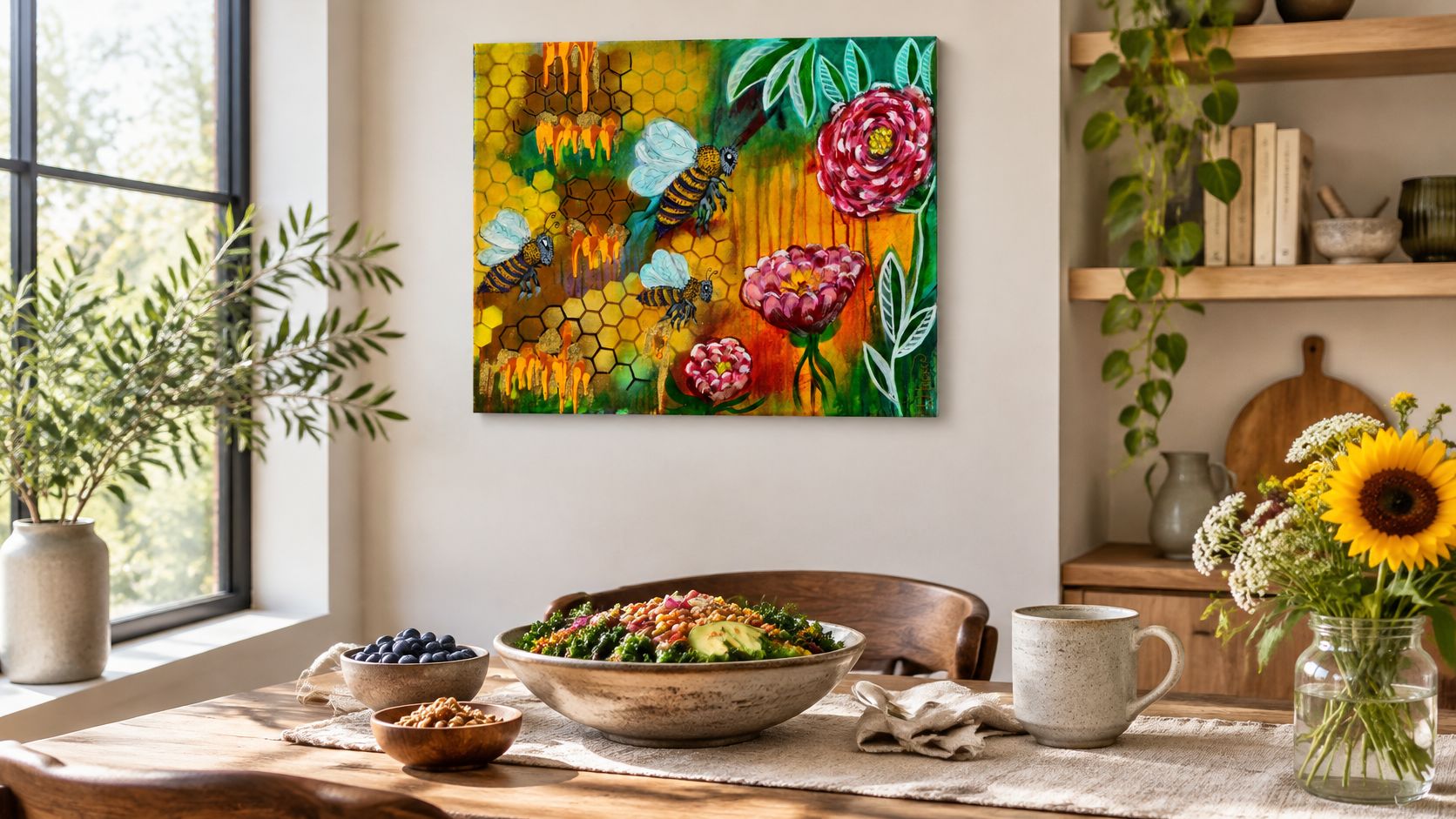
Art can make that small, easily missed activity easier to notice. William Tucker Bee Wall Art Painting - Worker Bees depicts worker bees with flowers and honeycomb forms in mixed media.
One blossom is only the start. Bees need places with overlapping flowering periods, not just a hive beside a crop that blooms and then stops.
Calories Stay but Diets Get Narrower
Bees aren't responsible for all food, and losing them wouldn't make every field stop producing. Major cereal staples generally depend less on animal pollination than many fruits, vegetables, nuts, seeds, and oilseeds.
The more accurate concern is what remains on the plate, who can afford variety, and what farmers can sell. A diet can provide enough energy while offering too little nutritional variety.
A full plate isn't necessarily a varied plate
Consider a meal built around rice or bread. Its calorie base might remain available even as the berries, squash, nuts, and other foods served alongside it become harder to produce reliably.
Households with money may absorb higher prices or buy alternatives. Households with tighter budgets have fewer choices. Pollinator decline can therefore affect access to varied food without creating an identical shortage everywhere.
A review of pollination, food security, and nutrition discusses these nutritional risks and reports a Rwandan estimate in which insect pollination added more than $100 million annually to crop production, with 62% of crops dependent on pollinators.
That example places the issue beyond wealthy countries and export orchards. Pollination matters to local farm income and the foods available within agricultural communities.
The question isn't only whether people can obtain enough calories. It's whether they can obtain a varied, nutritious diet.
The artwork below offers a visual pause around the animals behind those everyday food connections.
Food security includes what reaches the market
A harvested crop isn't automatically a usable crop. Growers and sellers also need produce that customers will buy and that can withstand handling and storage.
When pollination limits saleable quality, a farmer can lose income even while harvesting some fruit. Buyers may face a smaller selection of acceptable produce. The review also connects pollination with shelf life and marketability, making food waste part of the discussion rather than treating harvest weight as the only outcome.
The connection reaches across regions. The European Union's Official Journal reported in 2023 that 84% of European crops benefited at least partially from animal pollination and that 78% of wild plants in the European Union depended on pollinating insects.
The accurate message is more useful than an alarming slogan: bees sustain varied diets, farm income, and ecosystems, not every calorie on Earth.
Wild Bees Compared with Honey Bees
Honey bees and wild bees support crops in different ways. Growers can place managed honey-bee colonies near fields in bloom, while wild bees forage across farms and natural areas. For many crops, wild bees deliver more pollen-transfer value per visit.
What honey bees and wild bees each contribute
| Question | Honey bees | Wild bees |
|---|---|---|
| Main role | Movable colonies rented to crops in bloom | Resident pollinators across farms and wildflowers |
| Yield effect per visit | A scalable managed service, with a lower average effect per visit in the IPBES comparison | As a group, about twice the crop-yield increase per visit, according to the IPBES full assessment |
| When they work best | Large, predictable blooms where growers can arrange sufficient colonies | Flowers and conditions suited to particular species, including cooler weather for some |
| Documented money figure | Approximately $15 billion worth of U.S. crops annually, cited by the U.S. National Science Foundation; more than $400 million spent on U.S. honey-bee pollination services across 1.7 million acres in 2024, according to USDA | USDA research described in the IPBES assessment valued wild pollinators at more than $1.5 billion for seven studied U.S. crops; wild bee communities have also been estimated to contribute more than $3,000 per hectare to insect-pollinated crop production in evidence submitted to the Australian Parliament |
| What fails if we rely on them alone | Colony health problems and transport demands can disrupt a concentrated managed service | Habitat loss can remove the nesting places and flowers that resident populations need |
Why a visit isn't a standard unit
A bee may reach nectar without touching the flower parts that transfer pollen. Another bee's size, hair, posture, or movement may bring it into contact with those parts. The difference is like using tools shaped for different jobs: the flower and the visitor determine how much pollen moves.
Some wild bees also forage in conditions when honey-bee activity is reduced. The crop, weather, and bee species all matter, so the average comparison does not mean every wild bee outperforms every honey bee.
Managed colonies offer growers a way to bring many honey bees to crops during a concentrated flowering period. That scale can help commercial farms, while wild bees may pollinate particular flowers more effectively per visit.
Complementary workers, not competing teams
Each group contributes something the other cannot fully replace. The financial figures in the table describe different things: crop value, estimated pollinator contribution, and spending on hired services. They cannot be added together as if they were parts of one bill.
Explore the fascinating world of honey bees to learn more about this managed species. For crop pollination, growers benefit from managed colonies alongside healthy wild-bee communities.
Pressures That Shrink Bee Numbers
Bee decline isn't one uniform event with a single cause. Different species face different conditions, and several pressures can affect the same population at once.
Habitat loss is particularly direct: people can remove both a bee's food supply and its nesting place while leaving the area looking neat and green. A lawn or field may contain vegetation yet offer little usable flowering habitat.
Food and housing disappear together
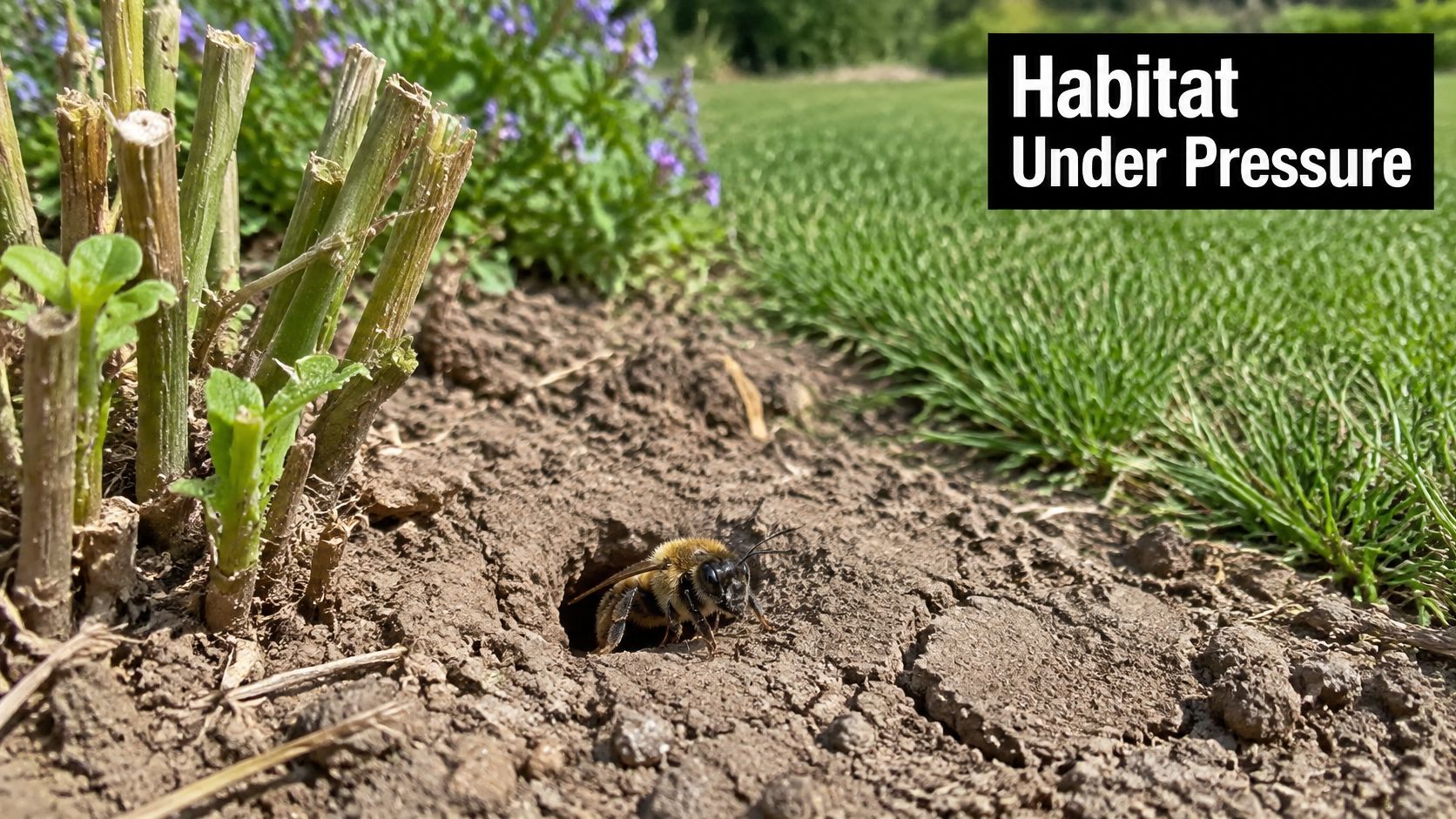
Many wild bees nest in soil, while others use stems or cavities in wood. Covering bare ground, clearing standing stems, or removing suitable dead wood can eliminate nesting opportunities.
A large crop bloom can provide abundant food temporarily. Once flowering ends, resident bees need somewhere else to forage. An area without later flowers leaves a gap that a productive bloom alone can't solve.
The nesting bee below illustrates why protecting bees means looking below flower height, too.
The broader relationship between endangered species and habitat loss helps explain why saving an animal requires more than protecting the place where people happen to see it.
Chemical exposure and poor timing add pressure
Insecticides can expose bees while they forage, through treated plants or contaminated materials. Avoiding an obvious bee kill isn't the same as avoiding all harm, and spraying when fewer bees are visible doesn't automatically make a product safe.
Disease and parasites create additional demands, especially for colonies already struggling to obtain adequate food. Moving and managing colonies also requires attention to health rather than treating bees as equipment that can be placed and forgotten.
Flowering and bee activity must overlap. Unusual warmth, cold, drought, or erratic seasons can change when flowers open and when bees can use them. A flower and its visitor can both remain present in a region yet fail to meet at the useful moment.
A bee needs more than a flower today. It needs suitable food, a nesting place, and a workable season.
For growers and gardeners, early signs may be fewer seeds, poor fruit set, or an unreliable harvest from an otherwise healthy-looking plant. Those symptoms can have other causes, so they aren't proof of a pollination shortage by themselves.
The practical response is to examine the whole setting: flowers, nesting habitat, chemical exposure, and seasonal continuity. Adding a hive doesn't repair every missing part.
How to Help Bees Where You Live
Start with the space you control, whether that's a balcony planter, a yard edge, or a community garden. The aim isn't to turn every household into an apiary. It's to make ordinary places more usable for bees already living nearby.
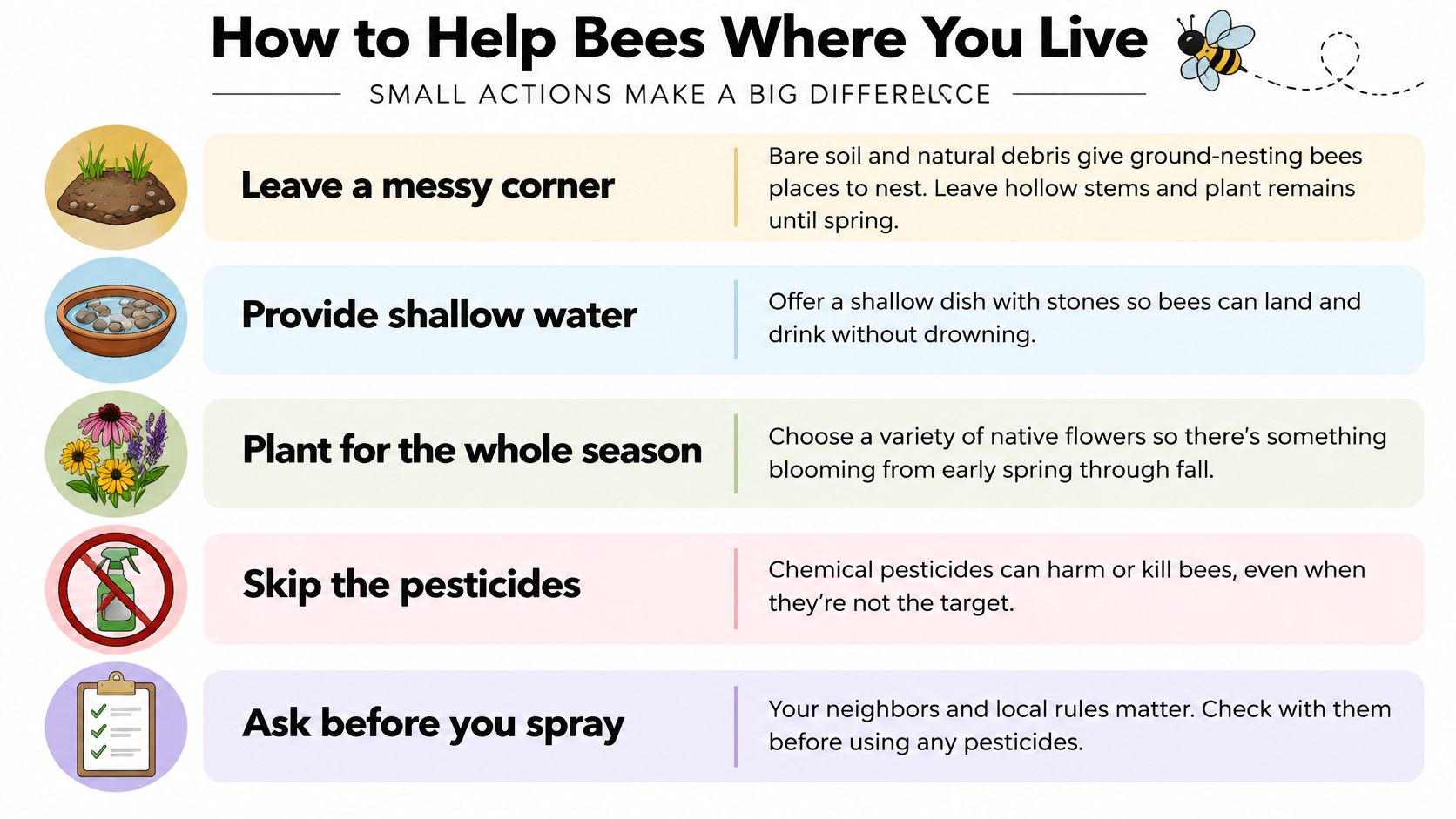
This checklist illustrates the kinds of small habitat decisions that help.
Start small and build outward
- Leave a refuge. Keep an undisturbed patch of suitable bare soil and leave some hollow or pithy stems standing through spring. If you provide water, use a shallow dish with stones for landing and clean it regularly.
- Plant across the season. Choose locally appropriate native flowers with overlapping bloom periods. Use Shopifarm's native plant guide for home gardeners as a starting point, then check regional growing advice before buying plants.
- Keep sprays off open blossoms. Avoid blanket insecticide treatments and ask whether treatment is necessary at all. If a pesticide is unavoidable, follow its label and pollinator restrictions precisely; dusk application alone doesn't make it safe.
- Make mowing less uniform. Where local rules and site conditions allow, leave flowering patches unmown or mow different areas at different times. Keep paths clear while allowing useful lawn flowers to finish blooming.
- Grow or buy a wider crop mix. Try berries, squash, or flowering culinary herbs suited to your space. When buying produce, ask growers how they maintain pollinator habitat rather than assuming a particular crop or label guarantees it.
- Connect habitat on shared land. In a community plot or farm, coordinate flowering borders and nesting refuges with neighbors. Nearby resources are more useful than an isolated planting surrounded by unsuitable ground.
Make conservation observable
Buying another honey-bee hive doesn't replace native flowers and nesting sites. For most households, improving habitat is a more direct starting point than taking on colony management.
For a visual companion to these actions, watch the video below.
These choices also fit the wider work of protecting endangered species: keep habitat usable and reduce avoidable harm.
This week, check for at least three kinds of flower in bloom, identify one nesting refuge, and keep sprays off open blossoms. These are observation goals, not a scientific threshold for a healthy bee population. Protect a mix of wild bees and flowers because that mix helps safeguard fruit quality, farm income, and wild plant communities.
Our Bee Collection offers bee-inspired art, with prints also available from the collection. William Tucker's work centers on bees, animals, and oceans and aims to draw attention to habitat loss and harmful chemicals. Visit William Tucker Art to explore artwork that can keep those conservation conversations present in your home or shared space.