
At its most basic, narrative art is any piece of artwork that tells a story. Think of a powerful painting not just as a static image, but as a single, frozen frame from a movie. It’s that one perfect shot that hints at everything that came before and everything that’s about to happen, all without a single word. It’s truly the art of visual storytelling.
The Timeless Allure of Storytelling in Art
We are, at our core, story-driven creatures. Stories are how we make sense of the world, connect with each other, and figure out our own lives. This fundamental human impulse is exactly why narrative art grabs us; it speaks a universal language that cuts across time, culture, and any spoken dialect. This power is wonderfully explored in analyses of the enduring appeal of picture books like Where the Wild Things Are, which break down how simple images can guide us through incredibly complex emotional journeys.
This kind of art isn't just about capturing a beautiful scene. It's about freezing a moment loaded with meaning and inviting us, the viewers, to play detective. You're not just seeing a portrait; you're meeting a character. You're not just looking at a landscape; you're stepping into a setting where something just happened, or is about to.
More Than Just a Pretty Picture
The real magic of narrative art is how it fires up our imagination. It doesn't spoon-feed us the answers. Instead, it drops clues—a subtle gesture, a sideways glance, a long shadow in the corner—and asks us to fill in the rest. A truly great narrative work doesn't just show an event; it makes you feel it and leaves you wondering.
This is what sets it apart from art that's purely decorative or abstract. While any art can stir emotions, narrative art aims to guide those feelings along a specific, if subtle, storyline. It’s the difference between a painting of a flower and a painting of a single, dropped rose on a rain-slicked cobblestone street. The first is beautiful, sure. The second makes you lean in and ask, "What’s the story here?"
A Tradition as Old as Humanity
Our drive to tell stories with pictures is one of our oldest instincts, so old it predates writing itself. We can trace narrative art back to prehistoric times, with some of the most stunning early examples found in the Lascaux cave paintings in France. These scenes, painted around 17,000 years ago, vividly show animals and hunting stories unfolding across the cave walls.
Fast forward a bit, and you see ancient Egyptians creating incredibly sophisticated narrative art. Their tomb paintings from around 3000 BCE are not just decorations; they are detailed visual guides documenting the deceased's epic journey into the afterlife.
Narrative art doesn't just show you something—it involves you. It turns the passive viewer into an active participant, a co-creator of the story unfolding before their eyes.
To really get a handle on this, let's break down the key ingredients.
Core Elements Of Narrative Art At A Glance
Here’s a quick look at the essential components that work together to tell a story in a single frame.
| Element | Description | Example in Art |
|---|---|---|
| Characters | The figures (people, animals) who act out the story. Their expressions, poses, and interactions are crucial. | The tense family in Goya's The Third of May 1808. |
| Setting | The time and place where the event occurs. The environment can establish mood, context, and tone. | The quiet, lonely diner in Edward Hopper's Nighthawks. |
| Plot | The implied action or sequence of events. It’s the "what's happening" part of the story, often a single, pivotal moment. | The dramatic climax of a battle shown in a history painting. |
| Conflict/Tension | The central struggle or problem. This is what creates drama and engages the viewer emotionally. | A figure's internal struggle, shown through a pained expression. |
| Mood/Atmosphere | The emotional tone of the piece, created through color, light, and composition. | The somber, reflective mood in a Rembrandt portrait. |
Understanding these building blocks is the first step. As we continue, we’ll see how these classic techniques are still powerfully relevant today, from grand museum halls to the intimate world of contemporary pet portraits.
A Brief History of Visual Storytelling
To really get what narrative art is all about, we need to hop in a time machine. The urge to tell stories with pictures isn't some new-fangled idea—it’s as old as humanity itself, stretching back tens of thousands of years before anyone had even thought of a written alphabet.
Our first stop is a deep, dark prehistoric cave. By the flickering torchlight, our ancestors used simple charcoal and ochre to bring their world to life on the stone walls. They painted dramatic hunts and great migrations. These weren't just doodles of animals; they were the very first visual stories, capturing life-and-death struggles, survival, and a deep respect for the world around them.
From there, the art of visual storytelling started picking up steam. In ancient Egypt, the walls of tombs and temples became elaborate storyboards. Artists and scribes worked together to create incredibly detailed, sequential images that told stories of the gods, documented historical events, and guided the souls of pharaohs on their journey into the afterlife.
From Myth to Mighty Empires
As civilizations like Greece and Rome rose, so did their storytelling ambitions. The Greeks covered their pottery in vibrant scenes from mythology, bringing the epic tales of gods, goddesses, and heroes to life. These weren't just pretty vases; they were cultural artifacts, teaching moral lessons and passing down stories like the Iliad and the Odyssey from one generation to the next.
The Romans, ever the showmen, went bigger. They used massive stone monuments to tell their stories of conquest and power. Just look at something like Trajan's Column—it’s a masterpiece of historical narrative, with a continuous, spiraling scene that chronicles an entire military campaign. It’s a story literally carved in stone for all time.
The Renaissance Revolution in Storytelling
The Renaissance was a game-changer for narrative art, pushing it to incredible new heights of emotion and realism. Artists from this period truly mastered how to imply a whole story—a before, a moment, and an after—within a single frame.
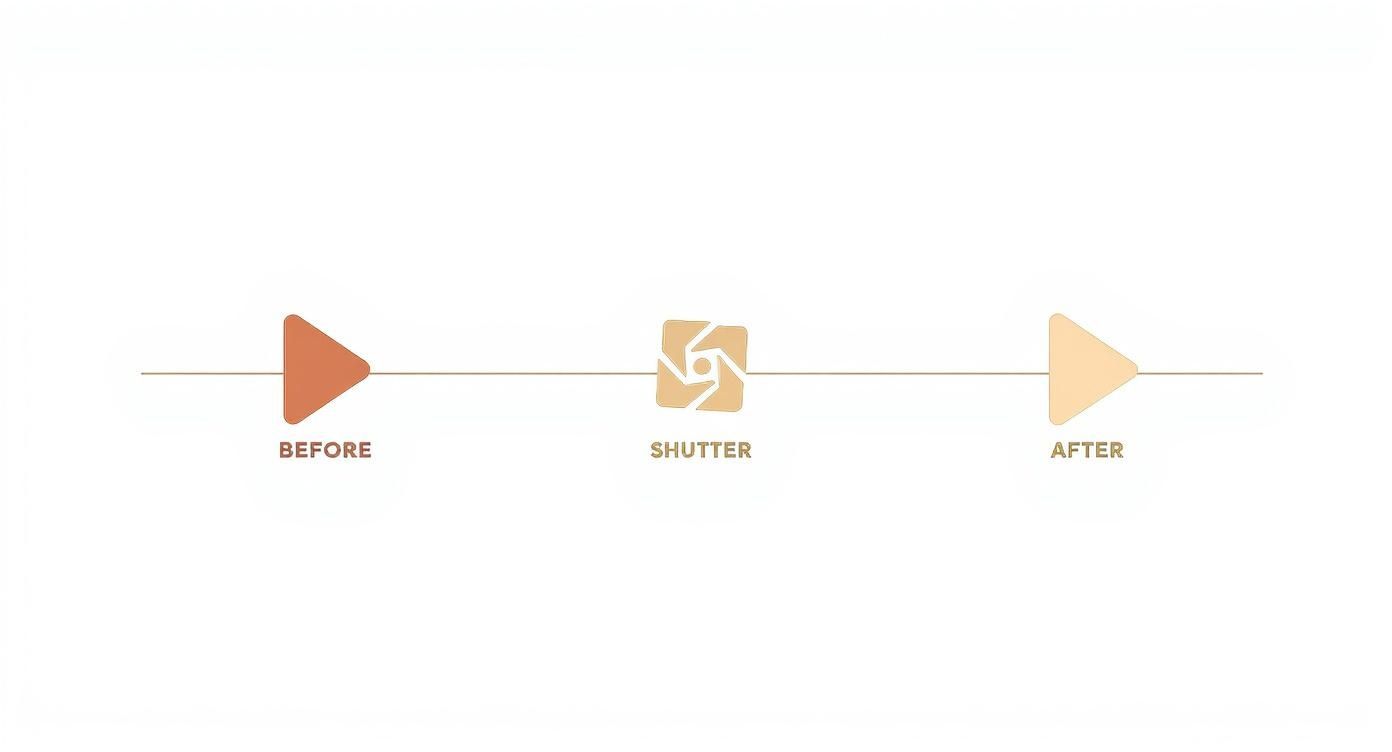
This simple structure is the secret sauce. By freezing a single, critical moment, Renaissance artists could make the viewer imagine the entire sequence of events, creating a truly dynamic and engaging experience.
During the Renaissance (14th to 17th centuries), artists like Leonardo da Vinci and Raphael created these sprawling, complex scenes packed with figures, telling biblical and mythological stories with breathtaking detail. It wasn't a niche interest, either. Art historians estimate that around 70% of major works commissioned during this time were narrative. People craved art that didn't just look beautiful but also told them a meaningful story.
A Timeless Tradition: "The ability of a single image to tell a story is a powerful form of communication that connects our present to the past, recording history and culture through depictions of myths, historical events, and cultural narratives."
Understanding this deep connection to history is key. If you want to dive deeper into how these visual narratives evolved over time, you can explore an Art History Periods Timeline.
New Stories for a New World
After the Renaissance, movements like Neoclassicism and Romanticism kept the storytelling tradition alive and well. Artists painted grand historical battles, pivotal revolutionary moments, and deeply passionate tales designed to stir the soul. They were masters of composition and light, using every tool in their arsenal to crank up the story's emotional impact.
But as the world modernized, so did the stories artists wanted to tell. When Impressionism arrived in the 19th century, the spotlight shifted away from gods and emperors. Artists like Edgar Degas and Pierre-Auguste Renoir started telling quieter, more personal stories about everyday life.
Their narrative art captured beautiful, fleeting moments that felt real and relatable:
- A candid, behind-the-scenes glimpse of ballet dancers in rehearsal.
- A sun-drenched luncheon shared by friends on a lazy afternoon.
- The chaotic, bustling energy of a modern city street.
This was a huge shift. Narrative art was no longer just for epic sagas. It could now explore the subtle dramas of our daily lives and the complex inner worlds of ordinary people. This journey through time shows just how adaptable visual storytelling is, always finding fresh ways to reflect the culture, concerns, and heart of its era.
Discovering the Key Ingredients of a Visual Story
So, how does a flat, silent image manage to tell a complex story, sparking our imagination and stirring our emotions? It’s not magic. It’s a masterful use of specific visual tools. Think of it as learning the secret language of painting, where every single choice an artist makes is a word or a phrase that builds the larger narrative.
To really get what narrative art is all about, we need to unpack this toolkit. Once you can spot these key ingredients, you'll go from just seeing a painting to actively interpreting the rich stories hidden inside.
Composition: The Art of Directing the Eye
At its heart, composition is simply how an artist arranges everything in the frame. It’s the visual scaffolding that holds the story together and, more importantly, tells your eye where to go. A strong composition makes sure you see the most important parts of the story in the right order.
Artists have a few go-to techniques for this:
- Focal Points: This is the main event, the part of the painting your eye naturally lands on first. It could be a character’s face, a burst of action, or a brightly lit object.
- Leading Lines: These are lines—sometimes obvious, sometimes implied—that guide you through the scene. Think of a road winding into the distance, a gaze between two figures, or a pointed finger. They connect the story's elements.
- The Rule of Thirds: By placing key elements just off-center, artists create a more dynamic and interesting scene that feels less staged and more natural.
A well-composed painting doesn't just let your eyes wander. It takes you on a carefully planned tour of the story, revealing clues and building the narrative step-by-step.
Symbolism: Speaking Without Words
Symbolism is one of the most powerful tools in an artist's arsenal. It's using everyday objects, figures, or even colors to represent bigger ideas. A wilting flower might suggest mortality, a key could stand for a secret, and a dog often represents loyalty.
These symbols add incredible depth, communicating complex themes that would be hard to show through action alone. For instance, in a lot of historical paintings, a skull wasn't just a skull—it was a “memento mori,” a stark reminder that life is fleeting. This adds a whole layer of philosophical weight to the scene.
Learning to recognize common symbols is like unlocking a hidden level of the story. It allows you to understand the artist's message on a much deeper, more intentional level.
This visual shorthand can turn a simple scene into a rich tapestry of meaning, inviting you to think more deeply about the story being told.
Character and Emotion: The Human Connection
A story is nothing without its characters, and in narrative art, their emotions are what drive the plot forward. Artists convey a massive amount of information through posture, gesture, and facial expressions. A slumped shoulder can express defeat more powerfully than any description ever could, while a clenched fist can signal raw anger or fierce determination.
These non-verbal cues create a direct line to us, the viewers. When we see a character’s anguish or joy, we feel a flicker of that ourselves. This empathy is what pulls us into the story and makes us care about what happens next.
Just think of the dramatic work of the Baroque painter Caravaggio. He was an absolute master of using chiaroscuro—that intense, dramatic contrast between light and dark—to spotlight the raw emotions on his subjects' faces. The lighting wasn't just for show; it was a narrative tool he used to crank up the tension and emotional weight, making the scene feel immediate and deeply human.
Bringing Animal Portraits to Life with Narrative
The magic of narrative art isn't just for epic historical scenes or dramatic human portraits. Those same storytelling principles can be incredibly powerful in wildlife and pet portraiture, turning a simple picture of an animal into a story you can feel.
This is how a portrait becomes more than just a record of how an animal looked. It becomes a timeless tribute to their spirit—capturing the quiet dignity, the goofy energy, or the deep, unspoken bond they shared with their family. It captures who they were.
More Than Just Fur and Feathers
A truly great narrative animal portrait gets you thinking. You're not just looking at a dog; you're wondering, "Is he patiently waiting for his human to come home?" or "Did he just get back from a glorious, muddy romp in the woods?" It's these implied stories that forge a real emotional connection.
An artist creates this feeling by carefully choosing every detail to act as a clue. The background isn't just a backdrop; it's a setting. That favorite, beat-up toy isn't just an object; it's a co-star in the animal's life story. These choices are what give a portrait its soul.
Let's dig into this by looking at the work of a modern artist who has truly mastered this. By seeing how he does it, we can understand exactly how a painting can tell a story.
A Case Study in Animal Storytelling
New Orleans artist William Tucker is a master at weaving narratives into his wildlife and pet portraits. He uses an animal's posture, its gaze, and the environment around it to build a story that feels incredibly personal yet completely universal. His work is a beautiful reminder that every animal has a tale to tell.
Think about a portrait where a dog is looking just past the edge of the canvas. It's a simple trick, but it instantly creates a sense of anticipation. As the viewer, you can't help but wonder what has grabbed the dog's attention, pulling you right into that living, breathing moment.
Now, imagine that same dog painted in different settings. These choices add rich layers of meaning:
- A Favorite Park: This location speaks of a life filled with adventure, fetch, and happy memories. The story is one of shared joy.
- A Well-Worn Armchair: This setting suggests comfort, companionship, and the quiet, steady presence of a family member. The narrative becomes one of loyalty and home.
These details are the vocabulary of visual storytelling. Tucker often uses abstract backgrounds, which is a brilliant move that isolates his subjects. It pushes all the focus onto the animal's personality and inner world, highlighting their spirit without the distraction of a literal scene. You can see for yourself in this gallery of expressive animal portrait paintings and discover how different approaches bring each unique story to life.
A portrait becomes a piece of narrative art when it successfully implies a "before" and an "after." The artwork freezes a single, meaningful moment, inviting the viewer to imagine the entire story arc that surrounds it.
This power to convey a history and a personality is what elevates a good portrait into a timeless one. The story is what makes the painting resonate for generations, telling the tale of a cherished friend long after they're gone.
The Power of Small Details
In narrative animal art, the smallest things can carry the most weight. Adding a single object can shift the entire tone and meaning of a painting. A muddy paw, a frayed rope toy, a dangling collar—each one is a breadcrumb that leads you deeper into the animal's world.
For instance, a portrait of a cat perched gracefully on a stack of books tells a completely different story than one of the same cat batting at a piece of string.
- The Studious Cat: The narrative here might be about a quiet, observant companion who shares in the calm, intellectual life of their owner.
- The Playful Hunter: This story is all about instinct, energy, and youthful spirit. It captures that bit of wildness that lives inside even the coziest house cat.
And that, really, is the magic of it all. Narrative art gives an artist the tools to capture the essence of a being who can't speak for themselves. It creates a silent, beautiful conversation between the subject, the artist, and you. It makes sure the portrait isn't just seen, but truly felt.
How to Read a Painting Like an Expert
https://www.youtube.com/embed/rKhfFBbVtFg
Let's be honest, walking into a gallery can feel a little intimidating. You're surrounded by incredible art, but how do you go from simply liking a piece to truly understanding its story? The great news is you don’t need an art history degree to see what's going on. All it takes is a bit of curiosity and knowing what questions to ask.
Think of reading a painting as having a quiet conversation. It’s not about finding one single "correct" answer, but about engaging with the work and letting it speak to you. When you start asking the right questions, you begin to unravel the layers of story the artist has so carefully woven into the canvas. It makes the entire experience richer and far more personal.
Start with the Obvious: What Is Happening Here?
The first step is always the easiest one. Just take a step back, take a breath, and describe what you see out loud. Seriously, imagine you're on the phone with a friend, telling them about the painting in front of you. Forget the fancy art terms; just state the facts.
Who are the main figures? Where are they? What time of day does it seem to be? Answering these simple questions builds the foundation of the narrative. This initial look grounds you in the scene before you start digging for the deeper stuff.
Follow the Clues: The Artist's Trail
Now that you've got the lay of the land, it's time to put on your detective hat. Artists are masters of leaving intentional clues to guide your eye and your thoughts. Your job is to spot them.
Start asking yourself a few follow-up questions to dig a little deeper:
- What are the characters doing? Pay close attention to their body language and facial expressions. A clenched fist, a downward glance, or a joyful leap can tell you everything you need to know about their state of mind.
- What does the background reveal? The setting is never just a backdrop; it’s a crucial part of the story. A stormy sky can signal turmoil and conflict, while a tidy, sunlit room might suggest peace and order.
- Are there any important objects? Keep an eye out for symbols. A wilting flower might hint at mortality, while an open book could represent knowledge or a new chapter. These little details add incredible depth to the main event.
Reading narrative art is an active process. The artist provides the visual text, but you, the viewer, bring your own experiences and imagination to complete the story. It's a partnership in storytelling.
This investigative approach transforms you from a passive viewer into an active participant in the story.
Feel the Story: What Is the Mood?
Okay, you've gathered your clues. Now it’s time to tune into the painting's emotional frequency. Artists are brilliant at creating an atmosphere, using color, light, and shadow to make you feel something. Ask yourself, "What is the overall mood here?"
Is the piece somber and quiet, or is it buzzing with chaotic energy? An artist’s choice to use warm, golden light versus a cold, blue shadow can completely change the emotional tone of a scene. This feeling is often the most powerful part of the story—it's the thing that sticks with you long after you’ve walked away.
By following these simple steps—Observe, Investigate, and Feel—you’ll be able to unlock the story in any piece of art you encounter.
Bringing Narrative Art into Your Home
So, you’re feeling that pull to bring a piece of visual storytelling home. That's fantastic. Making the jump from admiring art to owning it is a personal and exciting step. It's about finding a story that clicks with you and weaving it into the fabric of your everyday life. Whether you’ve been collecting for years or are just starting out, the process should always feel like a joy, not a chore.
When you're looking at a piece that catches your eye, the first thing to ask yourself is, "What story is this telling me?" A great narrative artist is a master of dropping hints—in the composition, the look in a subject's eyes, or the mood set by the color palette. You're looking for that piece that makes you stop and wonder what happened right before this moment, and what might happen next.
Finding and Commissioning Your Story
One of the most rewarding parts of collecting is discovering new artists. I always recommend keeping an eye on art school graduate shows, popping into local galleries, and browsing online art communities. It’s a great way to find fresh talent whose storytelling style really speaks to you. When you find an artist whose work you just can't stop thinking about, reach out to them! Many artists are open to commissions, which gives you the chance to create something truly one-of-a-kind.
Commissioning a portrait, especially of a beloved pet or family member, is a partnership between you and the artist. To get a result you'll both be proud of, keep these things in mind:
- Share Your Vision: Be clear about the story you want to tell. Is it about a goofy, playful personality? A quiet moment of connection? A cherished memory? The more detail, the better.
- Provide Great Photos: Good reference photos are worth their weight in gold. Send a variety of high-quality shots from different angles that really capture the subject’s spirit, not just a generic pose.
- Trust the Artist's Process: Remember, you chose this artist for their unique style and voice. Give them the creative space to interpret your story through their own lens. The magic happens when your vision meets their expertise.
Owning narrative art isn't just about filling a blank wall; it’s about living with a story. Every day, that piece invites you to pause, to feel something, to let your imagination wander. It enriches your home in a way that simple decoration never could.
It's no surprise that the art world is seeing a huge interest in this kind of meaningful work. The global art market hit a staggering $67.8 billion in 2024, and a big part of that energy is coming from younger collectors who are specifically seeking out art that tells a compelling story. This really underscores the timeless appeal of narrative art, proving it's not just culturally significant but a driving force in today's creative world. You can read more about current art market trends on myartbroker.com.
Once your new artwork is home, a little thought into placement and care goes a long way. Find a spot where you’ll see it often, but try to keep it out of direct sunlight, which can cause the colors to fade over time. Investing in a good frame with UV-protective glass is also a smart move to ensure its story lasts for generations. For more ideas on how to make your new piece feel right at home, take a look at our guide on how to choose art for your home.
Got Questions About Narrative Art? We've Got Answers.
As we've journeyed through this fascinating world of visual storytelling, you might still have a few things you're curious about. Let's tackle some of the most common questions people ask.
Does Abstract Art Tell Stories Too?
It absolutely can! When we think of "stories," we often picture a clear sequence of events with recognizable characters. But abstract art tells a story in a more intuitive, emotional way.
Instead of a plot you can follow like a book, an abstract piece might take you on an emotional journey. The artist uses color, texture, and form to suggest feelings like turmoil, peace, or pure joy. The narrative is less about what happens and more about what it feels like. It’s a story for the senses, and your own interpretation becomes a key part of the experience.
What's the Real Difference Between Narrative Art and Illustration?
This is a great question, because the line between them can feel a bit fuzzy. The simplest way to think about it is to look at its primary job.
- Illustration is almost always created to support something else—usually, a piece of text. Think of the pictures in a children's book or a diagram in a technical manual. Their main purpose is to help explain a pre-existing story or idea.
- Narrative art, however, is the story itself. It’s a standalone work that doesn’t need any accompanying text to communicate its message. The entire narrative is contained within the frame.
Of course, the best illustrators are often fantastic narrative artists, creating images so powerful they tell a complete story all on their own.
Think of it this way: Illustration often serves a text, while narrative art is the text, written in the language of visuals.
I'm Inspired! How Can I Start Making My Own Narrative Art?
That's the best takeaway! A great starting point is to focus on a single, powerful moment. Don't try to tell an entire epic tale at once. Pick one scene from a story you love and challenge yourself to capture its emotional core in a single image.
Get comfortable drawing people and animals, paying close attention to how posture and facial expressions communicate feeling. You can also learn a ton about framing a dramatic scene by studying composition in your favorite films. Above all, create art about the stories that genuinely move you. Your passion will shine through.
At William Tucker Art, we believe every portrait is a story waiting to be told. If you'd like to see how visual storytelling can capture the unique spirit of an animal, we invite you to explore our collections of wildlife and pet portraits.