
The real difference between a threatened species and an endangered one comes down to one thing: time. A threatened species is on a slippery slope, one that is likely to become endangered in the foreseeable future. An endangered species, however, is already at the bottom of that slope, facing a very high risk of extinction right now.
Think of it like a medical diagnosis. Threatened is a serious warning, while endangered is a full-blown, Code Blue emergency.
Understanding the Tiers of Conservation Concern
When you hear scientists and conservation experts use these terms, know that they aren't just throwing words around. Each classification represents a specific, scientifically determined threshold of danger. These labels are absolutely vital because they dictate the level of urgency and the kinds of conservation actions needed to pull a species back from the brink.
Two main players set these global and national standards: the International Union for Conservation of Nature (IUCN) and the U.S. Fish and Wildlife Service, which enforces the Endangered Species Act (ESA). While they share the same ultimate goal of saving wildlife, their specific definitions and the legal muscle behind them can vary, shaping how animals are protected around the world and right here at home.
At its core, the distinction is about timing and probability. A threatened species is on a dangerous path, but an endangered species has nearly reached the end of that path without immediate intervention.
To really get a feel for the difference, let’s break it down into a few key areas:
- Risk Level: Endangered species are in much more immediate peril.
- Population Status: The populations of endangered species are usually smaller, more fragmented, and declining faster.
- Urgency for Action: Efforts to save an endangered species are often far more intensive and immediate.
This system is all about prioritizing. It helps conservationists focus their limited resources and energy on the animals that need our help the most.
Quick Comparison Threatened vs Endangered Species
For a simple at-a-glance look, this table breaks down the fundamental differences between the two classifications.
| Characteristic | Threatened Species | Endangered Species |
|---|---|---|
| Extinction Risk | Likely to become endangered in the near future. | At a very high risk of extinction now. |
| Population Trend | Declining or vulnerable to rapid decline. | Critically low numbers or rapid decline. |
| Urgency | Proactive conservation is needed to prevent further decline. | Immediate, intensive recovery actions are critical for survival. |
Essentially, the "threatened" label is a crucial early warning system, giving us a chance to act before the situation becomes a crisis. Once a species is "endangered," the fight for its survival is already underway.
The Official Definitions Behind Conservation Labels
To really get to the heart of the "threatened vs. endangered" conversation, we need to look at who's making the call. These labels aren't just thrown around; they’re carefully assigned by two major players in the conservation world: the International Union for Conservation of Nature (IUCN) and the U.S. government, through its landmark Endangered Species Act (ESA).
These organizations create the rulebooks that scientists, governments, and conservation groups follow. Their definitions guide everything from which species get priority funding to what laws are enacted to protect them. And while they're both fighting the same fight, they define the terms a little differently.
The IUCN Red List: A Global Standard
Think of the IUCN Red List of Threatened Species as the most extensive global database on the health of the world's species. It's the go-to source for assessing how close a species is to disappearing forever.
The IUCN uses "Threatened" as a broad umbrella term. If a species is considered threatened, it means it falls into one of three specific sub-categories, each with a greater sense of urgency:
- Vulnerable (VU): Facing a high risk of extinction in the wild.
- Endangered (EN): Facing a very high risk of extinction in the wild.
- Critically Endangered (CR): Facing an extremely high risk of extinction in the immediate future.
So, under the IUCN’s system, all endangered and critically endangered species are also considered threatened. This global framework creates a consistent way for everyone, everywhere, to talk about extinction risk.
This screenshot from the IUCN Red List website shows their full spectrum of categories.
You can see how the color-coding, from a safe green to a critical red, gives you an immediate visual sense of a species' escalating danger.
The U.S. Endangered Species Act: A Legal Definition
Here in the United States, things are a bit more black-and-white. The definitions are tied directly to legal protections under the powerful Endangered Species Act of 1973. This isn't just about classification; it's about the law.
According to the ESA, an endangered species is "any species which is in danger of extinction throughout all or a significant portion of its range." A threatened species is one "which is likely to become an endangered species within the foreseeable future."
This legal distinction is absolutely crucial. While the IUCN's categories are more of a global report card, an ESA listing kicks off real, legally-mandated action inside the U.S. We're talking about things like critical habitat protection and formal recovery plans.
The need for these definitions is staggering. A massive global study analyzing over 71,000 animal species found that a shocking 48% have declining populations. This highlights the sheer scale of the biodiversity crisis these labels are designed to fight. You can dive deeper into the findings of this global species analysis to understand the full scope of the problem.
How Scientists Classify At-Risk Species
When we hear that a species is "threatened" or "endangered," it's easy to assume it’s a subjective call. But in reality, that label comes from a deep, data-driven investigation into its chances of survival. It’s less of a gut feeling and more like a comprehensive health checkup for an entire species.
Scientists and conservation experts don't just guess. They use a strict set of quantitative criteria to measure just how close a species is to blinking out of existence forever. They examine vital signs like population trends, habitat loss, and geographic spread to determine the precise level of risk.
The Core Metrics of Extinction Risk
At the core of these assessments are a few key factors that give us a clear snapshot of a species' overall health. Grasping these metrics is the first step in understanding the real difference between a threatened species vs endangered species.
- Population Reduction Rate: This is a big one. Experts track how quickly a species' numbers have dropped over the last 10 years or three generations (whichever is longer). A steep, rapid decline is a serious alarm bell.
- Geographic Range: It’s not just about how many animals are left, but where they can live. A small, fragmented, or degraded habitat makes a species incredibly vulnerable to threats like disease or environmental changes.
- Total Population Size: Simply put, the fewer mature, breeding individuals that remain, the higher the risk. Tiny populations are particularly susceptible to genetic bottlenecks and can be wiped out by a single catastrophic event.
This infographic breaks down how the International Union for Conservation of Nature (IUCN) organizes these risk levels under its broad "Threatened" umbrella.
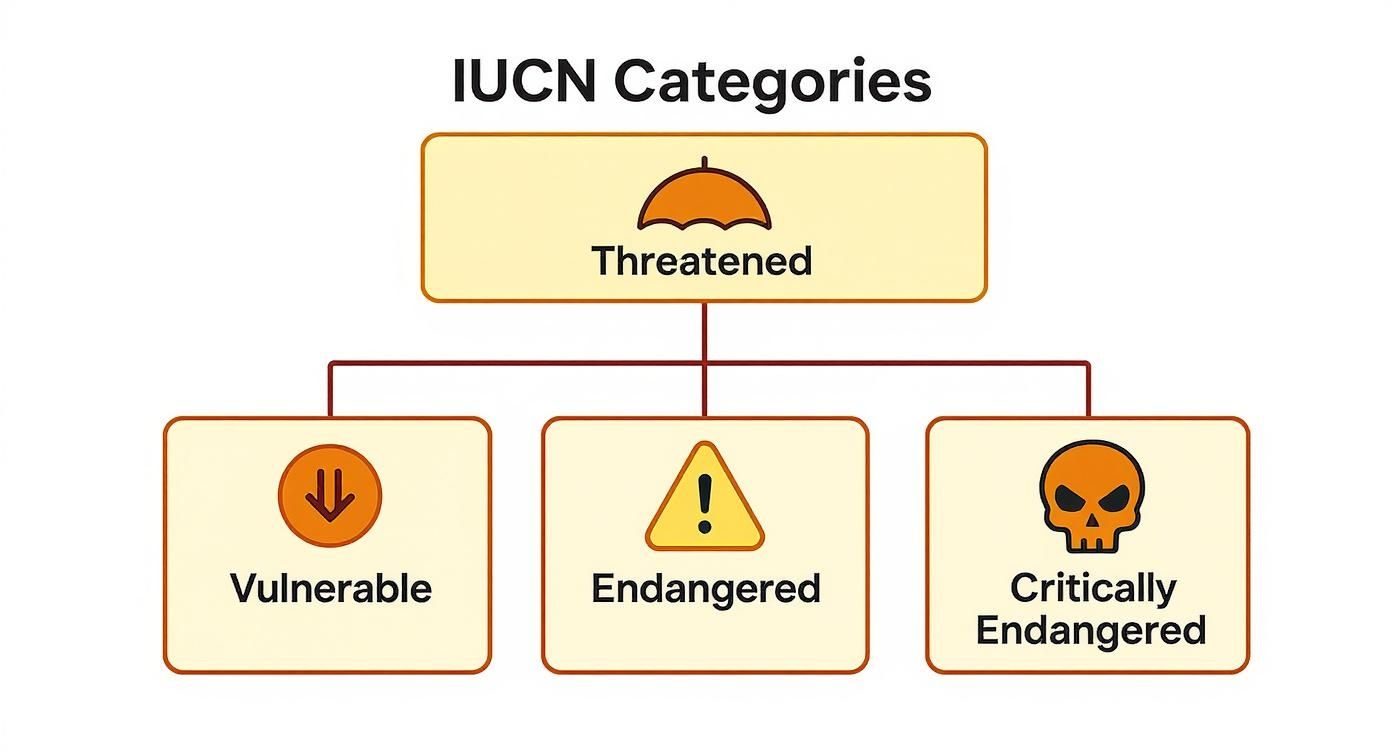
As the colors shift from yellow to orange to red, the danger level escalates. It's a clear visual signal of a species moving closer to the brink.
To put this in perspective, the Living Planet Index—a crucial measure of global biodiversity—reported a staggering average drop of 73% in monitored wildlife populations between 1970 and 2020. That shocking figure helps explain why such sharp population declines are a major red flag. You can dig deeper into the numbers yourself in the 2024 Living Planet Index update.
IUCN Red List Criteria Simplified
So, how do those metrics translate into an official classification? It all boils down to hitting specific, pre-defined thresholds. This table simplifies some of the core criteria used by the IUCN.
| IUCN Category | Population Reduction Rate (Over 10 years or 3 generations) | Estimated Population Size (Mature Individuals) |
|---|---|---|
| Vulnerable | >30% reduction | Fewer than 10,000 |
| Endangered | >50% reduction | Fewer than 2,500 |
| Critically Endangered | >80% reduction | Fewer than 250 |
As you can see, a species might land in the Vulnerable category if its population has dropped by more than 30%. But if that decline accelerates past 50%, its status is elevated to Endangered.
The key takeaway is that these classifications are not subjective. They are based on a standardized framework that allows scientists to compare the extinction risk of a tiny insect to that of a massive whale using the same objective scale.
This evidence-based approach is absolutely essential. It ensures that limited conservation funds, legal protections, and on-the-ground efforts are channeled to the species that need our help the most. It transforms a complex ecological crisis into a structured system for prioritizing action and giving our planet’s wildlife the best possible shot at a future.
Real-World Examples of Threatened and Endangered Wildlife
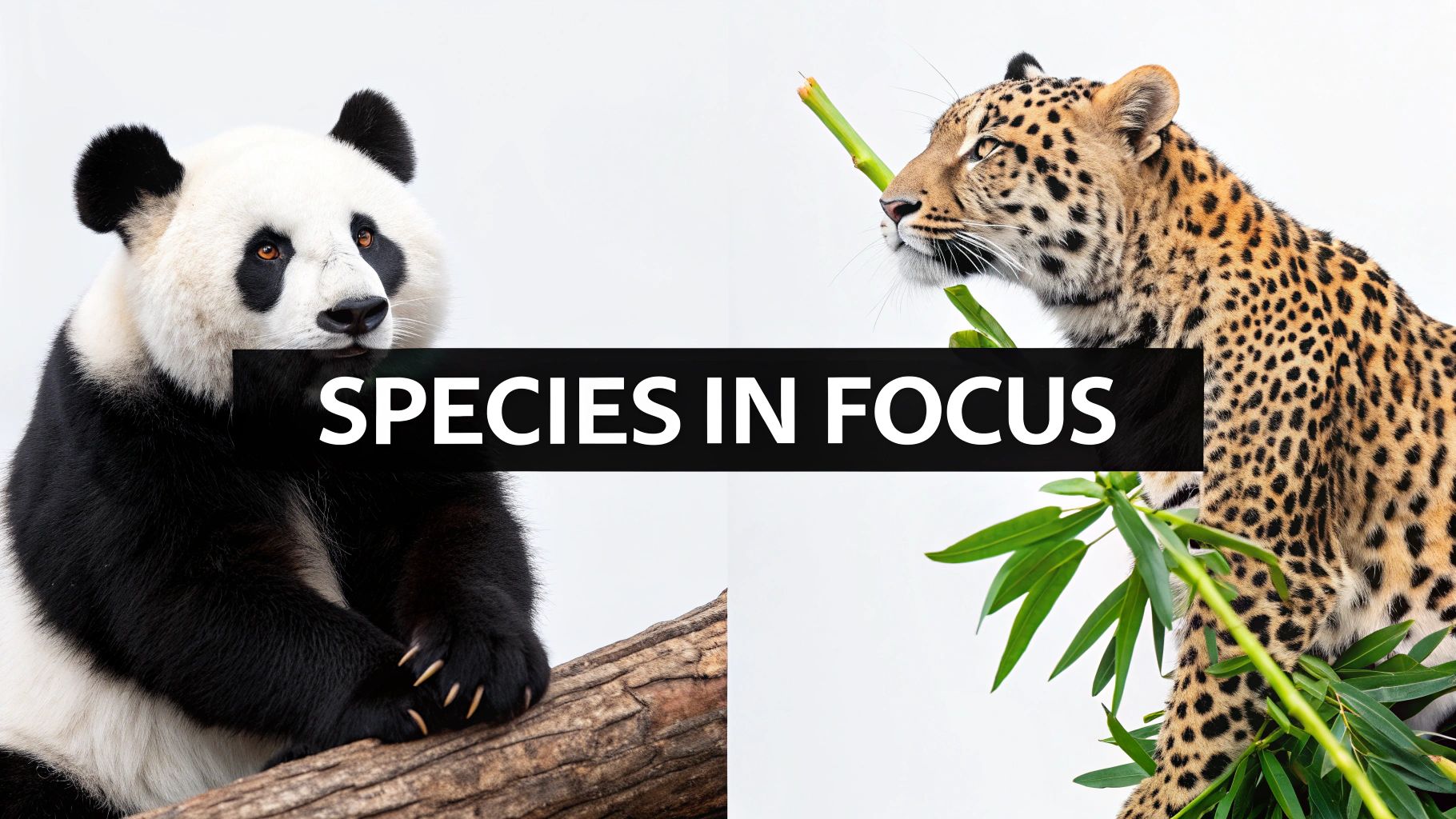
Sometimes, the best way to understand the difference between threatened species vs endangered species is to look at the animals themselves. These labels aren't just scientific jargon; they represent the real, ongoing survival stories of creatures we know and love.
Putting a face to the data makes the stakes much clearer. Take, for example, the majestic Manta Ray, which is currently classified as Vulnerable. This designation places it squarely in the broader "threatened" category, acting as a crucial warning that we need to step in now before things get worse.
Threatened Species: A Story of Hope
The Giant Panda is probably one of the most famous conservation stories out there. For years, it was the poster child for endangered species. But thanks to incredible, sustained efforts—like protecting their bamboo forests and running successful breeding programs—their numbers started to climb.
In 2016, the IUCN officially moved the Giant Panda from "Endangered" to "Vulnerable." It was a huge win! Still, their "threatened" status is a reminder that the work isn’t over. Their habitat is still patchy and at risk from climate change, showing just how long and delicate the road to recovery can be.
Endangered Species: On the Brink
On the other end of the spectrum is the Amur Leopard. This stunning big cat is living on a knife's edge. It's one of the rarest felines on the planet, with estimates suggesting fewer than 100 are left in their native forests in Russia and China.
Poaching and severe habitat loss have pushed them to the brink. With a population so critically small, the species is incredibly vulnerable to being wiped out completely. Saving the Amur Leopard is a desperate race against time that requires immediate and focused international action.
The journey of the Giant Panda shows that downgrading a species from endangered to threatened is a monumental success, while the plight of the Amur Leopard highlights the desperate, last-chance nature of an endangered classification.
Louisiana’s Own Conservation Stories
You don't have to look across the world to see these battles being fought; they're happening right here in our own backyard. The Louisiana Black Bear was once listed as threatened under the ESA. After decades of work restoring habitats through public-private partnerships, it was successfully delisted in 2016. It’s a powerful local example of what we can accomplish.
But we also have stories of ongoing struggle. The Kemp's Ridley Sea Turtle, which nests along the Gulf Coast, remains critically endangered. As the world's smallest and most at-risk sea turtle, it faces constant threats from fishing gear and the degradation of its nesting beaches. Its fragile existence is a constant reminder of why we need to protect our local wildlife and the places they call home.
What a Conservation Listing Actually Means
When a species gets officially classified as threatened or endangered, it's so much more than just a new label. Think of it as a legal S.O.S. call that triggers a whole cascade of protective actions and resources aimed at pulling that species back from the edge.
This official listing, especially under powerful legislation like the U.S. Endangered Species Act (ESA), transforms a scientific concern into a legal priority. The real difference between the two classifications lies in just how intense those safeguards are.
Protections for Endangered Species
For animals and plants listed as endangered, the protections are the most stringent we have. It’s an all-hands-on-deck situation.
These safeguards almost always include:
- A Strict Ban on 'Take': This legal term makes it flat-out illegal to harass, harm, hunt, capture, kill, or even just pursue a listed species. This protection extends to its habitat, too, making destruction a federal offense.
- Designation of Critical Habitat: Federal agencies must map out and protect the specific geographical areas that are absolutely essential for the species to survive and, hopefully, recover.
- Mandatory Recovery Plans: A detailed, science-based game plan has to be created and put into action. The goal is to bring the species’ population back to a healthy, self-sustaining level.
Flexibility for Threatened Species
The protections for a threatened species are a bit more flexible. While these species are absolutely still under legal protection, the ESA allows for what are called "special rules" that can be tailored to the specific needs of that animal or plant.
This approach is really practical. It allows for managing human activities in a way that aids the species' recovery without necessarily bringing down the absolute prohibitions required for an endangered species.
This legal distinction is what turns scientific data into a genuine lifeline. These classifications come from painstaking assessments of population numbers, the state of their habitat, and all the threats they face. The United States alone has over 1,300 species officially listed as threatened or endangered.
A conservation listing transforms a species' status from a data point into a mandate. It mobilizes federal agencies, directs funding, and empowers conservation groups to take concrete, legally-backed actions.
Ultimately, getting a species on this list directly influences how we use land, shapes industry regulations, and unlocks the critical funding needed to carry out those recovery plans. To see how these listings can change over time, it's fascinating to read up on stories like the conservation status of humpback whales, a species that has made an incredible comeback thanks to these protections.
These legal frameworks are the bedrock of modern wildlife survival, turning a scientific assessment into a tangible chance at a future. To dig deeper into the legal side, check out our guide on endangered species protection laws.
How Art Lovers Can Support Wildlife Conservation

You don’t have to be a field biologist to make a difference in wildlife conservation. If you're an artist, a collector, or simply someone who appreciates the natural world, your passion can be one of the most powerful tools we have.
Art has a way of translating cold, hard data about a species’ decline into a story that hits you on a personal level. It creates an emotional connection that numbers on a chart just can't match. When you commission a painting, create a sculpture, or buy a print featuring at-risk wildlife, you're doing more than just acquiring art—you're joining a vital conversation.
Turning Passion into Action
Supporting conservation can be woven directly into your artistic life. It’s all about being intentional. Here are a few tangible ways you can make an impact:
- Commission with a Conscience: Think about hiring a local artist to create a piece that features a threatened or endangered species right from your own backyard. Imagine a painting of Louisiana's own Kemp's Ridley Sea Turtle hanging in a local business—it’s a beautiful way to build community pride and awareness.
- Find Galleries That Give Back: Look for artists and galleries that commit a portion of their sales to wildlife conservation groups. This way, your purchase pulls double duty, becoming a direct donation to the people working on the ground to protect these animals.
- Create with a Purpose: If you're an artist, why not dedicate a collection to species on the threatened or endangered lists? You can use your art and your platform to tell their stories, explain the threats they're up against, and point your audience toward ways they can help.
Art has this incredible ability to bypass our analytical minds and speak straight to the heart. It builds a genuine sense of connection and responsibility, turning someone who was just a passive observer into a real advocate for our planet's most fragile inhabitants.
This approach transforms a personal passion into a public statement. When we bring the beauty and fragility of these animals into our homes and galleries, we refuse to let their struggle be forgotten. Recognizing the power of art for environmental awareness is the first step. Every brushstroke, every sculpture, and every sale can build a culture that actively fights to protect our planet's biodiversity.
Frequently Asked Questions
Got questions about conservation terms? You're not alone. The language can be a bit tricky, so let's clear up some of the most common points of confusion about threatened and endangered species.
Can a Species Be Both Threatened and Endangered?
Nope, a species can't wear both hats at the same time. These labels are specific steps on a ladder of risk. A species is either threatened, meaning it's likely to become endangered in the near future, or it's endangered, meaning it's already on the brink of disappearing.
That said, a species' status isn't set in stone. It can move up or down the ladder. Thanks to incredible conservation work, an endangered species might recover enough to be "downlisted" to threatened, just like the Giant Panda was. On the flip side, if a threatened species' situation gets worse, it can be "uplisted" to endangered.
Is Critically Endangered Different From Endangered?
Yes, and it's a crucial distinction. "Critically Endangered" is a term used by the IUCN to flag the most extreme and immediate risk of extinction. It's a step beyond endangered.
The IUCN actually has three levels for species facing a high risk of extinction, each one more serious than the last:
- Vulnerable: The species is facing a high risk of extinction in the wild.
- Endangered: The species is facing a very high risk of extinction.
- Critically Endangered: The species is facing an extremely high risk of extinction.
Think of "Critically Endangered" as the final, desperate red alert before a species is potentially lost forever.
Which Is More Serious: Threatened or Endangered?
Endangered is definitely the more serious classification. When a species is labeled endangered, it's in immediate, critical danger of being wiped out completely. A threatened species is in deep trouble and sliding toward that danger zone, but the crisis isn't quite as dire... yet.
When you boil it down, the real difference between threatened vs. endangered is urgency. An endangered listing is a five-alarm fire. It legally triggers the most intensive recovery actions because the clock is ticking and time has all but run out.
A threatened status is a warning—a last chance to step in and prevent a catastrophe. An endangered status means the catastrophe is already happening, and we need all hands on deck to pull the species back from the edge.
At William Tucker Art, we believe that art gives a powerful voice to wildlife, capturing both the stunning beauty and the delicate fragility of the animals that need our help. We invite you to explore collections that celebrate the natural world and find a piece that tells a story of conservation. Visit our gallery to see more.