
Your dog is stretched across the sunny couch, chin on a cushion, one ear tipped the wrong way. The phone photos of that nap are fine. None of them quite hold the animal you live with.
That gap is where professional pet portraits begin. A snapshot proves the afternoon happened. A portrait carries character onto something you can keep. Species, reference photos, materials, and the job of the piece, gift or memorial, all change the result.
You don't need art-school language for this. You need a clear picture of what you're buying, and why each step exists.
Why Pet Owners Are Commissioning Original Portraits
You open the camera roll and land on the couch photo again. The light is warm. The fur looks soft. The face still feels a step removed, as if the picture filed the day away instead of keeping the dog.
Plenty of households are in the same spot. The Insurance Information Institute, citing the American Pet Products Association's 2024–2025 National Pet Owners Survey, reports that 71% of U.S. households, about 94 million families, owned a pet in 2024–2025. Ownership stood at 56% of households in 1988, when that survey began. The same source puts U.S. pet-industry spending at $152 billion in 2024, up from $147 billion the year before.
From a phone frame to a wall
That spending covers food, veterinary care, supplies, and other services. It isn't a portrait budget. It does show a mature pet economy, with people already paying for things tied to family life.
A commission fits that pattern. Pets have moved from backyard animals into household members, memorial subjects, and markers of who you are. The rise from 56% ownership to 71% means the circle of people who might want a likeness has widened across decades.
The couch photo is a souvenir. The portrait is a choice about which version of your animal stays in the room.
You might want a gift, a centerpiece, or a quiet record after a long life. Any of those is an ordinary use, not a rare splurge. Your almost-right photo is reason enough to choose the next step with care.
What Professional Pet Portraits Actually Are
A photo is a receipt. A portrait is a translation.
The receipt proves a moment: this animal, this light, this Tuesday. The translation asks what that moment should feel like once someone has interpreted character, posture, and light. Professional pet portraits live on the translation side. They're usually original, handmade work built from photos you already own, not a filter dropped onto a file.
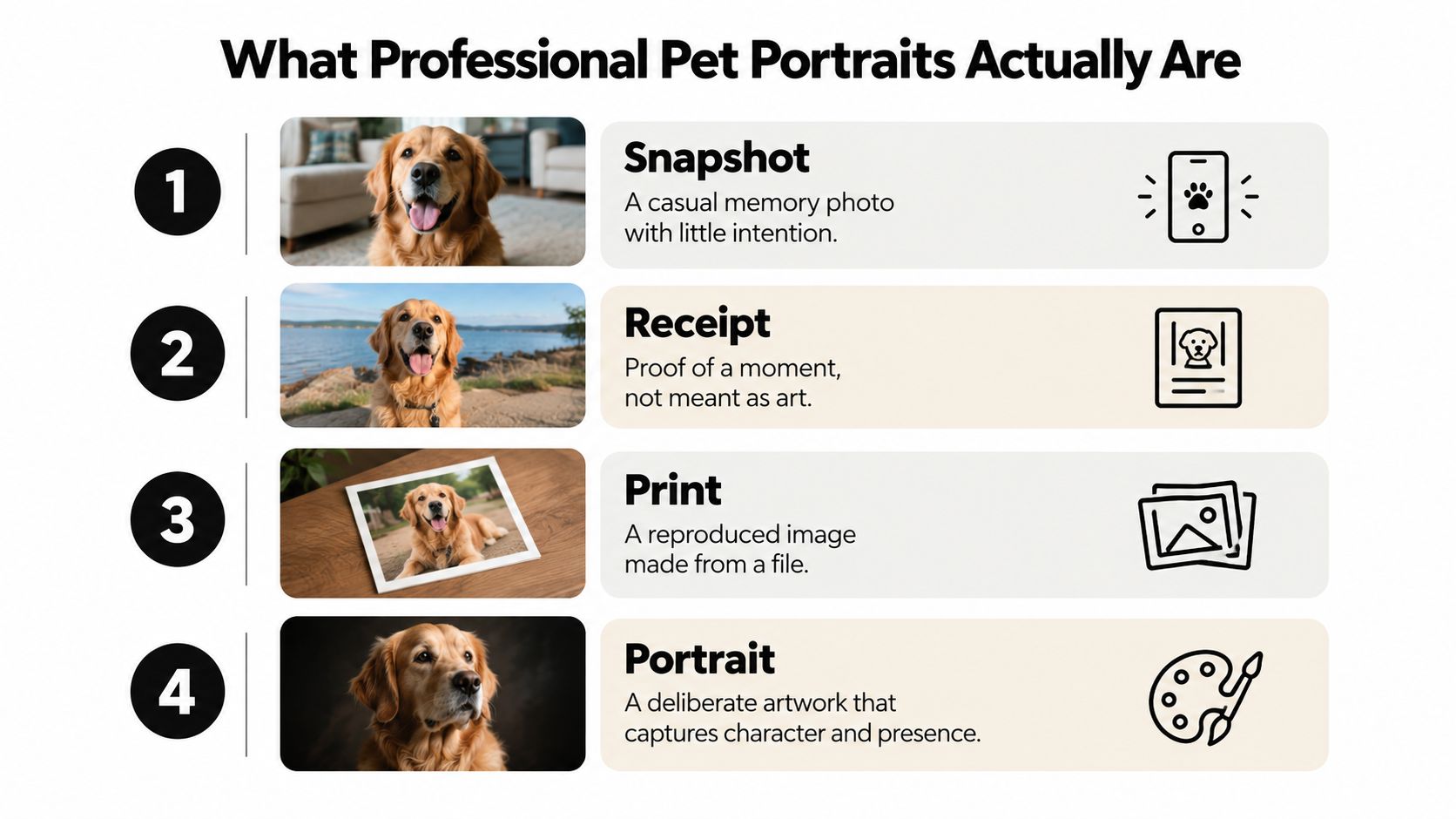
Four parts that build on each other
Reference photos are the raw material. They supply markings, eye color, and the way weight sits in a shoulder. A soft shot can still help with color. It limits how exact the likeness can be.
The artist's eye reads expression and anatomy. A tilted ear or a squint isn't a flaw to smooth away. It's often the feature that makes the animal yours. Wildlife or portrait training helps because fur direction and bone structure have to stay believable while the mood stays awake.
Composition and background set the volume. A quiet ground lets the face speak. A perch, a collar, or a bit of tack can place the animal in a life you recognize. Too much scenery competes. Too little can feel like a cutout stuck on a wall.
Materials finish the promise. Canvas, paper, or a wood panel changes how color sits and how you'll hang the piece. Acrylic, oil, and mixed media each layer and age differently. A shop enlargement of a phone photo can be lovely. It isn't the same object as a painting made for that animal.
A short sitting shows how timing and small choices add up before any paint starts.
Use the four-part test on anything you're offered. If the eyes, the posture, the setting, and the surface all feel chosen, you're looking at a portrait. If only the file got larger, you're looking at a print.
Benefits of Hiring a Professional Pet Portrait Artist
A phone photo, a print-shop enlargement, and an AI likeness can all be fine keepsakes. Hiring a person is a different purchase. You're paying for judgment, not just pixels.
The first return is a likeness with a pulse. A trained painter can keep a squinting eye or a crooked ear so the face feels awake instead of averaged. That matters most for gifts and memorials, because guests should recognize the animal before anyone explains the picture.
The second return is time on the wall. Paint and a sound surface are chosen to live through moves and new room colors. A conversation piece becomes an heirloom when materials aren't an afterthought. Families working through a loss sometimes find that a careful likeness gives them a way to talk about the animal. There's a fuller look at that side of commissioning in this piece on the healing side of pet portraits.
When a simpler option is enough
Be plain about the job. A small digital print is plenty for a desk, a holiday card, or a first apartment. The value of an original grows with how much the animal means in the family, and with how long you expect to keep the object.
Try this before you book:
- Name the job: Gift, daily decor, or remembrance.
- Name the lifespan: A season on a shelf, or decades on a wall.
- Name the risk you won't accept: A generic face, fading color, or a file you can't hang.
If two of those answers point past a quick print, a professional commission fits. If they don't, keep the budget. That's a sound decision too.
Portraits Beyond Dogs and Cats
Most portrait talk stops at dogs and cats. Plenty of households don't. Recent U.S. estimates from the American Pet Products Association count roughly 6 million households with birds, 6 million with small animals, 6 million with reptiles, and 2 million with horses. Bird owners reportedly spend an average of $40.52 per gift, 42% more than in 2023. A smaller population doesn't mean a smaller attachment.
Birds, scales, and a horse in tack
A parrot commission often turns on feather sheen and the exact curve of a beak. Glossy plumage blows out under a hard flash, so a softer window shot usually tells the truth. Personality may be a head cock, not anything like a smile.
A bearded dragon raises a different problem. Scales catch light in ridges, and a dim photo turns the eye into a dark bead. You know whether this lizard flattens out to bask or perches like a lookout. That note is as useful as the file.
Other companions need their own shortcuts:
- Horses: Identity sits in muscle, ear set, and tack. A clean bridle can belong in the painting. A muddy lead rope might not. A head study feels close. A full-body view needs room so the legs don't look pinched.
- Rabbits and small mammals: Shot from above, they vanish into bedding. Get low, keep the nearer eye clear, and say which ear flop is the everyday one.
Habitat without a cluttered cage
Backgrounds are a real trade-off with unusual species. A branch, a perch, or a hint of pasture can explain the animal. A full cage, a heat lamp, or a busy stall can swallow the face.
Species detail is the point. A generic cute-animal background throws away the reason you didn't order a standard dog portrait.
Your notes on habits, plus careful handling of feathers, scales, or tack, are what make the piece specific. Keepers, wildlife fans, and someone with one beloved reptile are all reasonable clients. The portrait should still look like that individual, not a plate from a field guide.
How to Choose the Right Pet Portrait Artist
Start with the portfolio, not the bio. Look for animals like yours, eyes and coat that stay sharp up close, and a style that repeats across pieces instead of one lucky standout.
Julip's advice on portfolio pitfalls is a useful outside check. Creators often hide weaker work or mix unrelated styles until a visitor can't tell what they'd receive. The same trap shows up in pet art. One heroic dog painting doesn't prove the artist can paint your senior cat.
Specialist or generalist
| What you compare | Specialist in pets | Generalist across subjects |
|---|---|---|
| Species comfort | Many dogs, cats, or exotics in a row | Occasional animal work among people and places |
| Likeness habits | Eyes, fur, and markings treated as the main event | Strong design, sometimes looser anatomy |
| When it fits | You want recognition first | You like their rooms and color, and the animal studies still hold |
A specialist is the steadier pick when the face has to be exact. A generalist can be right when you want a wider studio style and you've already checked the animal work.
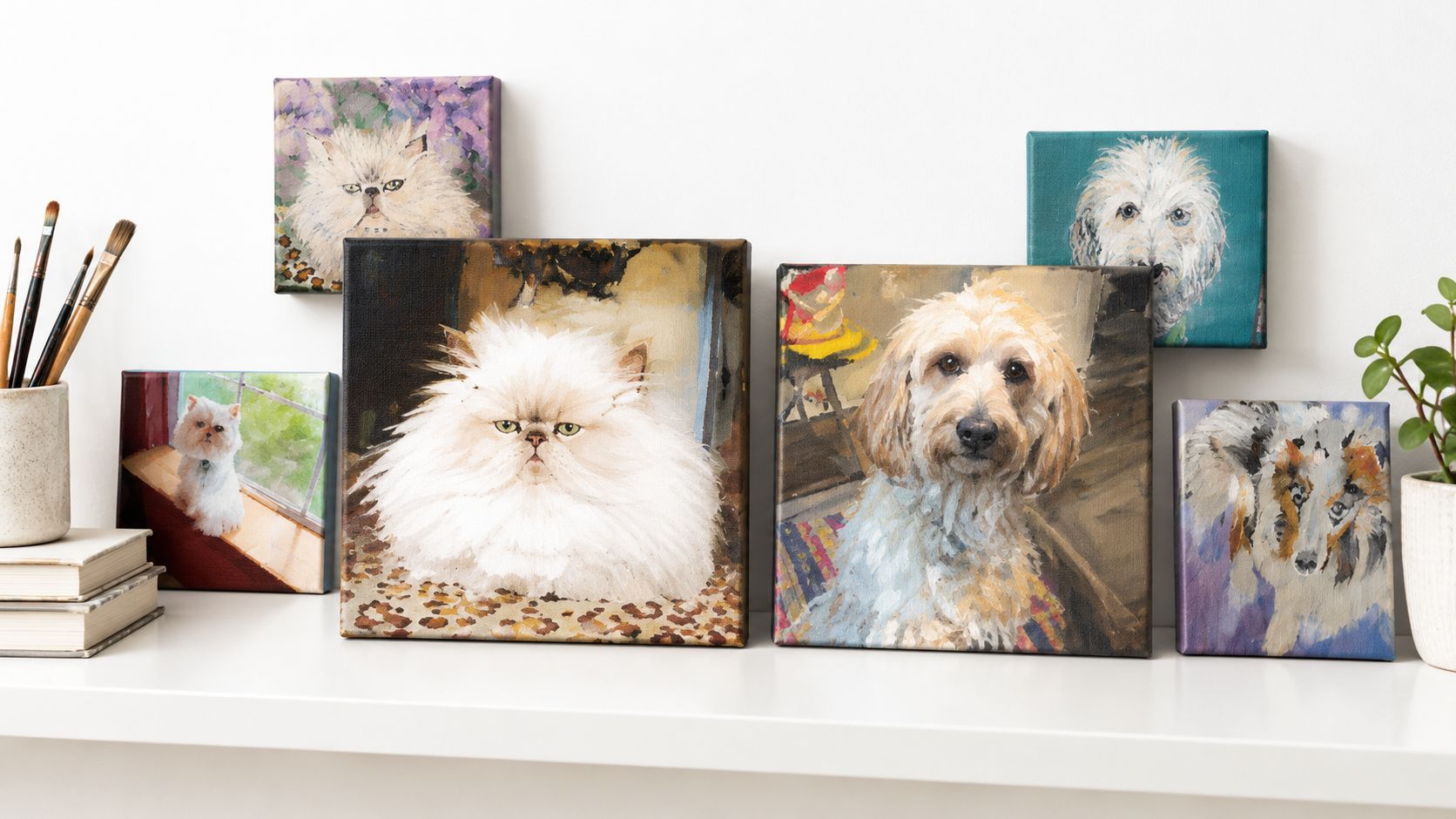
William Tucker Art sits inside that checklist as a New Orleans painter and Milan Art Institute graduate who paints dogs, cats, and exotic animals. The paintings pair abstract backgrounds with detailed subjects, in acrylic, oil, and mixed media on canvas, paper, or wood panels. Clients who want acrylic on gallery-wrapped canvas complete the William Tucker Art Acrylic Pet Painting Final Payment once preview images match what they expected. That step confirms the commission after you've seen the direction.
Questions worth asking first
- Previews: How many looks do you see, and what can still change?
- Consultation: Does the first talk cover size, medium, and background, or only price?
- Species proof: Can they show work close to your animal, not only a popular breed?
Leave the call with those answers written down. Taste is personal. Process should be plain.
The Commissioning Process From Photo to Final Payment
The order of a commission is fairly steady. Knowing it removes most of the worry.
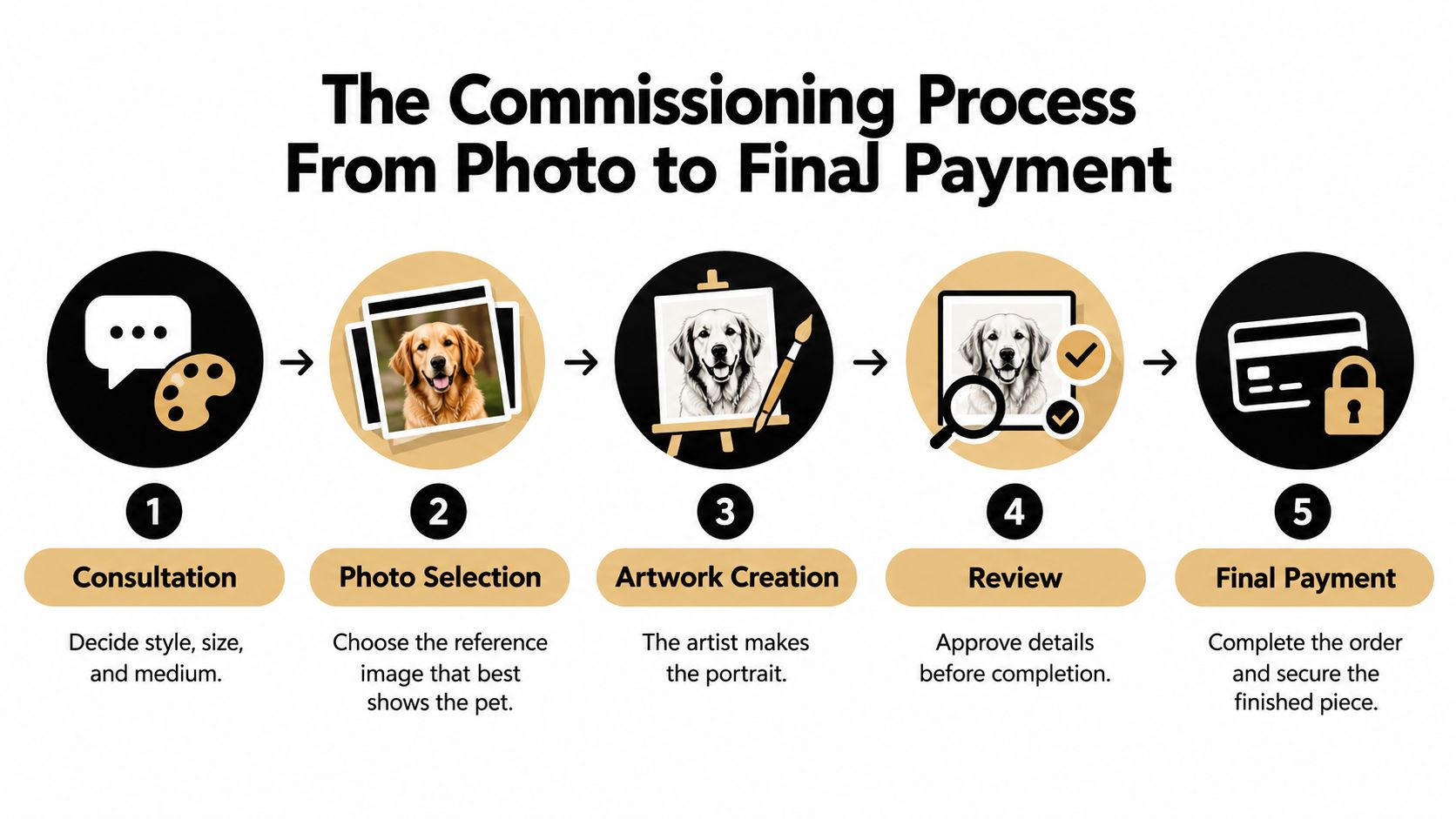
What you decide, then what you send
Consultation comes first. You and the artist settle style, size, and medium. A memorial, a multi-animal grouping, or a habitat hint belongs in that talk. Changing those later is harder than choosing them now.
Photo selection is your main job. Close-up work has a shallow depth of field, so the nearest eye has to be the sharp plane. Canon's pet photography guidance recommends Animal Eye AF when you have it, or a single focus point on the eye closest to the camera. A focus lock made before the animal moves can leave that eye soft. Continuous autofocus follows a shifting head better than a lock you set too early. Everyday shooting help also sits in these tips for photographing pets.
Send a few clear, well-lit frames rather than a folder of near-misses. Include one frame for markings even if another frame has the better expression. Say which photo carries the mood, and which is only for spots and color.
From deposit to the wall
A deposit usually holds your place. Then the artist paints. A preview lets you check eyes, markings, and background before the work is called finished. Final payment typically follows once that preview matches what you agreed. After that comes a close look at the piece, then shipping or handoff.
Don't rush the photo step just to get on the calendar. A soft eye in the reference becomes a guessing game in the painting.
Plan a little quiet between preview and framing so you approve with a rested eye. Write the milestones down when you book. Surprises shrink when the sequence is visible.
What Shapes Pricing and How to Budget Wisely
Quotes jump around because the work jumps around. Chasing the lowest number hides what you're buying.
A 2025 survey reported by Petfood Industry found that 40% of surveyed pet owners named veterinary care as their largest pet-care expense. Households can care a great deal about a memorial or a gift and still need tiers they can see. A portrait quote should work the same way, with plain parts instead of one mysterious total.
What moves the number
| Price Driver | How It Changes the Quote | Question to Ask the Artist |
|---|---|---|
| Size | More surface means more time and material | Which sizes do you paint, and how does price step up? |
| Medium | Oil, acrylic, and mixed media differ in layering and dry time | Which medium is this quote for, and what changes if I switch? |
| Number of animals | Each extra face adds likeness work | Is a second pet a full add-on or a smaller one? |
| Background | A plain field is faster than habitat, tack, or a room | Is the background included, or priced as complexity? |
| Detail level | Whiskers, scales, and text demand slower looking | What counts as standard detail versus extra? |
| Rush timing | A squeezed calendar pushes other clients aside | Is there a rush fee, and what date does it protect? |
What a fair quote should name
Ask whether consultation, packaging, and shipping sit inside the figure. A split between deposit and final payment protects both sides. You aren't paying the whole sum before you've seen progress. The artist isn't holding a slot with no commitment.
A memorial or a milestone gift can justify a higher tier than a casual decorative piece. That isn't a rule about what you owe an animal. It's a match between how long you'll keep the object and what you can spend. A closer look at the conversation sits in this guide to pet portrait commission pricing.
Request an itemized quote. Compare two itemized quotes, not two round numbers. The questions in the table are how you see the difference.
Preserving Your Portrait for Generations and Taking the Next Step
It's easy to treat a portrait as decor. Hang it, enjoy it, move on. That skips the part that makes it a keepsake. The surface has to stay honest, and the story has to be handled with care.
Color is a matching problem, not a mood. Fine art printing practice treats ICC profiles as translations between an image and a specific printer, ink, and paper. Change the paper without recalibrating, or without that sheet's profile, and hue, contrast, and shadow detail can shift. Pigment prints also need an outgassing period before heavy handling or framing, so the sheet can settle.
Match the paper and ink on purpose. A strong file on the wrong sheet is a different picture.
Memorial choices that aren't only sentiment
Commission a remembrance when you want the animal present in the house, not when a calendar says grief should be finished. An artist can work from a soft, old, or slightly damaged photo if you add notes on markings and expression. A companion who has died can share a canvas with a living pet. Say so at the start, and decide whether they should feel side by side or gently apart.
Archival paper, a stable canvas, and a file you keep offline each solve a different fear. Name the fear first. Then pick the object.
Gather a few clear reference photos. Note the size and medium you have in mind. A short consultation will show whether those photos can carry the piece you want.
William Tucker Art paints custom pet and wildlife portraits from New Orleans, working from your photos in acrylic, oil, and mixed media. If you're weighing a likeness of a dog, a bird, a horse, or a memorial companion, that studio work is built around the same choices this guide covers. Visit William Tucker Art to look through the paintings and start a conversation.