
You're sitting on the couch with your dog pressed against your leg, or your cat occupying the one clear space beside you. Your phone is full of photographs, but one keeps stopping you. The eyes are right, the pose feels unmistakably theirs, and you're wondering whether that image could become something more lasting than a rectangle on a screen.
Commissioning pet portraits on canvas can feel like one simple purchase. In practice, it's a chain of connected decisions. The reference photo affects the likeness, the style affects the mood, the canvas and ink affect aging, and the size affects whether the finished work feels comfortably placed or visually stranded on the wall. Proofing, revisions, shipping, and care matter too.
This guide approaches the process as a working artist might. You'll learn how to choose a style that suits your pet and home, assess materials without getting lost in jargon, plan proportions before ordering, understand what happens between upload and delivery, and spend your budget where it makes the greatest difference.
Sitting on the Couch Deciding to Commission a Portrait
The strongest commission usually starts before you contact an artist. It starts with observation. Which photograph makes you stop scrolling? Is it the one where your terrier is looking directly into the camera, the one where your elderly cat is curled into a familiar chair, or the unplanned image where a favorite expression appears for only a moment?
That choice matters because a portrait needs more than a recognizable outline. A good artist looks for the angle of the head, the direction of the light, the shape of the eyes, the tilt of an ear, and the posture that says something about the animal. A technically sharp photograph can still produce a flat portrait if the expression feels anonymous. A slightly imperfect photograph may work beautifully if it contains character.
Before you order, make a short list of the decisions ahead:
- Subject: one pet, several pets, or a companion animal with a meaningful object or setting.
- Mood: quiet and intimate, lively and humorous, formal, painterly, or boldly decorative.
- Style: realistic, traditional, modern, minimalist, pop-culture inspired, or abstract-background.
- Materials: cotton, linen, or a blend, paired with pigment-based or dye-based inks, acrylics, or another medium.
- Placement: the wall, furniture beneath it, viewing distance, and the amount of surrounding visual activity.
- Process: proofing, revision limits, turnaround, packaging, and what happens if the supplied photo needs interpretation.
Practical rule: Choose the portrait's emotional purpose before choosing its visual style. A memorial piece, a birthday gift, and a dramatic living-room centerpiece may all depict the same pet, but they don't need to look alike.
You don't need to know every artistic term before commissioning. You do need to know what you want the finished piece to make you feel, where it will live, and which details make your pet unmistakable. The rest becomes easier once those three points are clear.
What Pet Portraits on Canvas Actually Are
Animal art has a deep history. Evidence of humans painting animals reaches back more than 30,000 years, long before the modern pet portrait existed as a named category, as summarized in this history of animal painting. Later European artists depicted animals in hunting, livestock, and household settings, but individualized portraits became more visible when named dogs and horses began appearing as subjects in their own right.
The genre expanded strongly during the eighteenth and nineteenth centuries, when country-house and sporting culture created demand for portraits of prized animals. The Victorian period is often described as a golden age for pet portraits because families increasingly wanted painted likenesses of companion animals. A dog daguerreotype made around 1846 also shows how early photography began to intersect with the way people preserved memories of pets, according to the same historical account.
The modern format
Today, a pet portrait on canvas usually means an image created for a specific, named animal and transferred or painted onto a prepared textile surface. That surface may be cotton, linen, or a blend, stretched over wooden bars or mounted as a finished gallery-wrapped piece. The image may come from a hand-painted original, a digitally prepared file printed with archival inks, or a mixed process that combines digital preparation with painted finishing.
That distinction matters. A digital file can be viewed anywhere, but it isn't a physical artwork until printed. A paper illustration may offer beautiful detail, but it has a different surface, handling requirement, and framing process. A standard poster print may reproduce an image without the tactile weave and deeper visual presence associated with canvas.
Canvas also suits animal subjects because its subtle texture can support broad color fields while still holding important details in eyes, noses, whiskers, and fur. If you're comparing ways to turn photos into canvas art, check whether the service produces a simple reproduction or a customized portrait that addresses cropping, background, color, and likeness. The word “canvas” alone doesn't tell you how much artistic interpretation is involved.
Realistic, Stylized, and Abstract Pet Portrait Styles Compared
Style is not a ranking system. It's a choice about what the artist preserves and what the artist transforms. Realism gives more attention to visual accuracy, while painterly and stylized approaches may focus more strongly on expression, movement, color, or the relationship between the pet and the surrounding space.
| Style | Look | Best Reference Photo | Ideal Room | Price Band |
|---|---|---|---|---|
| Photorealistic | Close to the supplied image, with careful fur, facial, and tonal detail | Sharp, well-lit image with visible eyes and accurate color | Formal living room, study, memorial space | Usually higher |
| Traditional painterly | Visible brushwork, softened edges, and emphasis on warmth | Clear pose with a strong expression, even if every strand of fur isn't visible | Bedroom, library, traditional interior | Mid to higher |
| Stylized modern | Simplified shapes, amplified features, unusual color or graphic treatment | Strong silhouette and distinctive facial features | Contemporary living room, creative workspace | Mid-range |
| Pop-culture mash-up | Pet placed within a recognizable themed or artistic reference | Clear subject separation and a pose that reads quickly | Office, game room, playful gift setting | Varies |
| Minimalist line and wash | Economical lines, open space, restrained color | Simple profile or uncluttered head-and-shoulders pose | Small nook, hallway, quiet neutral room | Often more accessible |
| Abstract background | Detailed pet against expressive, loose, or color-led surroundings | Subject with clear edges and a personality that can carry visual contrast | Design-forward interior, gallery wall | Mid to higher |
A realistic portrait needs the most dependable reference because small errors in the eyes, muzzle, or markings become obvious. A painterly portrait allows more latitude, which can help when the available photograph is emotionally perfect but technically limited. Stylized work can handle stronger departures from the source, but the pet still needs a readable face or silhouette.
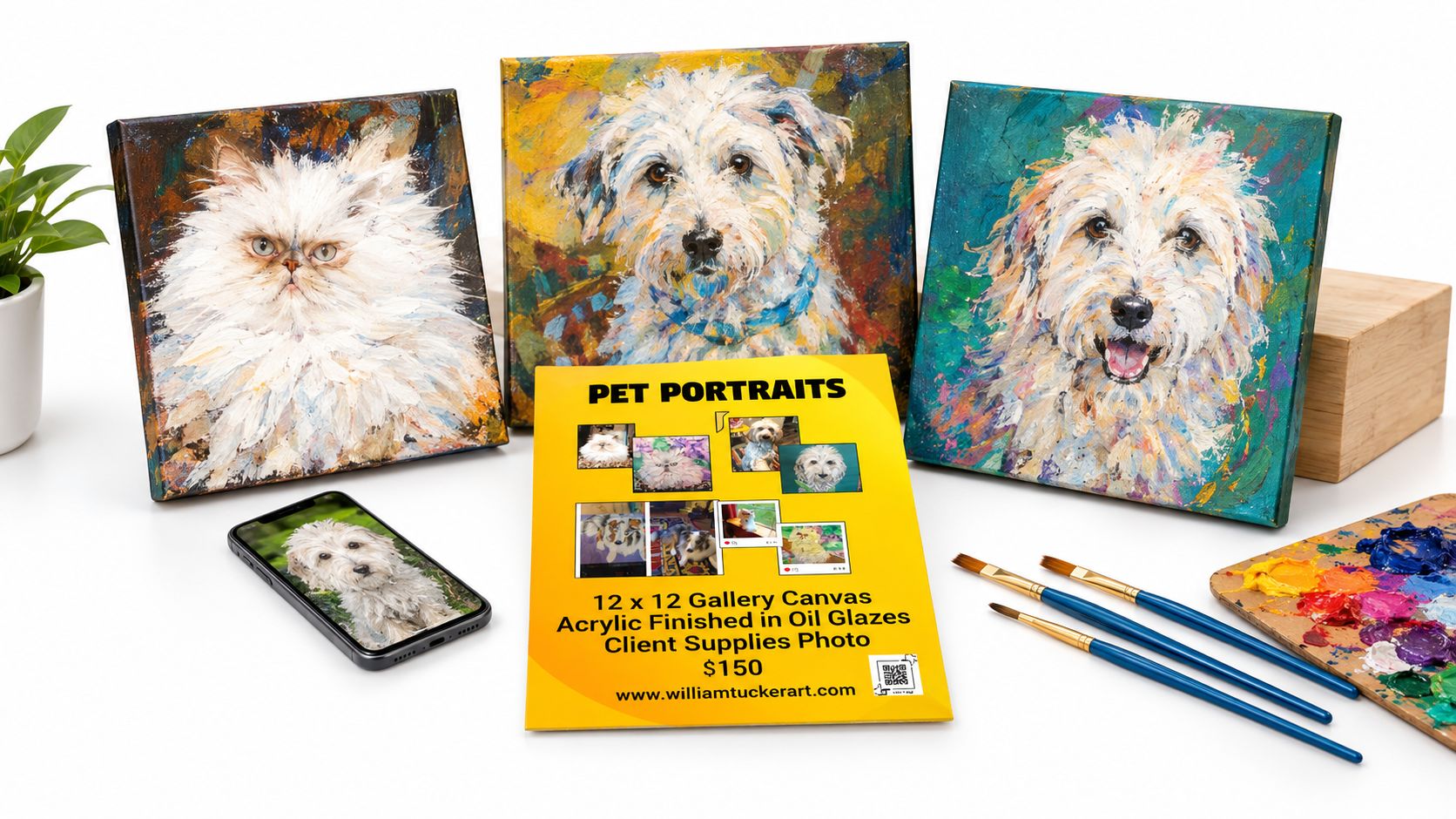
The William Tucker Art Acrylic Pet Painting Final Payment listing describes a custom acrylic portrait made from a client-supplied photo, finished on gallery-wrapped canvas, with final payment made after preview images meet the client's expectations. That workflow reflects an important principle: style and approval process should be discussed together, especially when the artist uses vibrant color or an abstract background.
Use a simple decision rule. Choose realism when exact likeness is your first priority. Choose painterly work when expression and atmosphere matter more than microscopic detail. Choose stylization or abstraction when the portrait also needs to function as a strong piece of interior design.
Canvas Types, Inks, and the Permanence Stack
A canvas portrait doesn't age as a single object. It ages as a system. The fabric, primer, ink or paint, protective finish, stretcher bars, and display environment all influence what you'll see years after delivery.
Cotton canvas is widely used for fine-art printing and painting because it offers a familiar weave and a surface that can hold both texture and detail. Linen has its own character and can be valued for its visual texture, but the artist or printer must account for how that weave interacts with fine facial details. Poly-cotton blends can offer a consistent surface and practical stability. Weight, weave density, brightness, and priming affect how colors settle and how evenly a coating sits.
The biggest technical distinction in printed work is ink chemistry. Pigment-based inks use insoluble particles that resist ultraviolet breakdown more effectively than dye-based inks. Industry guidance estimates roughly 75 to 100 or more years indoors for pigment systems, compared with about 5 to 15 years for dye-based systems, particularly when direct sunlight is avoided, as outlined by canvas print permanence guidance. These are estimates, not guarantees, because exposure and materials vary.
Think in layers
The permanence stack is easier to understand if you imagine the portrait from front to back:
- Substrate: Cotton, linen, or poly-cotton provides the foundation.
- Surface preparation: A bright, acid-free canvas and suitable primer help control color and ink anchoring.
- Image layer: Pigment inks or stable paint carry the visible portrait.
- Protective finish: Varnish or coating can slow oxidation, moisture uptake, and abrasion.
- Structure: Quality stretcher bars and careful stretching help prevent distortion.
- Display: Shade, moderate indoor conditions, and sensible handling reduce stress on every layer.
Search results for museum-style canvas repeatedly identify 100% cotton or poly-cotton archival canvas, bright-white acid-free construction, and archival primer or coating as important specifications. Some guidance places permanence claims in the 75 to 200 year range under controlled indoor conditions, but the source itself emphasizes that conditions matter. Direct ultraviolet exposure remains a major accelerator of visible fading.
| Material | Type | Typical Archival Lifespan | Best For |
|---|---|---|---|
| Cotton canvas | Natural textile substrate | Commonly cited in the 75 to 200 year range under controlled indoor conditions | Fine-art display and detailed portraits |
| Linen canvas | Natural textile substrate with distinctive weave | Depends on preparation, ink, paint, and display | Textural original artwork |
| Poly-cotton canvas | Blended textile substrate | Depends on the complete permanence stack | Consistent printed output and practical display |
| Pigment ink | Particle-based image medium | Roughly 75 to 100 or more indoor years with suitable conditions | Archival printed portraits |
| Dye ink | Soluble colorant-based image medium | About 5 to 15 indoor years in the cited guidance | Shorter-term decorative work |
For a more detailed explanation of how a canvas surface is prepared and supported, see this discussion of pre-stretched canvas. Ask the artist or printer what the canvas is made from, which inks or paints are used, whether the coating is archival, and whether the finished work is stretched before shipping. Those answers tell you far more than the word “premium.”
Choosing the Right Size and Aspect Ratio for Your Wall
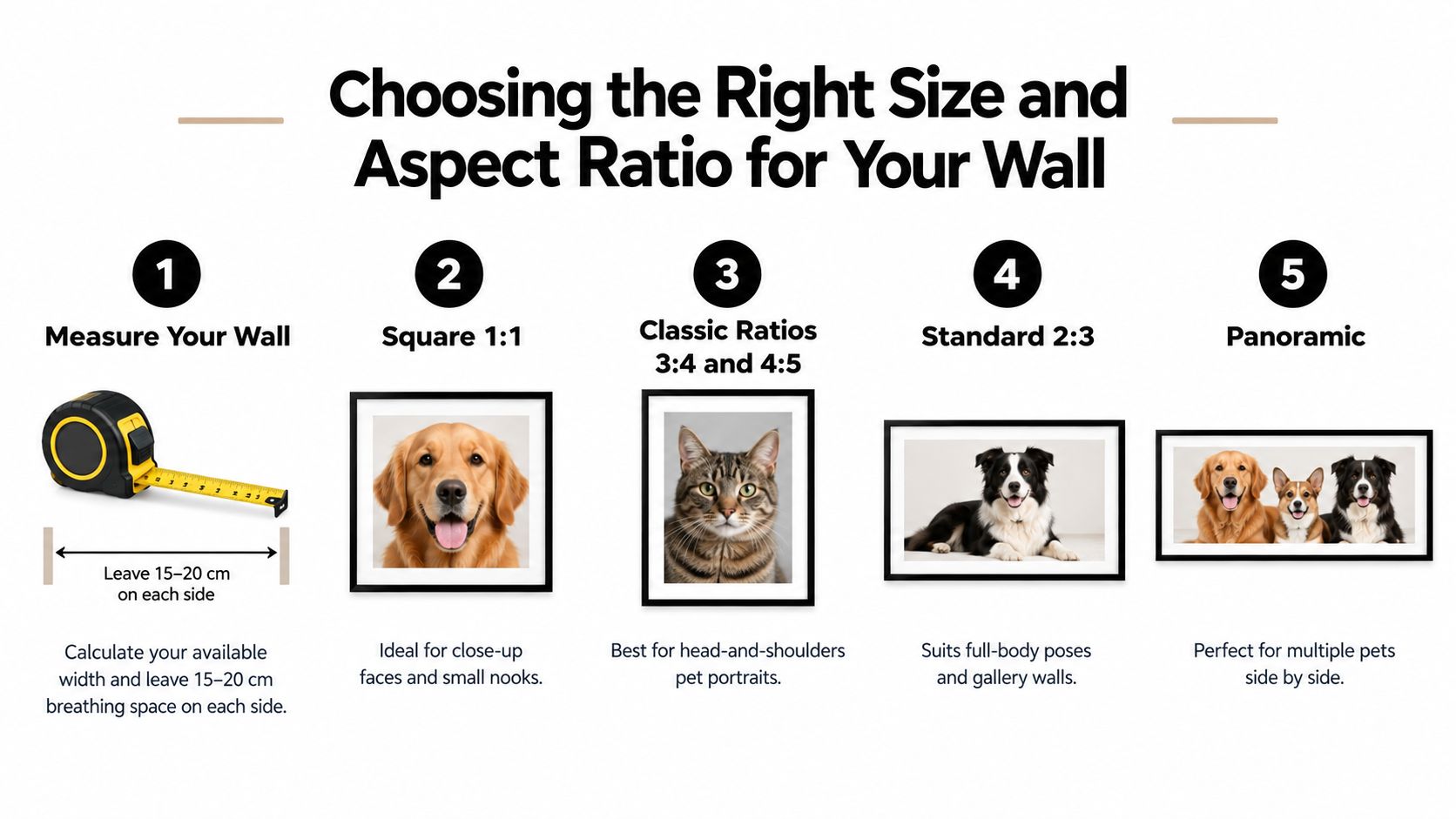
A portrait can be beautifully made and still look wrong if the proportions fight the wall. Start with the available area, not the product menu. Measure the wall, consider the furniture beneath it, and leave visual breathing room around the artwork. The supplied sizing guide recommends leaving 15 to 20 centimeters on each side after calculating the available width.
Let the crop support the subject
A square format works well for a close-up face, especially in a small nook or on a compact wall. The equal sides keep attention centered, but they can crop ears, tails, or shoulders if the reference image is naturally horizontal.
The 3:4 and 4:5 ratios suit head-and-shoulders portraits because they give the face vertical room without making the composition feel narrow. A 2:3 horizontal rectangle is more accommodating for a full-body pose, a pet lying down, or a scene with meaningful negative space. A panoramic format can hold several pets side by side, but each subject needs enough room to remain legible.
Before approving a crop, ask three questions:
- Are the ears and muzzle clear? Cropping a familiar feature can weaken recognition.
- Does the pet have room to look or move? Leave space in front of the gaze or body direction.
- Will the border show? Gallery-wrapped edges can continue the image, use a mirrored extension, or carry a solid color. Each choice changes the apparent scale.
A floating frame adds separation between canvas and wall, while a gallery wrap creates a cleaner, frameless appearance. Neither is universally better. A formal room may benefit from a frame, while a colorful modern portrait may need the uninterrupted edge of a gallery wrap.
Hang the center of the portrait near the room's natural sightline rather than placing it as high as possible. Above furniture, keep the relationship visually connected, and use paper cutouts or removable tape to test the outline before ordering. A few minutes with masking tape can prevent a costly mismatch between the chosen ratio and the actual wall.
How the Commissioning Process Works From Photo to Wall
A custom portrait begins with a photograph, but the artist's work starts by deciding what the photograph can support. A clear, well-lit image at least 1000 pixels wide is recommended by the practical guidance in this pet portrait FAQ. Resolution helps, but it isn't the only factor. Light across the eyes, an unobstructed muzzle, a natural angle, and a visible expression often matter more than a large file with poor lighting.
Suppose your favorite image shows a dark-furred dog near a window. The eyes are beautiful, but one side of the face disappears into shadow. You might send that image alongside another photograph showing the markings more clearly. The artist can use the first for expression and the second for structure, but you should agree on that approach before production begins.
The working sequence
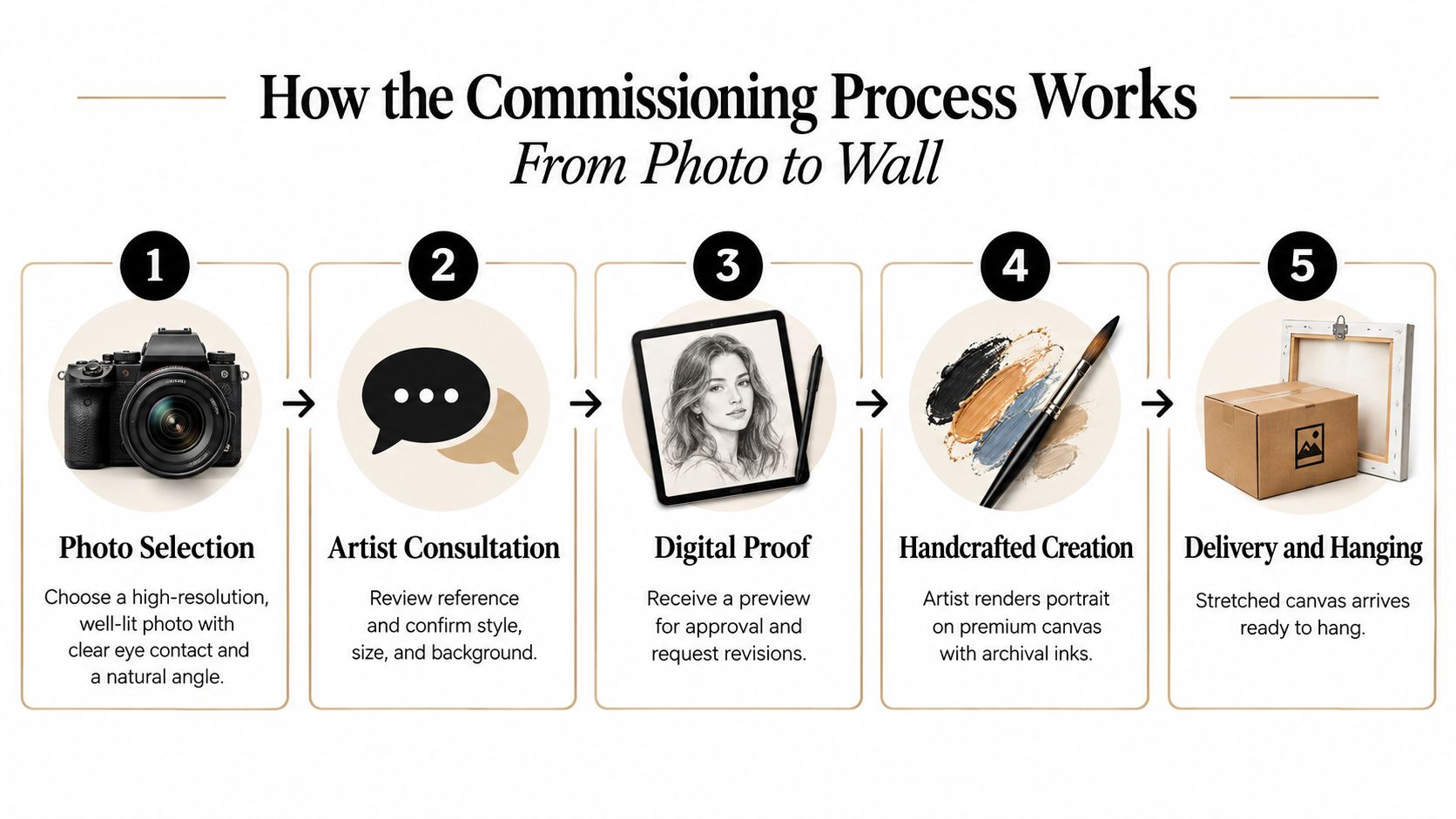
- Photo selection: You provide the strongest reference images and identify the details that must remain accurate.
- Consultation: You confirm the style, canvas size, crop, background, number of subjects, and any meaningful objects.
- Proofing: The artist supplies a sketch, digital preview, or other approval image, depending on the workflow.
- Revisions: You request reasonable changes within the stated policy. Ask whether revisions cover composition, color, background, or only minor details.
- Creation and finishing: The artist builds the image through stages such as preparation, underpainting or base rendering, detailed work, sealing, stretching, and inspection.
- Delivery: The finished canvas is protected for shipping and checked when it arrives.
Independent FAQ-style guidance indicates that proofing can take 2 to 3 business days, expedited proofing 1 to 2 days, and printing and shipping about 6 to 7 additional business days after approval. These are examples from the cited service guidance, not a universal schedule. A hand-painted commission may require a different timeline, so ask for the expected schedule in writing.
William Tucker Art's article on creating a portrait from photos is useful context for understanding why the supplied image becomes a working reference rather than a file copied without judgment.
The production details matter at the end. Inspect the canvas for surface marks, dents, loose fabric, uneven stretching, and damaged corners before hanging it. Photograph the package and artwork if something looks wrong, then contact the seller under the stated delivery or damage policy.
What You're Actually Paying For in a Custom Portrait
The price of a custom portrait represents more than the visible rectangle. It covers decisions and labor that may be easy to miss because they happen before the artwork reaches your wall.
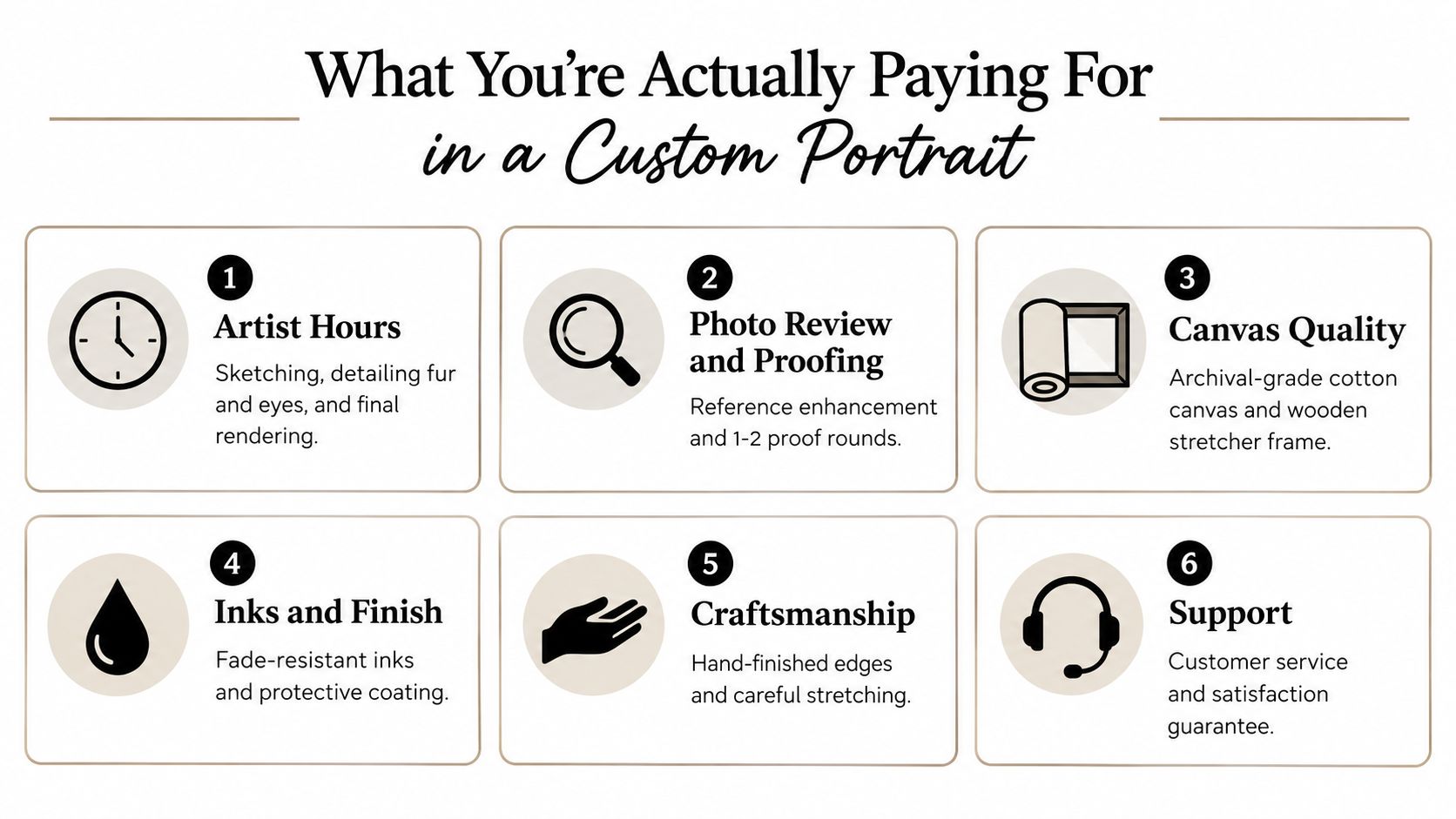
An artist studies the reference, sketches the structure, renders the eyes and fur, adjusts the background, and checks the result against the agreed brief. A printer or studio may prepare the file, calibrate color, print onto canvas, coat the surface, stretch the material, finish the edges, inspect the piece, and package it for transport. Higher-quality materials can cost more because they support better color control, handling, and expected stability.
Where the commission changes
The largest pricing variables are usually connected to the brief:
- Subject count: Two pets require more compositional planning and more individualized rendering than one.
- Size: A larger surface takes more material and often more working time.
- Background: A simple color field is different from an interior, outdoor, or complex themed setting.
- Style: Photorealistic detail demands a different labor pattern from a loose, minimalist interpretation.
- Finishing: Varnish, edge treatment, stretching, framing, and protective packaging add separate material and labor considerations.
- Proofing: A clear approval process gives you a chance to correct the direction before the final work is completed.
A buyer can save thoughtfully by simplifying the background, selecting one strong subject, choosing a style that suits the reference, or using a gallery wrap rather than adding a separate frame. Saving on the wrong layer, such as using a weak reference photo or accepting an unclear revision policy, can create frustration that no later discount repairs.
For a practical look at how artists may organize the cost of a commission, consult this guide to pet portrait commission pricing. Treat any current quote as specific to the artist, materials, size, and brief. Ask what the price includes, when payment is due, how many subjects are covered, and what happens if the approved proof changes substantially.
The most useful comparison isn't “Which portrait costs less?” It's “Which choices create the result I want?” Spend first on likeness, an appropriate composition, and a durable material system. Decorative extras come afterward.
Display, Care, and Making Your Portrait Last
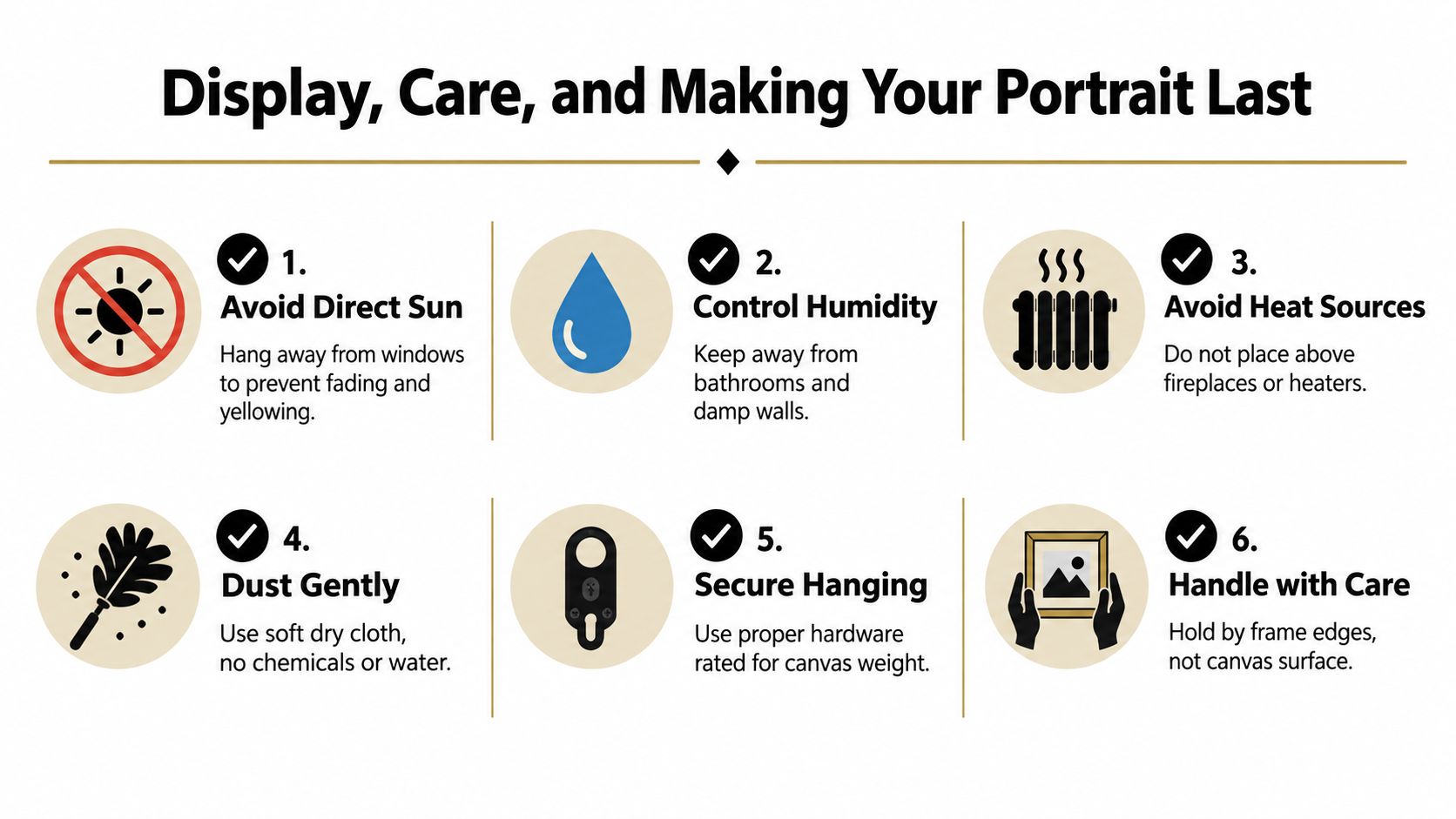
Placement begins the preservation process. Direct sunlight can accelerate fading, and heat and moisture can stress both the canvas and its support. Keep the portrait away from bright unfiltered windows, bathrooms, damp walls, radiators, fireplaces, and heating vents. Even a well-made work benefits from a calmer indoor location.
Hang it securely
Use hardware appropriate for the finished canvas and wall type. A lightweight print and a deep, stretched original don't place the same demands on a hook. Hold the work by its frame or stretcher edges, never by pressing fingers into the image surface, and ask another person to help with larger pieces.
A gallery wrap may arrive ready to hang, but check the back before lifting it into position. Look for a straight frame, secure hardware, and fabric that feels evenly tensioned. Felt bumpers can keep the lower edge from rubbing against the wall, while a backing card can reduce dust entering from behind when the construction allows it.
Clean the surface gently
Dust gathers along the top edge and in the weave. Use a soft, dry brush or a clean, gentle microfiber cloth without pushing hard against the canvas. Avoid household sprays, glass cleaner, abrasive cloths, and unnecessary water. A protective coating can improve resistance to light abrasion, but it doesn't make the surface immune to scratching or moisture.
Check the portrait occasionally for visible warping, loosened staples, unusual slackness, or changes caused by the room environment. Don't try to tighten or re-stretch a valuable piece without guidance. Contact the artist, framer, or conservator first, particularly if the surface has been varnished or the artwork is an original painting.
If you're adding a frame, compare the profile and depth before ordering. The practical DIY canvas framing tips from Striped Circle can help you think through floating frames, mounting, and the relationship between the canvas edge and the surrounding room.
The full decision comes back to the same chain you began with: a reference that carries personality, a style that supports it, materials selected for the intended lifespan, a size that belongs on the wall, and a commissioning process with clear approvals. Care then protects those choices. A portrait treated as a permanent artwork, rather than a disposable decoration, can remain a meaningful part of the room for decades.
William Tucker Art offers custom acrylic pet portraits created from a client-supplied photograph, with vibrant color, detailed subject work, and gallery-wrapped canvas finishes described in its commission listing. Visit William Tucker Art to review the artist's pet and wildlife work, then reach out with your strongest photo, preferred style, wall size, and the personality you want the finished portrait to preserve.