
You're standing in a gift shop on Florida's Gulf coast, holding two manatee prints. One is soft and grey-green, the animal half dissolved in tannic water, scars visible along its back. The other is a smooth cartoon sea cow, round as a beanbag, smiling at nothing. Both cost about the same. Only one of them tells you anything true about the animal.
That gap between charming and accurate runs through all manatee art, from museum walls to waterfront sculptures to the picture books your kids bring home. The good news is that the differences are learnable. A few facts about manatee biology, a few decisions about what the piece is for, and you can look at any manatee image and know what it's doing and whether it's doing it well.
Common Styles of Manatee Art at a Glance
Five styles cover almost everything you'll see, and each one serves a different viewer.
| Style | What It Emphasizes | Where You Find It | Example |
|---|---|---|---|
| Fine art photography | The manatee as a conceptual, staged subject | Museum and gallery collections | Hiroshi Sugimoto's Manatee (1994), J. Paul Getty Museum |
| Public sculpture | A three-dimensional manatee as a local symbol | Visitor centers and waterfronts | The manatee sculpture at the TECO Manatee Viewing Center in Apollo Beach, Florida |
| Wildlife painting | A detailed animal set in soft or abstract water | Galleries, online shops, collector homes | A detailed manatee painted against an abstract background |
| Scientific illustration | Accurate anatomy, scars and markings | Research and education materials | Scar maps from Florida's photo-identification work |
| Decorative or cartoon | Rounded, friendly gentle giant shapes | Gift shops and children's books | Cartoon manatees on mugs, T-shirts and picture books |
Read the table as a decision tool, not a ranking. Start with the feeling you want the piece to carry. If it's awe and a little distance, you're in the photography column. If it's hometown pride, you're looking at sculpture. If it's a living room piece that shows the animal closely, wildlife painting is the usual answer.
Only after that do you decide how much accuracy the job needs. Scientific illustration answers research questions, so a wrong fluke shape is a failure. Decorative art is built to be loved by a five-year-old, so a wrong fluke shape is fine.
Three of these styles are the ones most buyers meet: photography, sculpture and wildlife painting. The other two matter because they set the standard the first three get judged against. If you're sketching from a photograph and want to simplify it first, cartoon avatars for social media creators from ImagesArt AI can flatten a reference photo into a readable shape, which helps you see the silhouette before you commit to detail. For the wider tradition each style borrows from, this guide to exploring the captivating world of wildlife art traces the field from observation sketches to gallery work.
Manatee Art in Museums and Collections
The best-documented manatee in a museum isn't a painting. It's a photograph of a display built to look like the wild. Japanese artist Hiroshi Sugimoto made the gelatin silver print titled Manatee in 1994, and the work is held by the J. Paul Getty Museum.
It belongs to Sugimoto's Dioramas series, produced between 1975 and 1999, in which natural-history displays are photographed so the animals appear to be living in their habitats. The Getty Center showed the work in Los Angeles from February 4 through June 8, 2014, in the exhibition Hiroshi Sugimoto: Past Tense. The Getty also notes that Louis-Jacques-Mandé Daguerre introduced the diorama in Paris in 1822, decades before photography became a mass medium.
That lineage comes to life once it's framed and hung on a gallery wall.
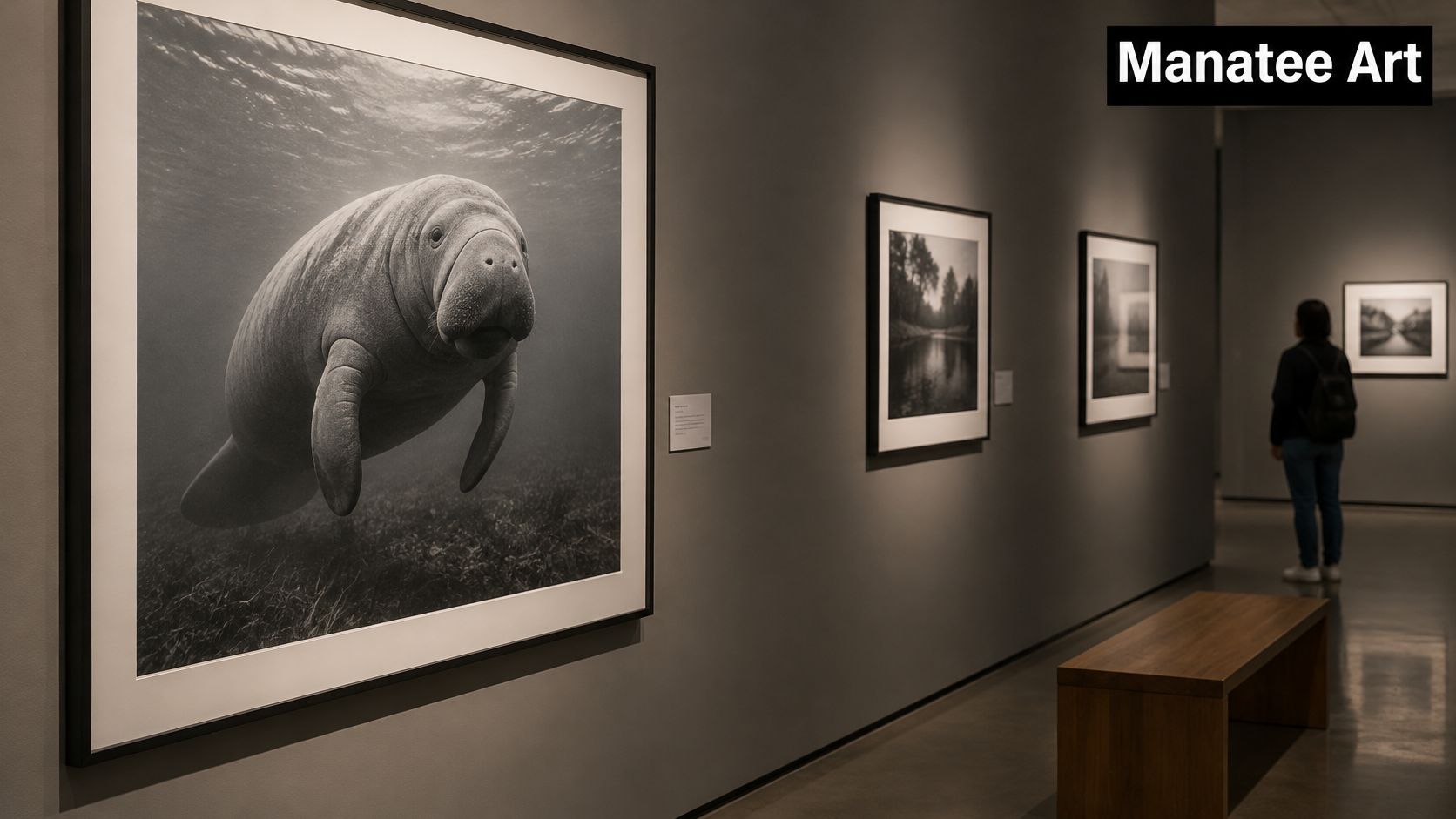
The animal in that frame was chosen, positioned and lit by people before Sugimoto ever pointed a camera at it. So the picture records display decisions as much as it records a manatee.
Three Questions to Ask of Any Museum Manatee
- Who built the display? A diorama is an argument about habitat, assembled by a team with a budget and an era's assumptions.
- What does the frame include, and what does it leave out? Water, plants and rock are editorial choices, and the crop decides what the viewer never sees.
- What is the viewer meant to believe about the animal's habitat? If the scene reads as pristine and permanent, ask what was removed to make it look that way.
Works like this sit where conceptual photography meets museum display history. Their meaning depends on the context around them, which is exactly why a manatee on a gallery wall asks more of you than a manatee on a postcard.
Themes Artists Use When They Paint Manatees
Two manatee paintings can hang side by side and do opposite jobs. One asks you to relax in front of it. The other asks you to worry, and to keep worrying after you leave the room. That gap is the theme, and every manatee image picks a side whether the artist decides or not: to comfort, to identify, to inspire or to warn.
The concept map below shows how those themes branch from one animal.
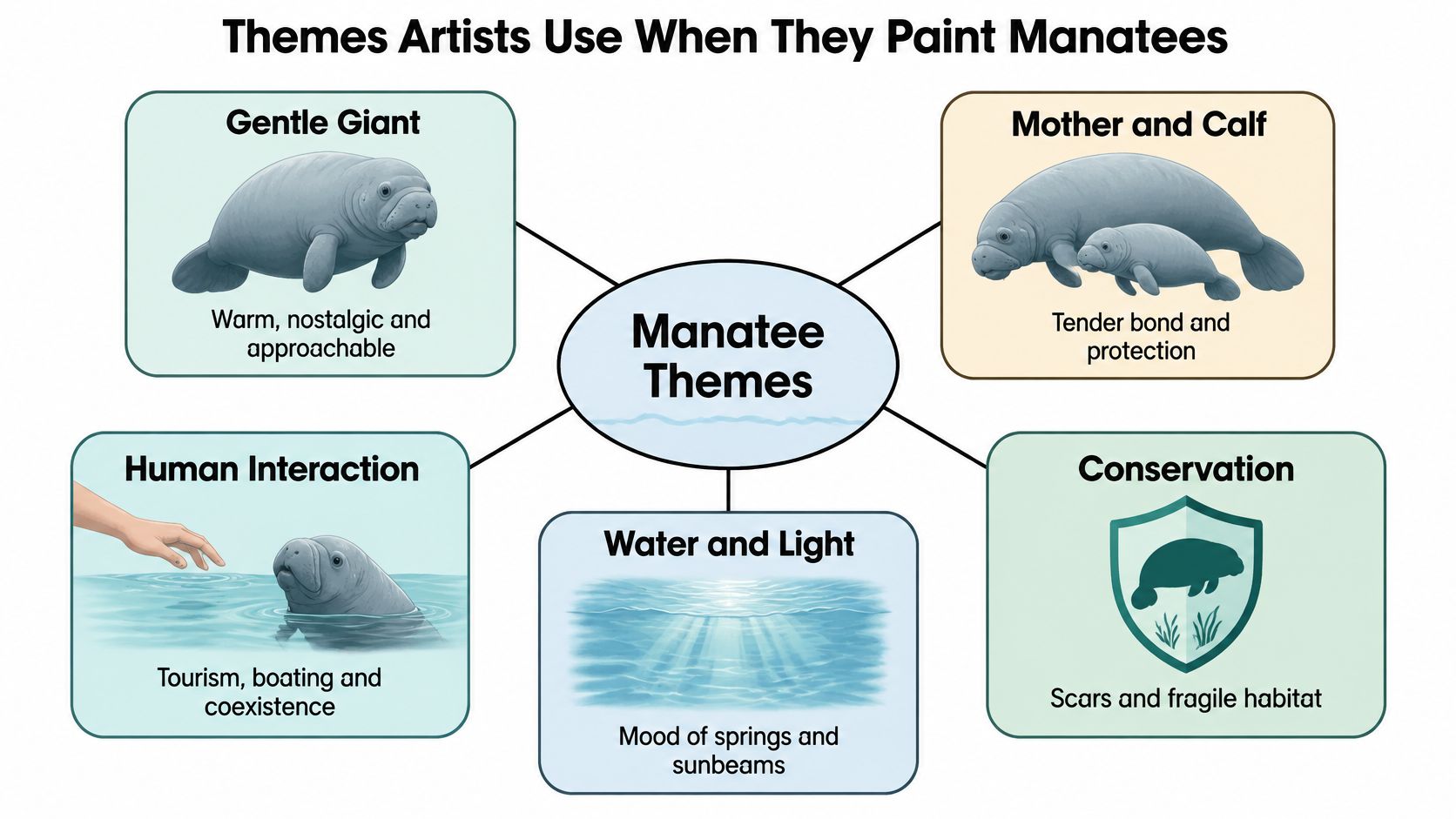
The gentle giant is the theme most buyers recognize. A slow, round, unbothered animal drifting through green water. Its risk is that comfort erases stakes. A manatee that looks permanently safe is a manatee nobody worries about, and worry is what funds rescue programs. If you paint this theme, leave one small sign of the wider world in the frame: a scar on the back, a rope line in the shallows, anything that admits the animal shares water with people.
Individual identity treats one animal as a subject rather than a specimen. A specific scar arrangement, a nicked fluke, a known face. The risk here is over-reach: marks invented for drama read as decoration rather than biography, and anyone who knows the species will spot it.
Individual Identity and the Story of One Animal
The theme that changes how viewers feel is usually the smallest one. This manatee, the animal with the curved propeller scar across its back and the notch on the left fluke, carries more emotional weight than manatees in the abstract, because a viewer can care about a single life.
Once the subject is a documented animal instead of a symbol, the craft changes with it. The artist works from reference photos, checks each mark against the record, and lets accuracy carry the load that exaggeration used to.
Wonder, Endangered Status and the Pull of Place
Wonder and reverence is the theme William Tucker works toward. Through his art, he aims to evoke wonder and reverence for the natural world and to prompt viewers to reflect on their connection to nature, and bees, animals and the oceans run through the whole body of his work. The risk is vagueness: a beautiful animal with no context can read as decoration rather than invitation.
Endangered species framing puts the animal's status in the picture. Tucker is known for depicting endangered animals, and that choice carries weight, because a threatened animal shown as thriving tells a story that isn't true yet.
Place turns the manatee into a regional emblem. The U.S. Library of Congress preserves a photograph of a manatee sculpture at the TECO Manatee Viewing Center in Apollo Beach, near Tampa, taken by Carol M. Highsmith on January 22, 2020, in a setting where public art sits beside living manatees and educational interpretation, as you can see in the Library of Congress record. Elsewhere in Florida, attractions such as Manatee Lagoon pair free public viewing areas with educational exhibits. The risk with place-based art is that local pride can substitute for ecological honesty.
Working method: name the theme before you start, then ask whether the piece needs one concrete real-world detail to stay honest. Usually it does, and usually that detail is small.
Scar Patterns That Make a Manatee Recognizable
Scars are the difference between a generic sea cow and a portrait. Florida's photo-identification program tracks individual animals by the unique arrangement of scars and mutilations on the trunk and tail fluke, and the causes it records include boat strikes, fishing-gear entanglement, cold-stress lesions and fungal infections, according to the Florida Fish and Wildlife Conservation Commission. Some documented manatees carry as many as 50 separate propeller-scar patterns.
That gives you a method rather than guesswork.
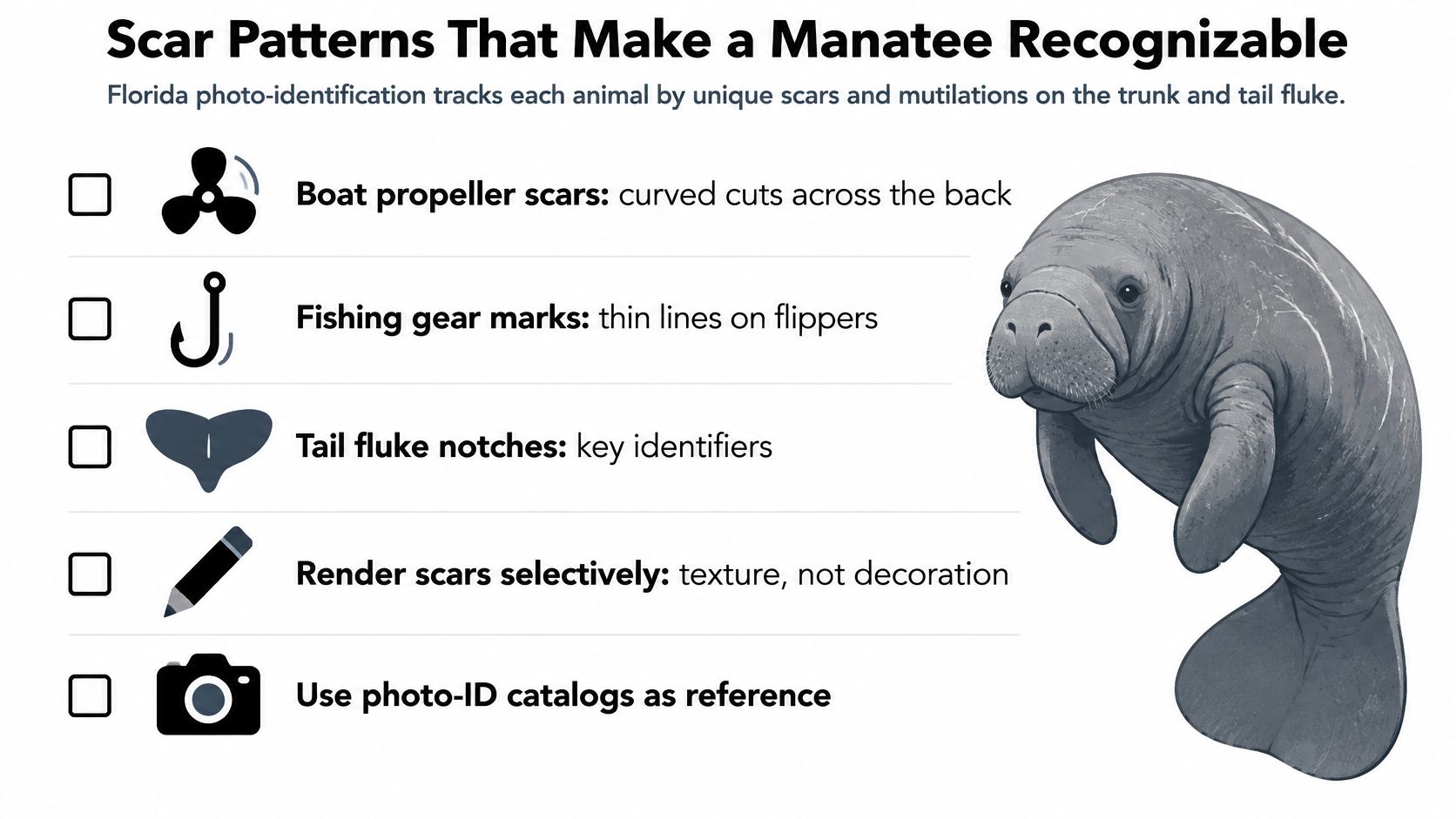
- Start from a reference photo. Work from an actual animal whenever you can, because invented scars default to the same few shapes. The common slip is sketching from memory and producing a manatee that looks like every other manatee you've drawn.
- Map each scar by anatomical position. Note whether it sits forward of the flipper, above the midline, or near the tail stock, and write that down before you paint. Positions carry the identity, so a scar moved six inches becomes a different animal.
- Separate linear propeller marks from rounded barnacle scars. Propeller cuts are curved and parallel, often in sets. Barnacle attachment marks are circular and clustered. The slip here is drawing every mark as a thin line, which flattens two very different histories into one texture.
- Avoid placing generic marks symmetrically. Real injuries don't mirror. If your manatee has the same scar on both flanks, you've drawn a pattern, not an individual.
- Scale every mark against the body's structure. The broad trunk curvature, the tapering caudal peduncle and the bilobed tail fluke give you the landmarks. A scar that's too large for the trunk reads as a graphic shape stuck onto a manatee.
Keep the scars subordinate to the form. They're evidence, not ornament, and a viewer should notice the animal first and the marks second.
That ordering matters for the people most likely to buy the work. Wildlife-oriented collectors, zoo audiences and conservation advocates respond to a pattern they can read, because it carries both an individual identity and a record of human impact.
Color and Light for Believable Manatee Art
Manatee color isn't a single swatch. It's a set of conditions, and the setting decides which one you're painting.
| Setting | Body Color | Background Cue | Note |
|---|---|---|---|
| Coastal Florida bay | Gray with green algae | Seagrass greens and coastal glare | Round barnacle scars may appear |
| Tannin-stained river | Gray shifting to warm brown | Amber and brown water tones | Keep the body restrained and let stronger color sit in the water |
| Freshwater spring | Gray to brown | Clear spring water with filtered light | Barnacles can be removed in freshwater |
| Very clear water | Gray-green | Bright, open water | Visual cues noticed up to about 115 feet |
Those rows come from biology, not taste. Florida manatees are generally gray, but algae growing on the skin can shift perceived color toward green or brown, and coastal individuals may carry barnacles that leave round scars, which movement into freshwater can remove, as the Florida Fish and Wildlife Conservation Commission explains. Manatees also have two retinal cone-cell types, which indicates color vision, and they respond to visual cues at distances up to approximately 115 feet in very clear water, though close-range depth perception appears limited.
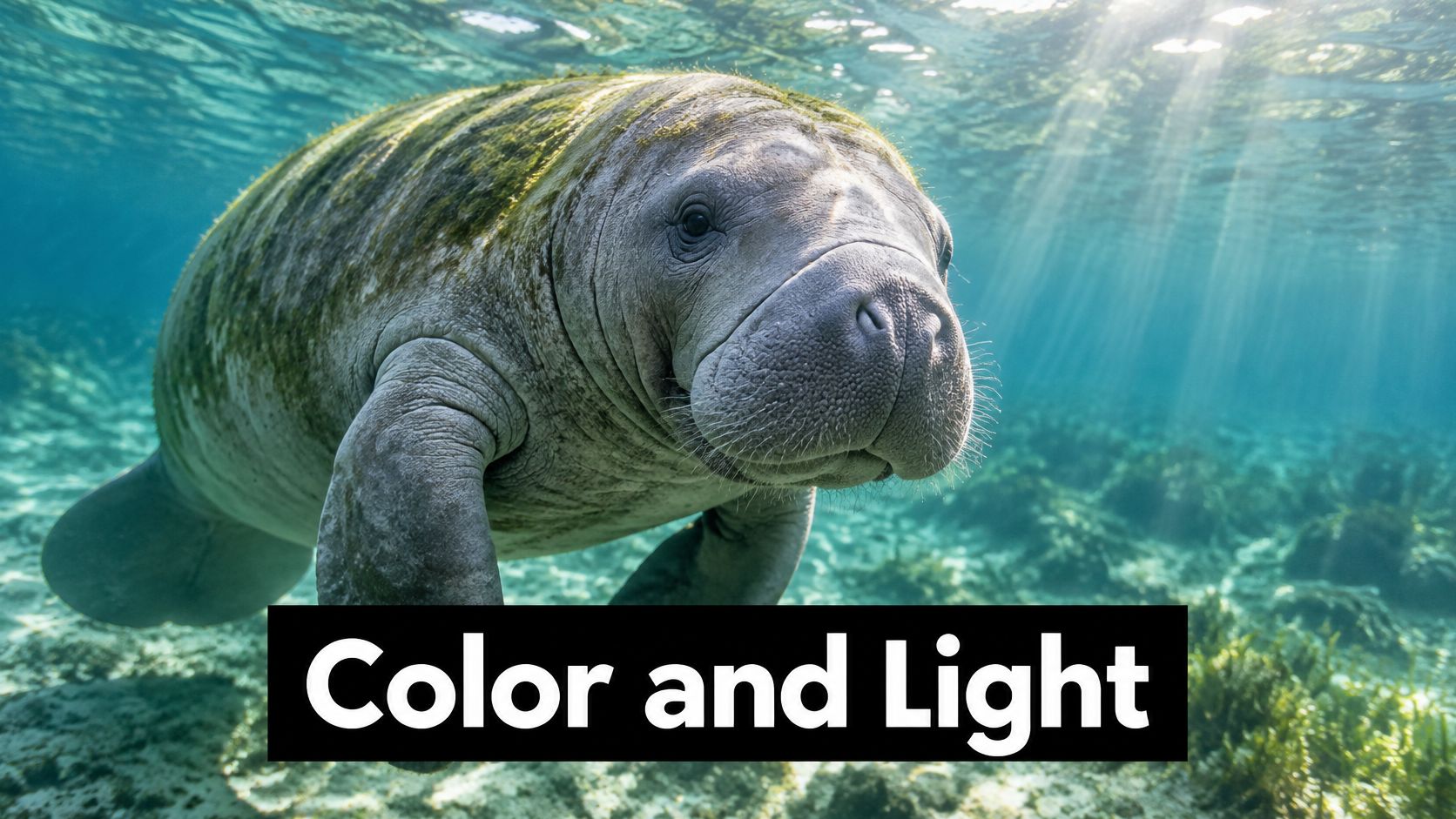
A Palette Built From Habitat Instead of Habit
The default choice for underwater scenes is a uniform blue-gray body against blue water. It's safe and it's wrong. Restrained, low-saturation gray-greens and warm browns read as a real animal, and the stronger color belongs to the environment: tannin-stained rivers, seagrass beds, coastal glare.
William Tucker builds depth and texture in his artworks with multiple layers of acrylic paint, using brushstrokes and transparent glazes, and that layering suits murky water particularly well. Each glaze darkens the water without turning the manatee into a flat silhouette.
For composition, separate the animal from its background with atmospheric contrast rather than anatomical exaggeration. Push value shifts along the rounded back and muzzle, soften the edges that sit deepest in the water, and keep sharper contrast around the eye, nostrils, flippers and tail where a viewer's attention lands.
If you want to understand how color temperature and film respond to underwater light before you mix your next glaze, this explanation of how film color science works from Department of Vibe is worth an hour.
Practical rule: keep the animal's color honest even when the background is bold. A vivid background on a truthful body reads as drama. A vivid background on a blue-gray body reads as a cartoon.
How Manatee Imagery Shapes Conservation Awareness
A charming manatee painting can suggest a lie. Not about the animal's shape, but about its situation. The gentle giant theme has become so dominant that most manatee art implies a species that is fine, when in reality it is watched constantly.
The numbers are encouraging yet incomplete. The Florida manatee population recovered from only a few hundred individuals in the 1970s to an estimated 6,620 in 2017, according to the Marine Mammal Commission. That recovery did not remove the underlying habitat problem. The same species remains threatened by boat collisions, seagrass loss, habitat modification, cold stress, harmful algal blooms and the loss of warm-water refuges.
Here's the confusion worth clearing up: an image can be accurate in every anatomical detail and still mislead. Proportion, scars and fluke shape can all be correct while the picture implies that the animal has nothing to worry about. Accuracy of form and accuracy of story are two separate jobs.
Three storytelling options work without turning a piece bleak.
- Show scars as records, not decoration. A curved set of propeller marks on the back tells a viewer something specific happened, and it gives them a fact to carry away.
- Pair degraded and restored seagrass. Two panels, or one background with a shift in density, do the work that a caption usually has to explain.
- Give warm-water springs a reason to exist in the picture. Springs matter in cold weather, and a viewer who understands why will understand what happens when a refuge is lost.
Then balance it. Most pieces don't need to be grim. An abstract background can carry the threat while the animal stays warm and dignified in the foreground, which is where Tucker's approach of pairing abstract settings with detailed subjects earns its keep.
The question worth sitting with isn't what a manatee symbolizes. It's what responsibility a manatee image carries when the species' most serious threats are invisible in the portrait. For a broader look at art built around environmental messaging, read this piece on art for environmental awareness.
The habit to adopt is small. Put one sentence of habitat or threat context beside any piece you display, in the caption, the label or the listing description. One sentence, and the image stops being decoration.
Choosing Manatee Art That Tells the Real Story
A manatee painting can be beautiful and still get the animal wrong. The body might be the right shape while the water around it says nothing about where that animal lives or what threatens it. Four checks will catch most of the problems before money changes hands.
- Accuracy. Are the scars, anatomy and proportions drawn with care? Check the fluke for a bilobed shape and the trunk for a curve rather than a tube.
- Color restraint. Is the body a restrained gray-green or warm brown, with stronger color reserved for the setting? A blue-gray body under saturated blue water usually signals decorative intent.
- Story. Does the piece connect the animal to a habitat or a threat? A background that suggests a specific place carries more truth than a generic gradient.
- Source. Is the artist clear about the reference they worked from and how they made the piece? If you cannot tell whether the animal was painted from a photo, ask.
These checks apply whether you buy from a catalog or order a commission. William Tucker Art, a wildlife and pet portrait artist based in New Orleans, sells wildlife pieces through the shop's collections, and the Pet Portraits collection is offered as commissions. For a commissioned portrait, the client supplies the photographs and other reference materials, so bring a well-lit image that clearly shows the animal's marks and tail, and ask how those marks will be mapped before work begins. Tucker is known for depicting endangered animals, and the wildlife work aims at the beauty and fragility of nature.
If you're weighing a hand-painted original against a digital print, this comparison of how AI-generated art differs from real art from AI Image Detector covers the process differences, and the shop's collection of wildlife paintings for sale shows what an abstract-background approach looks like in practice.
Run every candidate through all four checks before you commit. A piece that passes them puts the animal's ecology on the wall along with its silhouette. The catalog holds wildlife work built on that pairing of detailed subject and expressive setting, and pet portraits can be commissioned from your own reference photos. Browse the collections or ask about a pet portrait commission at William Tucker Art.