
You're looking across a Louisiana marsh, perhaps from a boardwalk or through a car window, and at first it seems like grass, water, and a distant bird. Then something moves along the bank. A heron leans forward, a fish breaks the surface, and the marsh starts to look less empty.
Understanding Louisiana wetlands wildlife begins with those connections. The useful question isn't which animals live here. It's what they're finding in this particular patch of water, vegetation, and shoreline, and whether those conditions will still meet their needs next season.
Louisiana Wetland Animals and Where They Live
| Habitat zone | Wildlife you may see | Why it matters |
|---|---|---|
| Shallow marsh edges | Shrimp, blue crab, wading birds | Feeding surfaces and nursery cover |
| Tidal channels | Red drum, fish, shrimp | Movement routes between fresh and salty water |
| Open shallow water | Waterfowl and wintering geese | Winter feeding in standing water |
| Wetland forests | Songbirds, raptors, amphibians, mammals | Breeding sites and refuge |
| Barrier islands | Nesting birds, shorebirds | Nesting ground and storm buffer |
Think of this as a habitat lookup rather than a promise of sightings. Animals move, water levels change, and much of the activity happens beneath the surface.
The U.S. Geological Survey's wetland science overview describes coastal wetlands as essential habitat for fish, shellfish, waterfowl, and fur-bearing animals, alongside the diverse wildlife associated with coastal forests. That variety makes more sense when you stop treating the coast as a single kind of place.
Look below the surface and along the edge
Fish and shellfish are central to the marsh community, even when you can't see them. White and brown shrimp, blue crab, red drum, and crawfish belong to the broader wetland story, but they aren't interchangeable occupants of every pool. Freshwater areas, brackish reaches, and more saline coastal waters offer different conditions.
Watch the boundary between vegetation and water. Small aquatic animals can find cover there, while wading birds search the accessible shallows for prey. Waterfowl use a different feeding space, often spreading across open shallow water rather than stalking a narrow bank.
Look upward and into shelter
Wetland forests add trunks, branches, leaf litter, and shaded water to the habitat mix. Songbirds use the vegetation, raptors watch from high perches, and amphibians, reptiles, and mammals occupy less conspicuous spaces around the forest floor and banks.
Fur-bearing mammals may leave tracks or disturbed vegetation without appearing in daylight. Likewise, hearing frogs can tell you something a quick visual scan misses. An animal you don't see isn't necessarily absent.
For a child learning to notice wetland birds, a tangible companion such as Snugglebug's Wayne the Whooping Crane can provide a starting point for discussing bird shapes and habitat needs. Keep that conversation separate from identification: a toy isn't evidence that the species occurs at your destination.
Field habit: Look for feeding, sheltering, and movement, not just a recognizable animal.
Many species use different zones as they grow or move through the seasons. Connected habitat matters more than an isolated patch. Before heading out, choose the zone you'll visit and check its row so you know where to direct your attention.
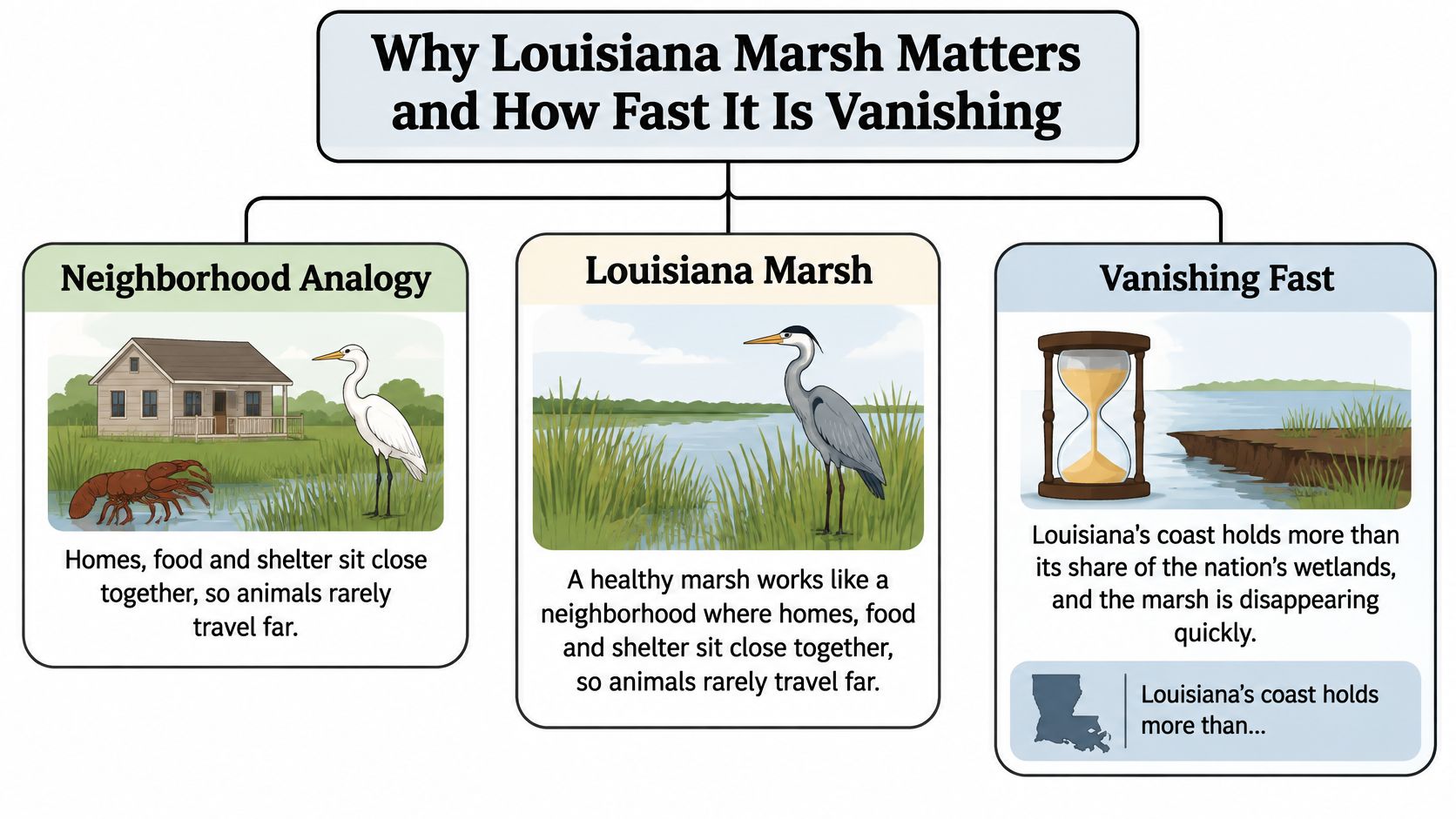
Why Louisiana Marsh Matters and How Fast It Is Vanishing
A marsh may still look wet after its plant cover has thinned, yet the animals using it face a different habitat. Stems, shallow pockets, and winding edges bring feeding space and shelter close together. As those features disappear, the remaining patches can become harder for wildlife to use.
Louisiana contains more than 45 percent of the intertidal wetlands in the contiguous United States, and its wetlands support approximately 75 percent of Louisiana's commercially harvested fish and shellfish species, according to the U.S. Fish and Wildlife Service's coastal restoration overview. These figures describe the share of habitat and species that depend on it, not the share of individual animals found in the state.
What disappears when land becomes water
When vegetated marsh turns into open water, animals lose the stems, shallow pockets, and sheltered edges that provide feeding opportunities and cover. Open water lacks that close arrangement of refuge and feeding space. Fish and shellfish may remain, while birds encounter a more exposed shoreline with fewer protected margins.
Several pressures can drive the change. Land subsidence, or sinking ground, and sediment erosion reduce marsh area. Saltwater intrusion changes conditions for freshwater vegetation and the animals associated with it. These processes can overlap, so a photograph alone may not reveal why a particular patch declined.
Read the loss record as a timeline
The figures below track different periods and measures. Each row identifies its source so the numbers can be read in context.
Louisiana wetland loss by period and rate
| Period or measure | Amount lost | Context and source |
|---|---|---|
| 1932 to 2016 | About 2,006 square miles, or 5,197 square kilometers | About 25 percent of 1932 coastal land. U.S. Geological Survey coastal wetland assessment |
| Peak annual loss rate | 32.0 square miles per year, or 83.5 square kilometers per year | Highest rate in the 84-year record. U.S. Geological Survey coastal wetland assessment |
| Later annual loss rate | About 10.8 square miles per year, or 28.0 square kilometers per year | Slower, but still continuing. U.S. Geological Survey coastal wetland assessment |
| 1956 to 2004 | Nearly 3,000 square kilometers of low-lying wetland | Converted to open water. U.S. Geological Survey coastal wetland assessment |
| 1932 to 2000 | About 1.2 million acres | Earlier estimate of wetland loss. U.S. Fish and Wildlife Service coastal restoration overview |
| Ongoing-loss estimate | About 10.9 square miles, or 6,944 acres, per year | Continuing loss estimate. U.S. Fish and Wildlife Service coastal restoration overview |
These rows should not be added together. Their periods overlap, and they measure related but different changes. Total coastal land loss describes a broader reduction in land area; conversion to open water tracks one specific change in low-lying wetlands.
For a visual view of the changing coast, watch the video below.
A lower annual loss rate means the decline has slowed, while the continuing loss still reduces habitat. Readers can explore endangered animals of Louisiana to connect habitat change with species at risk.
A declining rate of loss describes slower damage, not marsh recovery.
When reading a new headline, check its measurement period, geographic boundary, and annual rate. Together, those details show whether a figure describes accumulated loss, a yearly pace, or a particular kind of habitat conversion.
Why Water Depth and Timing Decide Who Shows Up
A winter marsh with standing water may attract greater white-fronted geese, while a dry patch nearby gets less use. Researchers tracking 78 greater white-fronted geese in Louisiana found that winter habitat use was greatest where water exceeded 5.1 centimeters in depth, according to USGS bird science highlights. The finding concerns this species in winter; other animals may need different conditions.
Wetness alone does not describe habitat. Depth, timing, and salinity shape which animals can feed, breed, or move through a marsh.
| Wildlife group | Water condition it needs | What goes wrong |
|---|---|---|
| Greater white-fronted geese | Standing water deeper than 5.1 centimeters in winter | Use drops on dry sites |
| Wading birds | Shallow edges where prey concentrates | Edges dry out or flood beyond the depth wading birds can reach |
| Fish and shrimp | Tidal channels with suitable salinity | Salinity shifts or channels fill in |
| Amphibians | Seasonal pools that last long enough to breed | Pools dry before breeding ends |
Wet Alone Does Not Make Habitat
Fewer feeding birds do not necessarily mean a marsh has lost land. The water may be too deep for birds to reach prey, or a useful feeding edge may have dried out.
Other mismatches take more care to notice. Water that is too salty can limit freshwater communities, and seasonal flooding may arrive outside an animal's breeding period. For amphibians, a pool must remain long enough for young to develop.
The goose finding supports managed agricultural flooding as a supplement to natural marsh habitat. Flooded fields can provide winter habitat for geese, while the study does not show that they replace coastal marsh or suit every species.
Ask before judging: Wet for which species, at what depth, and during which season?
Use those questions when visiting a marsh or reading a management proposal. A wetland label on a map cannot show whether the water is the right depth at the right time.
How to Tell If a Restored Marsh Is Working
A Barataria restoration project created 1,259 acres, including 1,170 acres of marsh and 89 acres of open-water features; one year later, white and brown shrimp, blue crab, and red drum were using the habitat, according to NOAA's Upper Barataria restoration account. The animal observations make that example useful: they show use of the constructed area, not merely completion of earthmoving.
They don't establish that every species has returned or that the habitat will function indefinitely. Occupation is evidence of progress, not a complete ecological verdict.
Follow the feedback loop
NOAA describes corrective measures, including adjusting water flow or replanting vegetation, if monitoring shows the marsh isn't thriving. Restoration therefore includes an ongoing sequence: build, observe, compare results with objectives, and correct problems.
Other projects work through different mechanisms. The Maurepas Swamp diversion is designed to convey 2,000 cubic feet per second of freshwater from the Mississippi River into the swamp, according to the Coastal Protection and Restoration Authority's project announcement. That design capacity describes intended water delivery, not a measured wildlife outcome.
A useful monitoring toolkit includes nekton abundance, meaning the abundance of swimming aquatic animals, alongside waterfowl use, wading-bird nesting, and forest condition. Together, these observations help distinguish a green-looking area from habitat that animals can occupy, feed in, and reproduce in.
Ask project managers questions that acreage alone can't answer:
- Who arrives first? Identify which species monitoring detects rather than assuming all groups respond together.
- How long does use take? Look for repeated observations of birds, fish, shellfish, and marsh mammals rather than imposing a universal timetable.
- Who gains and who might lose? Ask whether altered water conditions favor some species while making the site less suitable for others.
The strongest test combines animal use with evidence of habitat condition over time. Restoration succeeds as wildlife conservation when animals can use what people have rebuilt.
Reading Louisiana Wetlands Through Wildlife Art
A wetland painting can slow your attention in a way a passing roadside view can't. You can study the animal's outline, the space around it, and the suggestion of water without worrying that the subject will disappear into the grass.
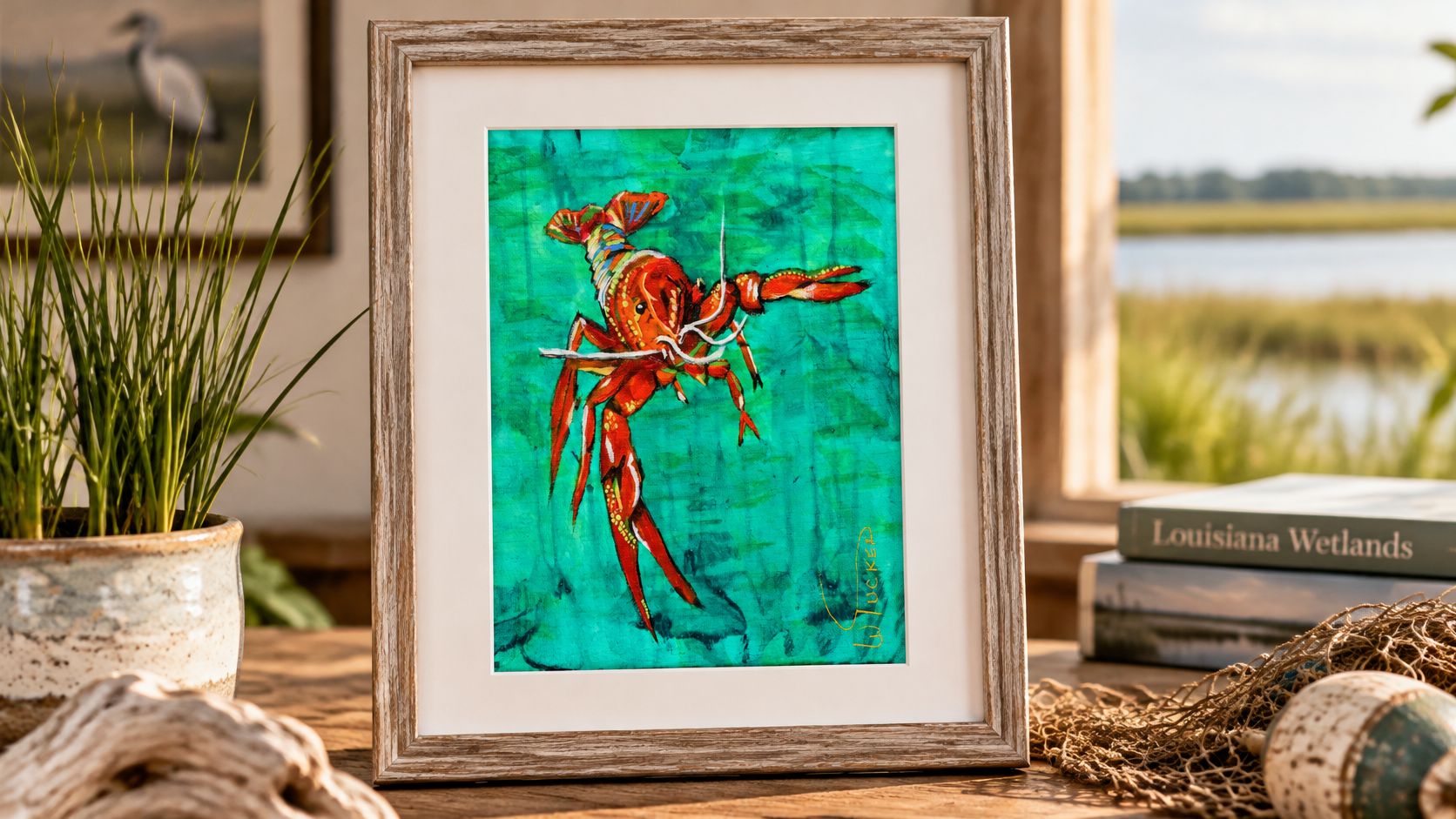
William Tucker is known for depicting endangered animals, with bees, animals, and oceans central to his work. His approach combines detailed subjects with abstract backgrounds, allowing a recognizable creature to stand against loose layers of color and atmosphere.
The crawfish image below offers a place to practice that closer looking.
Look like a naturalist
Start with the subject's relationship to its surroundings. Does the background suggest shallow water, a marsh edge, or open sky? Does the animal feel sheltered, exposed, or deliberately separated from a recognizable setting?
Then distinguish artistic suggestion from ecological documentation. Color can evoke water and weather without recording a particular site, and a painted animal doesn't establish a local population count.
Tucker aims to draw attention to damage caused by habitat loss and harmful chemicals, while encouraging reflection on our connection to nature. That intention offers a useful lens for Louisiana wildlife art that feels alive.
A painted heron beside a marsh edge can prompt a naturalist's questions: can it reach food, is there cover nearby, and what might change here? The painting opens the conversation rather than supplying every answer.
Plan Your Visit or Bring Louisiana's Wetlands Home
Begin with a habitat, not a wish list of animals. Choose a row from the habitat table and find an accessible place where you can observe that zone without entering sensitive vegetation or approaching nests. Check access notices and local seasonal guidance before leaving.
For waterfowl, consider the cooler months. If nesting birds interest you, investigate spring viewing opportunities while respecting closures and keeping well away from breeding colonies. Our guide to how to start birdwatching can help you turn casual looking into a more deliberate outing.
Make observations that others can interpret
Bring binoculars, a notebook, and a way to record the location. A useful sighting includes more than a species name.
- Record the setting. Note the date, habitat zone, weather, and whether water appears shallow, deep, rising, or receding.
- Describe behavior. Feeding, resting, moving through, and nesting mean different things. Don't record a breeding claim merely because birds are present.
- Mark uncertainty. Keep an uncertain identification uncertain, and photograph from a respectful distance when possible.
Follow local restoration updates and look for wildlife monitoring results, not only construction announcements. If a project accepts public observations, use its reporting method so your notes reach the people who can assess them.
Keep looking after the outing
At home, wildlife art can help sustain that attention. Rather than treating an animal image only as decoration, let it prompt a question about the creature's surroundings or the habitat you'd like to understand better.
Choose a habitat zone to learn about this month, then write down a species to look for on your next outing. Give yourself a specific place to look and a behavior to notice.
William Tucker Art offers wildlife artwork and a Coastal Print collection inspired by the Louisiana Coast and Bayous. Visit William Tucker Art to explore images that keep coastal animals in view and invite a closer connection with the places they need.