
Accredited zoos and aquariums support 117 reintroduction programs and have helped save at least nine species from the brink of extinction, including California condors, black-footed ferrets, and Przewalski's horses. That's the clearest answer to how zoos help endangered species, and it's only the starting point.
Modern zoos do far more than display animals behind glass. They now sit inside a coordinated conservation network that manages roughly 900 species classified by the IUCN as Vulnerable to Extinct in the Wild, which means the best zoos are working with species that need genetic backup, husbandry planning, field support, and sometimes a pathway back to nature (AZA zoo statistics).
A lot of people still picture the old model, a collection of animals for public viewing. That picture misses the shift that happened when zoo-based breeding became managed conservation, with genetic pairings, population tracking, and release planning built into the work. It also misses the fact that visitors now see only part of the job. Much of the conservation value happens behind the scenes, in breeding recommendations, veterinary care, field partnerships, and education that keeps species in public view long enough for people to care.
If you've ever taken a tour and wanted the behind-the-scenes version of that work, these zoo tour insights give a useful sense of how much happens away from the public path.
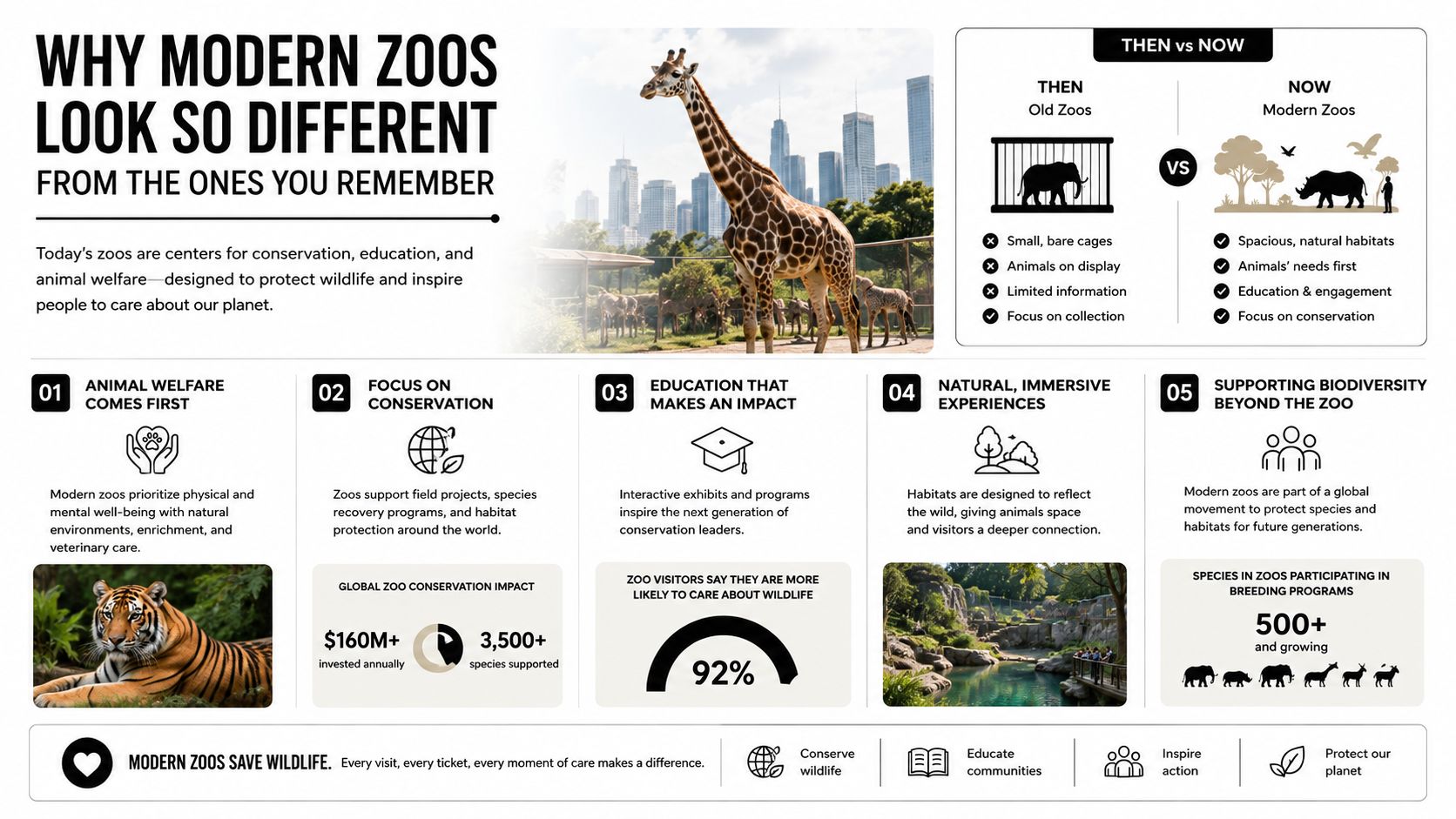
Why Modern Zoos Look So Different From the Ones You Remember
The biggest change is that accredited zoos no longer act like isolated islands. They work as part of a conservation network, with species managed across institutions instead of being treated as one-off exhibit animals. That matters because endangered species often need more than space and food. They need coordinated breeding, long-term records, and a plan for what happens next.
From display to conservation system
The modern vocabulary helps make that shift easier to understand. Ex situ conservation means keeping and breeding animals outside their natural habitat when the wild population is too small, too fragmented, or too threatened to recover on its own. Reintroduction means returning zoo- or aquarium-raised animals to nature. SSP, or Species Survival Plan, is the breeding coordination system that helps accredited institutions manage one species as a shared population rather than as separate collections (AZA statistics, SSP overview).
That shift matters because many endangered species don't have the luxury of waiting for habitat problems to disappear on their own. A captive population can function as a backup while field teams work on the bigger threats, like habitat loss, poaching, or disease. In that sense, the zoo is no longer just a place to look at animals. It's a place where a species' future can be organized.
Practical rule: if a zoo can't explain its role in breeding, reintroduction, or field conservation, it's probably not operating at the level people imagine when they ask whether zoos help endangered species.
You'll also notice that modern conservation zoos talk more about cooperation than ownership. Animals may move between institutions because the healthiest population isn't built by keeping every individual in one place. It's built by managing the species as a whole, often across continents, with the end goal of keeping the option of wild recovery alive.
Why this matters for visitors
The public-facing side of the work is important. Zoo educators, keepers, and artists all help translate a technical conservation system into something people can feel. A visitor who only sees an enclosure may miss the broader story, but a visitor who hears how a species is being protected can leave with a new sense of responsibility. That's one reason the modern zoo often pairs live animal care with storytelling, interpretation, and art that keeps the animals memorable long after the visit ends.
Captive Breeding and Reintroduction Pipelines
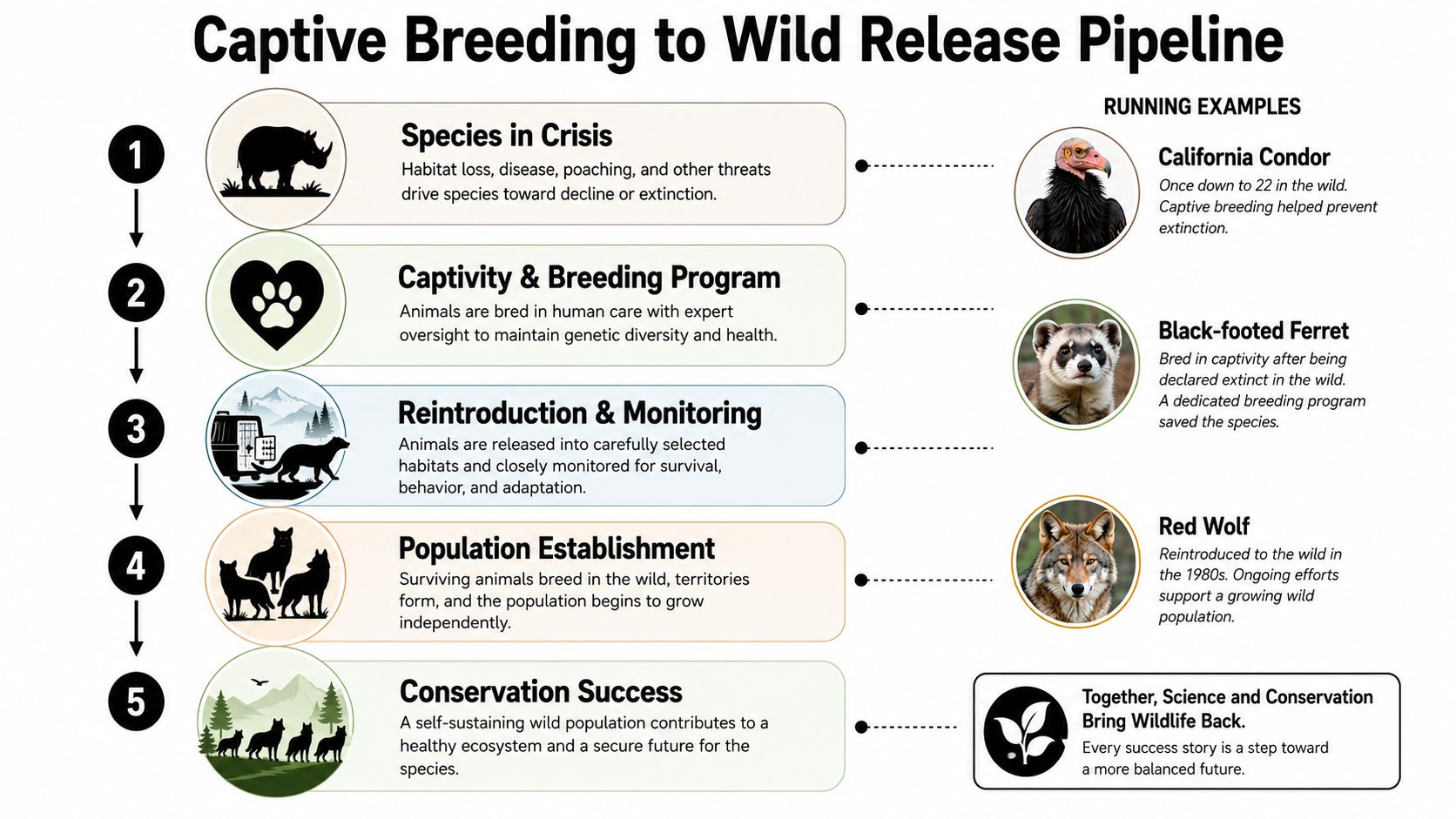
The cleanest way to understand this conservation work is to follow a species from crisis to release. Some animals can't rebound in the wild first. There may be too few breeders left, too much pressure from predators or disease, or too little habitat safety for young animals to survive. In those cases, a captive phase buys time.
The step from emergency to release
A breeding program starts by keeping a population alive and healthy, but it doesn't stop there. Care teams refine diets, monitor behavior, track reproduction, and build veterinary protocols that improve survival in human care. Then, when conditions are right, a subset of animals can move into reintroduction.
Reintroduction isn't a simple handoff. Animals may go through acclimation or soft release, where they're gradually introduced to field conditions before full release. After that, staff monitor them to see whether they forage, avoid danger, and settle into the ecosystem the way they need to. That post-release information feeds back into the next generation of planning.
The same pipeline shows up in species like California condors, black-footed ferrets, and red wolves, all of which are part of the broader conservation picture supported by accredited zoos and aquariums (AZA reintroduction programs). In each case, the zoo isn't just holding animals. It's helping create individuals who can participate in a wild population again.
A breeding program only becomes conservation when someone is planning for life after the enclosure.
Why release pipelines are harder than they sound
People often assume release just means “open the gate.” It doesn't. Zoos and partner organizations have to think about husbandry, nutrition, parasite exposure, social behavior, and whether an animal knows how to behave around others of its species. A captive-bred animal that never learned the right survival cues may look healthy and still fail in the wild.
That's why this work usually combines multiple skill sets. Keepers and veterinarians shape health. Genetic managers shape pairings. Field staff shape release conditions. Conservation doesn't happen in one department. It happens when those departments work from the same goal.
One simple example of how zoo work reaches into everyday life is wildlife art. A piece like William Tucker Art Acrylic Crab Painting Print Coastal Decor - Bleau Crab uses bold colors and textured backgrounds to bring attention to wildlife, which is the kind of visual storytelling that can keep conservation on someone's wall long after a visit ends.
A useful way to picture the pipeline
For a deeper look at how those recovery decisions are framed in practice, this guide to endangered species recovery plans is a helpful companion.
Genetic Management and Species Survival Plans
The technical heart of zoo conservation is genetics. When a population gets too small, animals start losing genetic diversity, which can make them less resilient over time. That's especially dangerous for species already squeezed by habitat loss, disease, or human pressure.
Why SSPs matter
Species Survival Plan programs solve that problem by treating multiple accredited zoos as one managed population. Instead of letting breeding happen randomly, curators and genetic specialists recommend pairings and transfers that help preserve high genetic diversity and demographic stability (SSP explanation). In plain language, the zoos act like distant relatives coordinating a shared family tree so the species doesn't drift into a genetic corner.
That approach is especially important for animals such as black-footed ferrets, California condors, and red wolves, where the wild population once became so weak that every surviving animal mattered. Centralized pairing reduces the risk that a few overrepresented individuals dominate the gene pool, and it keeps the population healthier for future recovery work.
How genetics and money work together
Genetic management alone wouldn't be enough if zoos stopped at the exhibit gate. The broader conservation record shows that accredited institutions also invest heavily in wild work. A peer-reviewed Nature paper reported $28.9 million in spending on field conservation and research for 74 ESA-listed species from 2013 to 2015, or an average of $9.6 million per year (Nature paper). More recent AZA data show accredited zoos and aquariums spent $252.2 million on field conservation in 119 countries in 2022, plus $29 million on AZA SAFE species programs the same year (AZA/Nature conservation spending).
| Category | Amount | Year | Geographic Reach |
|---|---|---|---|
| Field conservation | $252.2 million | 2022 | 119 countries |
| AZA SAFE species programs | $29 million | 2022 | Global program support |
Conservation genetics without habitat protection is incomplete. The same species management system that protects the gene pool also connects to field projects, anti-poaching work, veterinary support, and recovery planning. That combination makes zoo work measurable, not symbolic.
Research, Veterinary Science, and the Knowledge That Saves Lives
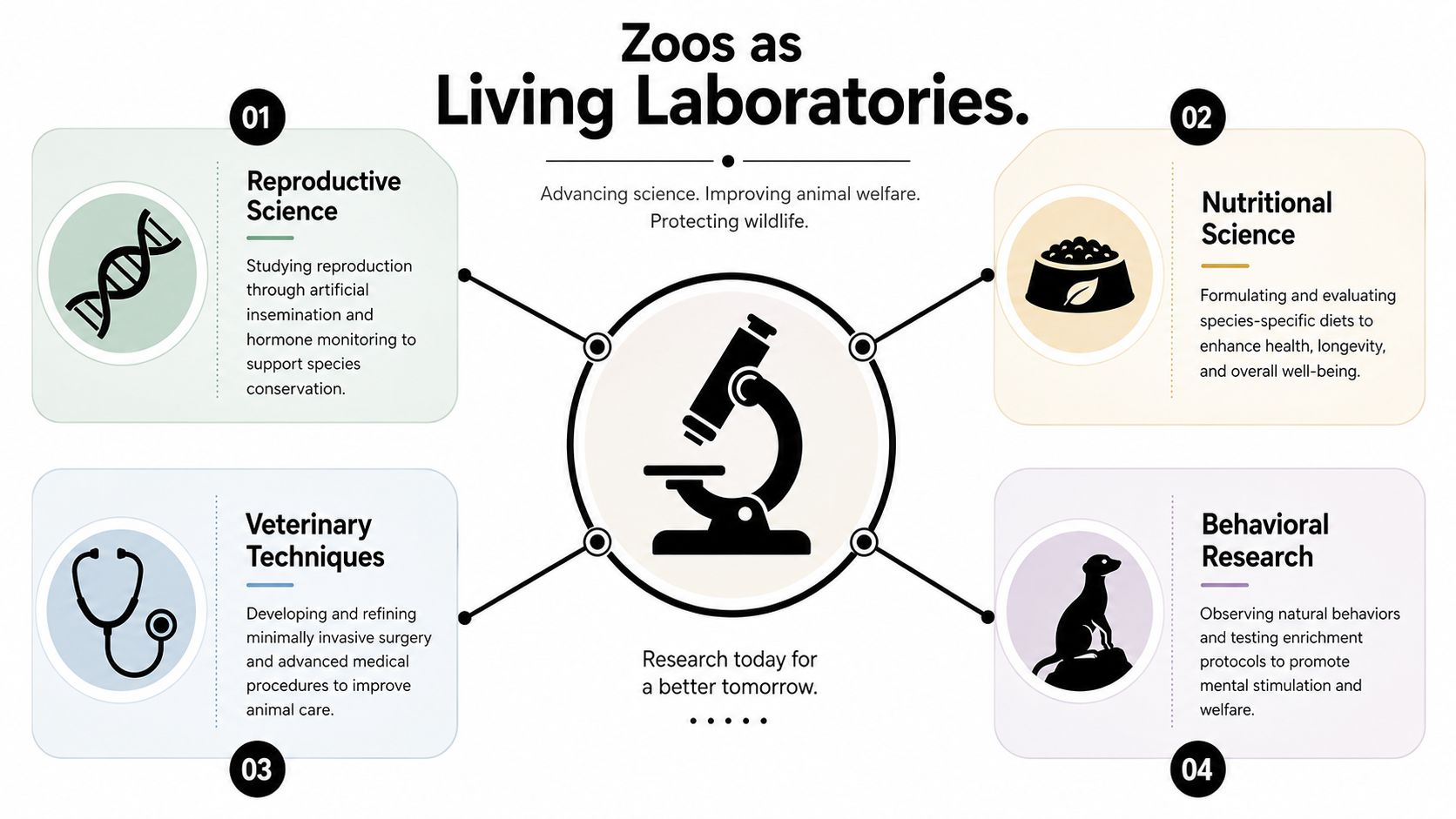
Zoos also help endangered species by producing knowledge that travels. A zoo is a place where staff can test diets, monitor reproduction, refine anesthesia, and track behavior under controlled conditions before applying those lessons in the field. That's why zoo science matters even when a visitor never sees a birth or release.
The clinic behind the exhibit
Veterinary teams treat injuries, manage chronic conditions, and help animals survive breeding programs that would be risky in the wild. Reproductive work can include artificial insemination, hormone monitoring, and egg incubation. Nutrition teams build specialized diets for animals with very different metabolic needs. Behavioral staff design enrichment and training so animals can cooperate with care, reduce stress, and maintain species-appropriate behaviors.
The important thing here is spillover. A protocol refined on one species can help another. A husbandry approach tested in captivity can improve survival after release. An animal that's been trained to accept routine care is easier to monitor, medicate, and move when conservation teams need to make a fast decision.
Behavior is part of survival
People sometimes think veterinary science is the whole story because it's the most visible. It isn't. Behavior matters just as much. A released animal needs to know how to forage, recognize threats, and interact with its own species. If those skills aren't there, survival drops even when the body is healthy.
Conservation success usually depends on details visitors never see, like whether an animal eats the right way, recognizes its own group, and stays calm during transport.
That's why zoos function as living laboratories. The gate is not the end of the conservation story. It's where a lot of the useful data starts. Public education also fits here, because people who understand why this research matters are more likely to donate, volunteer, or support field programs that need long-term funding.
Stories of Species That Came Back From the Brink
Some of the clearest proof comes from species whose names now stand for recovery. Their stories are different, but the pattern is familiar. A population falls into crisis, zoo teams step in with breeding and coordination, and field partners help restore animals to places they can survive again.
Golden lion tamarins and the power of coordination
Golden lion tamarins are one of the best-known examples of what coordinated zoo breeding can do. Their recovery depended on moving from isolated individuals to managed populations, then pairing that work with reintroduction in native habitat. What makes the story powerful is not just that the species survived, but that survival required both captive care and field restoration.
Przewalski's horses and the return to the wild
Przewalski's horses were once gone from the wild, which is a hard sentence to read and an important one to remember. Zoo breeding kept the species alive until reintroductions made it possible for animals to live in Mongolia again. That's a perfect example of why ex situ conservation exists at all. The captive population wasn't a replacement for the wild. It was a bridge back to it.
Black-footed ferrets and California condors
Black-footed ferrets and California condors show how severe the bottleneck can be. In both cases, recovery depended on taking a tiny surviving population seriously enough to manage every pairing, every transfer, and every release with care. The public often sees only the final bird or mammal. What it misses is the long chain of decisions that kept the lineage alive.
Those species now carry a message for visitors, keepers, and donors. Zoo work isn't abstract rescue theater. It's the slow, technical repair of a population that nearly disappeared. And when it works, the result is a species with a future, not just a memory.
Honest Criticism and Ethical Questions Zoos Are Working Through
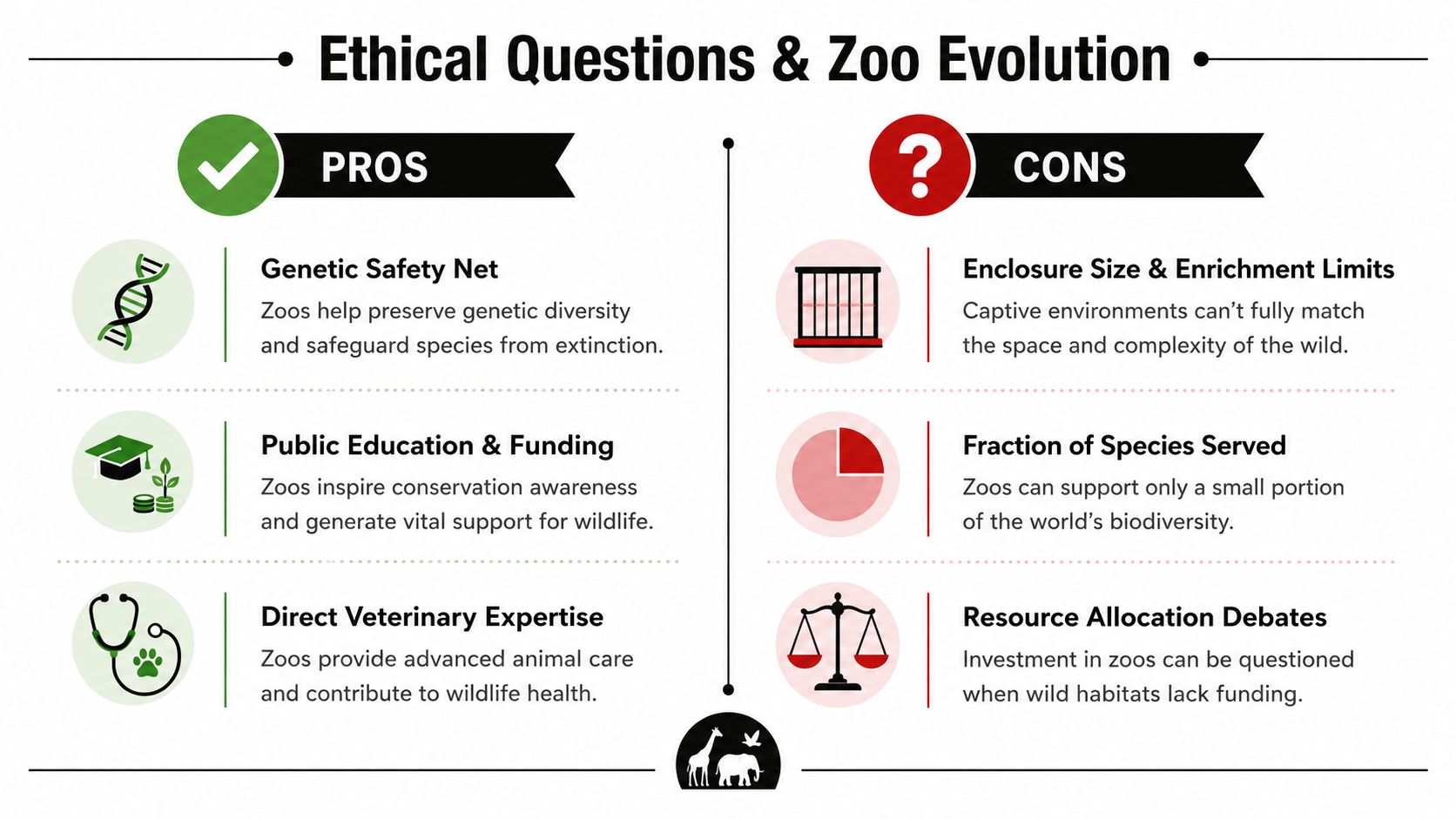
The strongest criticism is fair. Zoos have severe space constraints, and they can house only a small number of endangered species, which means they can't be the answer for everything (2023 review). Some species, especially less charismatic animals like many insects, amphibians, and plants, still get far less attention than big mammals do. That imbalance matters, because biodiversity loss doesn't only happen to the animals people line up to see.
The real tradeoffs
Animal welfare is the other major concern. A zoo can have excellent staff and still face hard limits on enclosure size, enrichment, and species suitability. Visitors are right to ask whether an animal's needs are being met, whether space is adequate, and whether the institution is putting conservation first or spectacle first.
There's also a question about resource allocation. If money goes toward animals in care, does that reduce support for field conservation? The answer depends on the institution. Some zoos clearly use in-house care as part of a wider conservation strategy, while others lean too heavily on display. That's why AZA accreditation is such an important signal. It doesn't make every decision perfect, but it does indicate a stronger commitment to standards, cooperation, and conservation action.
What honest evaluation looks like
A useful zoo asks you to care about more than the showpiece animals. It talks about breeding, field work, education, and technical support. It explains why some species are on exhibit, why some are behind the scenes, and how those decisions fit into real recovery efforts. It also admits limits instead of pretending every species can be saved the same way.
The best answer to how do zoos help endangered species is still, “it depends on the zoo and the program.” That isn't a dodge. It's the truth. A serious zoo will show you where its conservation value is strongest and where the hard tradeoffs still sit.
How You Can Help and Where Wildlife Art Fits In
You don't need to be a biologist to support this work. Visiting AZA-accredited zoos, becoming a member, and choosing institutions that can explain their conservation role are all practical first steps. If a zoo offers an adopt-a-species option, asks for donations to SAFE or field programs, or shows you how its animals connect to habitat work, that's a good sign your money is going somewhere meaningful.
A short checklist for action
- Support accredited institutions: Pick zoos and aquariums that can describe their breeding, education, and field conservation work clearly.
- Back field programs directly: Give to organizations working on habitat protection, anti-poaching, veterinary care, and species recovery.
- Avoid roadside attractions and pseudo-sanctuaries: If the facility won't explain where its animals came from or how they're contributing to conservation, be cautious.
- Choose meaningful objects and gifts: A good conversation piece can keep conservation visible at home, whether it's a wildlife print, a field guide, or a carefully chosen display item like a decorative specimen case.
Wildlife art fits here because stories stick when they have a visual anchor. William Tucker Art's Art for Environmental Awareness speaks to that same idea, and the Wild Things Collection uses mixed media animal portraits like New Dawn and Red Ivory to keep endangered wildlife in everyday conversation. That matters because conservation often begins with attention, then turns into support.
Zoos help endangered species by breeding carefully, releasing strategically, funding field work, and teaching the public why any of it matters. If you want to keep that chain strong, visit an accredited zoo, ask better questions, and bring conservation into your home in ways that keep the story alive.
If you want wildlife art that keeps endangered species in view, visit William Tucker Art and explore pieces that connect animal beauty with conservation awareness. His work turns a wall into a conversation starter, and that kind of attention can support the same long-term care this article is about.