
Your phone is full of them. The sleepy face on the couch. The muddy paws after a walk. The one perfect look your dog gave you at the back door, or the way your cat sat in a patch of sun like she owned the whole room. Then a birthday comes around, or a memorial date sneaks up, and suddenly those photos feel both precious and flimsy. You want something with more presence. Something that lives on the wall, not buried in a camera roll.
That's where hand painted pet portraits step in so beautifully. They take a familiar image and turn it into an object with weight, texture, and memory built into it. A good portrait doesn't just copy a photo. It holds onto the part of your pet that made you laugh, softened a hard day, or greeted you at the door like you were the mayor of the block.
If you're commissioning your first portrait, the choices can feel foggy at first. You might wonder whether you want realistic or expressive. Canvas or panel. Headshot or full body. Original painting or print. You might also be asking the question people sometimes feel shy about saying out loud. Will this feel like my pet when I look at it every day?
That's the question worth following.
Introduction to Hand Painted Pet Portraits That Capture Personality
A lot of folks arrive at pet portraiture in a tender, ordinary moment. Maybe you just celebrated your dog's birthday and thought, “I need to do something better with that photo.” Maybe your old cat isn't here anymore, and the snapshots on your phone don't feel like enough. Maybe you want a gift that says more than “I remembered the date.”
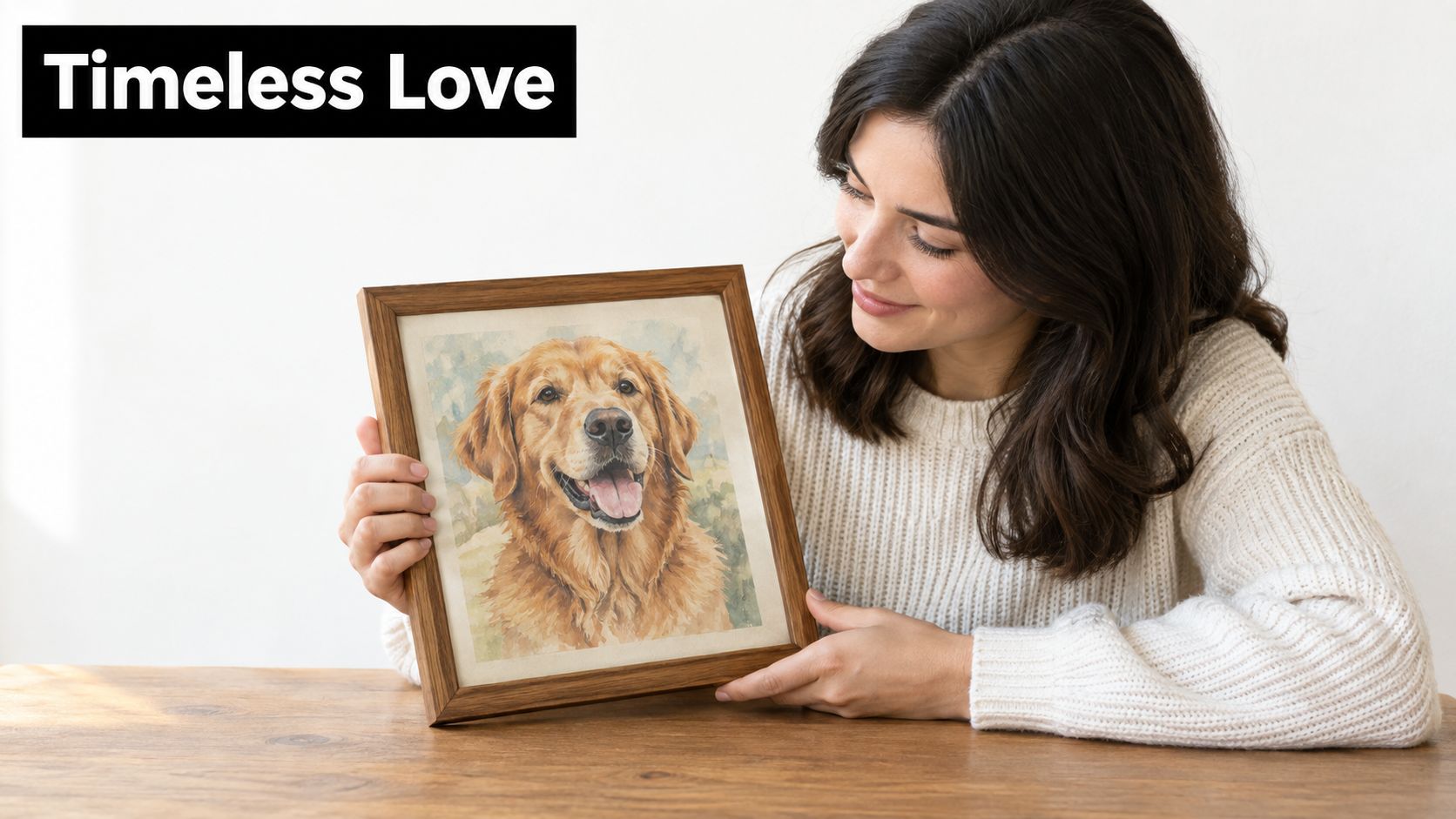
That pull toward a painted portrait isn't new. Pet portraits grew out of a much older animal-portrait tradition, but a clearer shift toward portraits of specific companion animals appeared in Europe by the late 17th and early 18th centuries. One documented milestone came in 1701, when King Louis XIV commissioned dog portraits for the Château de Marly. By the 19th century, pet portraiture expanded beyond aristocratic patronage as middle-class pet ownership grew. Even earlier, Leonardo da Vinci's Lady with an Ermine, painted around 1490, is often cited as an iconic early example of an animal appearing as a meaningful subject within elite portraiture, as outlined in the BBC's history of pet portraiture.
What matters for you today is simpler. A portrait becomes special when it treats your animal as an individual, not just a generic dog or cat shape. That's why two paintings with equal skill can feel completely different. One may be accurate. The other may feel alive.
A strong pet portrait doesn't only say, “This is what your pet looked like.” It says, “This is who lived with you.”
Some people want every whisker. Others want a painting that fits a quiet bedroom, a bright hallway, or a memorial nook with candles and books. That's why realism alone isn't the finish line. Emotional fit matters just as much. So does the photo you start with.
What first-time commissioners usually need most
- Clarity on style: You need to know whether you want lifelike detail, something looser, or a detailed subject with a more abstract setting.
- Confidence about materials: You want a piece that looks good now and still holds up later.
- A plain-English cost frame: You don't need mystery. You need to understand what changes the price.
- A workable process: You want to know what photo to send, what approvals happen, and how to avoid surprises.
That's the heart of it. A hand painted portrait should feel personal before it feels complicated.
What Makes a Portrait Truly Hand Painted
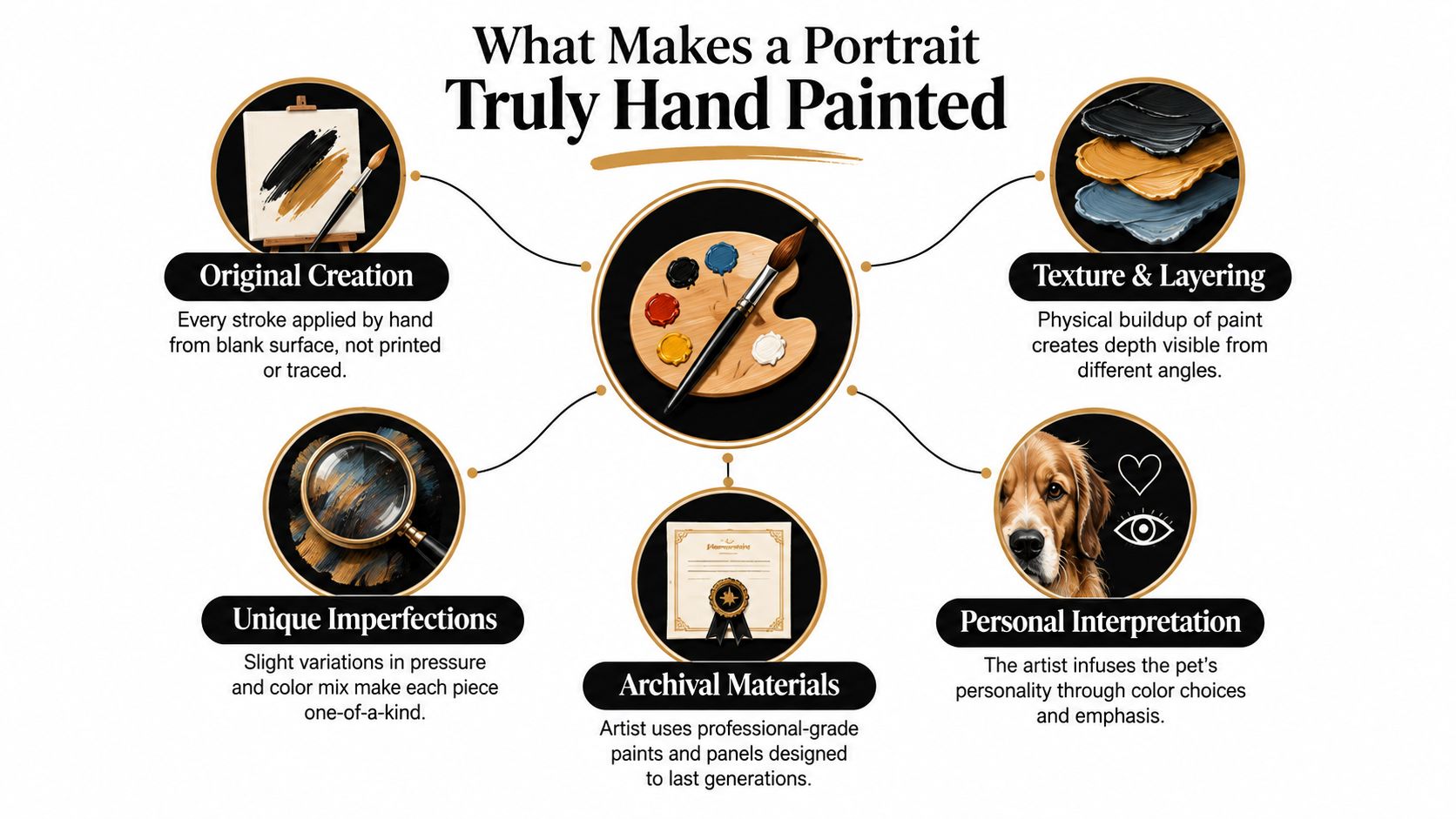
A hand painted original is not just an image of your pet. It is the actual object the artist worked on from the first sketch through the last brushstroke. The surface in your home is the same surface that held the mixing, layering, adjusting, and decision-making.
A simple way to think about it is music. An original painting is like a live performance recorded straight from the artist's hands. A print is more like a reproduction of that performance. It may still be lovely, but it isn't the same physical event.
The artist's hand shows up everywhere
In a real hand painted piece, the artist usually works through several stages:
-
Placement and drawing
The artist decides where the eyes sit, how the ears tilt, and how much space the pet gets within the frame. -
Color mixing
Fur is rarely “brown” or “black” in one flat note. A black dog may carry blue, violet, warm umber, or soft gray depending on the light. -
Layering
Shadows, nose shine, collar details, and eye depth often build gradually. -
Surface decisions
Some areas stay loose. Others tighten up. Those choices guide your eye.
That sequence matters because it creates a one-of-a-kind object. No two hand painted portraits can match stroke for stroke the way prints can.
How to tell the difference
Buyers often get confused by phrases like “hand finished,” “paint enhanced,” or “from my original artwork.” Those can describe many different things. If you want a fully hand painted original, ask direct questions.
- Was the portrait painted on a blank surface? That tells you whether the artist started from scratch.
- Is this the original artwork or a reproduction? Clear language matters.
- Will I see physical brushwork and paint texture? Originals usually show some evidence of touch, even in smoother styles.
- What medium was used? Acrylic, oil, watercolor, and mixed media each behave differently.
Practical rule: If the same image is offered in unlimited multiples with identical surface texture, you're usually looking at a print-based product rather than a one-off painted original.
Why the distinction affects value
The pet-owning audience is large, which helps explain why portrait commissions remain popular. In the United States, there are 68 million dog-owning households and 49 million cat-owning households, and a market summary cited in search results describes the pet portrait industry as worth over $1 billion globally and growing at nearly 10% per year. That same buyer guidance also notes that commissioned portraits commonly range from $150 to $2,000+, with traditional oil and acrylic often landing toward the higher end, according to this pet portrait market overview.
That difference in price isn't only about image size. It reflects labor, materials, and the fact that an original can't be duplicated in the same physical form. You're not only buying a likeness. You're buying the painted thing itself.
Materials and Techniques Behind Lasting Pet Art
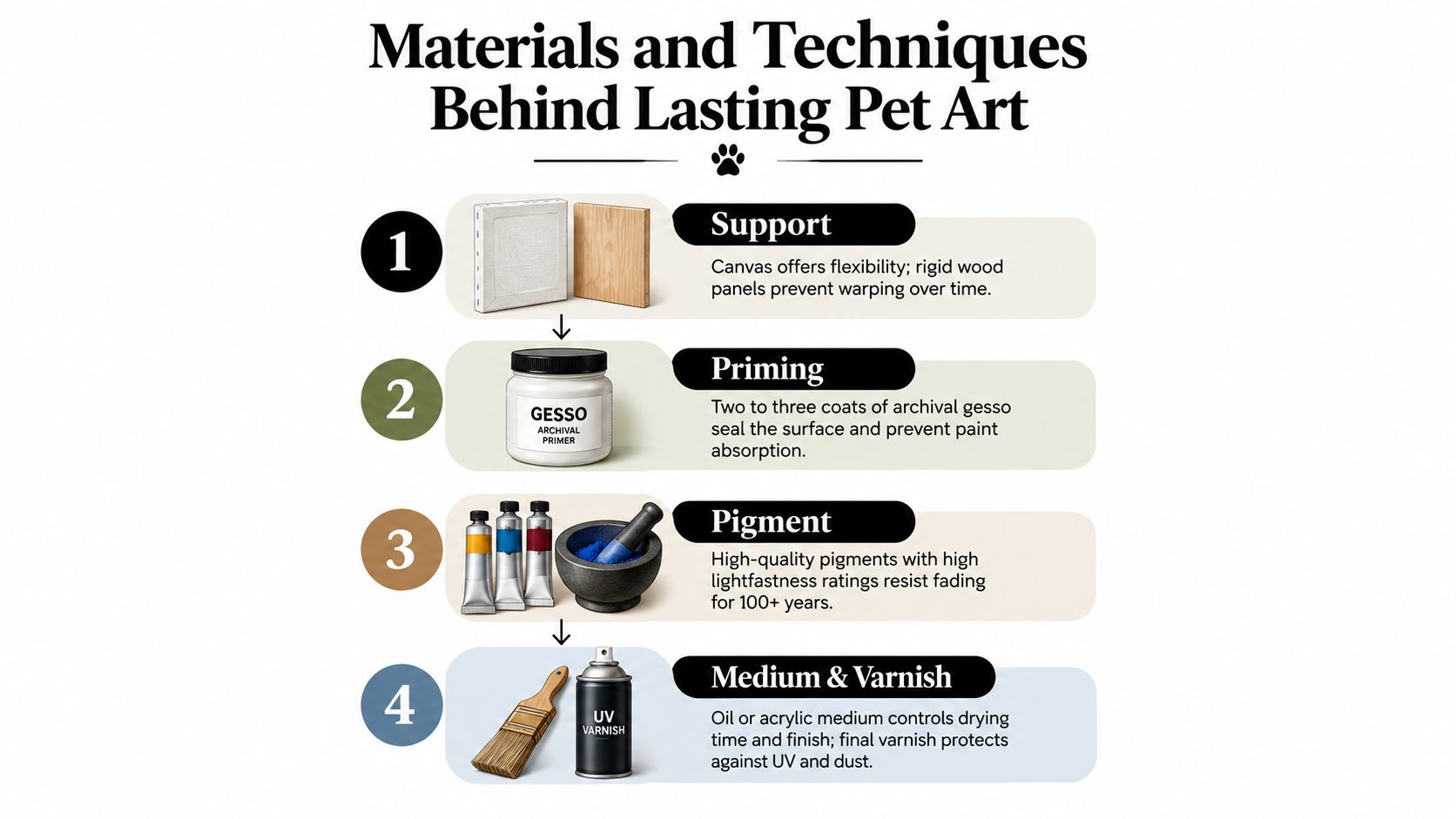
A portrait can look wonderful on day one and still run into trouble later if the materials underneath aren't doing their job. For long-term durability, the support matters just as much as the paint on top.
Why the surface matters
Think of the support as the floor under your house. If the floor shifts a lot, everything above it feels that movement. Conservation guidance notes that rigid supports such as wood panels or other dimensionally stable substrates reduce flex-induced stress, while stretched canvas can pass movement from humidity swings into the paint layers. That matters because paint films, especially oil, can become more brittle as they cure and age. Guidance for artists also recommends keeping relative humidity roughly in the 40 to 60% range and minimizing support movement, as discussed in this conservation article on paint longevity.
If you want the simplest durability question to ask, ask what the painting is made on and how that surface handles movement over time.
That doesn't mean canvas is bad. It means canvas and panel have different personalities. A taut canvas has some give. A rigid panel stays steadier.
Support and Paint Choices for Longevity
| Option | Best For | Longevity Note |
|---|---|---|
| Rigid wood panel | Buyers who want a steadier surface | Reduces flex-related stress in the paint film |
| Stretched canvas | Buyers who like a lighter, classic presentation | Can transmit movement from humidity changes |
| Acrylic paint | Bold color and a more flexible paint film | Flexibility can help compared with more brittle aging oil films |
| Oil paint | Deep blending and traditional finish | Can yellow and become more brittle with age |
Pigment matters as much as the pet
The portrait subject doesn't determine whether colors last. The pigments do. Conservation guidance notes that both acrylic and oil depend heavily on pigment lightfastness, while acrylics tend to remain more flexible and oil films can yellow and become brittle. For commission work, using ASTM-conforming paints with lightfastness ratings I or II is a practical benchmark, and museum-style care still matters. Low light, UV exclusion, and careful display help preserve the work, as explained in this guide to the archival qualities of acrylic paintings.
Questions worth asking an artist
Instead of trying to master conservation science overnight, ask a few grounded questions:
- What support do you use most often? Panel and canvas each have trade-offs.
- Are your paints professional grade and lightfast? This gets at fade resistance.
- How is the surface prepared? Proper priming helps the paint sit and bond well.
- What display conditions do you recommend? Good artists usually have a straightforward answer.
If you want a sense of how artists think through animal subjects in practice, William Tucker's thoughts on painting animal portraits give a useful first look at that studio mindset. In his broader body of work, vibrant acrylics, gallery-wrapped presentation, and mixed media choices create a crisp, contemporary look. For buyers, that often translates into color energy and a cleaner visual edge, especially in rooms that lean modern.
Exploring Styles From Realistic to Abstract
Style is where many people freeze up. They think they need to choose between “looks exactly like the photo” and “looks artistic.” But that's not the choice. The choice is what kind of feeling you want on the wall.
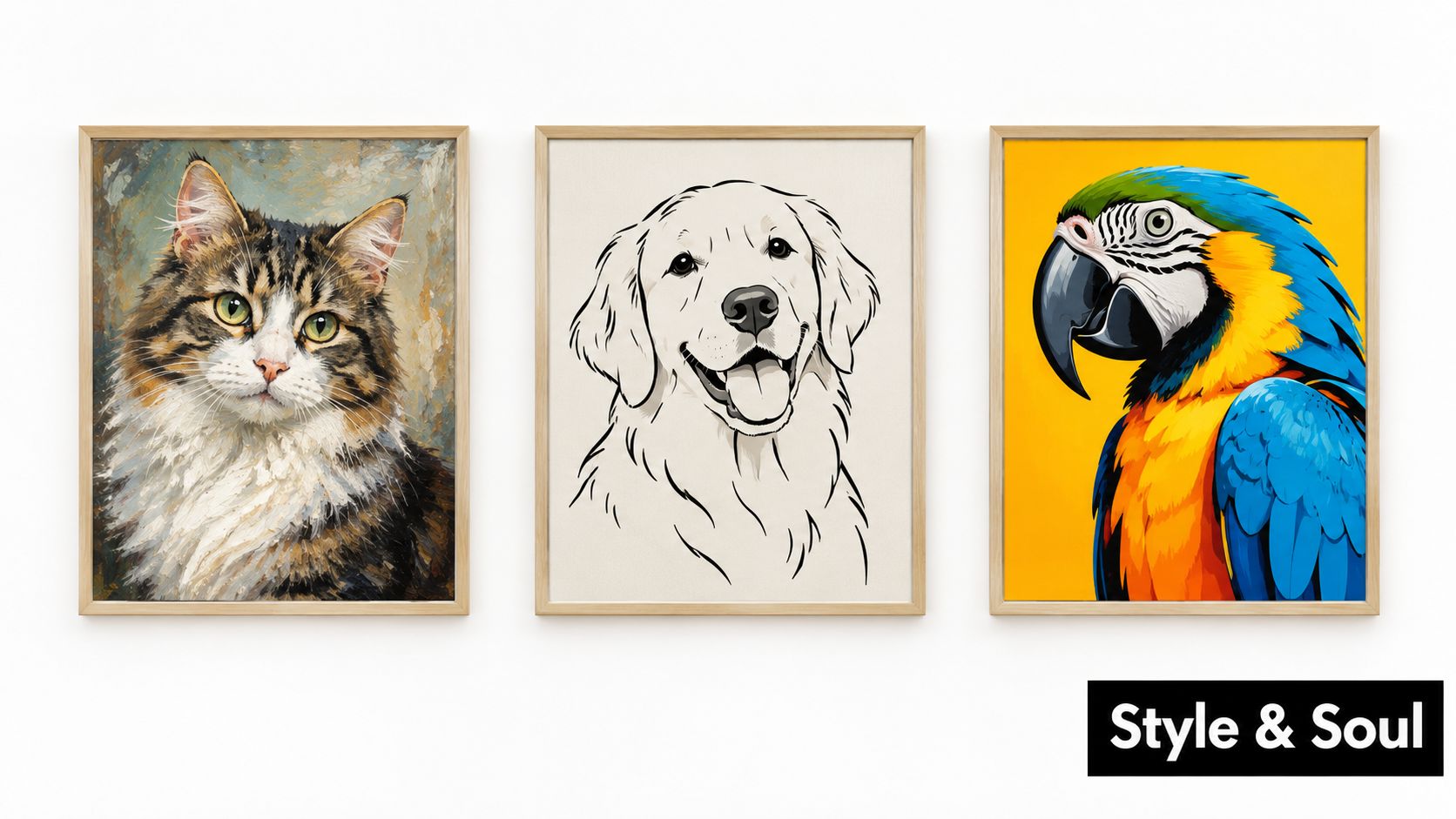
Recent commission guidance points to rising interest in abstract, minimalist, pop-art, and royal or renaissance-inspired pet portraits, along with highly customized presentation. The same guidance emphasizes a practical truth first-time buyers often miss. The best portrait is not always the most realistic one. It's often the one that matches the memory, the room, and the quality of the source photo, as discussed in this pet portrait commission guide.
Realistic style
A realistic portrait aims for recognizable markings, eye color, fur direction, and expression. This is a strong fit when the photo is excellent and the main goal is likeness.
It works especially well for memorial portraits because viewers often want that immediate “yes, that's him” response. The caution is that realism can also expose weak reference photos. If the eyes are blurry or the muzzle is cropped awkwardly, the painting has less solid ground to stand on.
Detailed subject with abstract background
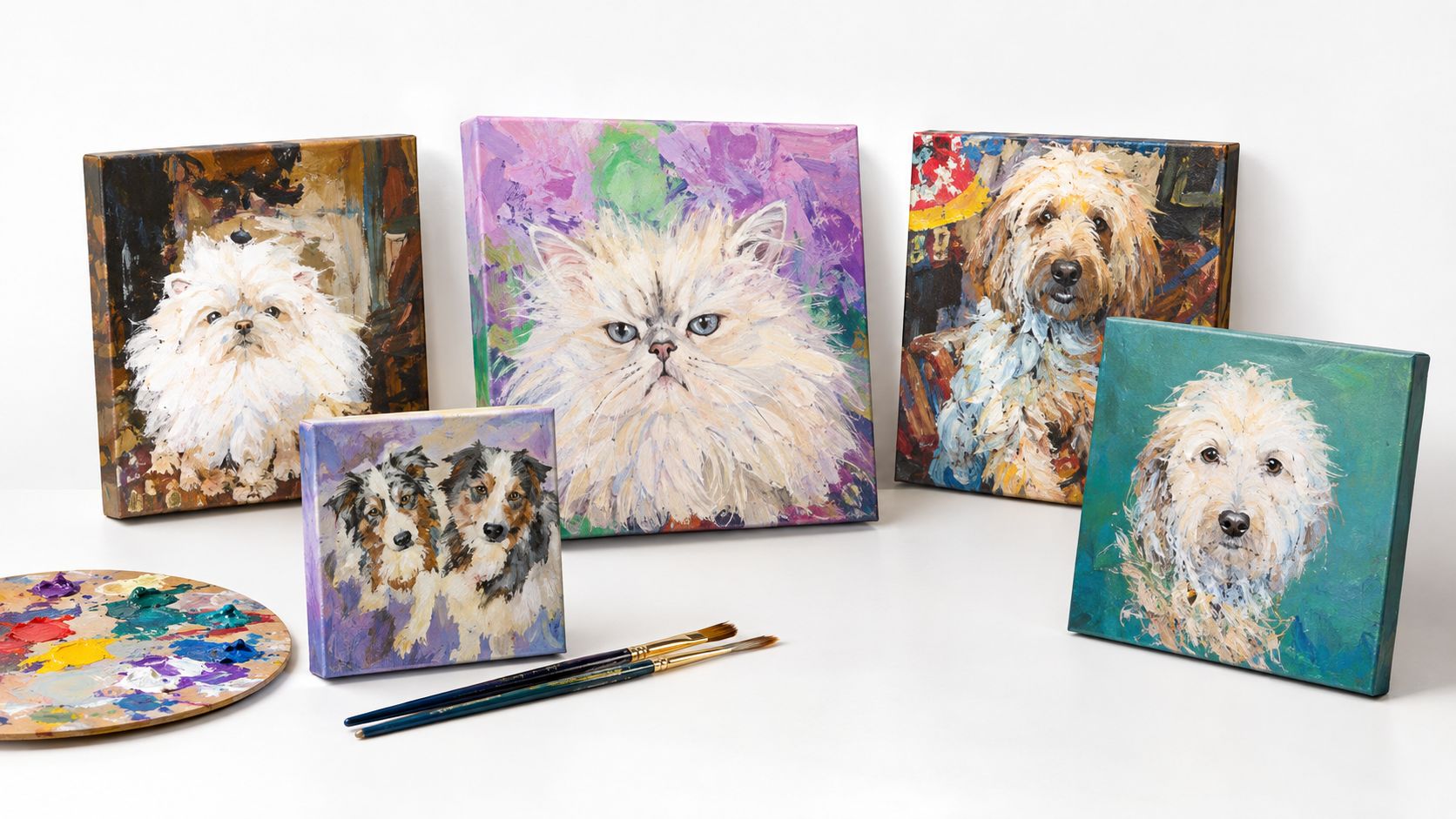
William Tucker's approach becomes especially useful for many homes. The pet stays detailed and recognizable, while the background loosens into color, shape, and atmosphere. That combination can solve a common problem. You want your dog's face to feel specific, but you don't want your wall art to look like an enlarged phone snapshot.
Abstract backgrounds also help the portrait live more comfortably with décor. A detailed beagle against a painterly wash of blues, greens, or warm earth tones can echo the room without locking the artwork into one literal place and time. It lets the memory breathe.
A portrait can honor the animal without copying every inch of the original background. Often that edit is what turns a photo into art.
Other popular directions
- Minimalist work suits calm interiors and people who love restraint. You might see fewer details, stronger silhouette, and more negative space.
- Pop-art styling turns up the volume. Brighter color fields and graphic contrast can suit playful pets and energetic rooms.
- Royal or renaissance-inspired portraits lean into costume, ornament, and humor. These often work best when the commissioner wants a conversation piece as much as a keepsake.
A short studio view can help you see how different choices change the mood of a portrait.
Match the style to the memory
If your dog was dignified and gentle, a loud pop-art treatment may feel off even if it's skillfully done. If your parrot was all color and drama, a severe minimalist rendering might flatten the fun. The best style usually answers three questions at once:
- What do I want to remember most?
- Where will this hang?
- Does my photo support this approach well?
That's why emotional fit beats realism as a stand-alone goal. A portrait can be less literal and still feel more true.
Hand Painted Originals Versus Prints and What You Gain
An original and a print don't solve the same problem. One gives you a unique art object. The other gives you access to an image at a lower threshold of commitment.
With a hand painted original, the biggest gain is presence. You see actual brushwork, surface variation, and color shifts that change a little as light moves through the room. It behaves like an object, not only an image. That's why originals often feel more intimate in person than they do online.
Where originals tend to matter most
Originals usually make the most sense when the portrait is tied to a milestone. Memorials, anniversary gifts, first-home pieces, and pets with a big emotional footprint often belong in this category. The painting becomes part of the home's story.
Prints have their place too. They're useful when you love an artist's image but don't need a one-of-one object, or when you want to test a look in a space before commissioning something custom. They also make sense for gifting when timing or budget is tighter.
Cost differences usually come from real choices
Pricing can feel mysterious until you break it into components. Independent buyer guidance notes a wide 2025 spread, with framed hand-painted oil pet portraits commonly ranging from about $169.99 to $399.99+ by size, while larger or specialty formats can go higher. Market reporting also projects the custom pet portraits category to keep growing at roughly 5% CAGR through 2031, which is a projection rather than a current fact, according to this custom pet portrait market report summary.
Those differences often come down to things buyers can understand plainly:
- Composition: Head-only portraits are often simpler than full-body scenes.
- Number of pets: Combining multiple animals usually takes more planning.
- Materials: Different paints, supports, and framing choices affect the final object.
- Finish level: Dense detail takes more work than a looser interpretation.
If you'd like a buyer-friendly breakdown of those variables, William Tucker Art's article on pet portrait commission pricing lays out the common decision points in straightforward language.
Prints are fine when you want the image. Originals are for when you want the artwork itself.
Neither choice is morally superior. They just answer different needs.
How to Commission Your Portrait With Confidence
Most commission stress comes from one place. The buyer and artist are picturing different outcomes. The cure is simple. Give the artist a strong photo and make a few key decisions early.
Start with the photo, not the size
A good source photo does more heavy lifting than people expect. Commission guides consistently recommend clear images that show the eyes, coat color, markings, expression, and body shape. They also suggest confirming whether the portrait will be head-only, full-body, or combined from multiple images, especially for memorials or multi-pet compositions, based on this custom pet portrait artist guidance.
If your pet's eyes are in shadow, the artist has to invent. If the phone lens stretched the snout, the artist has to correct. If the body is cropped, you can't request a natural full-body portrait later without another reference.
Make the main design choices in plain language
You don't need art-school vocabulary. You just need a few clear preferences.
- Pose choice: Tell the artist whether you love the alert face, the sleepy side-eye, or the running posture.
- Crop decision: Head-and-shoulders feels classic. Full body tells more story.
- Background mood: Neutral, abstract, colorful, or understated all create different energy.
- Use of multiple photos: This is common when one photo has the best face and another has the best posture.
For pet owners who also like personalized gifts beyond wall art, Pet Magasin custom dog gear is a helpful example of how different custom pet products solve different emotional needs. A bowl, collar, or tag handles daily use. A portrait handles memory and presence.
Understand the approval and payment rhythm
Every artist runs commissions a little differently, so ask about the checkpoints. Some share an early sketch. Some share preview images near the end. Some deliver framed work, while others deliver gallery-wrapped canvas ready to hang.
William Tucker Art offers a practical example through the product listing for William Tucker Art Acrylic Pet Painting Final Payment. The listing states that clients supply a photo of their pet, preview images are reviewed before final payment, and each portrait is finished on gallery-wrapped canvas using acrylics. For a first-time commissioner, that kind of process detail is useful because it shows when expectations are checked before the work is finalized.
A simple commission checklist
Before you hit send, make sure you can answer these:
- Which photo is the anchor image?
- Do I want head-only, full-body, or a combined composition?
- What feeling should the portrait have in the room?
- Do I want realism, decorative energy, or a balance of detail and abstraction?
- What details must stay accurate? Collar color, markings, eye color, favorite tilt of the head.
- Where will it hang? This helps with scale and palette.
Clear communication doesn't make a portrait less artistic. It gives the artist better raw material to work with.
That's how you get a result that feels less like a transaction and more like a collaboration.
Choosing the Portrait That Feels Right for Your Home
The right portrait usually reveals itself once you stop chasing some abstract idea of “best” and start choosing what fits your home and memory. Durability matters. Style matters. Budget matters. But the winning piece is the one that makes you feel that small jolt of recognition each time you walk past it.
A useful way to decide is to hold four questions together at once. Is the source photo clear enough to support the style you want. Does the material choice fit how long you want the piece to last. Do you want the unique presence of an original or the flexibility of a print. And does the finished look belong with your décor rather than fighting it.
A quick final gut-check
- Photo quality first: If the eyes and markings are clear, the artist has something solid to build from.
- Emotional fit over technical showmanship: The most realistic portrait isn't always the one that feels most like your pet.
- Room fit matters: A bold abstract background can make a portrait feel at home in a contemporary space.
- Intent clarifies budget: Memorial keepsake, birthday gift, daily joy piece, or statement artwork all call for different choices.
If you live with a vocal cat and are trying to understand the little personality behind the face you might commission, this guide on calm your talkative cat with FloofChonk adds a nice layer of behavior insight. Sometimes knowing why your cat “talks” so much even shapes which expression you most want preserved in paint.
A thoughtful hand painted pet portrait doesn't just decorate a wall. It keeps company.
William Tucker Art creates original pet and wildlife paintings with a distinctive New Orleans voice, often pairing detailed animal subjects with expressive abstract backgrounds that suit both memory and décor. If you're weighing photo choice, style, or how a custom portrait might live in your space, visit William Tucker Art to see how that approach looks in finished work.