
You're scrolling through photos of your pet, trying to choose the one that belongs on the wall. There's the beautifully lit picture where they look unusually serious, the blurry one that captures their entire personality, and the ridiculous sleeping pose you keep sending to friends. You want something playful, but you still want to recognize the animal you share your life with.
The most satisfying fun pet portraits don't depend on a clever costume. They start with the little things you'd miss if they weren't there: a crooked ear, an expectant stare, or the way your cat occupies a chair as though they're paying the mortgage.
Start With the Personality Behind the Portrait
A fun portrait must be silly, right? Not necessarily. A senior dog's solemn expression against an exuberant background can be just as playful as a dog dressed as an admiral, and considerably closer to how their family knows them.
There's a substantial audience for animal-centered household art. The AVMA's pet ownership statistics estimate that 45.5% of U.S. households owned dogs and 32.1% owned cats in 2024. Those figures establish the scale of pet ownership, not demand for any particular painting style, but they help explain why personal animal imagery belongs in conversations about meaningful home art.
Describe behavior rather than a theme
Before looking at backgrounds or props, describe what your pet does. “He's funny” gives an artist less to work with than “He sits very upright and watches us eat with an expression of wounded dignity.”
That description suggests concrete choices: an upright composition, a composed mouth, an attentive gaze, and perhaps a small reference to the dinner table. The humor comes from recognition, not from replacing the animal's character with a joke.
Try building a short personality profile around these prompts:
- Usual energy: Are they watchful, exuberant, reserved, or magnificently unbothered?
- Recognizable habit: Do they carry a worn toy, tuck their paws underneath themselves, or supervise from a particular perch?
- Emotional presence: Do you want the portrait to feel affectionate, mischievous, dignified, or companionable?
- Essential detail: Which feature would make the painting feel wrong if the artist changed it?
Let personality guide the invention
An alert cat might suit angular background shapes and plenty of space around the ears. A relaxed dog might suit a lower, wider composition with softer movement around the body. These are artistic options, not rules about animal temperament.
Practical rule: Choose the trait you want to recognize before choosing the joke you want to tell.
You don't need to write a biography. A brief description of the animal's character, supported by a familiar habit, gives the artist useful direction while leaving room to paint.
Choosing Reference Photos That Show Who Your Pet Is
Choose reference photos for different jobs rather than expecting a single image to explain everything. A calm photograph can establish the face and markings; a candid image can show the behavior you want the painting to capture.
Lay out your favorites so you can compare them without constantly switching between screens.
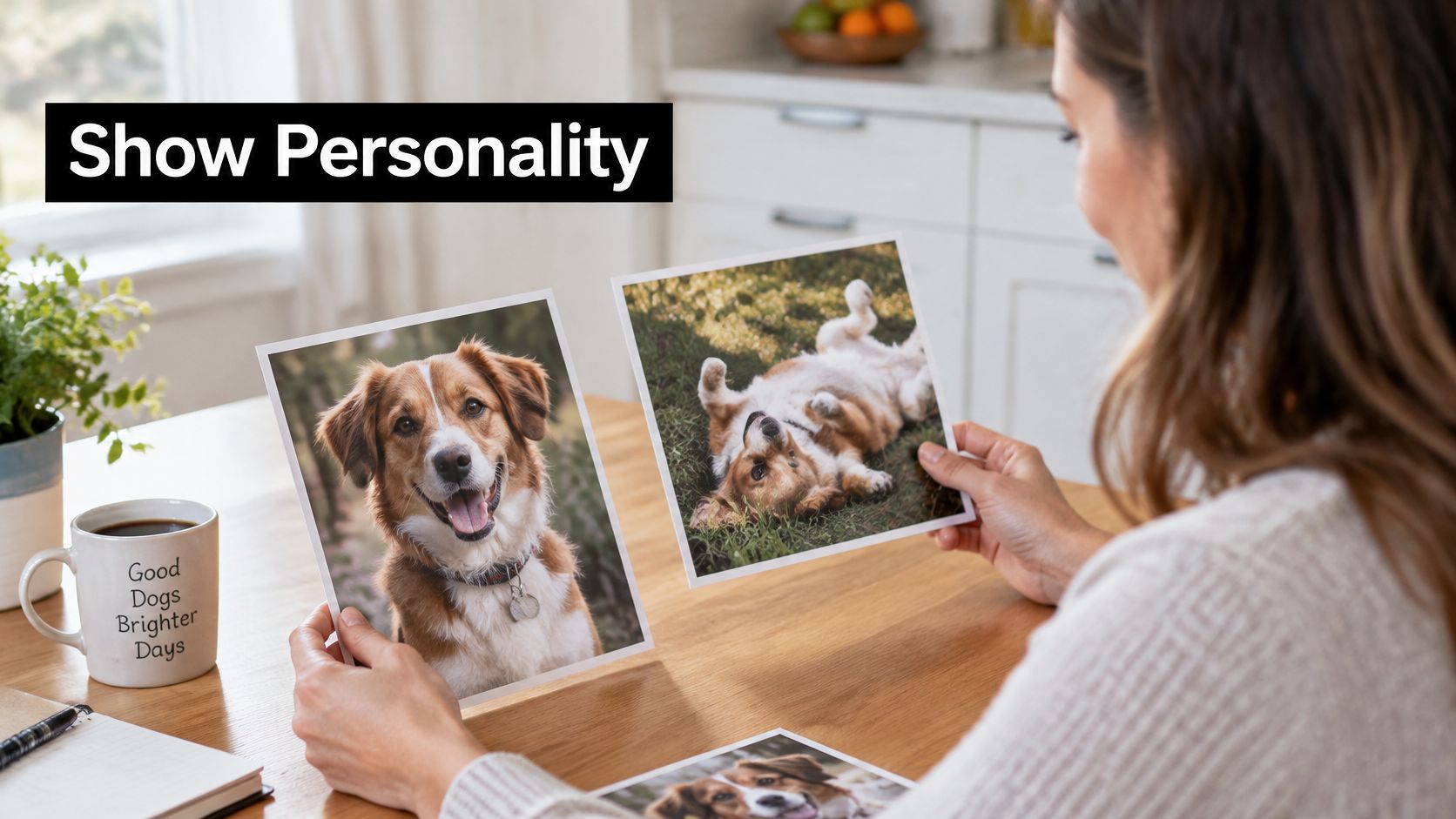
Make the face easy to read
Get down to your pet's eye level and keep the face unobstructed. Look for sharp eyes, visible catchlights, and enough detail to distinguish the muzzle from surrounding fur. An overhead snapshot may be charming, but it can be a difficult starting point if you want an eye-level painted portrait.
Use soft window light rather than direct flash. Dogs and cats have different visual sensitivities from ours, as discussed in this veterinary overview of animal vision, so there's no reason to make the photography session more visually intrusive than necessary.
Position your pet so the light falls gently across the face rather than directly behind it. If your camera allows shutter-speed control, use a fast setting and take a short burst to give yourself alternatives when your pet blinks or moves.
For practical preparation, use these tips for photographing pets alongside the artist's own reference requirements.
Choose useful information over polish
A white muzzle shouldn't become a blank patch of brightness, and dark markings shouldn't disappear into shadow. Check the original image before applying filters. If you can't see the detail, the artist will need another reference or your guidance.
Sort your selection by purpose:
- Main reference: Choose the clearest view of the intended head angle and expression.
- Supporting detail: Include images that explain coat color, markings, or an obscured ear.
- Personality reference: Add the windowsill stretch or favorite-toy photograph, even if it isn't technically perfect.
The embedded video offers another visual resource while you're considering your photographs.
Don't ask the artist to combine every favorite feature from unrelated angles. A forward-facing muzzle, sideways ears, and a gaze taken from another pose may not fit together convincingly. Choose a primary photograph, then explain what the supporting images clarify.
If the best expression exists only in an imperfect photograph, send it anyway. Ask what can reasonably be recovered rather than assuming either that it's unusable or that paint can solve every missing detail.
Comparing Playful Styles and Concepts
A costume portrait, a favorite-object portrait, and an abstract-background painting offer different kinds of enjoyment. The useful question isn't which style is most entertaining. It's which approach suits your animal and the way you want to live with the finished work.
Playful Portrait Styles at a Glance
| Style Direction | Likeness Strength | Humor Level | Best Use |
|---|---|---|---|
| Costume or theatrical setting | Depends on keeping facial features unobstructed | Overt and story-driven | A recipient who enjoys the specific joke |
| Favorite object or familiar setting | Strong opportunity to preserve everyday identity | Gentle and personal | Household art with a private reference |
| Characteristic expression | Relies heavily on accurate facial observation | Subtle | An intimate portrait centered on recognition |
| Detailed animal with abstract color | Can preserve clear facial structure while loosening surroundings | Expressive rather than comic | A lively focal point without a literal gag |
These are artistic trade-offs, not measured rankings. Any direction can work, but each asks the artist to balance different priorities.
Decide how much storytelling you want
Costumes establish a story immediately. They can also cover the neck, interrupt the silhouette, or draw attention away from a distinctive ear shape. If you choose one, keep the face readable and make sure the concept means something to the owner.
A familiar object needs less explanation. A battered ball or a carefully guarded cushion can carry the joke without changing the animal's appearance. Browse these pet portrait ideas with that distinction in mind: are you responding to the animal, or mainly to the surrounding concept?
For abstract treatments, I'd keep the eyes, nose, and identifying markings comparatively precise while allowing looser brushwork elsewhere. You can exaggerate the atmosphere without exaggerating the anatomy.
The deposit listing below is one option for discussing that balance before committing to a finished direction.
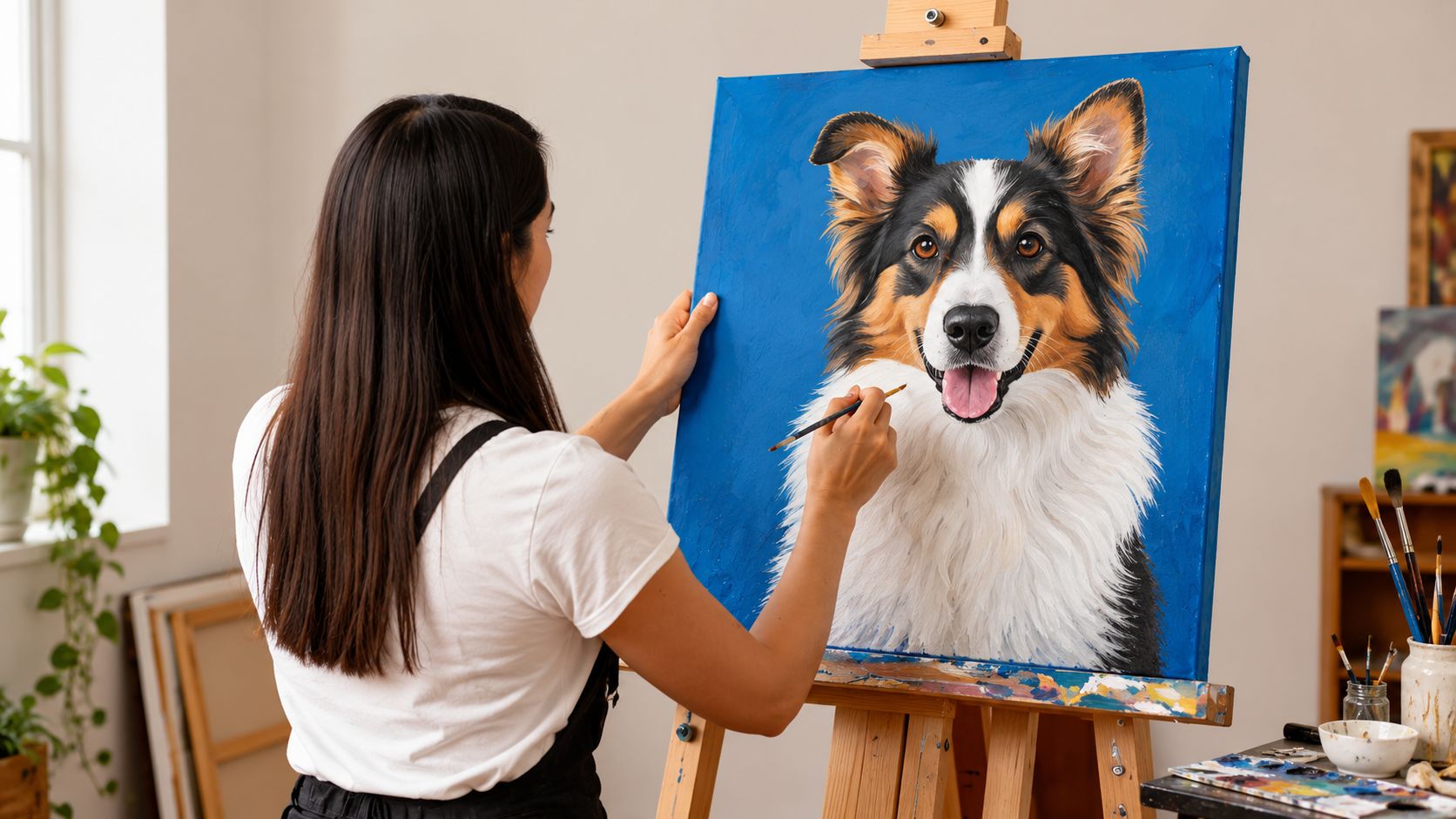
Match the concept to the room
Among custom portrait options, the William Tucker Art Personalized Pet Artwork Deposit reserves a commission and includes a free consultation about style, size, and medium. Tucker pairs detailed animal subjects with abstract backgrounds, working in acrylic, oil, and mixed media on canvas, paper, or wood panels.
Before choosing a direction, ask:
- Would I enjoy this without the surprise? A gift's initial reveal isn't the same as its everyday presence.
- Does the animal remain the focal point? The prop shouldn't require more attention than the face.
- Does the palette belong in the room? Bring a photograph of the intended wall rather than guessing.
- Would this concept fit any pet? If so, add something personal or simplify it.
Posing and Expressions That Keep the Likeness
Start with the position your pet chooses when nobody's directing them. A dog resting with their chin lifted, a cat sitting slightly sideways, or a bird leaning forward on a familiar perch gives you a more personal starting point than a pose selected because it looks impressive.
The pose should tell you something about the animal. It doesn't need to show activity to feel alive.
Translate habits into composition
For a dignified senior dog, consider a resting body with enough space around the head to let the gaze carry the portrait. For a curious cat, a slight head tilt may communicate more than a collection of props. A bird's habitual perch can establish a sense of place without requiring an elaborate background.
Don't automatically straighten every irregularity. If one ear sits differently or the mouth rests unevenly, ask whether that's part of the pet's familiar appearance. Accuracy includes characteristic asymmetry, not just ideal proportions.
Use this checklist when choosing the pose you want to photograph.
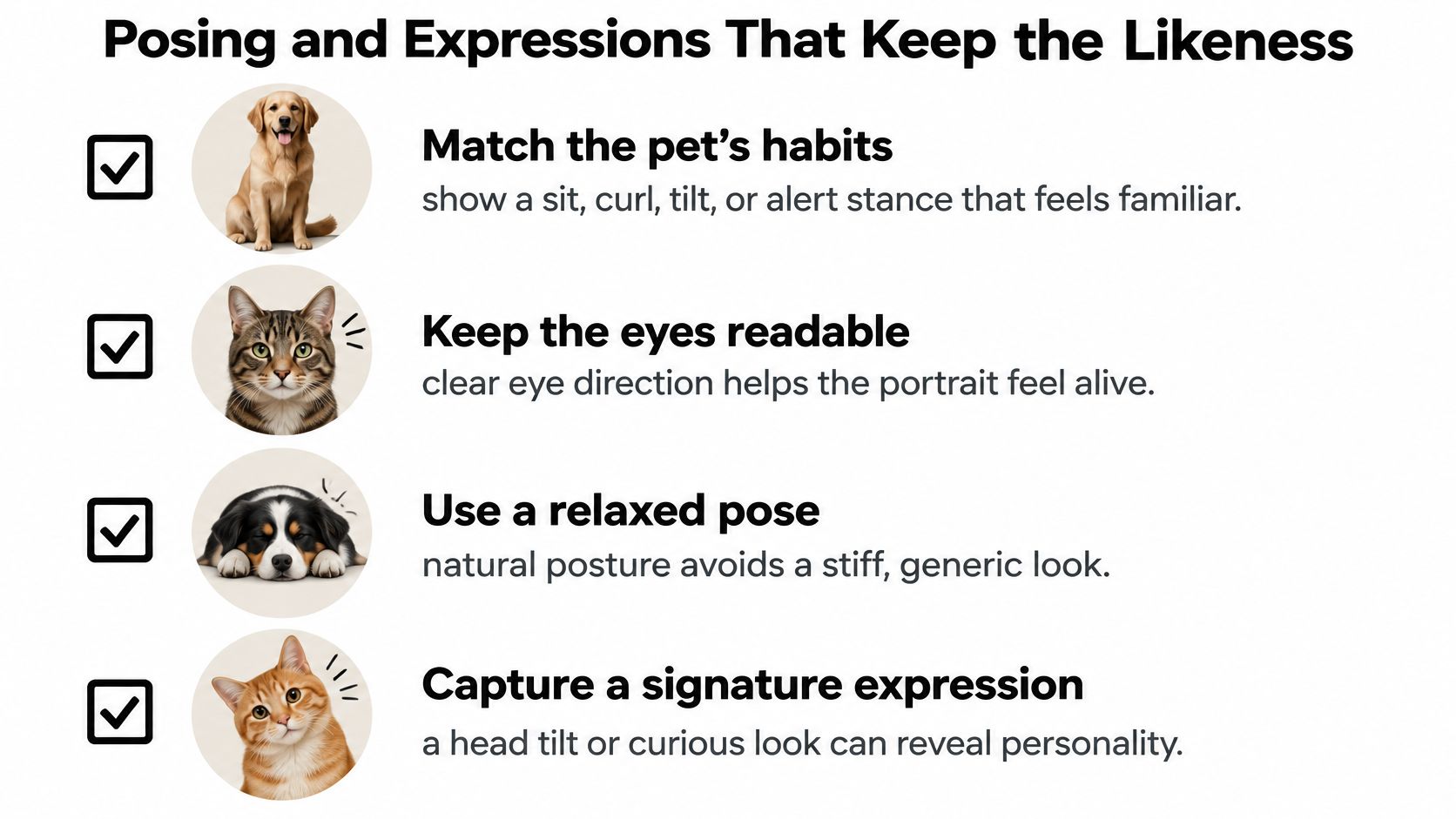
- Match the habit: Choose a sit, curl, tilt, or alert stance you recognize.
- Keep the eyes readable: Avoid a camera position that hides the gaze beneath fur or a heavy brow.
- Leave the body relaxed: Don't hold limbs or the head in place for the composition.
- Capture the signature expression: Watch for the look that appears during an ordinary, enjoyable interaction.
Let the animal end the session
Prepare a familiar space and have treats available if your pet enjoys them. Keep sessions short, offer breaks, and accept that the pose you wanted may not happen that day. A useful reference isn't worth forcing a reluctant animal through repeated attempts.
Repeated turning away, hiding, panting, or escalating tension are reasons to pause or stop, not invitations to become more persistent. You don't need a dramatic pose badly enough to override the animal's comfort.
The animal doesn't have to perform the finished painting. The artist can create drama through composition.
Be particularly cautious about interpreting an alert-looking photograph as a desirable expression. If you remember that your pet was frightened when you took it, tell the artist. That context matters more than whether the image looks visually striking.
Planning a Memorial or Celebration Portrait
Consider two hypothetical requests involving the same photograph of a dog carrying a muddy tennis ball. One owner wants a lively tribute to a companion who made every walk an adventure. Another wants a quiet remembrance and finds the ball too closely connected to a painful final outing.
Neither response is more appropriate. The owner decides what feels comforting, and the artist shouldn't assume that a joyful tribute requires comedy.
Name the emotional purpose
A living-pet commission can celebrate an ongoing relationship. A celebration-of-life portrait might emphasize the animal's most spirited years. An explicitly memorial work may call for stillness, a meaningful setting, or the simple presence of the animal without added symbolism.
Those categories are conversation starters, not fixed styles. A memorial can be colorful, and a portrait of a living pet can be contemplative.
A useful request: Please make this feel warm and affectionate, but avoid costumes or comic exaggeration.
For a family facing an approaching loss, arranging artwork may not be the most pressing need. The Companion Project offers a resource on emotional support before saying goodbye that can sit alongside, rather than be replaced by, decisions about remembrance.
Choose memories without setting a deadline
A recent photograph may show the pet exactly as the family remembers caring for them. An earlier image may better represent the period they want to celebrate. Don't automatically remove signs of age or illness without discussing what those details mean to the owner.
Use these questions to keep the consultation gentle:
- Which stage of life feels right? Let the family choose rather than assuming younger is preferable.
- Which objects belong? A collar or toy should have a clear emotional purpose.
- What should stay out? Ask about symbols, phrases, or humorous elements the owner doesn't want.
- When should previews arrive? Agree on a comfortable communication rhythm and ask whether the recipient wants a surprise.
These considerations for pet memorial pictures can help you organize possibilities without deciding everything immediately.
If you're commissioning a memorial as a gift, consider inviting the recipient into the process. Choosing the mood together may be more considerate than presenting an unexpected interpretation of their grief.
Practical Tips for Working With Your Artist
A useful commission brief tells the artist what must remain true and where they have freedom. It shouldn't prescribe every brushstroke. You're commissioning an interpretation of your pet, not asking someone to assemble a collection of unrelated preferences.
Write in ordinary language. “She's suspicious of visitors but completely relaxed with us” gives the artist more usable emotional direction than a list of broad style adjectives.
Give the artist a clear hierarchy
Separate must-have details from preferences. A particular marking might be essential; a muted green background might be your initial thought. If you don't distinguish between them, the artist has to guess where flexibility exists.
Use the following consultation reminders to prepare your notes.
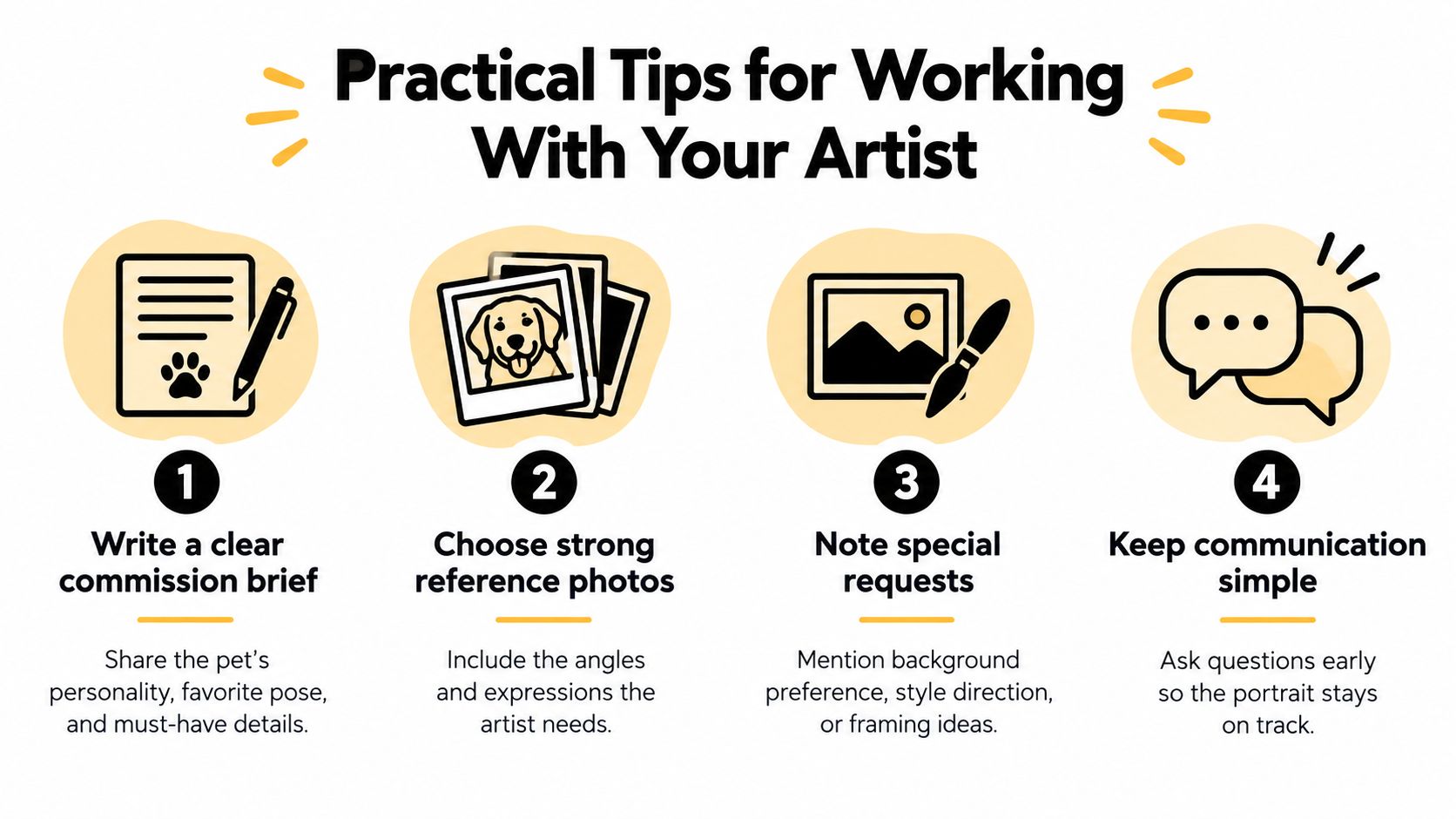
- Write a focused brief: Include the personality profile, desired emotional tone, and essential identifying features.
- Label your photographs: Explain which image establishes the pose and which clarifies a detail. Send original files when possible.
- Show the intended setting: Include the wall, nearby furnishings, and any framing preferences.
- Name your boundaries: Say whether costumes, text, exaggerated expressions, or invented scenery are welcome.
- Clarify the agreement: Ask what revisions are included, when feedback is due, and what happens if you request a major change.
Respond with observations, not diagnoses
When reviewing a composition sketch, describe what you notice. “His head feels narrower than in the reference” is actionable. “It doesn't have his soul” communicates your disappointment but gives the artist little direction.
You don't have to know how to fix a painting. Identify the discrepancy and let the artist propose the adjustment.
Likewise, name tonal problems early. If the concept feels too silly, say whether the problem is the prop, the posture, or the expression. If it feels too serious, ask about a lighter setting or more movement before requesting a change to the face.
Ask when structural decisions become difficult to revise in the chosen medium. Moving a head or changing a body position isn't equivalent to adjusting a background accent. Early clarity protects both the artwork and the working relationship.
Reviewing Proofs and Taking Your Next Step
Approve a portrait because it meets clear expectations, not because you feel awkward requesting a reasonable adjustment. A useful review separates recognition, expression, and reproduction instead of reducing everything to whether you like the overall impression.
That doesn't mean inspecting every brushstroke as though it were a photograph. Painterly simplification is part of the work. The question is whether the artist simplified details without losing the animal.
Check identity before decoration
Start with a small thumbnail view beside the primary reference. Look at the silhouette, muzzle proportions, ear position, and coat pattern. If you recognize the pet only when you zoom in to a decorative collar, the main structure needs another look.
Then inspect the eyes and mouth at full viewing scale. Compare gaze direction, pupil placement, and the familiar asymmetries discussed during consultation. Keep feedback specific and distinguish a likeness concern from a preference about how tightly the artist paints fur.
- Identity: Does the animal remain recognizable without relying on props?
- Expression: Does the face convey the agreed mood?
- Reproduction: Can you still distinguish important features in a reduced-size proof and an sRGB digital preview?
Ask for a grayscale view as well. If the face blends into the surroundings, discuss luminance contrast, the difference between light and dark, rather than requesting brighter color. A screen preview and a small print proof are useful checks, but neither should be treated as identical to viewing the original.
Approve through checkpoints
Reference selection, composition, color planning, and the final proof each answer a different question. Agreeing on those checkpoints is more useful than asking for a scientific-sounding likeness score. Research on dogs' visual perception and picture recognition isn't a universal grading system for commissioned portraits.
For an example of subject-background contrast, the New Orleans Artist Animal Painting by William Tucker - Pelican Portrait places a yellow-headed pelican against deep blue in a close-up acrylic composition. Consider how the separation directs attention, rather than treating its palette as a prescription for your pet.
The deposit option described earlier starts the reservation process. For an acrylic commission, the William Tucker Art Acrylic Pet Painting Final Payment is made once preview images meet your expectations. Confirm the applicable approval and payment arrangements during consultation, then keep your agreed brief beside you when reviewing the finished work.
William Tucker Art offers original custom pet portraits that pair detailed animal subjects with expressive backgrounds, with a consultation to discuss style, size, and medium. Visit William Tucker Art with a favorite photograph and a short personality profile to begin planning a portrait that feels playful without losing what makes your pet familiar.