
You've got a phone full of dog photos, a birthday or memorial date getting closer, and ten browser tabs that all promise a perfect likeness. One maker shows a fluffy replica with plastic eyes, another offers a stitched plush with a name on a bandana, and a third won't quote until you've sent every angle of your dog. It's easy to compare them by price first. Don't.
A customized stuffed dog is a textile product with seams, fill, dyes and small details that have to survive real handling. The right choice starts with how it'll be used, who'll handle it, and how long you want it to last. Get that match right and the photos, proof and price all become much simpler to judge.
Which Customized Stuffed Dog Type Fits Your Goal
There are three practical types. A photo-accurate replica matches coat colour, markings and body shape to your reference photos. A semi-custom plush starts from a standard dog body, then adds breed markings, embroidered features, a name or an outfit. A generic personalized plush takes an off-the-shelf dog and adds a tag, bandana or charm so it suggests your dog without copying the coat.
| Type | How It Is Made | Likeness to Your Dog | Price Tier | Typical Lead Time |
|---|---|---|---|---|
| Photo-accurate replica | Fabric and markings matched to reference photos, often with custom-cut patterns | High when photos are sharp and show all sides | Premium | Often several weeks, confirm with maker |
| Semi-custom plush | Standard dog body with embroidered eyes, nose, breed markings, name or outfit | Medium, captures colour and personality | Mid-range | Often two to four weeks, confirm with maker |
| Generic personalized plush | Off-the-shelf plush with name tag, bandana or memorial charm | Low, suggests the dog rather than copying it | Entry-level | Often days to two weeks, confirm with maker |
Run the intended use test first
Ask one question before you look at fabrics. Will this sit on a shelf, get played with by a child, or be handled during supervised time with people or pets? That answer changes which features are sensible, which seams need reinforcing, and what paperwork you should ask for.
A plush for a young child falls under children's toy requirements, while a decorative portrait collectible is marketed for display. As the plush toy safety standards guide notes, ASTM F963-23 became mandatory for applicable toys manufactured from April 20, 2024 in the United States, while the EU uses the EN 71 framework. A maker who just says safe or non-toxic hasn't told you enough.
Quick pick: For a memorial shelf, choose a replica. For a toddler, choose semi-custom with embroidered features and no detachable parts. For a lower-cost gift, choose generic personalized and spend your effort on a thoughtful tag message.
I would not buy a replica for daily toddler play. You'll pay premium money for delicate marking work, then watch it get dragged, chewed and washed in ways it wasn't built for. Match the build to the job and you'll be happier with both the price and the result.
Construction and Safety Rules by Age and Use
Safety starts with use and abuse, not appearance. The ASTM F963 standard covers foreseeable normal use and reasonably foreseeable abuse, and in the United States stuffed and bean-bag-type toys are specifically subject to third-party testing under the Consumer Product Safety Commission's ASTM F963 requirements. Pulling ears, chewing seams and tugging legs are exactly the sort of handling a child's plush should withstand.
Treat the dog as a textile assembly with known failure points. Seams and openings decide whether fill stays inside. The head-to-torso join takes the most stress when a child carries the toy by its neck. Leg joints, ear attachments, the tail and the stuffing opening come next.
What good construction looks like
European toy-safety guidance in the European Commission toy safety guidance document gives a concrete benchmark for soft-filled toys without small parts, stating that after seam testing a 12 mm probe must not enter more than 6 mm, and the seam test force is 70 N. You don't need to run that test at home. You do need a maker who can explain how seams are reinforced and closed so fill isn't exposed if stitching opens.
For young children, stitched detail beats attached detail every time.
- Embroidered eyes and nose: These can't pop off like glued or loosely attached hard parts.
- Printed or stitched markings: A patch over one eye or a white chest blaze can be built into the fabric panels.
- Few detachable accessories: Removable collars, charms and outfits add loss and choking concerns.
- Washable and colourfast fabric: The care label should match the actual construction, including any embroidery or printed coat pattern.
If a design includes sound, lights or a recorded bark, ask how the battery compartment is secured and read more about avoiding battery hazards in toys before you give it to a child. A compartment a child can open with fingers alone is a reason to walk away.
Match the specification to the user
| Age or Use | Main Risk | Design Rule | Ask the Maker For |
|---|---|---|---|
| Under 3 | Small parts, detachable eyes, loose fill | Embroidered features only, no small parts | Small-parts test report |
| 3 to 8 | Seam failure and stuffing exposure | Reinforced neck, leg and tail seams | ASTM F963 or EN 71 test report |
| 8 to 14 | Loose accessories and unclear age grade | Minimal detachable parts, age grade on packaging | Age grade and care instructions |
| Display or collector only | Being mistaken for a toy | Clear labeling on intended use | Display labeling and care card |
| Pets who chew | Swallowed fabric or fill | Keep out of reach, no loose parts | Fiber and fill details |
The CPSC position reflected in the ASTM source is blunt. Seams on toys for children under eight must not rip during required testing. That's why a cute photo of a finished plush tells you almost nothing. Ask what fibre and fill are used, what dyes or coatings touch the surface, and whether testing covered the final personalized configuration rather than a plain prototype in a different fabric.
A test report proves a specific product passed a specific test. It doesn't prove that every version is right for every child.
Keep the paperwork with the order confirmation. If you later gift the plush, pass on the age grade and care card too. A display replica handed to a toddler by mistake is a preventable problem, and clear labeling is part of the product, not packaging clutter.
How to Order a Customized Stuffed Dog Step by Step
Good orders feel calm because each decision is made once, in the right order. The overview below condenses the process into four stages before the detailed routine.
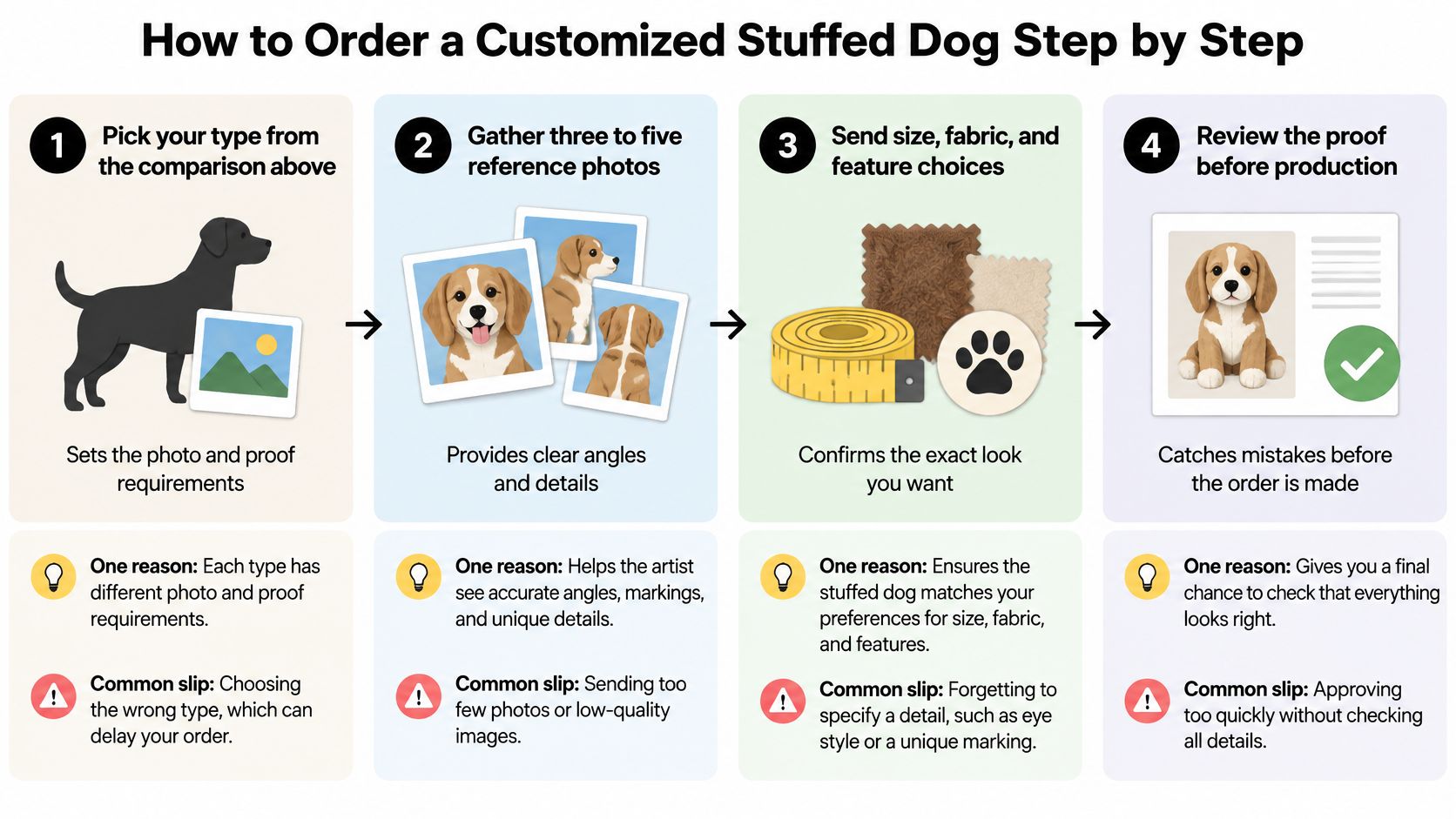
- Pick your type. A replica needs fuller photo coverage and a proofing stage. A semi-custom or generic plush needs fewer references. Choosing late often means starting the quote again.
- Gather three to five reference photos. Send a front view, both sides and a close-up of the face in daylight with no filters. You're responsible for supplying the photographs and other reference materials, and blurred or cropped shots cause most revision rounds.
- Record measurements. Note height at the shoulder and body length from nose to tail base, even if the plush won't be life size. Proportions from photos alone can mislead, especially with long-backed or very fluffy dogs.
- Describe markings in writing. State patch placement, eye colour, ear set, tail carriage and whether a collar should appear. Don't assume the maker will spot a small white toe or a kinked ear tip.
- Choose size by finished height. Ask for the completed sitting or standing height in inches or centimetres. Nominal sizes such as small and medium mean different things to different makers.
- Add personalization carefully. Check names, dates and short messages letter by letter before embroidery. A spelling slip stitched into a paw is expensive to unpick and may leave marks.
- Approve the proof. Review the digital proof or sketch for markings, proportions and text before cutting begins. Changes after fabric is cut usually cost more and can require new pattern pieces.
This short video is useful background while you compare how makers present their ordering process and finished work.
- Pay and keep the terms. Pay the deposit or balance the maker requires and save the order terms, proof approval and delivery estimate together. If you're also weighing painted options, our guide to pet portrait commissions explains how reference based artwork is briefed.
- Inspect it on arrival. Check neck, leg and tail seams with a gentle pull, confirm embroidered features feel firm, and compare markings against your approved proof. Photograph any problem before washing or gifting it.
If the maker asks for more photos, send them the same day if you can. Waiting on references stalls pattern work, proofing and the production queue behind you.
What Drives Price and Turnaround Times
There's no single price for a customized stuffed dog because you're not buying one fixed item. You're buying fabric, fill, pattern work, stitching time, proofing and shipping in a combination set by your specification. Two quotes can look far apart and still both be reasonable if one includes custom pattern pieces and two revision rounds while the other starts from a stock body.
| Cost Driver | Effect on Price | Effect on Turnaround |
|---|---|---|
| Size | Larger sizes use more fabric and fill, so higher price | Longer cutting and stuffing time |
| Reference photo quality | Poor photos may need extra work or a revision fee | Adds days while you send better images |
| Custom markings or colours | Each extra pattern piece raises cost | Adds pattern development time |
| Embroidery and personalization | Modest added cost per name or line of text | Adds a day or two for stitching |
| Revisions | Included in some quotes, charged per round in others | Each round adds days |
| Rush orders | Often carries a surcharge | Shortens lead time when capacity allows |
| Shipping and insurance | Priced by destination and carrier | Adds transit days |
Read the timeline as stages
Turnaround isn't just sewing time. It includes waiting for your proof approval, production, finishing, packing and transit. A maker can control the workbench schedule, but can't control how fast you reply, whether payment clears, or how long a carrier takes.
We work the same way with portraits. We can't be held to a specific timeline for a pet portrait because completion time changes with factors such as the number of subjects, custom backgrounds, and waiting for payments and reference materials. Build in buffer before a birthday, adoption anniversary or memorial date, and get the current estimate in writing. Our breakdown of pet portrait commission pricing shows how specification choices shape a quote in a related custom format.
Budget test: Set your maximum spend first, then choose the type that fits inside it. Don't fall in love with a premium replica and try to squeeze it into an entry-level budget by cutting proofing or seam quality.
Ask two or three makers to quote the same specification. Send identical photos, size, features and delivery details, then compare what's included. Check revision rounds, shipping, insurance and whether a proof is part of the price.
One policy deserves your full attention before you pay. Custom products such as special orders or personalized items cannot be returned. That makes your proof approval the decisive point of no return, so slow down there even if you're in a hurry everywhere else.
Custom Portraits and Sculptures as Alternatives
Some buyers do not want a toy. They want a likeness they can look at every day, with no concern about washing, chewing or a child dragging it through the garden. Portraits, sculptures and framed photographs fill that role.
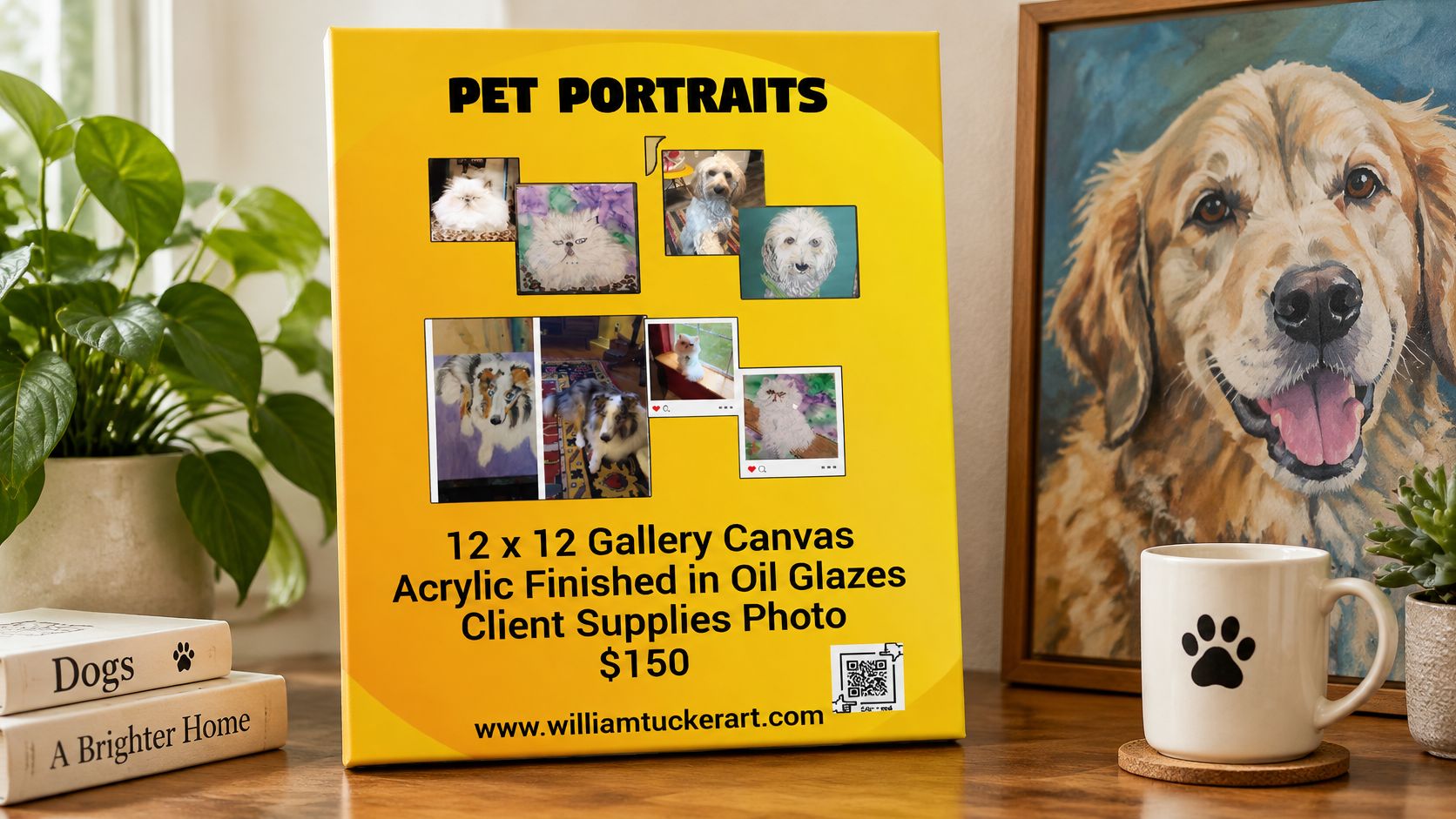
The example below shows the painted route, where colour and expression carry the likeness on a wall rather than in fabric.
| Option | Best For | Likeness | Durability | Typical Lead Time |
|---|---|---|---|---|
| Custom pet portrait | Wall display and gifts | High, painted from your photos | Strong indoors with normal care for the medium | 7 to 10 business days after all references arrive if there are no client delays |
| Custom pet sculpture | Memorial shelves | High in form, shaped by the sculptor | Durable on a shelf but fragile if dropped | Confirm the schedule in writing with the sculptor |
| Framed photo or commemorative print | Budget keepsake | Exact photographic likeness | Set by frame, glazing and paper quality | Confirm production timing with the printer |
Choose by how you'll live with it
A custom pet portrait in acrylic, oil on canvas or on a wood panel suits wall display and gifting. It isn't a photocopy. A pet portrait is our interpretation of the subject, based on the pictures and information you provide, so tell us what matters most. Expression, coat colour, background and mood all guide the painting. You supply the photographs and other reference materials, and a $50 non-refundable deposit starts the work.
If there are no delays on your end, most of our pet portraits should be completed and delivered within 7-10 business days of receiving all client-supplied reference materials. Once a portrait is complete, it is packed, insured and shipped to you, and you sign for delivery. For readers comparing formats, our overview of custom pet artwork covers how painted commissions are structured.
Final payment for a pet portrait is due upon delivery, and payments can be made online at williamtuckerart.com. The William Tucker Art Acrylic Pet Painting Final Payment listing is the listing our clients use to settle that balance.
A custom pet sculpture gives you form and presence on a memorial shelf. Its timeline is less predictable than a print or a standard plush body, so confirm milestones before you commit. A framed photo is the budget route and the only option with exact photographic likeness, though it offers no interpretation or texture.
Ask about rights before any artwork begins. We hold the full copyright and reproduction rights to our pet portrait paintings, so check whether prints or licensing are available if you want copies for family.
A painted interpretation also covers the cases a plush cannot: an elderly pet with a worn coat, a single grainy snapshot, or markings a fabric pattern would lose.
Confirm Materials, Claims and Next Steps Before You Order
Before you pay, run one final check. The product, the paperwork and the payment terms should all describe the same item.
- Intended use and age grade: State whether it's for play, display, memorial use or supervised handling.
- Type and specification: Confirm replica, semi-custom or generic personalized, plus finished size and features.
- Safety documentation: Request test information for the final personalized design you'll receive.
- Materials: Ask for fibre, fill, dye and coating details, seam construction and the care label.
- Production and packing: Confirm where it's made, what packaging is used and how far it ships.
Sustainability needs the same discipline. Market reporting from Future Market Insights on the personalized toys market estimates that market at USD 254.7 million in 2025 and projects it to reach USD 435.0 million by 2035, with a 5.5% CAGR. Those figures track buyer demand, so the useful questions stay material ones: ask about recycled or bio-based content with documentation, repairability, expected lifespan and what happens when a one-off keepsake is no longer wanted.
A documented, repairable keepsake you keep for years is a stronger choice than a green label with no material details behind it.
Then get the agreement on paper. Send your checklist answers to the maker and ask for one document that ties them together: a written spec or order confirmation listing size, materials, age marking and care instructions for the exact item you'll receive. Keep the maker's proof approval in writing, and confirm deposit, payment method and final-payment terms before any money moves. For our portraits, a $50 non-refundable deposit is required to start, and payments can be made online at williamtuckerart.com.
If a painted likeness fits your goal better than plush, we create custom pet portraits from your reference photos. You supply the pictures and information the portrait is based on, pay the deposit to start, and the finished painting is packed, insured and shipped for you to sign on delivery, with final payment due at that point. Visit William Tucker Art to review the Pet Portraits collection, check current terms, and start with the photos that show your dog's expression and markings most clearly.