
You've got the tree partly decorated, your dog's asleep beside the ornament boxes, and you're scrolling through photos for the one that would look right on a keepsake. Or you're holding an old collar and wondering how to include a pet who won't be beside you this Christmas. Either way, the decision deserves more thought than choosing a cute shape and adding a name.
My advice is to approach pet Christmas ornaments as small art commissions, not impulse purchases. Decide what makes the animal recognizable, choose construction that suits your household, and plan the display before you order. A beautiful likeness matters, but so does an ornament you can bring out again without worrying about loose parts or a fragile body.
Why a Pet Ornament Belongs on Your Tree
You can probably already picture it: your terrier's crooked ears painted against a deep green background, or your cat's white chin catching the tree lights. The ornament doesn't need an elaborate scene. It needs the detail that makes you think, that's my animal.
Pet-centered holiday decorating isn't an isolated habit. A 2025 industry survey cited by Perfect Imprints reported that 52% of U.S. pet owners had holiday decorations for their pets, including a dedicated stocking or ornament, according to its custom Christmas ornament trends overview. That figure covers pet holiday decorations broadly, not custom portrait ornaments specifically, so it shouldn't be treated as a measure of the commissioned-art market.
Choose the memory before the decoration
I'd start with the reason you want the piece. An adoption keepsake might emphasize the name you chose together, while a memorial ornament might need nothing more than a familiar expression. A gift for someone else should reflect their relationship with the pet, not just your preferred Christmas color scheme.
Useful starting points include:
- A recognizable feature: A folded ear, uneven blaze, or distinctive eye color.
- A personal marker: The pet's name or an adoption reference that matters to the owner.
- A familiar mood: Watchful, sleepy, mischievous, or calmly expectant.
- A restrained background: A color that complements the animal rather than competing with it.
Artist's recommendation: Put the likeness first. Seasonal decoration should frame the pet, not disguise it.
An ornament also suits someone who loves original artwork but hasn't decided where a larger portrait would live. For other formats with a similar personal connection, these gift ideas for pet lovers can help you compare the options.
Treating the piece as a keepsake changes the buying questions. Instead of asking whether it matches this year's tree, ask whether the design will still feel like your pet when your decorations change. That's the standard I'd use for a commission.
Materials That Hold Up Around Real Pets
Non-glass doesn't automatically mean pet-safe. A solid-looking ornament can still have detachable eyes, a weak hanging tab, or a surface your dog can chew apart. Choose the complete construction, not just the material named in the listing.
Veterinary guidance favors simpler alternatives: Cornell's Feline Health Center recommends cloth, straw, or wooden ornaments with cloth loops rather than hooks, while the AVMA's holiday pet-safety guidance identifies glass, ceramic, salt-dough, and small detachable decorations as hazards. These are safer design directions, not permission to let an animal play with an ornament.
Ornament Materials at a Glance
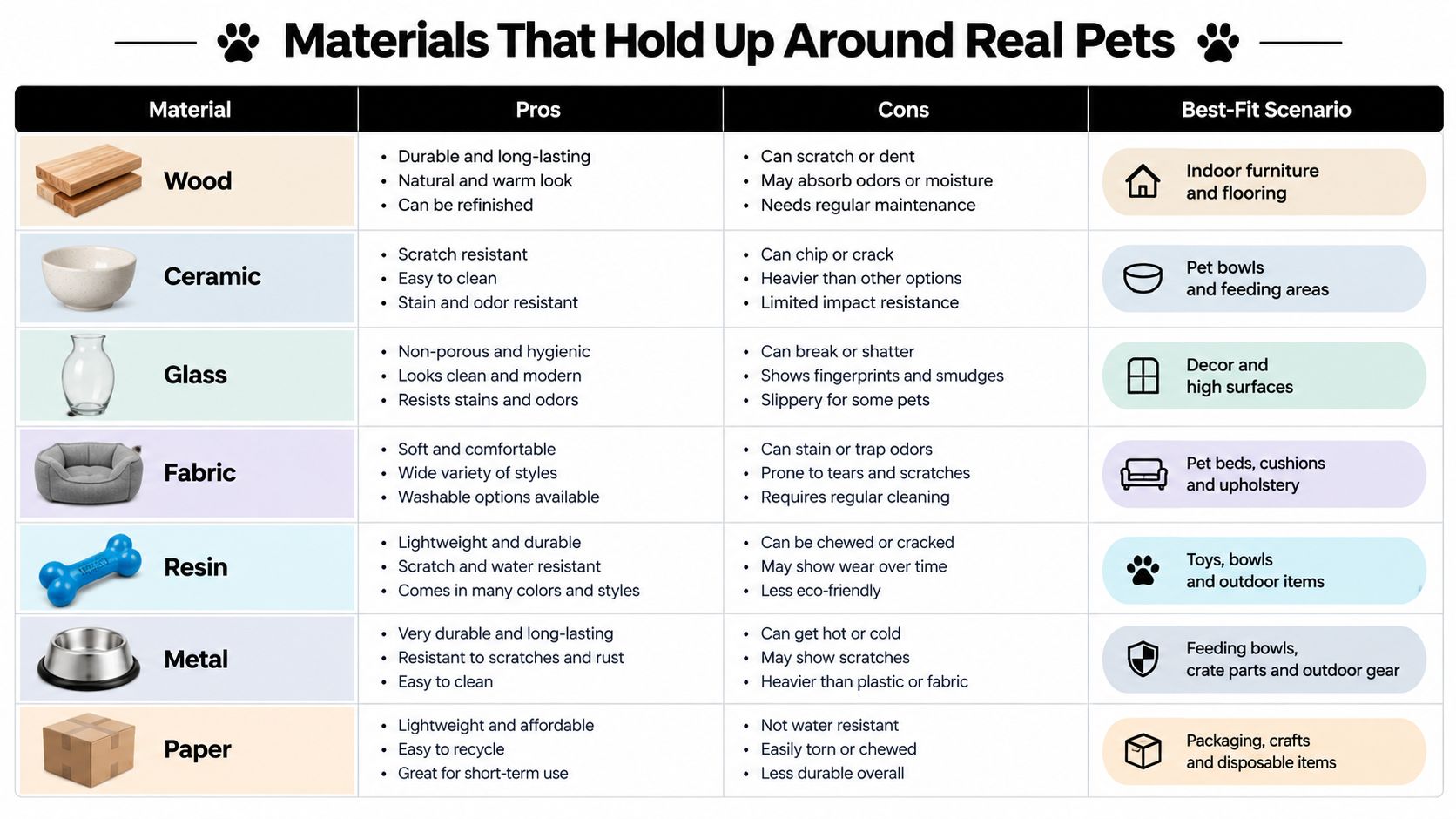
The comparisons below are practical selection judgments. Actual durability depends on the thickness, finish, shape, and attachment.
| Material | Durability | Pet Risk | Best For |
|---|---|---|---|
| Wood | Good candidate for a rigid keepsake | Chew damage, splinters, loose fittings | Painted portraits displayed beyond reach |
| Ceramic | Rigid but vulnerable to breakage | Sharp fragments after a fall | Protected cabinet displays |
| Glass | Fragile | Shattering and sharp pieces | Inaccessible decorative displays |
| Fabric | Forgiving of ordinary knocks | Loose threads, stuffing, sewn-on parts | Simple, securely stitched designs |
| Resin | Depends on formulation and shape | Broken projections, detachable details | Solid designs in controlled displays |
| Metal | Sturdy body, variable edges and fittings | Sharp edges, weight, loose hardware | Smooth-edged pieces on secure supports |
| Paper | Lightweight but easily damaged | Tearing and accessible scraps | Temporary artwork behind a barrier |
Use this visual comparison to narrow your material choice.
Why I'd start with wood or fabric
For a painted likeness, I'd usually propose a simple wooden body without projecting ears, glued-on charms, or dangling embellishments. It gives the artist a straightforward surface while keeping the silhouette compact. Ask about edge preparation, paint, sealant, and the hanging attachment before approving the design.
Fabric makes sense when a softer, stylized interpretation matters more than detailed portrait painting. Choose securely finished seams and an embroidered face rather than beads or buttons. Don't confuse softness with chew resistance.
For any painted or sealed piece, request the actual coating details and care instructions. A seller's “non-toxic” description shouldn't be interpreted as “safe to swallow.” Food-based decorations don't belong in my recommended commission materials, and a beautifully finished glass or ceramic piece belongs somewhere protected, not somewhere a tail can sweep it down.
Commissioning a Custom Pet Ornament Step by Step
Start with an inquiry, not a deposit. Confirm that the artist accepts ornament commissions, because a custom pet painting service doesn't necessarily include miniature hanging pieces. Give the artist the intended display location and your pet's behavior alongside your visual preferences.
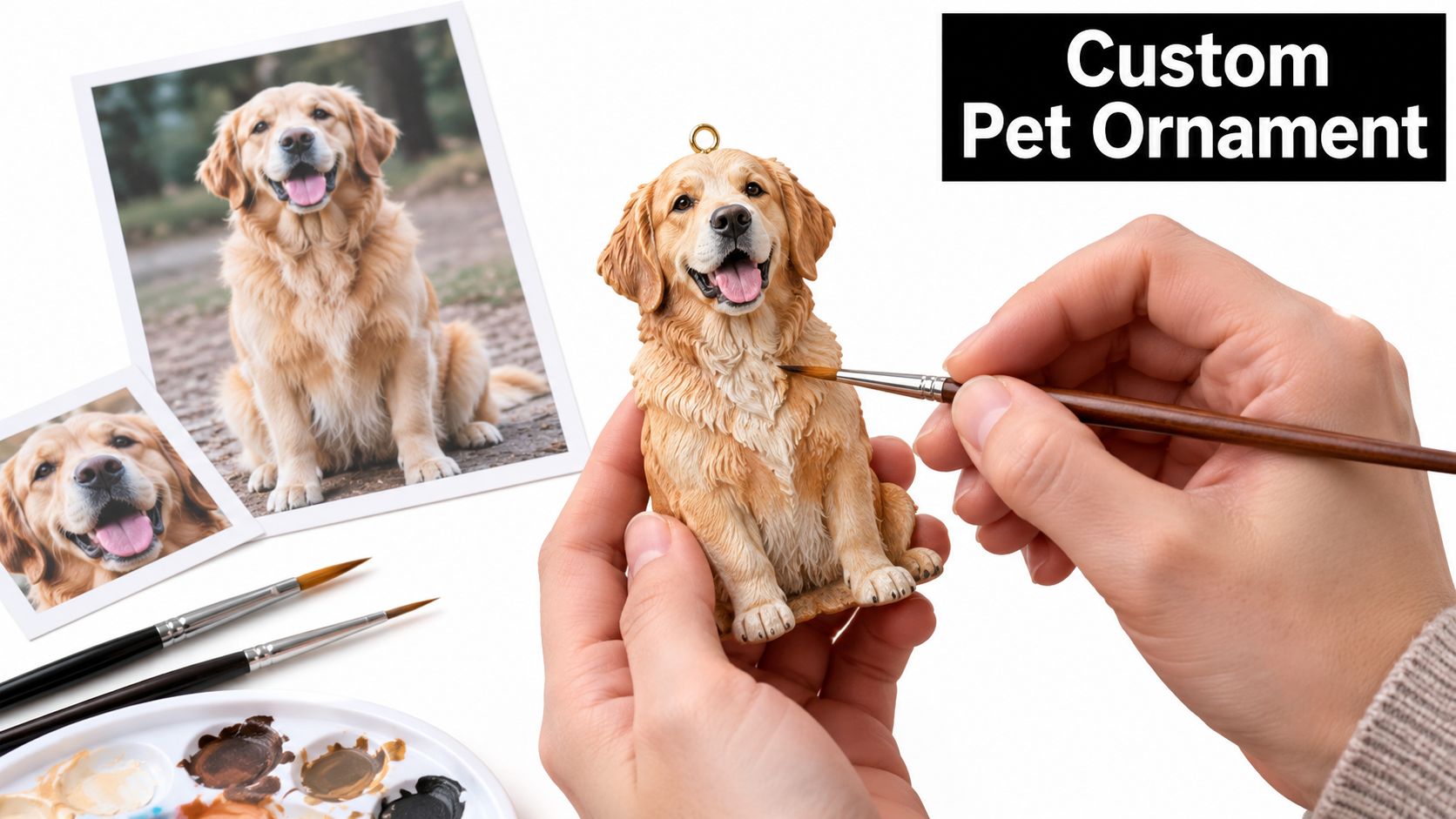
The image below illustrates the photo-to-painting idea, rather than a guaranteed product format.
Agree on the scope before paying
Among custom-art options, William Tucker Art's personalized pet artwork deposit secures a commission spot and includes a free consultation about style, size, and medium, followed by preview approval and the acrylic pet painting final payment. That's a documented portrait workflow, not confirmation of an ornament service; ask whether your proposed format is available.
Use this sequence for any artist you approach:
- Send the brief: Describe the animal, preferred expression, lettering, material, and intended use.
- Confirm the specification: Agree on dimensions, attachment, finish, portrait style, and whether the reverse is decorated.
- Set the schedule: Ask for the current completion estimate and delivery arrangements before committing.
- Clarify revisions: Find out when changes are possible and what happens after preview approval.
- Approve deliberately: Check the likeness, spelling, colors, and orientation before authorizing completion.
A broader guide to custom pet artwork can help you frame the consultation. Keep the main reference consistent once work starts; replacing it with a different pose can change the composition rather than merely refine it.
Check the finished piece before hanging
For a visual pause, watch the video below, then return to the written specifications for your own order.
When the artwork arrives, inspect the packaging, surface, edges, and loop before displaying it. Keep the artist's cleaning instructions and original reference together. Don't promise yourself a Christmas deadline based on a general commission description; get the artist's current schedule in writing.
DIY Versus Commissioned Pet Ornaments
Make the ornament yourself if the making is part of the memory. Hire an artist if the likeness is the point. Neither route guarantees durability, and neither deserves to be judged solely by the initial spend.
A handmade paw impression can preserve a personal gesture without looking like a polished portrait. A commissioned painting can capture the tilt of a head or an expression that a silhouette won't convey. Choose the result you want, rather than expecting a craft technique to do a portrait artist's job.
| Decision | DIY Makes Sense When | Commissioning Makes Sense When |
|---|---|---|
| Budget | You already own suitable supplies | You want a quoted, defined scope |
| Time | You enjoy experimenting and remaking | You prefer an agreed process |
| Skill | A silhouette or simple motif suits you | Recognizable facial detail matters |
| Durability | You can assess your own construction | You want material and care questions answered |
| Emotional payoff | Shared making is the tradition | The finished likeness is the keepsake |
Keep DIY ambitions manageable
Painted wooden blanks, paper silhouettes, and vinyl cutouts are reasonable creative starting points. I'd choose a bold profile or distinctive coat marking rather than attempt tiny eyes with a tool I haven't practiced using. A clean, simplified design usually serves the idea better than crowded detail.
An air-dry clay paw impression is another possible keepsake format, but don't assume the finished piece can withstand a fall. Don't press a reluctant animal's paw into unfamiliar material, and check the product instructions before involving the pet. Salt dough isn't a substitute I'd recommend.
For a separate personalization project, stylish doll craft from Jolitee offers another avenue to explore. Treat it as a craft resource, not veterinary guidance or instructions for making a pet-safe ornament.
Choose DIY for the pleasure of making. Choose a commission for an artist's interpretation, not merely for someone else to assemble the supplies.
Whichever route you take, avoid decorative extras that don't contribute to the likeness. A plain, well-resolved piece is preferable to a complicated ornament whose glued-on details need constant attention.
Turning a Favorite Photo Into Ornament Reference
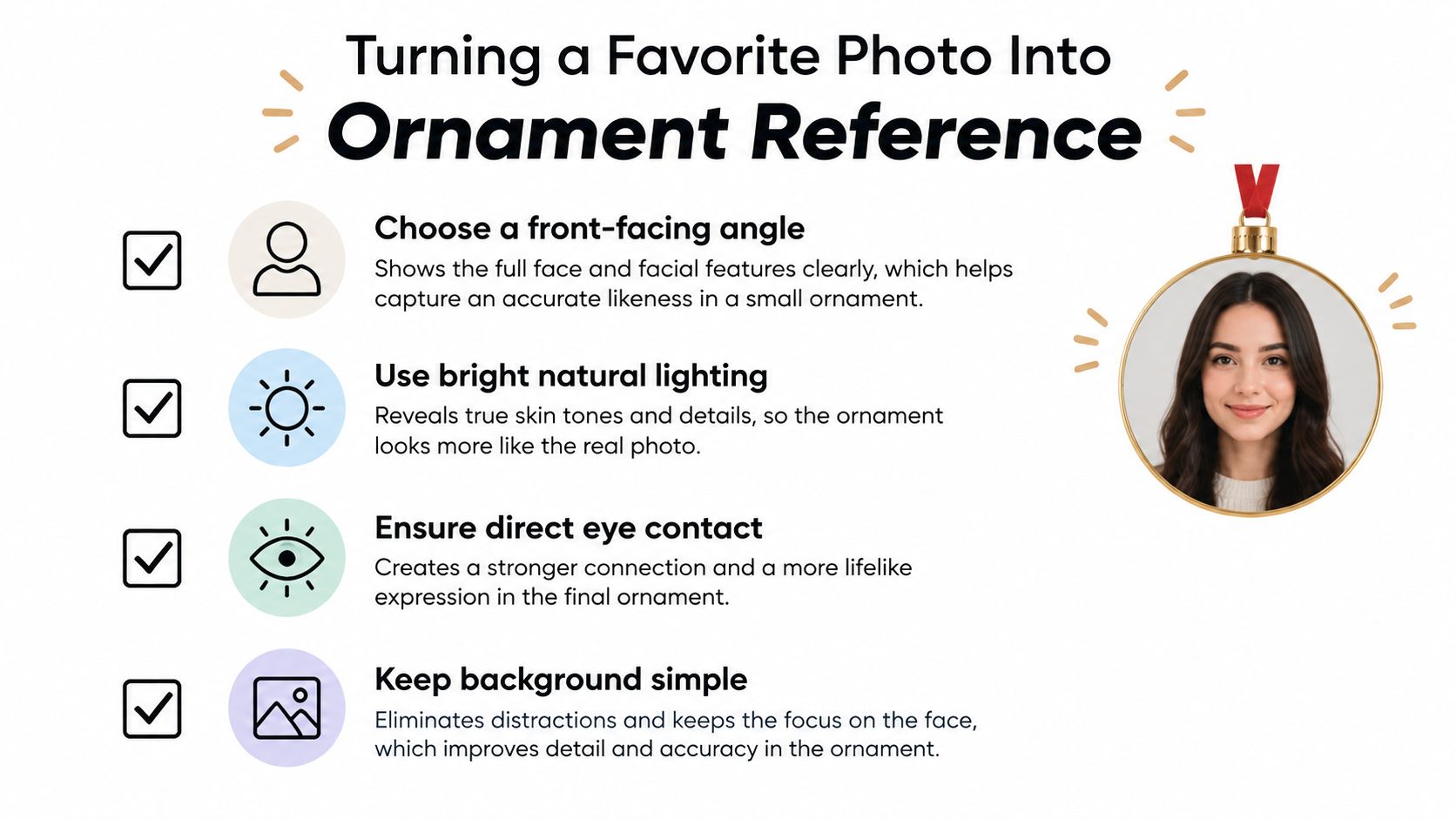
Your favorite photograph and your strongest portrait reference may be different images. The beach snapshot might carry the memory, but the shaded face may leave the artist guessing at the eyes. Send the sentimental image for context and a clearer image for anatomy.
For a small painted portrait, I'd prioritize visible eyes, a readable muzzle, and the pet's characteristic ear position. A front-facing or gentle three-quarter view is a useful starting point. Direct eye contact can create connection, but don't discard a side glance if that expression is unmistakably your pet.
Use this checklist when sorting your photos.
Give the artist information, not filters
Soft natural light is my preference because I want to see the coat rather than interpret a heavy color cast. Send the original image file where possible, not a screenshot with interface elements or an edited social-media crop.
Before submitting, check:
- Eyes and nose: Are their shapes visible rather than lost in glare or shadow?
- Ears and outline: Does the crop preserve the features you want painted?
- Coat markings: Can the artist distinguish dark patches from shaded fur?
- Color: Have filters changed the animal's appearance?
- Background: Can unnecessary scenery be removed without losing the pose?
These tips for photographing pets provide a useful starting point for gathering references. If you're comparing a painted keepsake with a dimensional interpretation, Sculpty's photo to figurine print prep is another resource to consult for that separate format.
For a memorial commission, use what you have. Tell the artist which details matter most and which images show them clearly. Don't ask for every blanket pattern and background object to survive at ornament scale; reserve that space for the animal.
Matching the Ornament to Your Pet's Personality
Choose for the pet who lives in your house, not the calm animal pictured beside the product. A puppy who mouths everything and a cat who climbs need different display plans, even if you commission the same portrait.
Holiday hazards aren't merely theoretical: Trupanion data reported by State Farm found foreign-material ingestion cases were about 10% above the daily average on Christmas Eve and Christmas Day, while burn cases were 64% more frequent, in its holiday pet-emergency report. Those figures concern holiday emergencies broadly, not the safety performance of any particular ornament material.
Chewers and floor scavengers
For a teething puppy, don't try to solve the problem by buying something advertised as chew-resistant. Remove access. I'd choose a compact portrait without projections and display it behind a physical barrier, rather than test its strength against the puppy's teeth.
For a dog who searches the floor, the concern continues after an ornament falls. A detached fitting or piece of wrapping can become accessible even when the artwork itself started well above the dog. Keep unpacking and decorating materials out of the animal's search area.
Climbers and curious birds
A high branch isn't a dependable solution for a climbing cat. An enclosed display or a room the cat can't enter is my recommendation for a valuable keepsake. The attachment advice discussed earlier matters, but it doesn't make the whole tree inaccessible.
With a curious bird, I'd avoid exposing the ornament during free-flight time. Don't offer decorative loops, painted surfaces, or small fittings as objects to investigate. That's a conservative display recommendation, not a species-specific material certification; ask an avian veterinarian if you need guidance for your bird.
Before ordering, answer these questions:
- Access: Can the pet reach the display by climbing, jumping, or using nearby furniture?
- Behavior: Does the animal chew, pull, investigate, or collect dropped objects?
- Supervision: Who will prevent access when household routines change?
- Construction: What could detach if the piece falls?
Veterinary warnings about sharp fragments, obstruction, electrical injury, and batteries explain why these distinctions matter, as outlined in American Humane's pet-safe holiday decoration guidance. Match the entire display arrangement to the behavior, not just the ornament body.
Hanging, Displaying, and Storing With Pets in the Room
Placement can matter more than material. A wooden portrait hanging where a cat can bat it isn't a sensible display just because wood was the preferred commission choice. Decide where the artwork will live before you open the box.
The ASPCA's holiday safety guidance warns about tree-tipping risks and supports anchoring the tree and managing pet access. For an unsupervised household, I'd use a closed room or a suitable barrier rather than rely on a heavy base alone.
Choose a display you can control
A full-size tree needs secure anchoring above the base as well as a stable position. Keep restraint lines inaccessible to pets. A tabletop tree isn't automatically protected if an animal can reach the table, pull the covering, or climb from a nearby chair.
A wall-mounted display can work when both its mounting and its location prevent access. A mantel is useful only if the pet can't get onto it, and a delicate ornament shouldn't sit near active heat. My preference for a fragile or irreplaceable piece is an enclosed cabinet with a secure door.
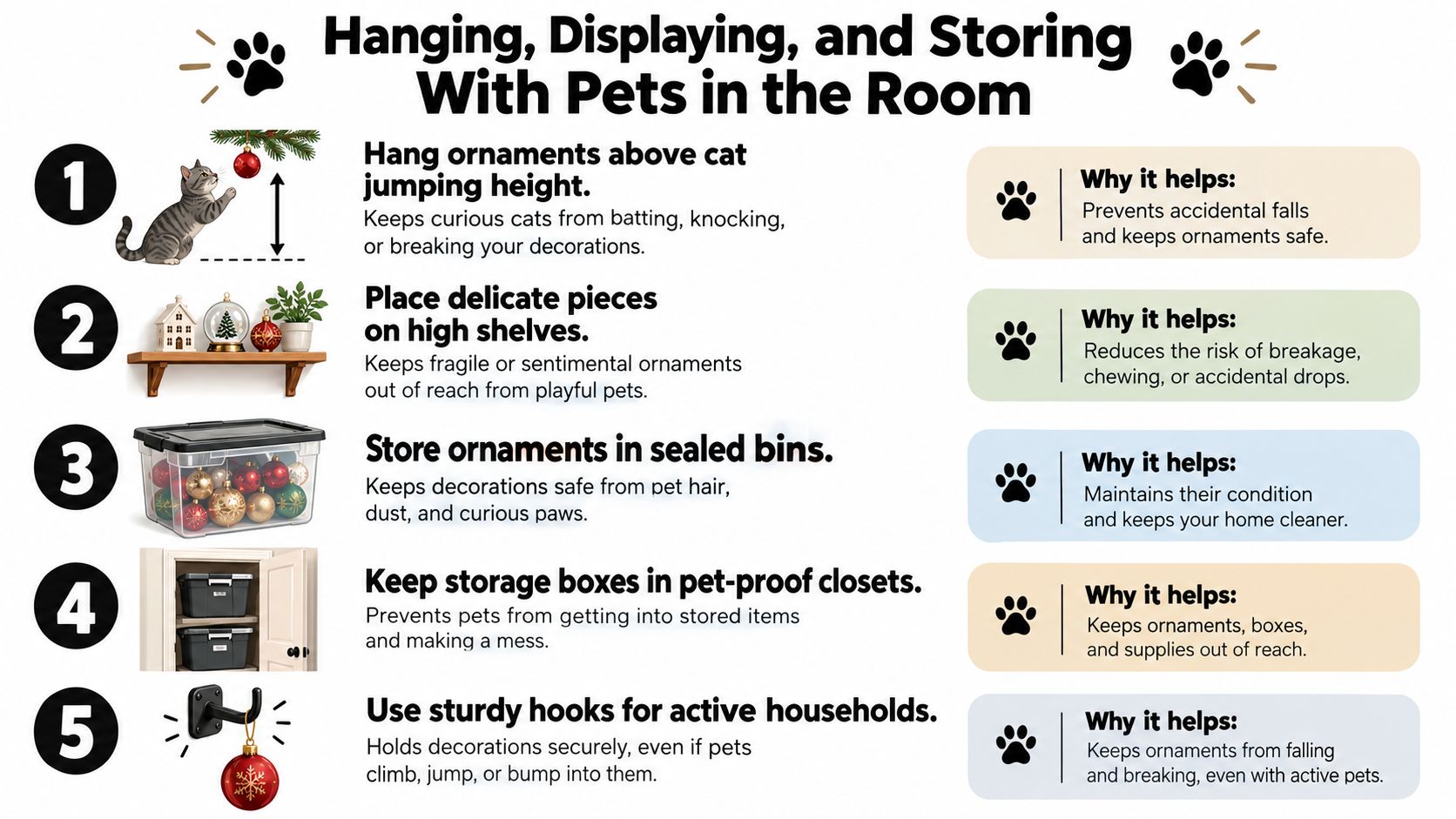
Use the visual guide as a planning prompt, with an important qualification: no universal hanging height defeats a climbing cat, and hardware must suit the location. For accessible tree ornaments, follow the earlier cloth-loop recommendation rather than interpreting sturdy hooks as permission to leave metal hooks within reach.
Visiting children and multiple pets change the setup. Give guests a clear place for bags and wrapping, and ask them not to move barriers or hand ornaments to an animal. Recheck access after furniture moves or gifts accumulate beneath the tree.
Respond to damage before displaying again
If an ornament falls, move the pets out before collecting pieces. Inspect the artwork, attachment, and surrounding floor, including beneath furniture. Don't rehang a cracked piece or a loop that has begun to pull free.
Emergency rule: Suspected ingestion needs veterinary advice immediately. Don't wait for visible symptoms, and treat suspected battery ingestion as an emergency.
Vomiting, diarrhea, depression, abdominal pain, breathing difficulty, or collapse warrant immediate veterinary attention. Homemade doesn't mean harmless either: the FDA warns that salt-dough decorations can deliver a dangerous salt load if eaten. Keep such decorations out of your ornament-making plans.
Pack for next December
Follow the artist's cleaning instructions. I'd begin with gentle dry dusting and avoid solvents, soaking, or abrasive rubbing unless the maker specifically approves them. Wrap pieces separately, cushion them against movement, and don't place heavy decorations on top of painted faces.
For organizing the broader collection, these ideas to store holiday decorations smartly can help you plan containers and storage locations. Keep the packed collection in a pet-proof closet, with spare attachments and care notes contained rather than loose.
If a keepsake needs repair, send the artist photographs before applying glue or paint. Ask whether restoration is practical or whether a new commission using the original reference makes more sense.
Keep the annual routine simple:
- Inspect: Check the surface, edges, and attachment before display.
- Place: Choose the location for the pets you have now.
- Protect: Control access whenever supervision stops.
- Store: Cushion, label, and close the container.
You can still make hanging day a tradition. Rotate which pet's portrait gets the place of honor, then put safety ahead of symmetry.
William Tucker Art offers personalized pet portrait commissions with a consultation to discuss style, size, and medium. Visit William Tucker Art with your favorite reference photos and ask whether an ornament-sized keepsake is available, or choose a portrait format that suits your pet and your home.