
You're standing in your living room with your phone in one hand, scrolling through photos of your cat and trying to imagine each one on the wall. The question isn't whether you want a cat painting. It's which canvas painting of cat will still look right when the novelty wears off, the light changes, and the piece has to work with your furniture.
A successful commission starts before you contact an artist. Choose the visual mood, define the job the painting must do in the room, and gather references that show more than a cute expression. Canvas size, shape, surface finish, and the artist's working method all affect what you'll see every day.
Deciding What Kind of Canvas Painting of Cat You Actually Want
Start with three decisions. Don't browse artist portfolios until you've made them, or you'll save twenty unrelated ideas and still have no useful brief.
Choose the visual language
Realistic painting is the strongest choice for a single anchor piece. It rewards careful reference photos and gives attention to eyes, markings, body structure, and expression. Choose it when the cat itself should command the wall.
Illustrative work feels lighter and more relaxed. It suits a reading corner, hallway, nursery, or casual gallery grouping where you want personality without the visual weight of a formal portrait.
Impressionistic painting works through color, gesture, and atmosphere rather than exact fur rendering. It's a good option when the room already has strong color and you want the portrait to feel integrated rather than photographic.
Pop-art or highly graphic treatment makes the cat part of the room's design language. It can look excellent in a modern interior, but it needs a confident palette. A timid brief usually produces a timid result.
Decide what the painting should make you feel
Write down one mood: calm, playful, regal, curious, mischievous, or memorial. “Capture my cat” isn't enough. The same animal can look serene in a low, side-lit pose or theatrical in a direct, close-up composition.
Memorial work deserves particular care. You may want a familiar posture, a favorite blanket, or a background color connected to the home. Tell the artist what must remain emotionally recognizable, not only what physical markings must be copied.
Give the artwork a job
A centerpiece needs a stronger composition and more breathing room than a small keepsake. A gift may need to communicate the recipient's relationship with the cat. A gallery grouping can tolerate a more cropped or stylized portrait because neighboring pieces provide context.
Practical rule: Choose the wall role before you choose the crop. A beautiful face can still feel wrong if it's too small for the wall or too tightly framed for the furniture beneath it.
Write one sentence before you contact anyone: “I want a calm, realistic portrait of my black cat sitting upright, sized for the wall above the console, with a muted background that works with the room.” That sentence keeps your search focused. The custom cat portrait planning guide can help you think through the brief without treating every commission like a generic product order.
Building a Reference Photo Set That Will Make the Artist's Job Easier
One attractive photo rarely contains enough information for a convincing painting. Build a small reference library instead. Three to eight high-resolution photos give the artist a better understanding of the cat's structure, markings, fur direction, and personality than one supposedly perfect image.
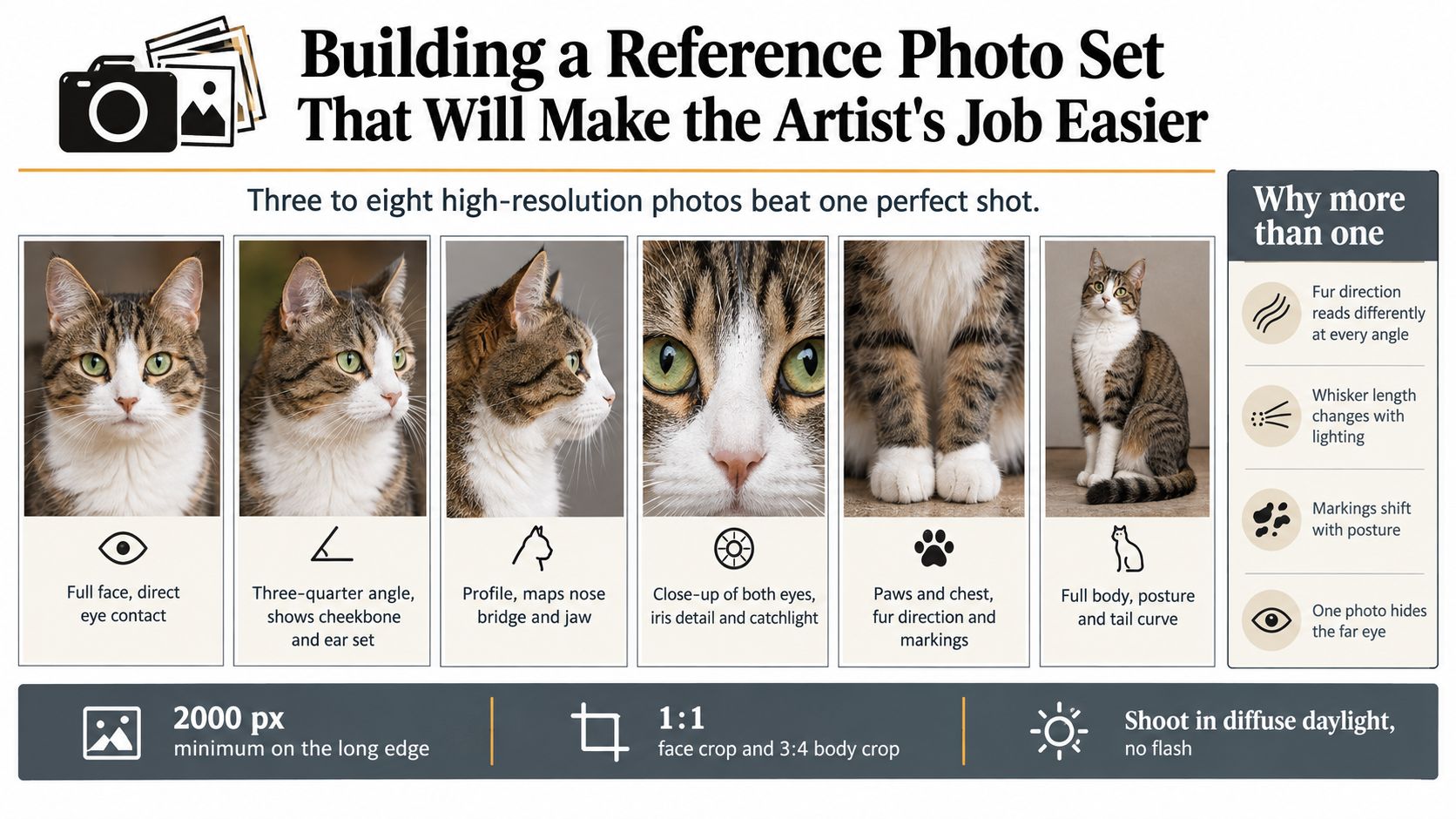
Include different kinds of evidence, not eight versions of the same pose:
- A sharp face detail: Show the eyes, nose, whisker pads, and fur around the cheeks. This helps the artist understand the features you'll notice first.
- A full-body profile: Capture the usual posture, back line, paws, and tail. A profile reveals proportions that a cropped headshot hides.
- A natural-light color reference: Photograph the cat near a window or outdoors in soft daylight. Indoor yellow light can shift white fur toward cream and make cool grey fur look brown.
- A personality photograph: Include the stretch, head tilt, half-closed eyes, or alert posture that feels unmistakably yours.
Shoot at the cat's eye level. Use soft daylight, turn off the flash, and avoid harsh overhead lighting. Keep the ears and tail in frame unless you've already agreed on a deliberate crop. A close-up can be useful, but it shouldn't replace a full view of the head and body.
If the portrait must match the room, photograph the wall from the position where the painting will hang. Include nearby furniture, flooring, and the dominant colors. The artist doesn't need a perfect interior photograph. They need enough context to judge contrast, scale, and whether a warm or cool background will sit comfortably in the space.
Package the files clearly
Create one folder with descriptive filenames such as Milo_face_daylight.jpg, Milo_full_body.jpg, and living_room_wall.jpg. Send the original files rather than screenshots copied from a social feed. Add a short note identifying the preferred pose, the must-keep markings, and anything that shouldn't appear.
The practical advice in this reference photo guide for artists is useful because it treats photography as part of the commission, not as an afterthought. A clean reference set reduces guesswork and makes the first sketch more productive.
Choosing Canvas Size, Shape, and Finish for the Room It Will Live In
A canvas can look perfectly proportioned in a product listing and feel too small on your wall. Measure the available area, mark the proposed edges with painter's tape, and stand where you usually view the artwork before choosing the format.
| Size | Best Aspect Ratio | Recommended Finish | Room Placement |
|---|---|---|---|
| 8 x 10 | Square or portrait | Matte or satin | Shelf, bedside wall, or small nook |
| 11 x 14 | Portrait or square | Matte or satin | Narrow wall, bookcase, or intimate corner |
| 16 x 20 | Portrait or square | Satin | Desk wall, entryway, or small grouping |
| 18 x 24 | Portrait or horizontal | Satin | Entryway, office, or medium wall |
| 24 x 36 | Horizontal | Satin or matte | Living-room centerpiece or long console |
| 30 x 40 | Horizontal or portrait | Matte or satin | Large feature wall with generous viewing distance |
Use these sizes as starting points, then adjust for the pose and the room. A sitting cat usually suits a square or portrait ratio, since the vertical body and face need sufficient space. A stretched cat, reclining pose, or scene with two animals generally reads better in a wider format. Don't force a horizontal reference photo into a vertical canvas just because the wall is narrow. Ask the artist to design the crop around the cat, rather than letting the frame dictate it.
Finish controls how the painting responds to light. Matte varnish minimizes reflections and is the safest choice for a wall opposite a window. Satin varnish keeps colors lively without turning every lamp into a bright spot. Gloss varnish can strengthen darks and highlights, but it requires careful placement and exposes reflections in rooms with direct light.
Think about the edges and frame
A gallery wrap continues the image around the sides and can hang without a traditional frame. It suits contemporary rooms and compositions with enough background around the cat. A shallow edge looks discreet. A deeper edge gives the work more presence but projects farther from the wall.
Traditional framing adds structure and can make a smaller portrait feel more substantial. Choose it when the room already includes wood, painted moulding, or classic decorative details. Before installation, use this guide to hanging wall art to plan the position, spacing, and viewing height. The canvas size matters, but the surrounding wall space matters just as much.
What the Commissioning Process Looks Like From First Message to Delivery
Your first message should make it easy for the artist to answer. Put the essentials in one place:
- Project: Describe the cat, preferred style, and intended mood.
- Format: Give the approximate canvas dimensions and orientation.
- References: Attach the strongest photos or provide a clearly labeled folder.
- Room: Explain where the artwork will hang and share a wall photograph if relevant.
- Schedule: State the date if it's a gift or memorial, and ask whether the artist can meet it.
- Questions: Ask about medium, revisions, varnishing, framing, and delivery.
Artists structure commissions differently. Some request a deposit to reserve a place in their schedule, while others confirm the project after a consultation. Ask exactly what the payment covers, when the remaining balance is due, and whether shipping or framing is separate. Get the agreement in writing before work begins.
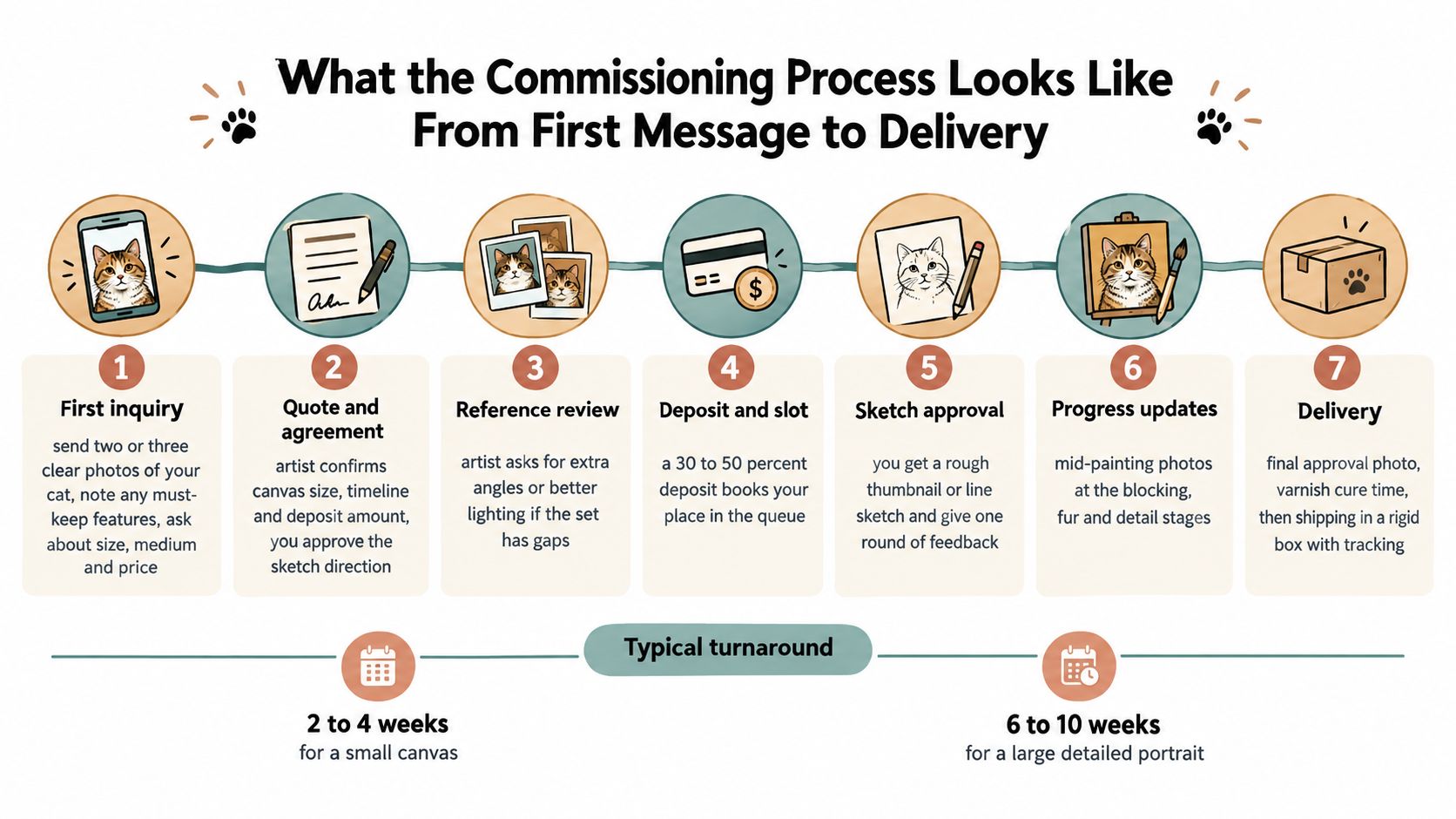
Agree on the checkpoints
A sensible process has a composition stage, a blocked-in stage, progress updates, final approval, and delivery. The artist may send a thumbnail or rough sketch first. That's the right moment to correct the head angle, crop, background, or position of the paws. Once detailed fur is painted, major changes become more disruptive and may affect the agreed fee.
Ask how many revision rounds are included and what counts as a revision. “Make the cat look more like her” is different from requesting a new pose, a different background, or a second animal. Scope changes should be priced and approved before the artist continues.
The physical stages also matter. Acrylic may move more quickly through the studio, while oil work often needs drying time between layers and before varnish. A finished-looking progress photograph doesn't necessarily mean the painting is ready to pack. Confirm when the surface will be varnished, how long it must cure, and whether the work will arrive stretched, framed, or rolled.
Rolled canvas can reduce shipping bulk, but you'll need a professional framer or stretcher to prepare it. Stretched canvas arrives ready to hang when packed properly, though it requires more protective shipping. Request tracking and ask how the artist protects corners, surface, and frame bars.
The process is collaborative, not transactional. Your job is to make decisions at the agreed checkpoints. The artist's job is to interpret the references, manage the materials, and protect the coherence of the painting. For perspective on selecting someone whose style fits the brief, explore these cat portrait artist considerations.
How Artists Actually Paint a Cat on Canvas and What You Should Expect to See
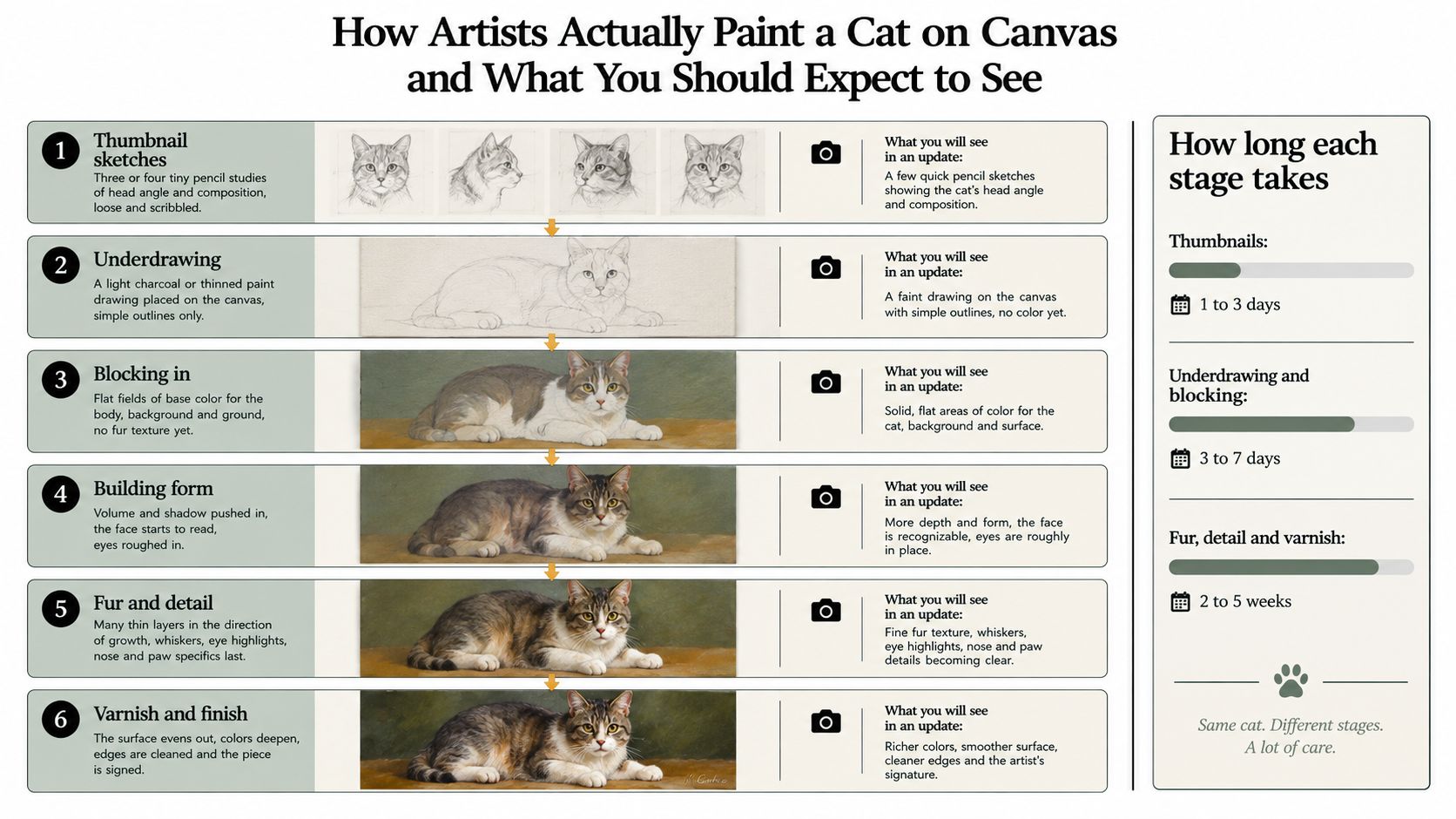
A professional update can look underwhelming if you expect a finished portrait at every stage. The artist first solves structure, value, and composition. Fur comes later because texture can disguise mistakes but can't fix a misplaced eye or distorted shoulder.
Read the early stages correctly
The process often begins with small composition studies. The artist tests the head angle, crop, background shape, and balance of empty space. An underdrawing then places the key landmarks. Strong animal-art guidance recommends checking the eye line, shoulder, rib cage, and hock before adding coat detail, because proportional errors become harder to correct once the fur is developed (expert guidance on animal painting structure).
A toned ground or simple underlayer establishes the overall temperature. During blocking, you'll see broad masses of background, body, shadow, and light. It may look flat or strangely simplified. That's a good sign if the artist is still checking the large relationships rather than decorating the surface.
Judge the update, not every brushstroke
When you receive progress photographs, ask useful questions:
- Does the head angle match the approved sketch?
- Is the light source consistent across the face, body, and background?
- Are the eyes aligned with the skull rather than floating on the surface?
- Does the far side of the body retain believable volume?
- Are the markings placed according to the cat's anatomy and posture?
Fur should be layered. A middle-grey or dark undercoat, thin paint layers, dry-brush or scumbling, and glazing can create depth without turning the coat into a collection of disconnected lines. Brush direction should follow growth direction. Larger brushes establish broad masses first, then smaller brushes refine the face, paws, whiskers, and highlights. This wildlife painting technique guide explains why over-detailing too early can flatten the form.
Don't judge wet oil paint as if it were a finished digital image. Surface sheen can make some passages look darker or lighter than they will after drying and varnishing. If you need a faithful record for approval, ask the artist about photographing the work under even light. A resource such as this scanner guide for artists can also help you understand the difference between documenting physical artwork and evaluating it in person.
For an acrylic commission, William Tucker Art Acrylic Pet Painting Final Payment is one example of a listing used to finalize a custom pet portrait after preview images meet expectations. The catalog description states that these portraits use acrylics on gallery-wrapped canvas, with clients supplying a pet photograph.
Why Canvas Is Worth More Than a Digital File or Framed Print
Canvas earns its place when you want the portrait to feel like an object, not merely an image. Its woven surface catches light differently across the brushwork. Even a restrained painting has a physical presence that a file on a phone can't provide.
A digital file is flexible and convenient. You can print it later, change the size, or use it for a card. That flexibility is also its weakness. It leaves the final decisions to you, and the file can remain unseen in a camera roll. A standard framed print gives you an immediate wall object, but the surface is usually flatter and the result depends heavily on the quality of the reproduction and frame.
| Format | Lifespan | Cost Range | Visual Impact |
|---|---|---|---|
| Digital file | Depends on storage, backups, and future file access | Lower initial cost | Convenient, but no physical presence until printed |
| Framed print | Depends on print materials, glazing, light, and care | Moderate and variable | Clean and finished, with a flatter surface |
| Painted canvas | Depends on medium, materials, varnish, and care | Higher and variable | Textured, personal, and designed as an original object |
Canvas also gives you a framing choice. Gallery-wrapped edges can create a clean contemporary finish without a separate frame. A traditional frame can add weight and architectural detail. In either case, ask about the canvas material, paint medium, varnish, and care instructions rather than assuming every canvas has the same durability.
The emotional value matters most for memorials and gifts. A custom portrait preserves the animal's particular expression and markings instead of offering a generic cat image. You're paying for interpretation, preparation, materials, and the artist's time, not just for a rectangle decorated with pixels.
The market includes inexpensive digital portraits, canvas prints, framed portraits, and hand-painted work. One independent overview places digital portraits at about $25 to $75, canvas prints at $120 to $500, and framed portraits at $150 to $600, while hand-painted canvases can exceed $300, depending on size and medium (pet canvas portrait pricing overview). Treat those figures as broad comparison points, not a quote. The right choice depends on whether you want speed, customization, or a lasting original.
A Simple Checklist Before You Message an Artist Today
You don't need a polished art direction document. You need enough information for an artist to understand the cat, the room, and the decision you're asking them to make.
Use this checklist now:
- Choose two to three reference photos. Include the face, eyes, full body, and signature markings in natural light.
- Name one must-keep feature. It might be the white blaze, uneven ear, amber eyes, or distinctive tail.
- Measure the wall. Record the open width, height, furniture below it, and the distance from which you'll view the painting.
- Choose the shape. Use square or portrait for a sitting cat, and horizontal for a stretched pose or multi-cat composition.
- Pick the surface direction. Ask for matte if glare is a problem, satin for balanced color, or gloss only when the lighting is controlled.
- Write the brief. State the pose, mood, background preference, medium, intended room, and deadline in one paragraph.
- Prepare your questions. Ask how the artist handles revisions, when progress updates arrive, what the payment schedule is, and whether the canvas ships stretched or rolled.
You can copy this message:
I'd like to commission a [style] portrait of my cat, [name], for [room or purpose]. I'm considering a [size and orientation] canvas with a [mood] feeling. I've attached [number] reference photos, and the feature I most want preserved is [feature]. Could you tell me which photo or composition you recommend, your medium, revision process, expected schedule, payment terms, and shipping options?
Spend ten minutes gathering those details, then send the first message today. Your brief doesn't need to be perfect. A good artist will help shape the choices once they understand what you want the finished canvas to do.
William Tucker Art offers custom pet portraits built from client-supplied photographs, with acrylic, oil, and mixed-media approaches available across its artwork catalog. If you want to discuss a canvas painting of your cat with an artist whose work includes vibrant pet and wildlife subjects, visit William Tucker Art and start with your reference photos, wall measurements, and preferred mood.